Let's get straight to the point: what does FOB Price actually mean? Think of it as a relay race for your products, where your Chinese supplier handles the first crucial leg of the journey.
Free On Board (FOB) is an agreement where the price you pay your supplier covers everything needed to get your goods manufactured, packaged, and loaded on board the vessel at a specific Chinese port. The moment those goods are safely on the ship, the supplier hands the baton—and all responsibility—over to you.
The Handover Point That Defines Your Shipment
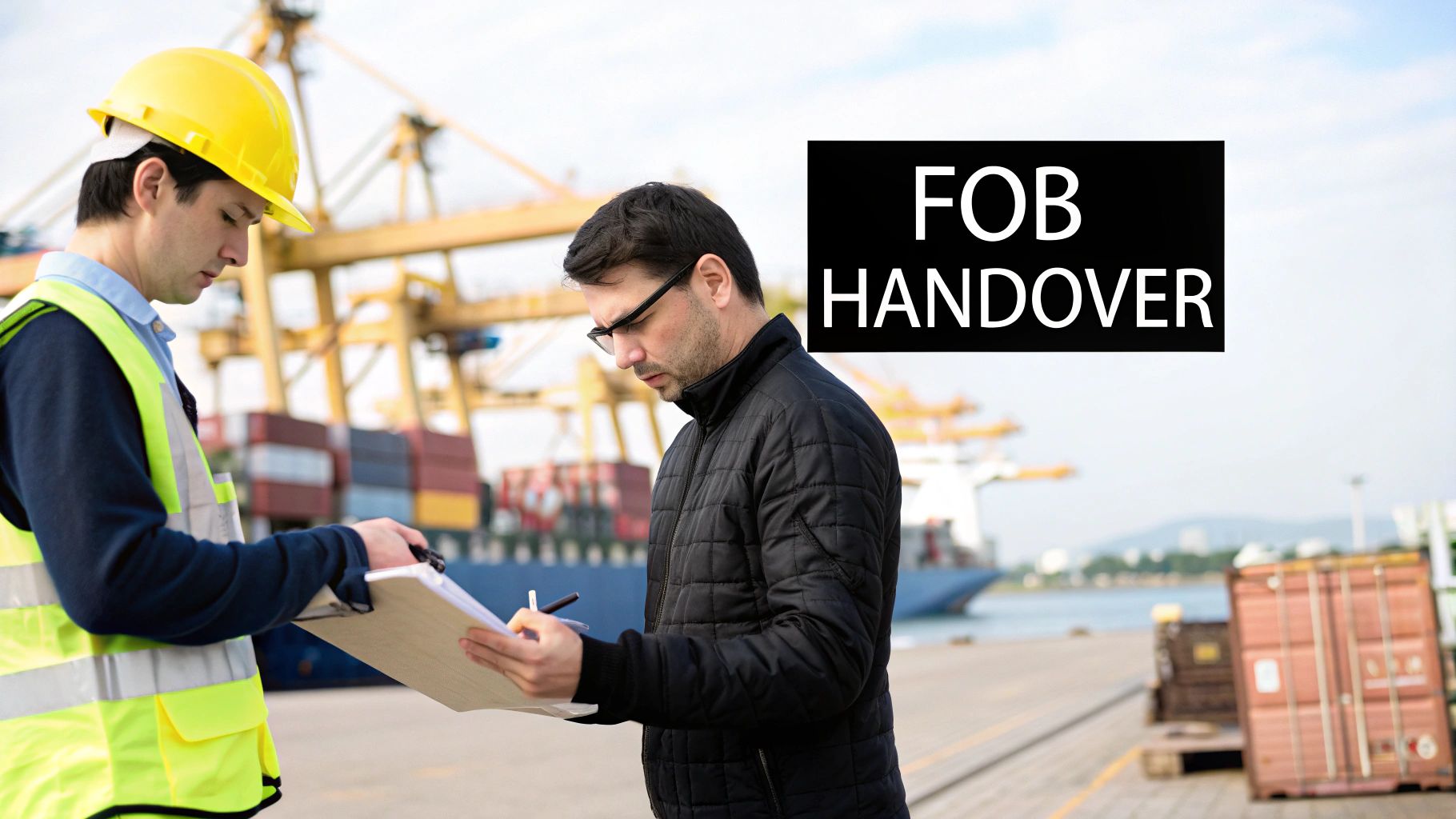
When you agree on an FOB price, you’re really defining a clear, physical handover point. This is a huge advantage because it means your supplier navigates all the complex, local logistics inside China. You don't have to worry about the nitty-gritty on the ground.
This includes:
- Production Costs: The straightforward cost of manufacturing your items.
- Local Transport: Getting everything from the factory floor to the designated port of departure.
- Export Clearance: Managing all the paperwork and paying the necessary fees to clear Chinese customs.
This setup is a favourite among experienced importers. Why? Because it gives you control over the most expensive part of the shipping journey—the international freight—without you having to get tangled up in the local laws and logistics of a country you might not be familiar with.
Why This Matters for Importers
Opting for FOB puts you in the driver's seat. You get to choose your own freight forwarder, which is a game-changer. It means you can shop around for the best shipping rates, pick carriers you trust, and have total visibility over your cargo once it leaves the port. You’re not stuck with whatever shipping partner your supplier prefers, who might be more expensive or less reliable.
Free On Board (FOB) is a critical Incoterm where the seller's obligations are fulfilled once the goods are loaded onto the ship at the origin port in China. This makes it a perfect fit for importers who want to manage their own international shipping, perhaps using a service like Upfreights' sea freight from Tianjin or Jingtang.
The predictability of FOB pricing is another major plus. For example, if you look at steel prices in the CN region, the cost for a product like HRC-FOB-Q235B-3.01250C at Tianjin Port was holding steady at 467 USD/mt on December 26, 2025. This kind of stability, which you can track on platforms like metal.com, shows the consistency in China's export pricing and makes FOB a dependable choice for planning your import budget.
FOB At A Glance: Who Is Responsible For What?
To make it even clearer, here’s a simple breakdown of who handles what under FOB terms. This table shows exactly what your Chinese supplier pays for versus what you, the buyer, are responsible for.
| Task | Seller Responsibility | Buyer Responsibility |
|---|---|---|
| Product Manufacturing | ✔️ (Included in FOB Price) | |
| Packaging for Export | ✔️ (Included in FOB Price) | |
| Transport to Port of Origin | ✔️ (Included in FOB Price) | |
| Export Customs & Duties | ✔️ (Included in FOB Price) | |
| Loading onto the Ship | ✔️ (Included in FOB Price) | |
| Main Sea/Air Freight | ✔️ (You book and pay for this) | |
| Shipping Insurance | ✔️ (Highly recommended, your responsibility) | |
| Unloading at Destination Port | ✔️ (You arrange and pay for this) | |
| Import Customs Clearance & Duties | ✔️ (You handle all import procedures and taxes) | |
| Transport to Final Destination | ✔️ (You arrange delivery from the destination port) |
As you can see, the supplier's job is done once the goods cross the ship's rail. From that point on, you take complete control of the cost and logistics.
What’s Actually Inside an FOB Price?
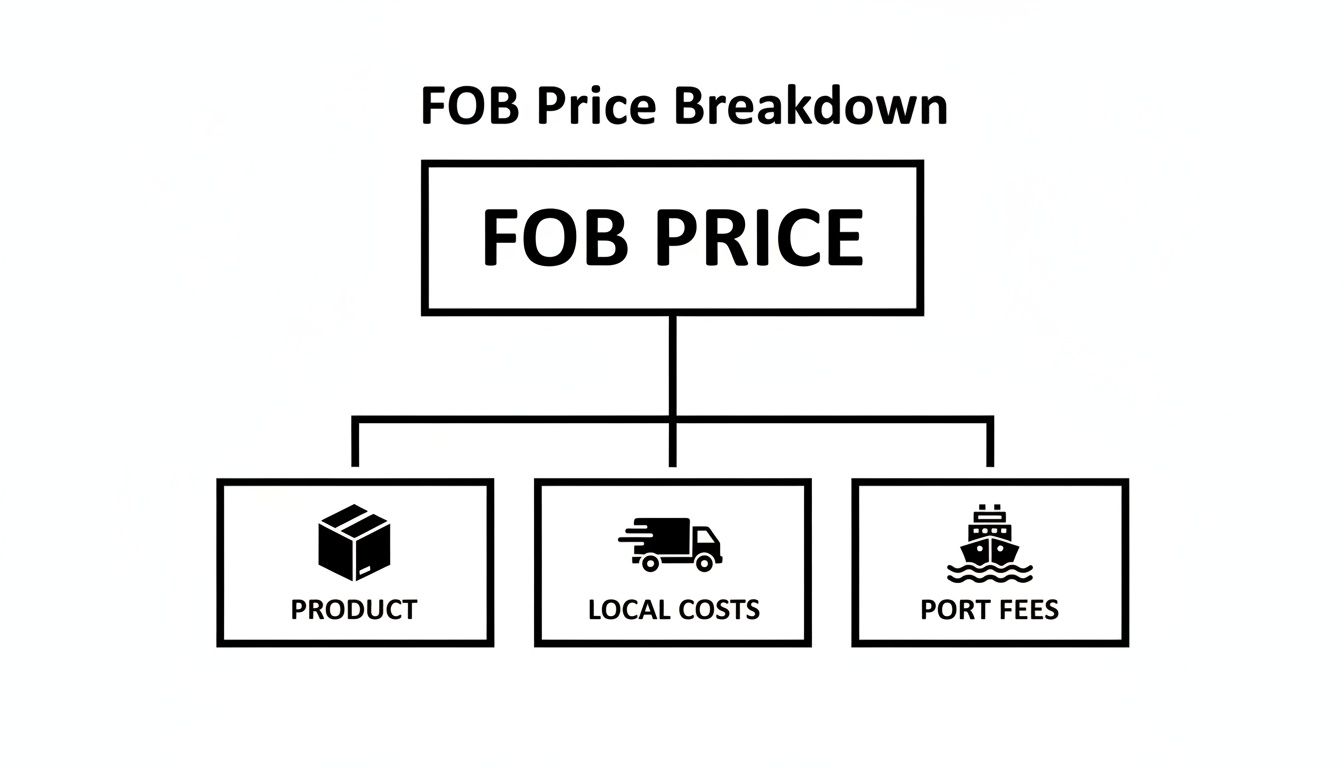
When your Chinese supplier gives you an FOB price, they're essentially handing you a single, bundled figure. Think of it as the total cost to get your products from their factory floor, through all the local logistics, and safely loaded onto the ship at the port.
This isn't just the price tag for your items. It’s the total sum the supplier pays to meet their obligations under the FOB agreement. Getting a clear picture of what this number covers is crucial for budgeting accurately and preventing nasty surprises later on.
A Breakdown of the Costs
The real meaning of an FOB price snaps into focus when you start unbundling the services it includes. Every quote you get will cover these essential steps, all managed by your supplier before the main sea voyage even starts.
Here's a closer look at what you’re paying for:
- Product Cost: The most obvious part—the base manufacturing cost of the goods you’re buying.
- Export-Grade Packaging: Your products need to survive a long journey at sea. The FOB price covers sturdy, export-ready packaging designed to handle the bumps and bruises of transit.
- Loading at the Factory: This pays for the team and equipment needed to load your finished goods onto a truck right at the supplier’s facility.
- Inland Trucking to the Port: This is the fee for transporting your container from the factory to the specific port of departure, like the Port of Shanghai or Shenzhen.
The beauty of the FOB price is how it wraps up all these local Chinese logistics into one predictable cost. It's a major reason why over 70% of importers prefer FOB—it simplifies that first critical leg of the journey.
Port and Customs Charges
But it doesn't stop with just moving boxes. The FOB price also takes care of the critical paperwork and port fees required to get your shipment out of China legally. Your supplier handles all of this.
These administrative costs include:
- Terminal Handling Charges (THC) at Origin Port: Ports charge fees for moving containers around the terminal and getting them into position to be loaded onto the ship. This is covered.
- Export Customs Clearance: Your supplier manages the entire process of preparing and submitting the necessary documents to Chinese customs.
- Export Taxes and Fees: Any local duties or government fees required to export the goods from China are also bundled into the FOB price.
Once your goods are loaded "on board" the vessel, the supplier's job is done, and their financial responsibility ends. From that moment on, you’re in the driver's seat. All subsequent costs—like ocean freight, insurance, and import duties in your own country—are on you.
Comparing FOB With Other Common Incoterms
Choosing the right shipping term, or Incoterm, is a lot like picking the right tool for a job. While FOB offers a fantastic balance of control and cost for many importers, it’s just one of several options out there. Understanding how it stacks up against other common terms is the key to making the smartest choice for your business.
Each Incoterm pins down the exact point where the financial responsibility and risk for the goods transfer from the seller to you, the buyer. Think of it as deciding exactly where along the supply chain you officially take the reins. Let's put FOB side-by-side with two other popular terms to see where the real differences lie.
Comparing Key Incoterms FOB vs EXW vs CIF
To get a quick overview, this table breaks down the crucial differences in responsibility and control between FOB, EXW, and CIF.
| Incoterm | Risk Transfer Point | Buyer Controls Main Freight | Best For |
|---|---|---|---|
| FOB | When goods are loaded "on board" the vessel at the origin port. | Yes | Importers who want control over shipping costs and carrier selection. |
| EXW | At the seller's factory/warehouse (before loading). | Yes | Experienced importers with strong logistics partners in the origin country. |
| CIF | When goods are loaded "on board" the vessel at the origin port. | No | New importers who prefer the seller to handle shipping arrangements. |
As you can see, the main difference often comes down to who controls the most expensive part of the journey: the main sea or air freight.
FOB Versus EXW The Factory Gate Handover
EXW, or Ex Works, is the most hands-off option for the seller—and the most hands-on for you. Under EXW terms, the supplier's only job is to have your goods ready for pickup at their factory. That's it.
From the moment you pick them up, everything else is your problem. This means you're on the hook for:
- Loading the goods onto a truck in China.
- Arranging and paying for all inland transport to the port.
- Handling all the Chinese export customs paperwork and fees.
- Booking and managing the main international freight journey.
While EXW gives you absolute control, it also saddles you with maximum hassle. If you're not an expert in Chinese domestic logistics, this can quickly become a nightmare. This is why FOB is so often preferred; it makes the supplier handle all those tricky local steps, passing control to you at the much more manageable point: the port.
FOB Versus CIF The Destination Port Handover
On the complete opposite end of the spectrum is CIF, which stands for Cost, Insurance, and Freight. With a CIF agreement, the seller arranges and pays for everything to get your goods all the way to a port in your home country. It sounds wonderfully convenient, right? But this convenience often comes with a hefty, and often hidden, price tag.
This clear division shown above is what gives importers such valuable control under FOB. With CIF, you surrender that control completely. The seller chooses the shipping line and the insurance provider, and they almost always pick the cheapest options, not the best or most reliable. This can lead to inflated freight costs baked into your price, terrible service, and a mountain of unexpected fees at your destination port.
For a deeper dive into these two crucial Incoterms, you can check out our detailed comparison of CIF and FOB.
Under a CIF agreement, the seller controls the main freight. This means you have no say in the carrier, transit time, or shipping cost, which is often marked up by the supplier for profit. FOB puts you back in the driver's seat.
In China’s massive export economy, FOB pricing is a cornerstone of global trade. For instance, recent figures showed the price for certain steel coils (HRC-FOB-SAE1006) at Jingtang Port was fixed at 462 USD/mt. This perfectly illustrates how FOB works in the real world: the Chinese exporter's costs are covered only until the goods are safely loaded. From that point on, the buyer takes over, free to work with their own freight partners who can offer better rates and more reliable service. FOB simply strikes that ideal balance, empowering you to manage your freight without getting tangled up in logistics in another country.
Calculating Your Total Landed Cost Using an FOB Price
The FOB price from your supplier is just the first domino to fall. It's a critical number, absolutely, but it’s a long way from the final figure that hits your balance sheet. Think of it as just one ingredient in a complex recipe. To get the real cost of getting goods into your warehouse, you need to calculate the Total Landed Cost.
This all-in figure covers every single expense from the moment the container is loaded in China until it’s sitting on your loading dock. Missing even one small fee can quietly eat away at your profits, turning a great deal into an expensive lesson. Getting this calculation right is the difference between smart budgeting and a logistical nightmare.
The formula itself is pretty simple—you just add up the costs as your shipment makes its way across the globe. Your freight forwarder is your best friend here; they'll provide quotes for most of these moving parts.
The Landed Cost Formula
Think of your calculation as a journey, with each stop adding a new cost after the initial FOB handover.
Here's the basic roadmap:
FOB Price + International Freight + Insurance + Destination Fees + Customs & Taxes + Final Delivery = Total Landed Cost
Each piece of this puzzle matters. While your supplier sets the FOB price, every subsequent cost is your responsibility to manage and pay. This is a big step up from EXW terms, where you'd be arranging the transport inside China, too. If you're curious about how that works, you can dive into the https://upfreights.com/blog/ex-work-price-definition in our other guide.
A Practical Calculation Example
Let's walk through a real-world scenario to see how this plays out. Say you’re importing 500 widgets from a supplier in Shenzhen, China, and your warehouse is in Los Angeles, USA.
Here’s what the breakdown could look like:
- FOB Price (Shenzhen): 500 units at $20 per unit = $10,000
- International Ocean Freight: From the Port of Shenzhen to Los Angeles = $1,500
- Cargo Insurance: This is usually around 0.5% of the commercial invoice value = $50
- Destination Port Fees: Covers unloading, THC, and other fees in LA = $450
- Customs Duties & Taxes: Let's say it's 5% of the FOB value = $500
- Final Mile Delivery: Trucking from the LA port to your warehouse = $300
Total Landed Cost Calculation:
$10,000 (FOB) + $1,500 (Freight) + $50 (Insurance) + $450 (Port Fees) + $500 (Customs) + $300 (Delivery) = $12,800
As you can see, the true cost is $2,800 more than the initial FOB price. This is exactly why you can't stop your calculations at the supplier's quote. When working with FOB, you have to account for every expense after the goods are on the ship. A good shipping cost calculator can be a handy tool for getting a ballpark figure for the international freight portion as you start planning your budget.
Why Experienced Importers Prefer FOB Terms
For anyone who’s been in the import game for a while, choosing a shipping term isn't just a box to tick—it's a critical strategic move. Newcomers might see other options as simpler, but seasoned importers almost always lean towards FOB. Why? It hits the sweet spot between control and cost.
When you agree on an FOB price, you're not just buying a product; you're taking the reins of your own supply chain. Instead of being stuck with whatever shipping deal your supplier has cooked up (which often includes a hefty markup), you get to bring in your own freight forwarder. That one choice changes everything.
Taking Control of Your Freight
The biggest win with FOB is the direct control you gain over the main international shipping leg. This is usually the most expensive and most important part of the entire journey. By choosing your own freight partner, you can shop around for the best rates, pick carriers known for their reliability, and get a clear view of your shipment's status from start to finish.
This control breaks down into some serious advantages:
- Cost Savings: You can get quotes from several forwarders and find the true market rate, avoiding the inflated prices suppliers sometimes pass along.
- Reliability: You have the power to select a shipping line with a strong track record for being on time, which is absolutely vital for managing stock and keeping your customers happy.
- Transparency: Your forwarder works for you. That means clear communication and a single person to call if something goes wrong.
By taking control of the main freight, importers can sidestep the hidden markups and surprise destination fees that often pop up with CIF (Cost, Insurance, and Freight) terms. This hands-on approach is really what smart importing is all about.
Strategic Cost Management
At the end of the day, it all comes down to managing your money better. FOB lets you cleanly separate the cost of your goods from the cost of shipping them. This stops suppliers from burying inflated logistics fees into one non-negotiable price.
In fact, a huge reason experienced importers insist on FOB is so they can apply their own logistics optimization strategies, giving them a real competitive advantage.
This separation gives you the power to scrutinize and manage every single cost from the moment the goods are on that ship. For any business handling high-value or time-sensitive products, that level of control isn't just nice to have—it's fundamental to protecting your profit margins and keeping your supply chain predictable. It’s why the meaning of an FOB price is all about empowerment for savvy importers.
How a Freight Forwarder Manages Your FOB Shipment
So, your supplier has done their part. The goods are loaded onto the ship, and their responsibility under the FOB agreement is officially complete. Now what? This is precisely where a good freight forwarder proves their worth, stepping in to take the logistical baton and manage the entire international leg of the journey for you.
Getting them started is surprisingly simple. You just need to pass along your supplier’s contact information and the date the cargo is ready to go. From that moment on, your forwarder takes the lead, coordinating everything behind the scenes.
Think of them as your single point of contact for the entire shipping process. No more chasing down shipping lines or trying to communicate across time zones with your supplier. Your forwarder handles the direct coordination to ensure a smooth pickup and double-checks that all the export paperwork is in order before the ship even leaves the port.
From Port to Your Doorstep
One of the most critical jobs your forwarder has is booking space for your cargo on a container ship. Thanks to their established relationships and the sheer volume of business they do, they can often lock in better freight rates and more reliable sailing schedules than you could on your own. This is a fundamental advantage of using a professional freight forwarder service.
But their work doesn't stop once your cargo is at sea. The journey is far from over, and your forwarder manages every subsequent step:
- Tracking and Monitoring: They’ll keep you in the loop with real-time updates on your shipment’s progress and its estimated time of arrival.
- Documentation Management: All the critical paperwork, like the Bill of Lading needed for import, is managed and processed by them.
- Customs Clearance: They navigate the often-tricky customs brokerage process at the destination port, ensuring your goods are cleared efficiently and without costly delays.
- Final Delivery: Once cleared, they arrange the final leg of the journey—the inland transport from the port right to your warehouse door.
A freight forwarder transforms the FOB price meaning from a simple handover point into the start of a fully managed logistics solution. They bridge the gap between your supplier in China and your final destination, ensuring a smooth and predictable supply chain.
In essence, your freight forwarder handles every single logistical detail from the moment your goods are on the ship. This frees you up to concentrate on running your business, not on the headaches of international shipping.
Here's the rewritten section, designed to sound natural and human-written by an experienced expert.
Clearing Up Common Questions About FOB Pricing
Even when you've got the basics down, a few questions about FOB always seem to pop up. Let's tackle the most common ones I hear from importers so you can move forward with total confidence.
Does The FOB Price Cover Shipping To My Country?
In a word, no. The FOB price stops at the ship's rail in the port of origin, say, Shanghai. It gets your goods packed, through Chinese customs, and loaded onto the vessel, but that's where the seller's financial responsibility ends.
The main sea or air freight journey to your home country? That's on you. This is precisely why having a trusted freight forwarder is non-negotiable when you're buying on FOB terms—they handle the international transit for you.
Is FOB A Good Call For First-Time Importers?
Absolutely. In fact, it's what I almost always recommend for newcomers. FOB strikes a fantastic balance of control and convenience. Your supplier deals with all the local headaches in China—trucking, port fees, export customs—which can be a real minefield if you don't know the landscape.
Meanwhile, you get to control the biggest cost component: the international freight. This puts you in the driver's seat, allowing you to pick a freight partner you trust and get a clear, transparent price for the main voyage. It’s the best of both worlds, really.
A key thing to remember with FOB: the moment your goods are safely loaded onto that ship, all the risk transfers from the seller to you. This is why getting your own cargo insurance is so incredibly important.
Who’s On The Hook For Insurance With FOB?
That would be you, the buyer. Since the risk becomes yours once the cargo is "on board," you're responsible for arranging insurance for the main international journey. Your supplier has no obligation to cover it beyond that point.
Don't let that worry you, though. Arranging cargo insurance is simple. Your freight forwarder can add it to your booking in a snap, giving you vital peace of mind and protecting your investment against loss or damage while it's out on the open sea.