Think of a freight forward service as the ultimate travel agent, but for your products. They're the logistics experts who map out and manage your cargo's entire journey, from the factory floor all the way to your customer's doorstep.
Crucially, these partners don't own the massive cargo ships or planes themselves. Instead, they use their deep industry knowledge and extensive network of contacts to find and book the most efficient and cost-effective route for your goods.
What Is a Freight Forward Service, Really?
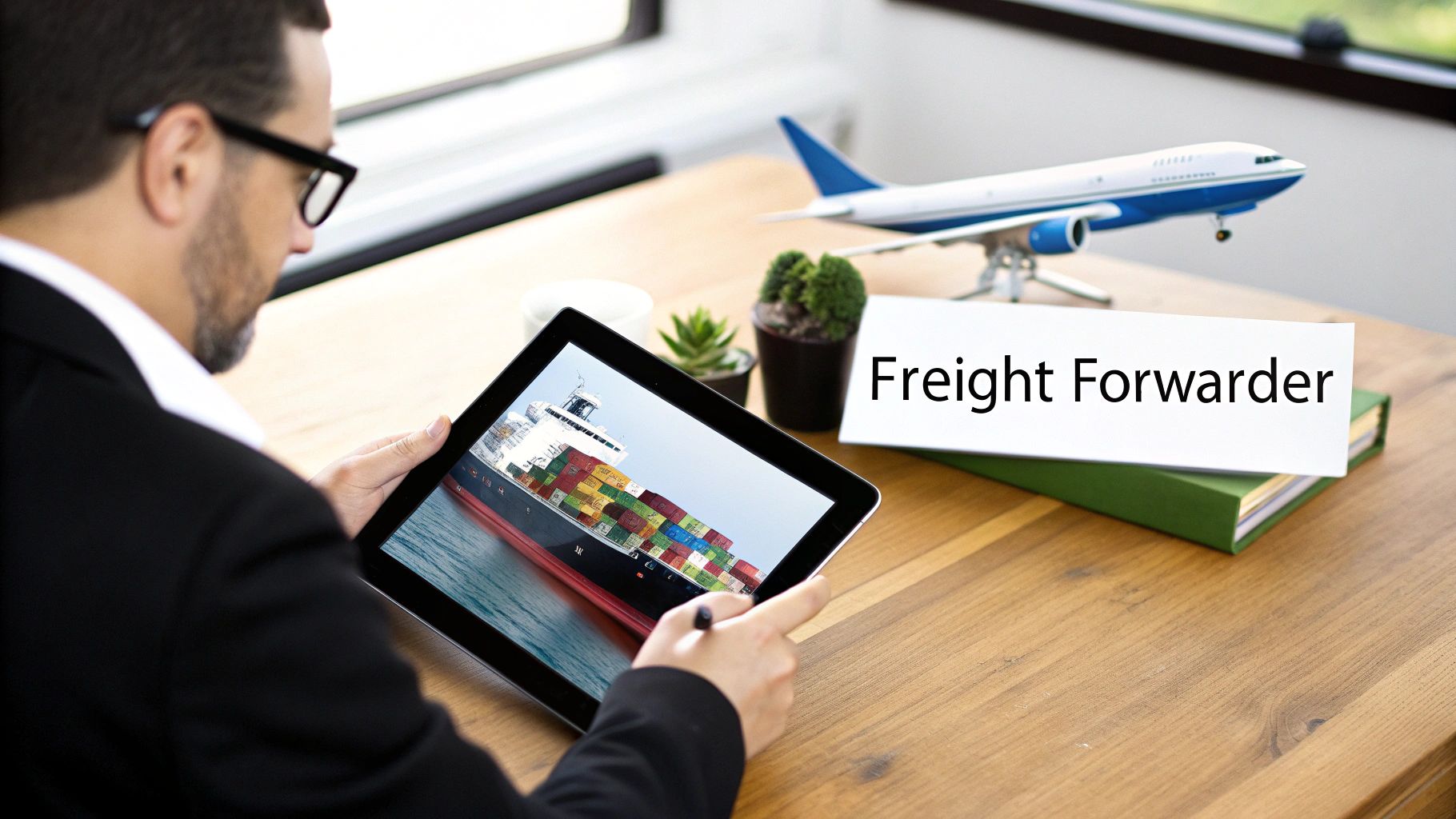
Let's say you need to get a container of goods from a supplier in China to your warehouse in Canada. On your own, you'd have to find space on a ship, handle Chinese export customs, manage the ocean crossing, then tackle the maze of Canadian import regulations and final-mile trucking. It's a logistical nightmare of multiple companies, languages, and mountains of paperwork.
This is exactly where a freight forward service steps in. They become your single point of contact, the architect who orchestrates all these moving pieces for you. By combining your shipment with those of other clients, they can secure better rates from carriers—savings they then pass along. It's their job to turn a massive headache into a smooth, managed process.
Your Advocate in Global Trade
At its heart, a forwarder's role is to anticipate and solve problems before they even start. They are the proactive coordinators making sure every link in the supply chain is strong. Their work goes way beyond just booking a spot on a container ship.
A great freight forward service handles a whole suite of critical tasks:
- Documentation Management: They expertly prepare and manage all the essential paperwork—like the bill of lading, commercial invoices, and customs forms—ensuring every detail is perfect to avoid costly hold-ups.
- Carrier Negotiation: Because they ship in huge volumes, forwarders have the leverage to negotiate much better rates with ocean and air carriers than a single business ever could.
- Logistics Coordination: They manage the entire chain of events: arranging the truck to pick up goods from the factory, booking the main ocean or air transit, and scheduling the final delivery.
- Customs Clearance: Acting as your representative, they navigate the tricky customs processes at both origin and destination, ensuring your shipment complies with all trade laws.
By taking all this on, a freight forwarder frees you up to concentrate on what you do best—growing your business. They turn the complexity of global shipping from a potential weakness into a genuine competitive advantage.
More Than Just a Middleman
It’s easy to mistakenly see forwarders as simple go-betweens, but they're much more than that. They are strategic consultants who provide real value. They’ll advise you on the smartest shipping methods, helping you weigh the trade-offs between the speed of air freight and the cost-effectiveness of ocean freight.
They can also arrange cargo insurance to protect your investment and provide sophisticated tracking systems so you always know where your goods are.
Knowing the lingo of international trade is a big deal, and forwarders speak it fluently. If you want to get up to speed on the key terms, our freight forwarding terminology is the perfect place to start. It will help you communicate clearly and confidently with any logistics partner.
In the end, a freight forward service is a partner dedicated to making your supply chain stronger, more predictable, and more efficient.
What a Freight Forwarder Actually Does: The Core Services
A great freight forwarder is more than just a booking agent; they’re your logistics partner, armed with a whole suite of services to manage your shipment from start to finish. Knowing what’s in their toolkit is the first step to building a supply chain that’s both smart and reliable.
Think of it this way: each service is a specific tool for a specific job. Whether the challenge is speed, cost, or shipment size, a seasoned forwarder knows exactly which tool to pull out to get your cargo moving smoothly, affordably, and without any compliance headaches.
Let’s break down the essential services you’ll come across.
Air Freight vs Sea Freight: The Big Question of Speed vs Cost
The first and most important decision you'll make is whether your goods will fly or sail.
Air freight is the express lane of global shipping. It's incredibly fast, reliable, and the go-to choice for high-value, time-sensitive products. If you're shipping electronics, fresh produce, or pharmaceuticals, getting your goods across the world in just 3-7 days can be a massive competitive advantage.
Sea freight, on the other hand, is the powerful workhorse of international trade. It’s dramatically cheaper, making it the only practical choice for large, heavy, or non-urgent cargo. A container ship might take 20-40 days to get from China to Canada, but the cost savings are huge. There's a reason over 90% of everything we buy travels by sea—it’s the backbone of global commerce.
Your choice isn't just about speed versus cost. It's a strategic decision that needs to align with your business goals, your inventory cycle, and what your customers expect.
Air Freight vs Sea Freight: A Quick Comparison
Use this table to quickly compare the primary trade-offs between air and sea transport for your goods.
| Factor | Air Freight | Sea Freight |
|---|---|---|
| Speed | Very fast (3-7 days) | Slower (20-40+ days) |
| Cost | High | Low |
| Ideal For | High-value, perishable, or urgent goods | Bulk items, heavy cargo, non-urgent goods |
| Capacity | Limited by aircraft size | Extremely high capacity |
Ultimately, a good forwarder will help you weigh these factors to find the right balance for each specific shipment.
FCL vs LCL Shipping: Your Container Options
If you’ve decided on sea freight, the next question is how much container space you need. This leads to another key choice: FCL or LCL.
FCL (Full Container Load) is exactly what it sounds like. You rent an entire 20ft or 40ft container all to yourself. This is the best bang for your buck if you have enough freight to fill most of it. It’s also typically faster and more secure because your container is sealed at the factory and isn’t opened again until it reaches you.
LCL (Less than Container Load) is the perfect fit when your shipment isn’t big enough to justify a full container. With LCL, your cargo is grouped with other shippers’ goods inside a shared container. It’s basically carpooling for your products—you only pay for the space you use. This makes it an incredibly flexible and affordable option for smaller businesses.
Want to get into the nitty-gritty? You can explore the differences between FCL and LCL shipping in our detailed guide.
Essential Services That Make All the Difference
Moving a box from A to B is just the beginning. A top-tier freight forwarder provides critical support services that protect your business and prevent costly problems.
- Customs Clearance: This might be the single most valuable service a forwarder offers. Navigating customs is a minefield of complex paperwork, strict regulations, and ever-changing rules. Your forwarder acts as your licensed customs broker, handling all the documentation to ensure your duties are paid correctly and your shipment is fully compliant. Getting this right prevents delays, fines, or even having your goods seized at the border.
- Cargo Insurance: Don't assume your shipment is fully covered. Carrier liability is notoriously limited and often won’t pay out the full value of your goods if they’re lost or damaged. Real cargo insurance protects your financial investment against things that can—and do—go wrong, like port accidents, theft, or weather events.
- Real-Time Tracking: Gone are the days of wondering where your shipment is. Modern forwarders offer sophisticated tracking portals that give you complete visibility from the factory floor to your front door. This isn't just for peace of mind; it allows you to plan inventory, keep customers updated, and manage your supply chain with confidence.
Mapping the Freight Forwarding Journey Step-by-Step
Trying to understand what happens behind the scenes in freight forwarding can feel like a lot to take in, but it all follows a pretty logical path. The best way to think about it is like a relay race. Your cargo is the baton, and your forwarder is the team making sure every handover is seamless.
From the moment you ask for a quote to the final signature at delivery, each step is carefully managed to keep your supply chain running smoothly. It all kicks off with one simple request from you.
Phase 1: The Quote and Booking
Your journey begins the second you reach out for a shipping quote. To get you an accurate price, a freight forwarder needs a few key details about your shipment.
- Origin and Destination: Simply, where is it coming from and where does it need to go? Specific addresses or port names are crucial here.
- Cargo Details: What exactly are you shipping? This means providing the dimensions (length, width, height) and the total weight.
- Incoterms: These are the rules of the road. Terms like EXW (Ex Works) or FOB (Free on Board) clearly define who pays for what and who carries the risk at each stage.
- Service Requirements: Are you just looking for a port-to-port service, or do you need a complete door-to-door solution where everything is handled for you?
Once you give the green light on the quote, the booking is confirmed. That’s when your forwarder really gets to work, securing space with a carrier—whether that's an airline or a shipping line—and arranging the initial pickup of your goods.
Phase 2: Origin Operations and Export
With the booking locked in, the physical journey starts in the country of origin. This phase is all about getting your cargo prepped and legally cleared to leave the country.
First up is origin haulage. This is just the process of moving your goods from your supplier's factory to the forwarder's warehouse, or sometimes straight to the port or airport.
If you’re shipping LCL (Less than Container Load), your items are then consolidated in a warehouse. Here, they're carefully loaded into a container with goods from other shippers heading to the same destination. This is a classic freight forwarding service that saves businesses a ton of money on smaller shipments.
Before a single box can leave the country, it has to clear export customs. Your forwarder handles this entire headache, submitting all the necessary declarations and paperwork to ensure your shipment complies with local laws. One tiny mistake here can cause massive delays.
The infographic below shows the two main transport options your forwarder will arrange for the long-haul part of the journey.
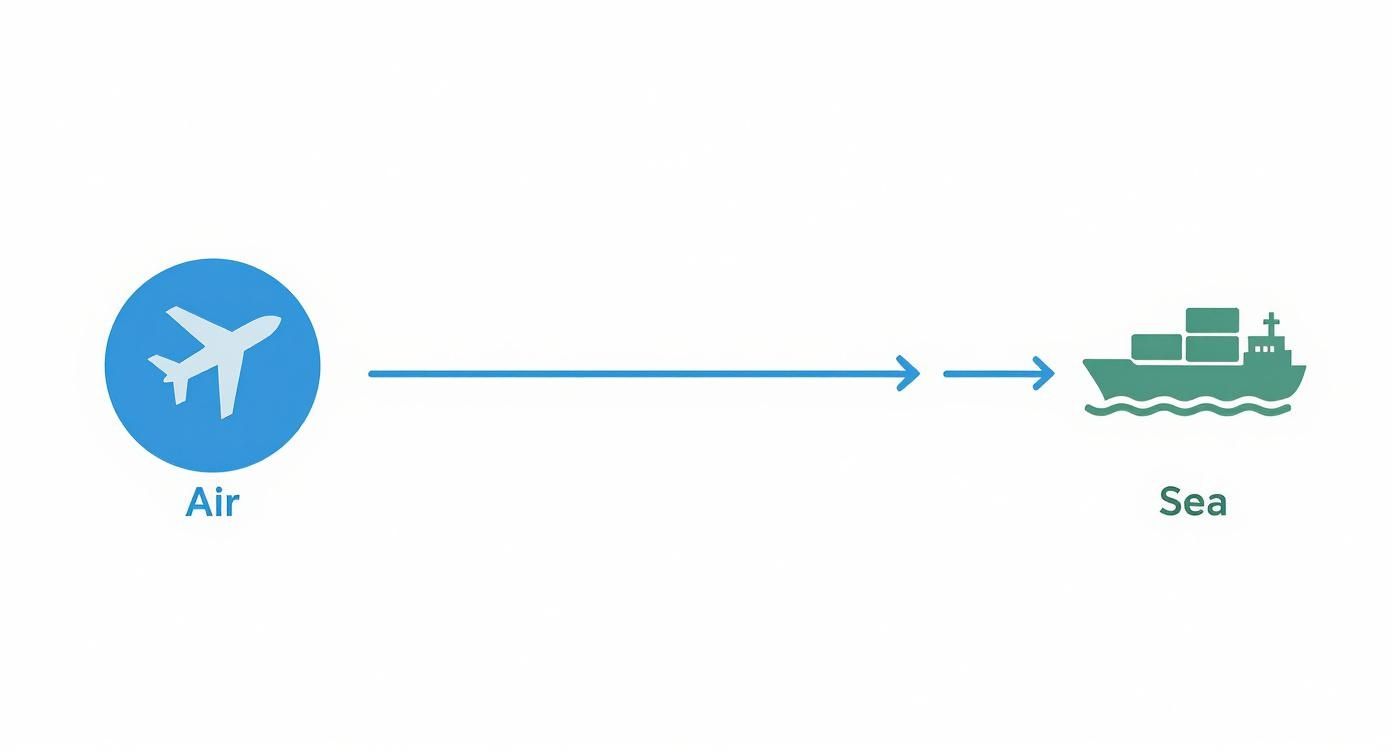
This choice between air and sea is probably the single biggest decision affecting both the speed and the cost of your shipment.
Phase 3: Arrival and Import Clearance
After the long trip by air or sea, your cargo arrives at the destination port or airport. Now, it has to navigate the import rules of the destination country, a step where real expertise makes all the difference.
The first thing that happens is import customs clearance. Your forwarder, acting as your customs broker, submits all the required documents to the local authorities—things like the commercial invoice, packing list, and bill of lading. They also handle paying any duties and taxes owed on your behalf.
Once customs gives the all-clear, your cargo is officially released. For LCL shipments, the container is then moved to a local warehouse for deconsolidation, where your goods are carefully separated from everyone else's.
Phase 4: Final Mile Delivery
We're on the home stretch. After clearing customs and being separated (if it was an LCL shipment), your cargo is ready for its final trip.
Your forwarder arranges destination haulage, lining up a local trucking company to pick up your goods and deliver them to your final specified address. This could be your own warehouse, a distribution centre, or an Amazon FBA facility.
When the goods arrive, you or your receiver signs a proof of delivery, which officially marks the end of the journey. From a simple quote request to that final signature, your freight forwarder has orchestrated every single move.
How to Choose the Right Freight Forwarding Partner

Picking a freight forwarder isn't like hiring another supplier; it's more like bringing on a strategic business partner. This is the company that will guard your entire supply chain. Their performance directly affects your bottom line, your delivery schedules, and ultimately, your customers' happiness. The wrong choice can quickly spiral into delayed shipments, unexpected costs, and a constant stream of logistical headaches.
To make the right call, you have to look past the initial price quote. A truly great partner is defined by their capabilities, reliability, and deep-seated expertise. It’s about finding someone who genuinely gets your business and has the network, performance record, and technology to back it up.
Evaluate Their Network and Expertise
A forwarder is only as good as their network. You absolutely need a partner with a solid presence in the countries you’re shipping between. If you’re sourcing from China, for example, a forwarder with deep local roots means they have real relationships with truckers and customs officials on the ground. That kind of connection is priceless for ensuring a smooth departure.
Just as important is their hands-on experience. Have they handled your type of cargo before? Are they constantly managing shipments on your primary trade lanes, like China to Canada or China to the UK? This specialised knowledge means they can spot and solve potential issues long before they become expensive problems for you.
This network strength is particularly vital in growing markets. The Canada rail freight transport market, for instance, is projected to grow at a compound annual growth rate of over 3.5% between 2025 and 2030. A forwarder with strong local partnerships is crucial for navigating this expansion and managing the complexities of cross-border transit.
Verify Carrier Relationships and Performance
The rates and cargo space a forwarder can offer you are a direct result of their relationships with air and sea carriers. A well-connected forwarder has access to better, pre-negotiated rates and can secure spots on vessels or aircraft even when everyone else is scrambling during peak season. Don't be shy; ask them directly about their carrier network.
But relationships are only half the story. You need to see the data. Push for their key performance metrics:
- On-Time Performance Rate: What percentage of their shipments actually arrive when they say they will? A transparent forwarder will have this number ready.
- Customer Retention Rate: Do their clients stay for the long haul? A high retention rate is a huge vote of confidence in their service quality.
- Average Response Time: How fast do they get back to you when you have a question or a problem? When something goes wrong, you need answers, not silence.
A great freight forwarder won't just move your boxes; they'll provide a reliable, predictable service backed by measurable performance. Their job is to bring stability to your supply chain.
Assess Technology and Support Systems
In today's logistics world, information is just as valuable as the physical shipment itself. A top-tier freight forwarder will have invested in technology that gives you a clear, real-time picture of where your cargo is.
At a minimum, look for a forwarder with a clean, user-friendly online portal for tracking. This isn't a luxury; it's a standard feature. This visibility lets you monitor your shipment’s progress, anticipate its arrival, and keep your own customers in the loop.
Of course, technology can’t replace people. Who do you call when there's an issue? A dedicated account manager or a genuinely responsive support team is non-negotiable. Put them to the test during the vetting process. If they take days to respond to a simple quote request, just imagine the radio silence when a real problem crops up. While exploring your options, it's often helpful to look at related industries for insights, such as tips for choosing an international removal company.
Before you sign on the dotted line, check out our guide on the top freight forwarding services companies to benchmark what leading providers offer. This will give you a solid foundation for what to expect from a quality partner, helping you make a choice that will truly support your business growth.
Navigating Common Pitfalls When Shipping from China
Shipping from China can be a game-changer for your business, but it's a path filled with potential tripwires. A simple paperwork mistake or a misunderstanding of a trade term can snowball into expensive delays, surprise fees, and a stalled supply chain. Getting out in front of these common issues is the key.
Successfully importing from China isn't about luck—it's about smart preparation and having the right expertise on your side. Think of an experienced freight forward service as your local guide, helping you steer clear of the hidden traps that catch so many businesses off guard. Let’s walk through the most common problems and how to sidestep them.
Misclassifying Products and Incorrect HS Codes
One of the easiest and most costly mistakes you can make is getting the Harmonised System (HS) code wrong. This six-to-ten-digit number is a universal language for customs, telling officials exactly what you're shipping and, crucially, how much duty and tax you owe. Guessing, using an old code, or just taking your supplier's word for it can trigger inspections, fines, and serious hold-ups at the port.
The only way to avoid this is to be meticulous. Before your cargo even thinks about leaving China, you need to work with both your supplier and your freight forwarder to lock in the correct HS code for every single item. A sharp forwarder will help you verify the codes, ensuring your customs declaration is bulletproof.
Getting the HS code right from the start is non-negotiable. It’s the bedrock of a smooth customs process and the difference between your goods sailing through or getting stuck at the border for days, or even weeks.
This attention to detail becomes even more critical in complex supply chains. Freight forwarding is the glue that holds intermodal operations together, making sure goods move seamlessly from factory truck to port to vessel. As global logistics networks expand, the forwarder's role in managing this fine-grained compliance becomes indispensable. For instance, in September 2025, intermodal shipments originating from Canada—often orchestrated by freight forwarders—jumped by 5.0% year over year. You can dive deeper into these trends with the latest Canadian transportation and storage statistics.
Incomplete or Inaccurate Documentation
Customs agents live and breathe details. A commercial invoice that’s missing a street address, a packing list that doesn’t quite match the actual cargo, or a bill of lading with a typo can bring your entire shipment to a screeching halt. Even the smallest inconsistency can raise a red flag and land your paperwork in a pile for manual review.
The solution here is to adopt a zero-error mindset. Your freight forwarder should act as a second set of expert eyes, giving you a clear checklist of every document needed and then reviewing each one for absolute accuracy before it’s submitted.
The essentials almost always include:
- Commercial Invoice: This must clearly state the buyer, seller, product descriptions, HS codes, values, and the agreed-upon Incoterms.
- Packing List: This document needs to be a perfect mirror of your cargo, listing the exact contents, weights, and dimensions of every box or pallet.
- Bill of Lading (B/L) or Air Waybill (AWB): This is the contract between you and the carrier. Its details must align perfectly with everything on the invoice and packing list.
Misunderstanding Incoterms and Hidden Costs
Incoterms like FOB (Free On Board) and EXW (Ex Works) are the rules of the road—they spell out who pays for what, and who carries the risk at every step. Many first-time importers get lured in by an attractive EXW price from a supplier, thinking they've scored a deal, only to get slammed with a laundry list of unexpected origin fees later.
Here’s the difference: with EXW, your responsibility begins right at the factory door. That means you’re on the hook for everything that happens in China: the trucking to the port, all the local port charges, and the export customs clearance. FOB, on the other hand, makes the supplier responsible for all of that. They deliver your goods, cleared for export, to the ship.
Understanding this distinction is fundamental to budgeting accurately. Always confirm the Incoterms with your supplier, and then have your freight forwarder break down their quote so you know exactly what is—and what isn’t—included. No surprises.
Your Freight Forwarding Questions Answered
Even with a clear map of the process, it's natural to have questions about how a freight forward service works in the real world. Global logistics is full of moving parts, and getting straight answers is the only way to feel confident about your shipping plan.
Let's tackle the most common questions we hear from businesses every day. We'll cut through the jargon to break down key roles, clarify how costs are structured, and look at the critical part risk management plays. Think of this as your go-to guide for making sense of freight forwarding.
What Is the Difference Between a Freight Forwarder and a Carrier?
This is probably the most common question we get, and the distinction is simple but important. A carrier is the company that actually owns the ships, planes, and trucks used to move your goods. We're talking about the major shipping lines and global airlines.
A freight forwarder, on the other hand, is your logistics partner. We don't own the heavy assets, but we act as the architect for your entire shipment. Our job is to leverage our network and expertise to book space with the right carriers, manage all the complex paperwork, and coordinate the entire journey from your factory floor to your warehouse door.
Here’s a good way to think about it: the carrier is the airline that flies the plane. The freight forwarder is the expert travel agent who books your ticket, arranges the transfers, handles the visa paperwork, and makes sure your whole trip is seamless.
How Are Freight Forwarding Costs Calculated?
There's no single sticker price for international shipping. Instead, your final cost is a blend of several key factors. Any good forwarder will give you a transparent, itemised quote so you know exactly what you’re paying for.
The main components that drive your costs are:
- Mode of Transport: Air freight is always going to be faster and pricier than sea freight.
- Shipment Weight and Volume: Carriers calculate what's called "chargeable weight," which is a comparison between the actual weight and the volume (or size) of your cargo. You're billed on whichever is higher.
- Origin and Destination: The shipping lane itself is a huge factor. Some routes are simply more expensive than others due to demand, distance, and port fees.
- Incoterms: The shipping terms you agree on with your supplier (like FOB or EXW) dictate who pays for which part of the journey.
- Additional Fees: You'll also see charges for things like fuel, terminal handling, customs duties and taxes, and insurance.
Can a Freight Forwarder Handle My Customs Clearance?
Yes, and honestly, they should. Managing customs is a fundamental part of what a freight forwarder does. A reliable forwarder acts as your licensed customs broker, which is absolutely essential for avoiding expensive headaches at the border.
This service isn't just about filling out forms. It involves preparing and submitting all the required documentation, classifying your goods correctly with the proper HS codes, and coordinating the payment of duties and taxes. Getting this right is what prevents delays, fines, or even having your shipment seized.
Why Do I Need Cargo Insurance If My Goods Are Packed Well?
It’s true that good packing is your first line of defence against minor dings and scrapes, but it won’t do a thing to protect you from the big stuff. We're talking about major events like containers lost in a storm, accidents at the port, cargo theft, or a fire on board. What really surprises most people is how little carriers are legally responsible for.
A carrier's liability is capped and is usually based on the weight of the cargo, not its commercial value. That means if your $50,000 shipment of electronics is lost at sea, you might only get a few hundred dollars back from the carrier. Cargo insurance is what closes that gap. It protects your financial investment for its full value against loss or damage, giving you the peace of mind you need.