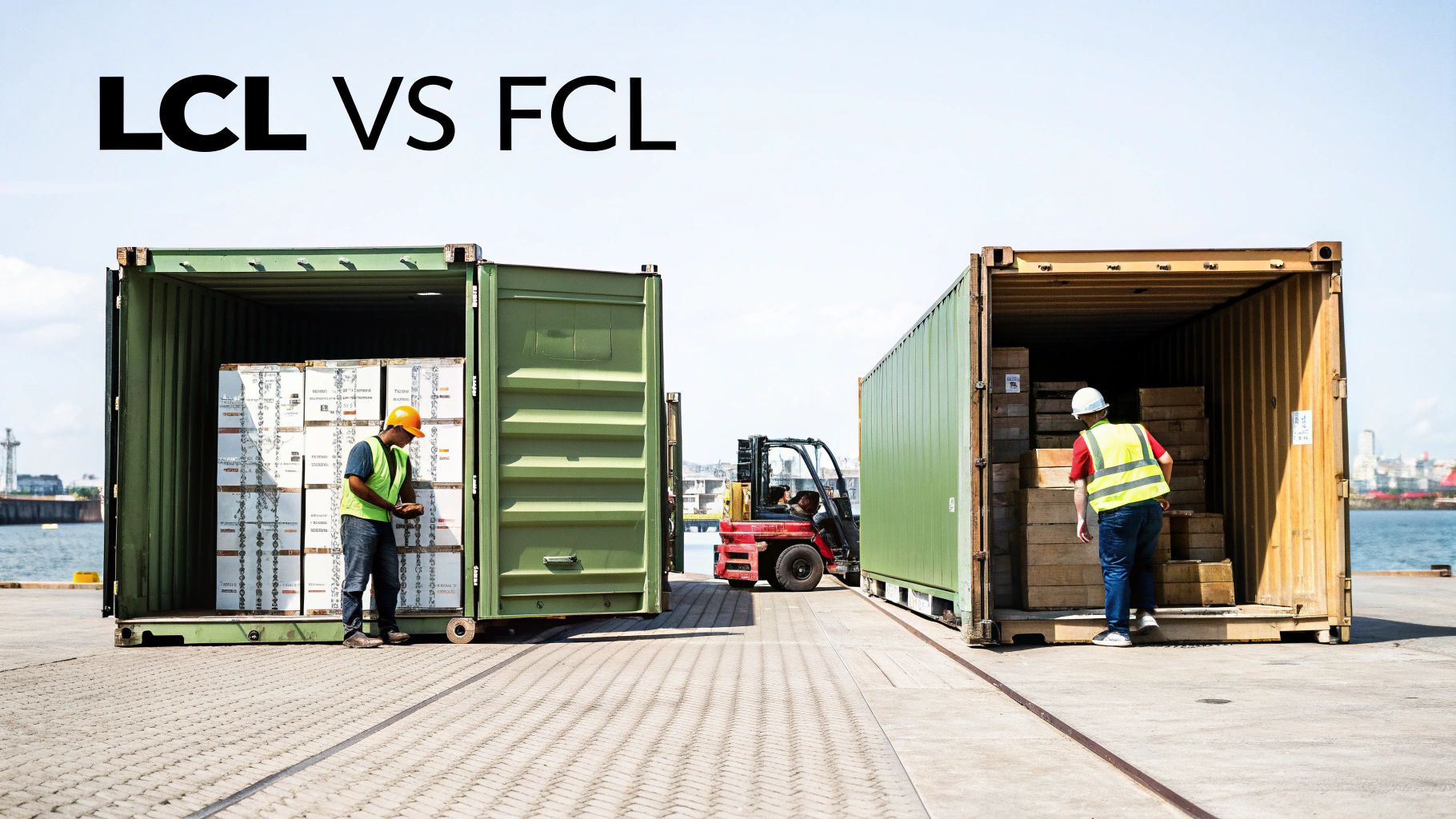
The real difference between LCL and FCL boils down to one question: do you want to share or go solo? Think of LCL (Less than Container Load) as a cargo carpool—you only pay for the seat your goods take up. FCL (Full Container Load), on the other hand, is like booking a private limo; the entire container is yours and yours alone.
Getting to Grips with LCL and FCL Shipping
When you're dealing with ocean freight, wrapping your head around LCL and FCL is the first real step to building a smart, cost-effective supply chain. This choice ripples through everything—your final shipping bill, how long it takes to get your goods, and even how secure your cargo is along the way. Get it wrong, and you could be looking at blown budgets or frustrating delays. It’s a foundational decision for any importer.
LCL: The Smart Choice for Flexibility and Smaller Shipments
LCL shipping is the go-to solution when your cargo won't fill an entire container. A freight forwarder bundles your goods together with shipments from other companies into one shared container. This model is a lifesaver for small to medium-sized businesses or anyone managing fluctuating inventory levels, making it incredibly budget-friendly.
The shift towards more agile shipping is clear. As of May 2025, search interest for "LCL shipping from China" shot up by a staggering 1,100% year-over-year. This isn't just a blip; it points to a major trend where businesses prefer smaller, more frequent shipments to stay nimble. You can find more analysis on these global trade dynamics on supplyia.com.
FCL: When Volume and Security are Paramount
With FCL shipping, you’re booking the whole container, whether you pack it to the ceiling or not. This is usually the most economical path once your shipment size creeps over 13 cubic metres (CBM).
The real advantage? Security. Your container is sealed at your supplier's facility and isn't opened again until it reaches your destination. This hands-off approach drastically reduces the risk of damage or loss, making FCL the undisputed champion for high-value or delicate cargo.
LCL vs FCL Quick Comparison
To make the decision a bit clearer, it helps to see the core differences side-by-side. This table breaks down the essentials at a glance.
| Factor | LCL (Less than Container Load) | FCL (Full Container Load) |
|---|---|---|
| Best For | Small shipments, typically 1-13 CBM. | Larger shipments, usually 13+ CBM. |
| Cost Structure | Pay per cubic metre (CBM) or per tonne. | A single flat rate for the entire container. |
| Transit Time | Generally longer due to consolidation and deconsolidation steps. | Faster, more direct transit from port to port. |
| Security | Higher risk from being handled multiple times. | Much lower risk; the container is sealed at the source. |
| Flexibility | Great for shipping smaller quantities on a frequent basis. | Less flexible; you often have to wait to accumulate enough goods. |
Ultimately, the right choice isn't just about volume. It’s a strategic decision that balances cost, speed, and the specific needs of your cargo.
Breaking Down LCL and FCL Cost Structures
Looking past the initial freight quote is essential to understanding the true, all-in cost of your shipment. The way LCL and FCL are priced couldn't be more different, and getting a handle on these nuances is the key to accurately forecasting your total landed cost and avoiding nasty surprises on your final invoice.
Unpacking the LCL Pricing Model
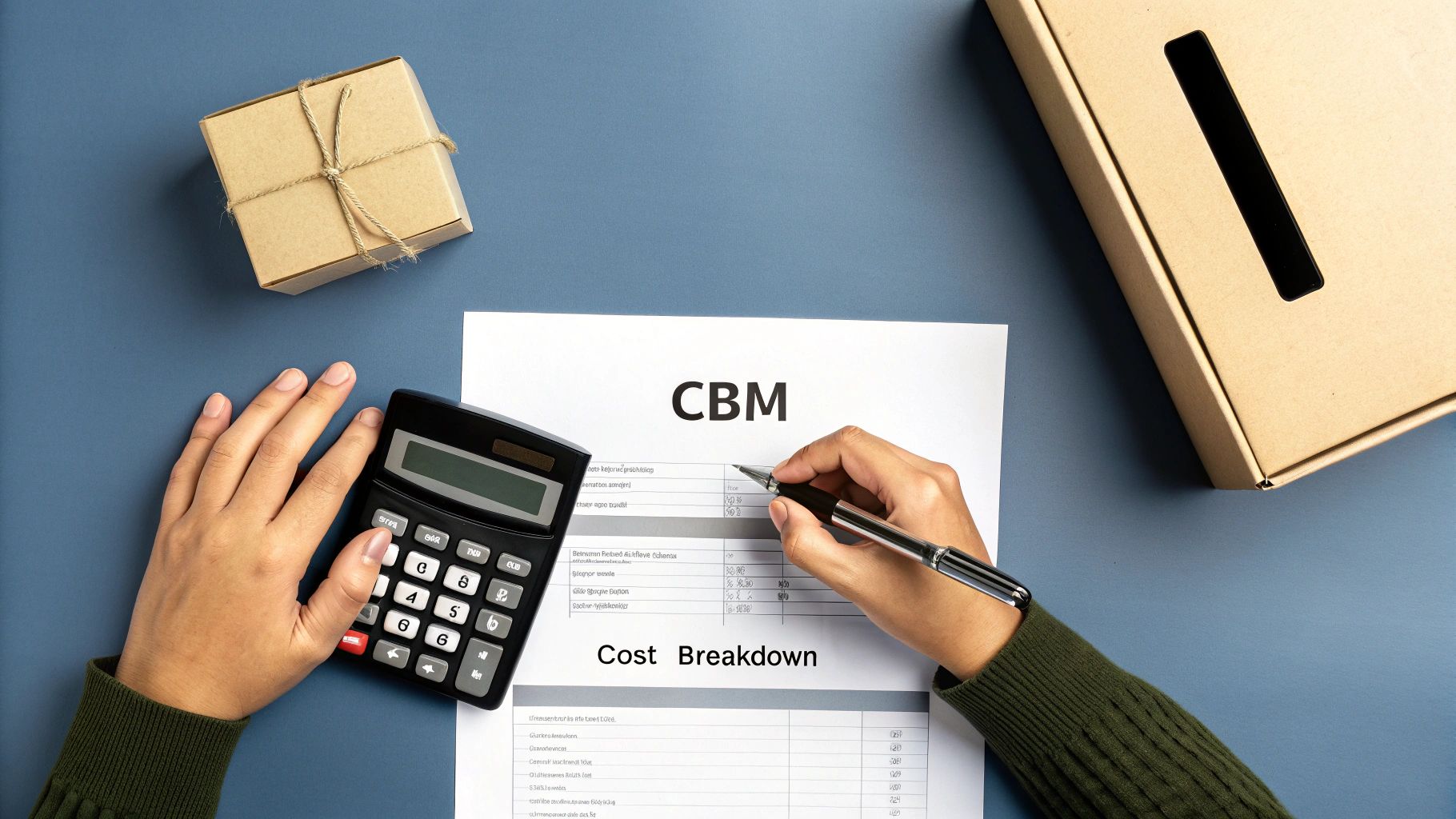
With LCL, you're essentially renting space. You pay based on the volume your cargo takes up, measured in Cubic Metres (CBM). The main part of your bill is a rate per CBM, but that's really just where the costs begin.
Since your goods are bundled with others, they have to be processed at a Container Freight Station (CFS) at both origin and destination. This consolidation and deconsolidation process adds several extra line items to your bill.
You can expect to see fees like:
- CFS Charges: For the labour involved in handling, loading, and unloading your specific goods at the warehouse.
- Documentation Fees: The administrative costs for preparing the bill of lading and other vital paperwork.
- Destination Handling Charges: Fees for breaking down the consolidated container and getting your cargo ready for collection.
These variable, per-shipment fees can make LCL costs feel a bit less predictable than a straightforward FCL quote. If you need a refresher on measurement, our guide on how to accurately calculate CBM for your shipment walks you through it.
Dissecting FCL's Flat-Rate Structure
FCL works on a much simpler premise: you pay one flat rate for the entire container, whether it's a 20ft or 40ft box. This rate covers the ocean journey from port to port, which gives you fantastic cost predictability for bigger shipments.
But that flat rate isn't the whole story. You still need to factor in surcharges and, crucially, inland transport.
Key Insight: While the FCL flat rate for ocean transit is predictable, always remember to budget for inland transportation (drayage). The cost to move the container from the port to your final destination can significantly impact your total spend.
Common FCL costs to keep in mind:
- Inland Transport (Drayage): The trucking cost to get the container from the port to your warehouse or distribution centre.
- Chassis Fees: A rental fee for the wheeled trailer frame the container sits on during its land journey.
- General Rate Increases (GRI): During peak seasons or when demand spikes, carriers might add a GRI—a surcharge applied across specific trade routes.
These costs are standard, but because the base rate is fixed, FCL becomes much easier to budget for once you know all the pieces.
Pinpointing the Financial Tipping Point
So, where's the breakeven point? When does it make more financial sense to book a whole container? The exact number shifts with market rates, but a reliable rule of thumb is around the 13-15 CBM mark.
Let's run a quick scenario. Imagine you have a 5 CBM shipment. Recent data suggests LCL rates in 2025 can be anywhere from $50 to $80 per CBM, before all the handling fees are added. For comparison, in April 2025, FCL rates from Shanghai to the U.S. West Coast hovered around $2,103 for a 40ft container (FEU).
At 5 CBM, your LCL cost might be $400 plus a few hundred in fees—clearly the cheaper option. But once you get to 15 CBM, that LCL cost could easily top $1,200 plus fees. Suddenly, you're getting very close to the cost of an entire FCL container, which also comes with the huge perks of faster transit and better security.
Comparing Logistics Timelines and Processes
Money isn't everything. Beyond the cost, the biggest difference between LCL and FCL is the journey your cargo takes. The logistics for each method will directly shape your total transit time, how predictable your delivery dates are, and even your shipment's exposure to potential delays. It's a critical piece of the puzzle.
An FCL shipment is about as direct as it gets in ocean freight. Your container is loaded and sealed at the point of origin, travels to the port, gets loaded onto a ship, and heads straight to the destination port. Once it arrives, it's moved to its final destination, and that seal isn't broken until it's in your hands.
This straightforward path is what makes FCL timelines so much faster and more reliable.
The Nuances of the LCL Journey
The LCL process, on the other hand, has a few extra stops along the way, and each one adds time to the clock.
- Origin Consolidation: First, your cargo doesn't go straight to the port. It's delivered to a warehouse or a Container Freight Station (CFS), where it waits for other shipments that are heading to the same destination.
- Container Stuffing: Once the consolidator has gathered enough cargo, everything is carefully loaded—or "stuffed"—into a single shared container.
- Destination Deconsolidation: When the container arrives, it’s not released to you. It’s taken to another CFS to be unpacked. Here, all the individual shipments are unloaded and sorted in a process called "devanning" or "deconsolidation."
- Final Availability: Your goods are only ready for pickup or final delivery after this entire sorting process is finished.
All this extra handling and waiting around is precisely why LCL shipping takes longer. If you want to get deeper into the mechanics, you can explore various freight consolidation strategies to see how it all comes together.
Key Takeaway: The extra steps in LCL shipping—consolidation at the start and deconsolidation at the end—are the main reasons its transit times are longer and more variable than the A-to-B journey of an FCL container.
Customs Clearance and Shared Risk
Customs clearance is another timeline factor you can't ignore. With an FCL shipment, you're the only one in the container. If your paperwork is correct, customs clearance is usually a smooth process.
LCL, however, introduces a "shared risk" problem. If just one of the shipments in that shared container has a documentation error or gets flagged for a random inspection, the entire container can be delayed by customs. That means your perfectly documented cargo could be stuck, waiting for someone else's problem to be resolved. It's a risk you completely sidestep with FCL.
This difference shows up in the numbers. For instance, recent shipping data shows FCL transit from China to the U.S. typically takes 15–35 days. In contrast, LCL shipments for the same route often take 20–40 days, largely because of those consolidation and deconsolidation phases. To see how LCL and FCL fit into the big picture and affect your entire operations, it's worth reading a comprehensive International Supply Chain Management Guide.
How Safe Is Your Cargo? A Look at Security and Handling Risks
When you're weighing LCL against FCL, don't just stop at cost and transit times. We need to talk about something just as crucial: the safety of your goods. The way your cargo is handled is fundamentally different between the two, and that directly impacts the risk of something going wrong.
For shippers who prioritise security, FCL is the clear winner. Think about it: your goods are loaded, the container doors are shut, and a seal is put on. That seal stays put all the way across the ocean, only broken when it reaches you or your designated agent. It’s a single, sealed journey, which dramatically cuts down the chances for damage, theft, or loss.
LCL: The Risk of Many Hands
Now, let's look at the LCL journey. It's a completely different story. Your shipment travels with a crowd, which means it gets handled a lot more. First, it goes to a warehouse to be consolidated, where it's loaded alongside cargo from dozens of other shippers. When it arrives, the whole process is done in reverse at another warehouse for deconsolidation.
Every time your goods are moved, sorted, or stacked, the risk goes up. It's just a reality of the process. More handling creates more opportunities for:
- Damage: A box could be dropped, a pallet could be stacked improperly, or things could shift around inside the container during transit.
- Loss: It's easier for a single carton to get misplaced or sent to the wrong place in a busy Container Freight Station (CFS) with thousands of boxes moving around.
- Theft: An unsealed pallet sitting in a shared warehouse is simply a more tempting target than a locked container with an intact seal.
The Bottom Line: With FCL, your security is tied to the integrity of the container seal. With LCL, the safety of your cargo relies on the careful work of many different people and, most importantly, on how well you've packed it.
Protecting Your Goods on an LCL Journey
Since your cargo will be handled multiple times, you absolutely cannot skimp on packaging for an LCL shipment. You have no idea how well others have packed their items, so yours needs to be tough enough to survive the trip on its own.
This means investing in strong, high-quality boxes. Make sure your pallets are tightly shrink-wrapped, and use plenty of protective material—like bubble wrap or foam inserts—inside your cartons to stop things from rattling around. You’re essentially building a small, private fortress for your products.
On top of that, good cargo insurance is a must for LCL. Carriers and forwarders have limited liability, which won't come close to covering your costs if something gets lost or damaged. A solid insurance policy protects your investment against the higher risks of sharing a container. For anything valuable or fragile, it’s not just a good idea; it’s a non-negotiable part of doing business.
How to Choose Between LCL and FCL
Picking the right shipping method isn't just about crunching numbers on a cost-per-CBM basis. It’s a practical decision that requires you to look at your specific situation from every angle. By walking through a few real-world examples of LCL and FCL in action, you can build a solid framework for making the smartest choice for your cargo, your budget, and your timeline.
Let's get practical. A good decision comes down to weighing the most important factors: your shipment's volume, how sensitive the cargo is, how quickly you need it, and what your budget can handle.
Analysing Real-World Shipping Scenarios
Picture a startup importing its first batch of products. They're starting small with a shipment of just 3 CBM. In this case, LCL is the only logical choice. Paying for an entire container would be a massive, unnecessary expense. LCL lets them test the market and manage cash flow without locking up capital in shipping costs.
Now, think about a retailer shipping 18 CBM of high-end, fragile electronics. While that volume could technically squeeze into an LCL shipment, FCL is the far better move. Why? Because an FCL container is sealed at the origin and opened at the destination. This single journey dramatically cuts down on handling, which is the number one cause of damage to sensitive goods.
Finally, consider a manufacturer rushing to get critical components for their production line. For them, time is money. FCL offers a much more predictable and direct transit time, skipping the consolidation and deconsolation steps that can add unexpected delays to LCL shipments. The speed and reliability of FCL are non-negotiable here.
A Quick Decision Checklist
To make the choice easier, we've put together a simple checklist to help you weigh the variables. This ensures you’ve covered all your bases before you book your freight.
To help you decide, we've created a straightforward checklist. Run through these points to see which method aligns best with your shipment's needs.
Decision Checklist LCL or FCL
| Consideration | Choose LCL If... | Choose FCL If... |
|---|---|---|
| Shipment Volume | Your cargo is under 13 CBM. You're paying only for the space you use. | Your cargo is 15 CBM or more. The flat-rate cost becomes more economical per unit. |
| Cargo Sensitivity | Your goods are sturdy and well-packaged to withstand multiple handling points. | Your goods are fragile, high-value, or could be contaminated by other cargo. |
| Delivery Urgency | Your timeline is flexible and can absorb potential delays at consolidation/deconsolidation hubs. | You have a firm deadline. The direct journey is faster and more predictable. |
| Budget & Cost Structure | You need the lowest possible upfront cost for a small shipment. | You prefer a predictable, all-inclusive cost for a larger volume to simplify budgeting. |
This table provides a quick reference, but always consider how these factors interact. For instance, even a small, 2 CBM shipment of irreplaceable or extremely fragile goods might be better off in an FCL container if damage risk is your biggest concern. It's all about balancing cost against risk and time. For larger shipments, you can learn more about optimising space by understanding the specifics of a 40 ft container size.
This decision tree illustrates how the nature of your cargo, particularly its fragility, should guide your packaging and shipping choices.
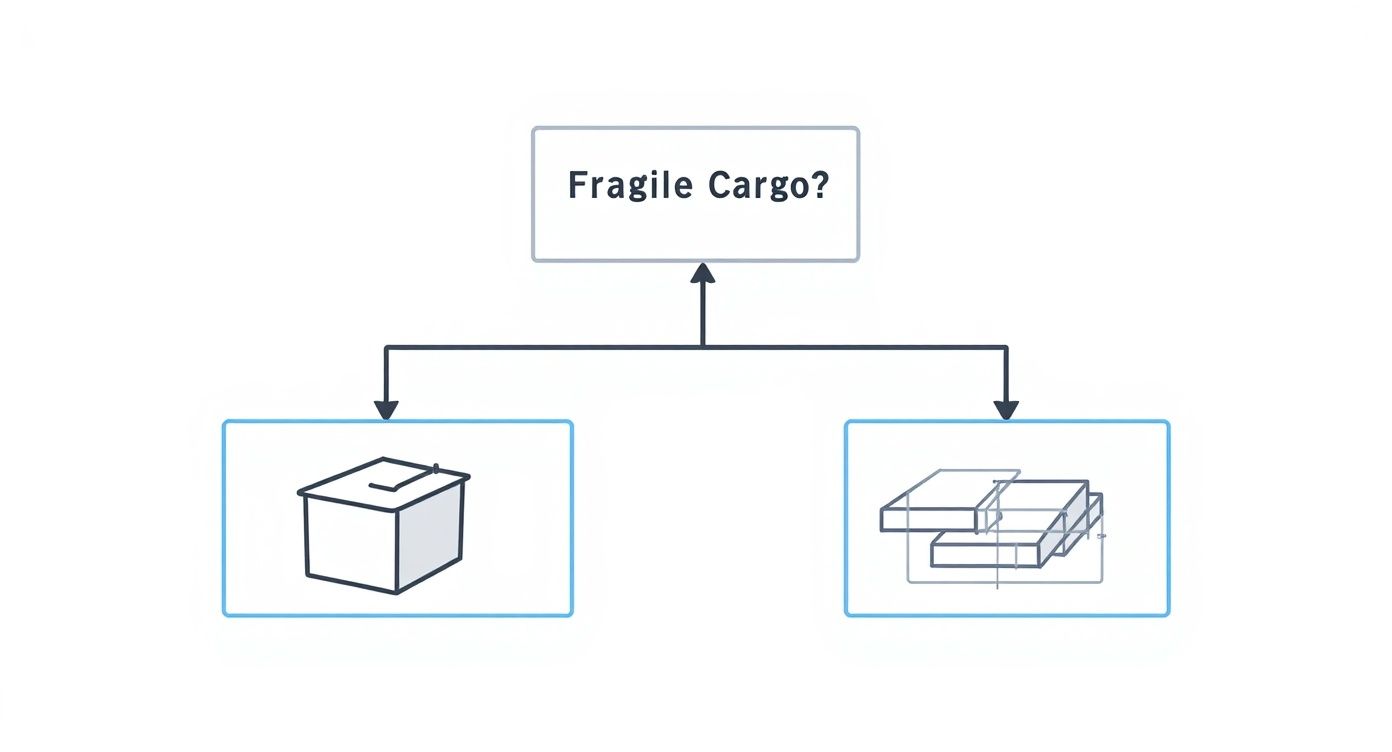
As you can see, when dealing with fragile items, the security of a single, sealed FCL container is often the recommended path. It’s the best way to protect your investment from the bumps and bruises that can happen at busy consolidation points.
Got Questions About LCL vs. FCL? We've Got Answers
Even with a clear comparison, you're bound to have some practical questions when it's time to book your shipment. Let's tackle some of the most common ones we hear from shippers every day.
When Does It Make More Sense to Just Book a Full Container?
The cost-benefit tipping point usually lands somewhere between 13 to 15 Cubic Metres (CBM).
If your shipment is smaller than this, LCL is almost always the more budget-friendly route. But once you start creeping up toward that 15 CBM mark, the combined per-CBM rates and handling fees of LCL start to rival the flat-rate cost of your own dedicated container. It's at this point that FCL becomes the smarter financial choice.
Can I Ship Hazardous Goods Using LCL?
This is a tricky one, and the short answer is: probably not. Shipping hazardous materials via LCL is incredibly restrictive for a simple reason – your cargo shares space with everyone else's.
Freight forwarders are understandably cautious. The risk of one hazardous shipment potentially damaging or contaminating the entire container's contents is a liability most consolidators won't take on.
Key Insight: Always declare hazardous materials upfront and accurately. FCL is almost always the required and safer option for these goods. It keeps your cargo isolated, which simplifies the compliance and handling process for everyone involved.
How Do I Figure Out the CBM for My Cargo?
Calculating the Cubic Metre (CBM) volume is simpler than it sounds. You just need to measure your carton's dimensions in metres and multiply them together.
- The Formula: Length (m) x Width (m) x Height (m) = CBM
- A Quick Example: A box that is 0.5m long, 0.4m wide, and 0.3m high has a volume of 0.06 CBM.
What Happens if Someone Else's Shipment Holds Up My LCL Cargo in Customs?
This is one of the built-in risks of LCL shipping. If another shipper's goods in your shared container get flagged for inspection or have documentation issues, the entire container is detained by customs authorities.
Unfortunately, your perfectly compliant cargo gets stuck right along with it. This "shared risk" is a major reason why businesses with strict deadlines often lean towards FCL for peace of mind. The popularity of both LCL and FCL options is a huge factor in China's sea freight market, which was valued at USD 131.97 billion in 2025. You can find more details in China's booming sea transport market report on mordorintelligence.com.