When you picture a 40ft container, think of a space roughly the size of a two-car garage. With an external length of about 12 metres and a cargo capacity hovering around 67 cubic metres, it's a massive unit. This impressive size is exactly why it has become the workhorse of international shipping for importers and businesses moving large quantities of goods.
Understanding 40ft Container Size at a Glance
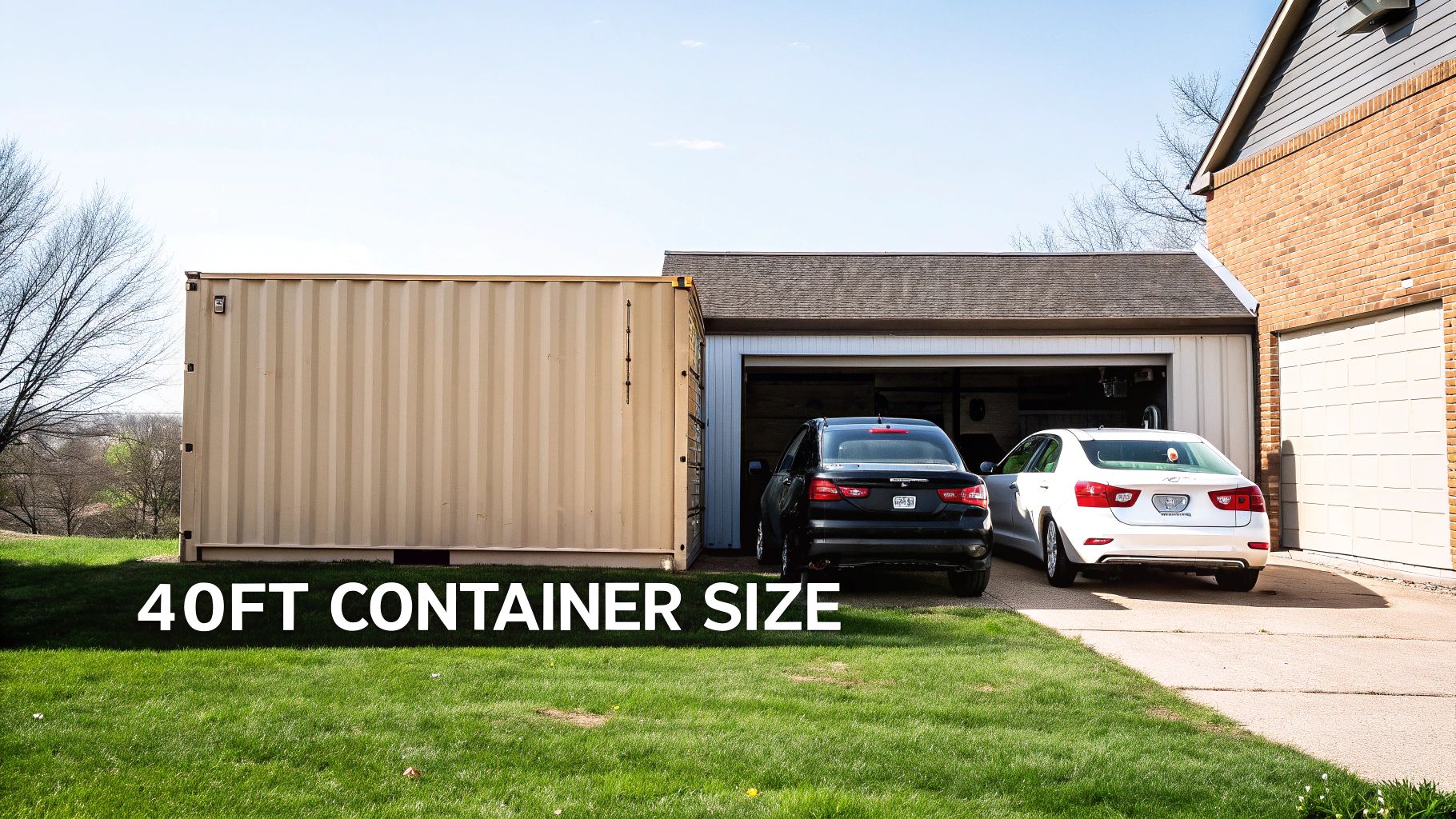
Before you get lost in the weeds of logistics planning, it’s crucial to get a firm grasp on the basics. Knowing the fundamental dimensions and capacity of a 40ft container is the first real step toward making a smart shipping decision. It helps you mentally place your cargo inside the unit and figure out if it's the right financial move for your business.
Getting these core numbers right from the start helps you sidestep common blunders like running out of room or, worse, overloading the container. A 40ft unit offers more than double the space of its smaller sibling, but it's not a free-for-all; you still have to respect the weight limits. For a closer look at the smaller alternative, you can explore the dimension of a 20 ft container in our other guide.
Comparing Common 40ft Container Specifications
You'll often hear people talk about "a 40ft container" as if it's a single thing, but there are actually several variations designed for different jobs. The three you’ll run into most often are the Standard Dry container, the High Cube, and the Refrigerated (Reefer) container. Each one has distinct specs that can make or break your shipment.
A key takeaway for shippers is that a 40ft container generally provides double the volume of a 20ft container for only about 20-30% more cost, making it highly economical for voluminous cargo.
The High Cube, for example, gives you a precious extra foot of height, which is a game-changer for tall or bulky items that wouldn't otherwise fit. A Reefer, on the other hand, has thicker insulated walls to maintain a specific temperature. This slightly reduces its internal volume but is essential for shipping perishable goods.
To make things easier, I've put together a quick reference table. It lays out the essential specs side-by-side, helping you instantly see which container is the best fit for your cargo.
Comparing Common 40ft Container Specifications
| Specification | 40ft Standard (Dry Van) | 40ft High Cube (HC) | 40ft Refrigerated (Reefer) |
|---|---|---|---|
| External Length | 12.19 m (40 ft) | 12.19 m (40 ft) | 12.19 m (40 ft) |
| External Height | 2.59 m (8 ft 6 in) | 2.90 m (9 ft 6 in) | 2.90 m (9 ft 6 in) |
| Internal Length | 12.03 m (39 ft 5 in) | 12.03 m (39 ft 5 in) | 11.56 m (37 ft 11 in) |
| Internal Height | 2.39 m (7 ft 10 in) | 2.70 m (8 ft 10 in) | 2.55 m (8 ft 4 in) |
| Cubic Capacity | 67.7 m³ (2,389 cu ft) | 76.4 m³ (2,698 cu ft) | 67.3 m³ (2,376 cu ft) |
| Max Payload | 26,500 kg (58,422 lbs) | 26,500 kg (58,422 lbs) | 27,400 kg (60,407 lbs) |
As you can see, while the external length is consistent, the internal dimensions and payload capacity can vary quite a bit. Paying attention to these small differences is key to optimising your shipment and avoiding any unwelcome surprises down the line.
What These Container Specs Actually Mean for Your Cargo
Looking at a spec sheet full of numbers is one thing, but figuring out what they mean for your shipment is where you start making smart logistics decisions. The dimensions and weight limits of a 40ft container aren't just trivia; they're the hard-and-fast rules that dictate how much you can pack, what will physically fit, and ultimately, how much bang you get for your buck.
The first hurdle for many is wrapping their head around external versus internal dimensions. The external size is what matters for stacking the container on a ship or loading it onto a truck. But for you, the shipper, it’s the internal space—the actual cavern you have to fill—that counts. The container's corrugated steel walls, floor, and ceiling aren't paper-thin; they eat up precious centimetres on every side.
This might not sound like a big deal, but those centimetres can be the difference between squeezing in that last pallet or facing the painful cost of booking a whole new container. A standard 40ft container, for instance, loses about 16 centimetres of its length and 15 centimetres of its width on the inside.
Getting Weight and Payload Right
Beyond just the space, you have strict weight limits to follow. These aren't suggestions; they are non-negotiable rules for safety and legal compliance. Get them wrong, and you could be looking at hefty fines, frustrating delays, or even your shipment being turned away at the port.
Here are the three weight figures you absolutely need to know:
- Tare Weight: This is simply the weight of the empty container. A standard 40ft container is about 3,750 kg (8,268 lbs) before you put a single box inside.
- Payload Capacity: This is the big one—the maximum weight of cargo you're allowed to load. For a 40-footer, you're looking at a limit of around 26,500 kg (58,422 lbs).
- Maximum Gross Weight (MGW): This is the all-in weight of the container plus your cargo (Tare Weight + Payload). It's the absolute heaviest the entire unit can be.
A classic rookie mistake is to focus only on filling up every cubic metre of space. If you're shipping something dense and heavy—think machinery, ceramic tiles, or metal components—you'll almost certainly hit the payload limit long before you run out of room.
It's crucial to remember that the payload capacity printed on the container door is just a starting point. The actual legal limit for road transport in your destination country might be much lower once you factor in the weight of the truck and its chassis.
Don't Forget the Door Opening
Finally, let's talk about a detail that’s easy to ignore until it's too late: the door opening. You can have all the space in the world inside, but if your biggest crate can't make it through the doorway, that space is worthless. Because of the door frame and rubber seals, the opening is always a bit smaller than the internal height and width.
A standard 40ft container door is typically 2.34 metres (7 ft 8 in) wide and 2.28 metres (7 ft 6 in) high. When you're planning how to load everything, especially if you're using a forklift or have bulky items, these numbers are just as critical as the internal dimensions. Always double-check them to avoid that gut-wrenching moment at the warehouse when you realise your cargo won't fit.
Choosing The Right 40ft Container Type
Once you’ve got the basic numbers down, the next big decision is matching the right type of 40ft container to what you’re actually shipping. This is just as critical as getting your volume or payload calculations right. Pick the wrong one, and you could be looking at damaged goods, wasted money, and a whole lot of logistical pain.
Think of it like picking a vehicle for a job. You wouldn't try to haul furniture in a two-seater sports car, right? It's the same logic here. Each type of 40ft container is built for a specific purpose, and knowing the difference is fundamental to a smooth shipment.
You'll mainly come across three options: the Standard Dry, the High Cube, and the Refrigerated (or "Reefer"). They all share that classic 40-foot length, but their individual features make them worlds apart in what they can handle.
The Workhorse Standard Dry Container
The Standard 40ft Dry container is the backbone of global shipping. It's the most common, versatile, and readily available box you can get. This is your go-to for a huge range of general cargo—think boxed electronics, clothing, toys, and palletised dry goods.
If your products aren’t unusually tall and don't need to be kept at a specific temperature, the standard dry container is almost always your best and most economical choice. It hits that perfect sweet spot of space, strength, and affordability.
The Voluminous High Cube Container
The 40ft High Cube (HC) container offers a simple but brilliant upgrade: an extra foot of height. It might not sound like much, but that single foot bumps the internal capacity from around 67 CBM to 76 CBM. That's a 13% increase in usable space.
This extra room is a game-changer for anyone shipping tall, bulky, or lightweight goods.
Here's where a High Cube really shines:
- Furniture and Home Goods: Think sofas, mattresses, and flat-pack furniture. You can stack them higher, getting more into a single container.
- Oversized E-commerce Products: If you're selling large kids' playsets or garden sheds online, an HC lets you fit more units per shipment.
- Apparel on Hangers: The garment industry loves High Cubes. That extra vertical space means clothes arrive with fewer creases.
For instance, an importer bringing in tall floor lamps can pack way more into an HC container, which drops the per-unit shipping cost significantly. The slightly higher booking price for the High Cube is easily paid back by the extra cargo you can fit inside. While a 40ft container offers significant space, understanding the characteristics of other common sizes, such as various 20 ft container storage solutions, can help in making informed decisions for diverse cargo requirements.
Choosing a High Cube is a strategic decision for volume-driven businesses. The extra space allows you to ship more goods for a marginal increase in cost, directly improving your profit margins on bulky items.
A common mistake is thinking more space means you can ship more weight. Keep in mind that the payload capacity of a High Cube is virtually identical to a standard one. It's all about volume, not density. For shippers with smaller but numerous items, understanding the nuances of shipment consolidation is also key. You can learn more about this process in our guide to Less than Container Load shipping.
The Specialized Reefer Container
The 40ft Refrigerated container, better known as a "Reefer", is a highly specialised piece of equipment. It’s basically a massive, mobile refrigerator designed to keep its contents at a precise, constant temperature from door to door.
Reefers are absolutely essential for moving sensitive cargo like:
- Perishable Foods: Fruits, vegetables, meat, and seafood.
- Pharmaceuticals: Many medicines and vaccines need strict temperature control to remain effective.
- Chemicals and Florals: Speciality flowers and chemicals can be ruined by even minor temperature shifts.
These containers have heavily insulated walls and a special T-shaped floor decking that allows cold air to circulate evenly around the entire load. All that insulation and the cooling machinery means the internal dimensions and cubic capacity are slightly less than a standard dry box. The refrigeration unit also adds to the tare weight and needs a constant power supply, whether it's on a ship, truck, or sitting at the port.
All this technology makes Reefers the most expensive option by a long shot, so you should only book one when your cargo absolutely demands it.
Maximising Your Cargo Space and Pallet Count
Knowing the raw dimensions of a 40ft container is just the starting point. The real art, and where you can seriously save on shipping costs, is in how you use that space.
Think of it this way: every cubic metre you don't fill is space you've paid for but aren't using. That directly eats into your profit margins. To get the most out of every shipment, you need to think less about just fitting things in and more about a smart, strategic loading plan. This applies whether you're shipping perfectly stacked pallets or a jumble of loose boxes. The goal is always the same: squeeze every bit of value out of your Full Container Load (FCL).
This infographic gives you a quick visual rundown of the key differences between the most common 40ft container types.
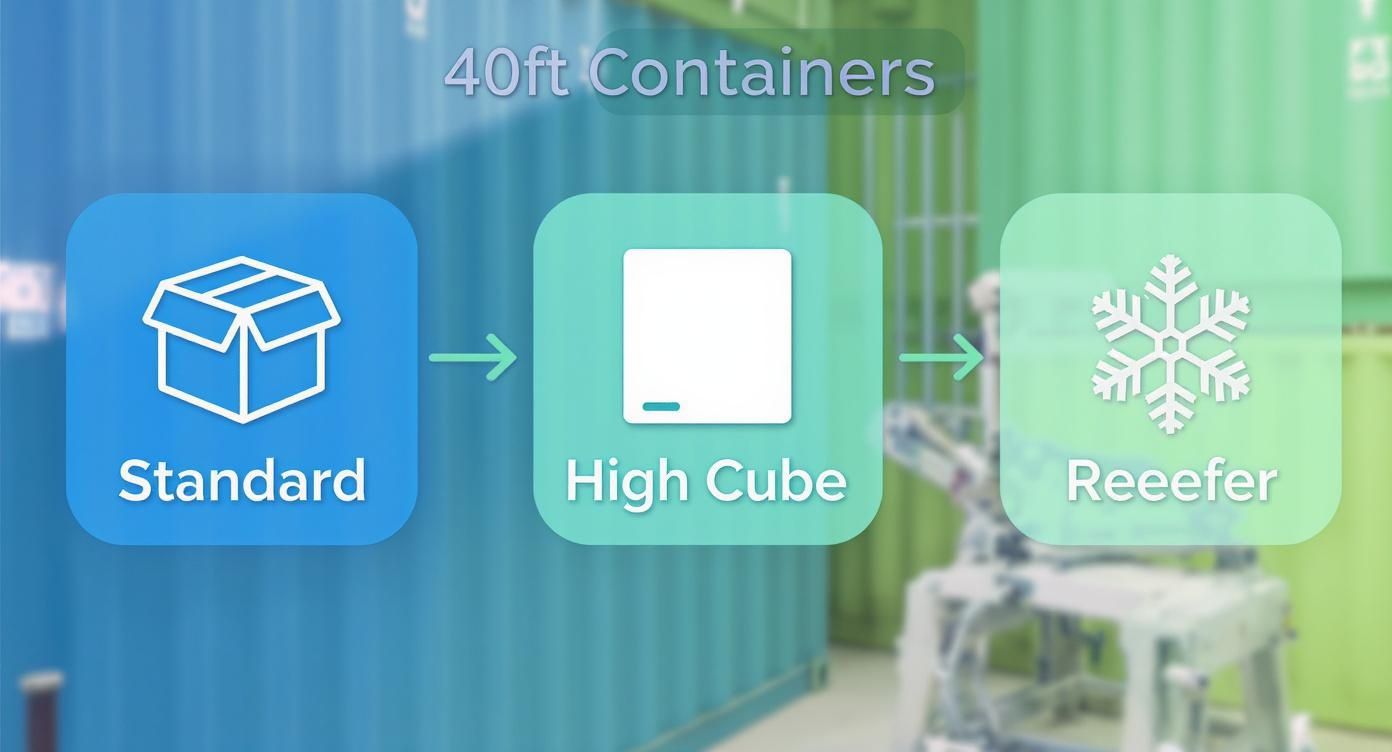
As you can see, the Standard, High Cube, and Reefer containers all share the same external length, but their internal capacity and features are tailored for different kinds of cargo.
How Many Pallets Fit in a 40ft Container?
For most businesses shipping goods, the number one question is simple: "How many pallets can I get in there?" The answer isn't fixed. It really comes down to two key things: the type of pallet you use and how you arrange them. In global trade, you'll almost always encounter one of two sizes.
- Standard American Pallets: These measure 40" x 48" (around 1.01m x 1.22m).
- Euro Pallets (EUR): A bit more compact at 1200mm x 800mm (roughly 1.17 sq. metres).
Their different shapes mean you can pack them differently. A standard 40ft container will typically hold 20 American pallets or up to 23-24 Euro pallets, assuming they're single-stacked. For anyone shipping high volumes, that difference of a few pallets per container adds up fast.
The secret to getting the most pallets in is your loading pattern. Just lining them up straight is easy, but it's rarely the most efficient way. By alternating the pallet orientation—a technique often called 'pinwheeling' or 'turning'—you can take better advantage of the container's width and often sneak in an extra pallet.
This might seem like a small detail, but it can be the difference between a smooth shipment and an overflow situation where you're forced to book another container. Always work out a loading plan before your cargo is ready to be packed.
A basic loading plan is a good starting point, but the exact number of pallets can vary. Here’s a quick guide to what you can generally expect.
Estimated Pallet Capacity for a Standard 40ft Container
| Pallet Type | Loading Pattern | Estimated Pallet Count |
|---|---|---|
| Standard US (40"x48") | Straight Loaded | 20 |
| Standard US (40"x48") | Pinwheeled/Turned | 21 |
| EU (800mm x 1200mm) | Straight Loaded | 23 |
| EU (800mm x 1200mm) | Pinwheeled/Turned | 24 |
As the table shows, a simple change in how you load the pallets can create room for one more, optimising your space and lowering your per-unit shipping cost.
Calculating Space for Loose-Loaded Cargo
Of course, not everything ships on a neat pallet. If your cargo consists of furniture, irregularly shaped equipment, or boxes of all different sizes, you'll need to think in terms of cubic metres (CBM). This is crucial for making sure your loose-loaded goods will actually fit.
The formula for calculating CBM is dead simple:
Length (m) x Width (m) x Height (m) = CBM
First, measure each item or box in metres. Then, multiply those three numbers together to find its volume in CBM. Finally, add up the CBM for everything you're shipping to get your total cargo volume. A standard 40ft container offers about 67 CBM of usable space.
Let's run through a quick example. Say you're shipping 200 boxes, each one measuring 0.5m x 0.4m x 0.4m.
The CBM for a single box is:0.5 x 0.4 x 0.4 = 0.08 CBM
The total volume for all 200 boxes is:200 boxes x 0.08 CBM/box = 16 CBM
While this would easily fit inside a 40ft container, the calculation also tells you something else: a full container (FCL) might be overkill. You'd likely save money by shipping it as LCL (Less than Container Load) instead.
Taking the time to accurately calculate your pallet count or total CBM is the bedrock of efficient shipping. It gives you the confidence to book the right container, avoids the last-minute panic of realising your cargo won't fit, and ultimately ensures you're getting maximum value for your money.
How 40ft Container Shipping Costs Are Determined

Knowing the size of a 40ft container is one thing, but figuring out what it costs to ship is a whole other challenge. The price you get from a freight forwarder isn't just a number pulled from a hat. It's the end result of a complicated dance between global economics, on-the-ground logistics, and the constant push and pull of market demand.
It helps to think of shipping rates a bit like airline tickets. The price for a flight from Shanghai to Los Angeles is completely different from one to Rotterdam, and that price can change by the hour. It all depends on demand, the time of year, and even major world events. The exact same logic applies when you're moving a massive steel box across an ocean.
Getting a handle on what drives these costs is crucial for anyone importing goods. It means you can set a realistic budget, know the right questions to ask your logistics partner, and won't be caught off guard when your shipping bill swings wildly from one month to the next.
Key Factors Influencing Your Shipping Quote
Your final shipping quote is a blend of several key ingredients. These factors are always in motion, which is why the market can feel so volatile. Knowing what they are helps you see price hikes coming and plan your shipments more strategically.
Here are the biggest pieces of the puzzle:
- Trade Route and Distance: This one’s the most obvious. A long-haul journey on a busy route, like from China to the US, is naturally going to cost more than a shorter, regional trip.
- Seasonal Demand: Shipping has its own peak seasons. Think about the mad rush to get products on shelves before Christmas or the slowdown around major holidays like Chinese New Year. When everyone wants to ship at once, demand spikes and so do the prices.
- Fuel Prices (Bunker Fuel): A container ship's fuel, called bunker fuel, is a huge operating cost. When global oil prices go up or down, carriers pass that change on to you through something called a Bunker Adjustment Factor (BAF).
- Port Congestion: If ports like Los Angeles or Rotterdam get jammed up with ships waiting to unload, it creates a massive bottleneck. This ties up containers and vessels, creating scarcity that pushes shipping rates higher as carriers try to make up for the delays.
On top of these core factors, things like geopolitical events can throw a real spanner in the works, causing sudden, sharp price spikes. A conflict near a key shipping lane or new trade tariffs can add risk and cost almost overnight, completely redrawing the pricing map.
Understanding Spot Rates Versus Contracts
When you go to book a shipment, you'll generally run into two types of pricing: spot rates and long-term contracts. A spot rate is the current market price for a single, immediate shipment. It’s flexible but can be extremely volatile.
A long-term contract, on the other hand, is where you agree to a fixed rate with a carrier for a certain number of containers over a period of time, usually a year. This is perfect for businesses with a steady flow of goods, as it offers predictability and protects you from sudden price jumps.
For shippers, the choice between spot rates and contracts depends on volume and risk tolerance. Spot rates offer flexibility for fluctuating needs, while contracts provide stability for predictable supply chains, shielding businesses from sudden market spikes.
The best choice often depends on what the market is doing. For instance, recent figures from the Drewry World Container Index show just how much rates can move. Rates from Shanghai to key European ports saw small increases, while the cost to ship to the U.S. West Coast jumped by 5% to $2,713 per 40ft container. These prices are a far cry from the peaks we saw during the pandemic, but they're still much higher than pre-2020 levels, proving the market is still sensitive.
Ultimately, understanding what goes into your shipping quote gives you the power to plan better. Beyond just knowing the costs, exploring strategies to reduce shipping costs is a critical next step. To get a more precise estimate for your own shipments, check out our guide on using a sea freight cost calculator. This knowledge transforms you from someone who just accepts a price to an informed shipper who can make smart decisions.
Your 40ft Container Questions, Answered
As you get closer to locking in your shipping plans, it's completely normal for a few practical questions to pop up. Getting these details right can be the difference between a shipment that sails through smoothly and one that gets hit with costly, frustrating delays.
This section tackles some of the most common questions importers and business owners have when they're in the weeds of planning a 40ft container shipment. Think of it as your go-to cheat sheet for navigating those final, crucial details with confidence.
What's the Real Difference Between a 40ft and 20ft Container?
The two big differences boil down to space and cost-effectiveness. A 40ft container gives you more than double the internal volume of a 20-footer, but here's the kicker: it usually only costs about 20-30% more to ship on most major ocean freight routes.
This creates a fantastic economic sweet spot. If you’re moving a lot of bulky but relatively light goods—think furniture, clothing, or consumer electronics—the 40ft container offers a much lower cost per cubic metre. You're essentially getting twice the room for a small bump in price, which can seriously improve your per-unit shipping costs.
On the flip side, a 20ft container is often the smarter choice for freight that's heavy and dense. We're talking about things like machinery, raw metals, or palletised bags of grain. With this kind of cargo, you'll almost certainly hit the maximum weight limit long before you run out of physical space. In these cases, paying for the extra volume of a 40ft container is just throwing money away.
Ultimately, your choice comes down to a trade-off between volume and weight. If you're shipping bulky items, the 40ft container provides incredible value. If you're shipping heavy stuff, the 20ft ensures you don’t pay for space you can't legally use.
When Should I Go with FCL Instead of LCL?
Choosing between a Full Container Load (FCL) and Less than Container Load (LCL) is a major fork in the road for your logistics plan. The rule of thumb I always give clients is this: once your total cargo volume hits 15 cubic metres (CBM), you should seriously consider booking an FCL shipment.
With FCL, you're renting the entire container for your exclusive use. This comes with some massive advantages:
- It’s Faster: Your container gets loaded at your supplier's factory and sealed. It doesn’t have to stop at various warehouses to consolidate with other people's cargo, which can shave significant time off the total journey.
- It’s Safer: Because your goods aren't being moved around alongside other shipments, the risk of damage, loss, or contamination drops dramatically. Your products stay untouched from your supplier’s door to yours.
- The Cost Makes Sense: When you hit that 15 CBM mark, the flat rate for an FCL booking often becomes cheaper than paying the per-CBM rate for LCL.
LCL is fantastic for smaller shipments where you share container space. But that process of consolidation and de-consolidation always adds time and handling. If your shipment is on the cusp, FCL is almost always the more efficient and secure way to go.
Are There Road Weight Restrictions for Containers?
Yes, and this is one of the most critical details people overlook. While a standard 40ft container can technically hold over 26,000 kg of cargo, you can almost never load it that heavily if it needs to travel by truck on public roads at its destination.
Every country—and often individual states or provinces—has strict legal limits on how much a truck can weigh. This "gross vehicle weight" includes everything: your cargo, the container itself (its tare weight), the truck, and the chassis it sits on. In the United States, for example, the federal limit is typically 80,000 pounds (about 36,287 kg).
Getting this wrong can lead to a world of pain:
- Hefty Fines: Overweight trucks get slapped with big financial penalties at weigh stations.
- Painful Delays: The truck can be taken off the road until the excess weight is removed. This process, called "transloading," is both expensive and a massive time sink.
- Legal Headaches: If an accident happens, an overweight truck creates a legal and insurance nightmare.
The most important thing you can do is give your freight forwarder the precise weight of your cargo. They know the legal road limits for the entire route and will tell you exactly what your maximum payload can be to stay compliant.
How Can I Track My 40ft Container?
Keeping tabs on your container as it crosses the ocean is pretty simple these days. When you book your shipment, the shipping line or your freight forwarder will give you a unique container number. This code—usually four letters and seven numbers (like MSCU 1234567)—is your golden ticket to tracking.
Here are the main ways to use it:
- The Carrier's Website: Every major shipping line (like Maersk, MSC, or CMA CGM) has a public tracking tool. Just punch in your container number to see where it is, when it arrived at a port, and its estimated departure times.
- Your Freight Forwarder's Platform: Most modern forwarders, including us at Upfreights, have a dashboard that pulls all this information into one place. It makes tracking much easier and often sends you automatic alerts for key milestones.
- Third-Party Tracking Sites: There are also independent websites that pull data from many carriers, giving you another option for tracking.
To make sure you can always find your shipment, keep your key info handy: the container number, the name of the vessel, and your Bill of Lading number. With those details, you’ll never be in the dark about where your cargo is.