Think of it like carpooling for your cargo. Instead of booking a whole private car when you only need one seat, you share the ride with others heading in the same direction. That’s the simple idea behind Less Than Container Load (LCL) shipping. It's a savvy, cost-effective way for businesses to ship goods when they don't have enough to fill an entire container on their own.
This approach lets you send smaller batches of products more frequently, which can do wonders for your cash flow and keep your inventory lean.
What Is Less Than Container Load Shipping?
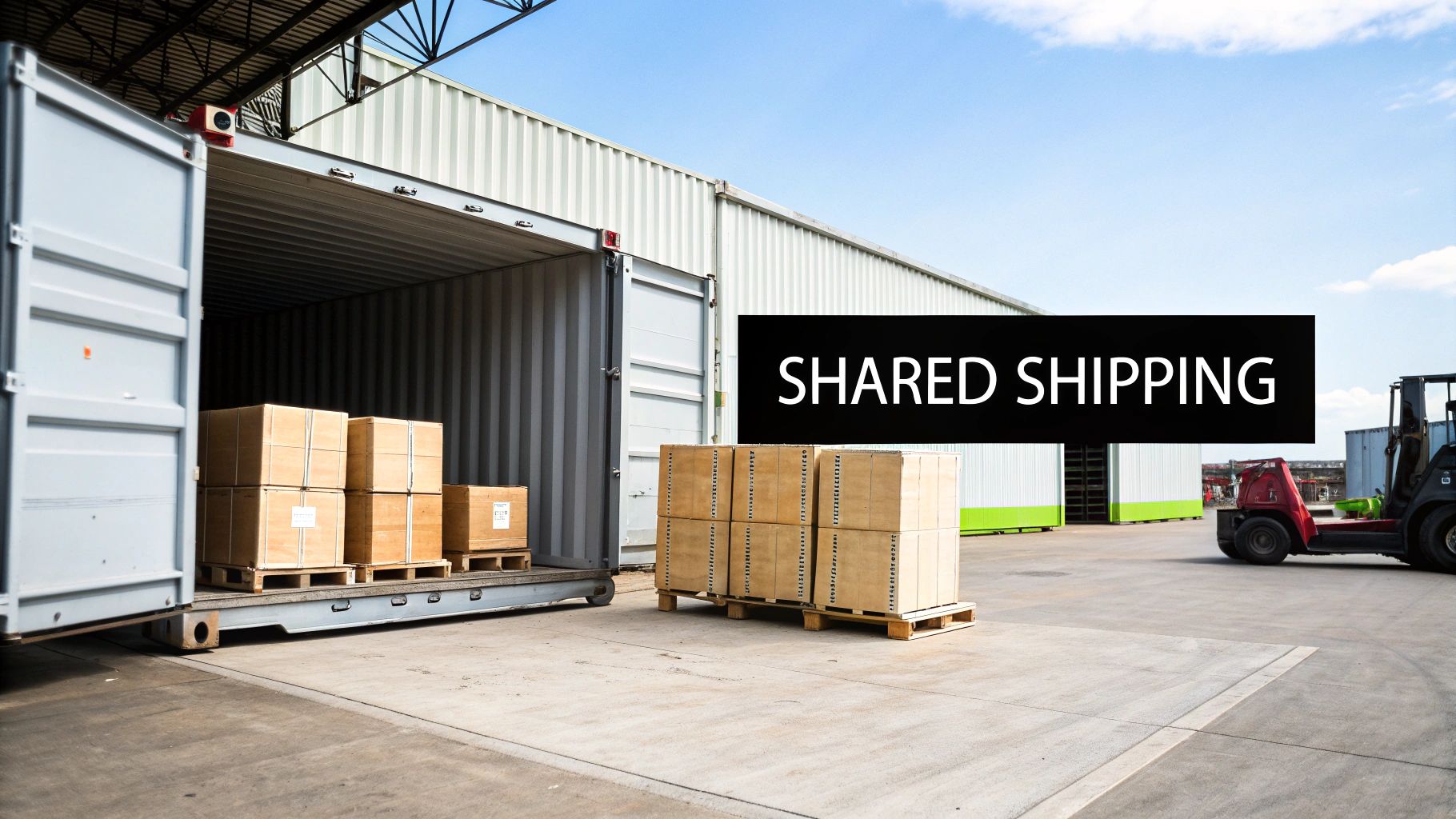
Less than Container Load (LCL) is an ocean freight option where you book a portion of a container and share the rest of the space—and the cost—with other shippers. Instead of footing the bill for a whole container that’s half-empty, you only pay for the volume your goods actually take up. This makes it a go-to choice for small and medium-sized businesses (SMEs) and growing e-commerce brands.
Here's how it works in practice: your freight forwarder is like a master coordinator. They collect shipments from different businesses at a warehouse called a Container Freight Station (CFS). Once they have enough cargo to fill a container, they pack it all together, seal it, and get it on a ship. When it arrives at the destination port, the process happens in reverse—the container is "deconsolidated," and each individual shipment is sorted and sent on its way.
The Core Benefits of LCL Shipping
This shared model has really opened up global trade for businesses that might have been sidelined by the steep cost of a full container. The advantages are pretty clear:
- Cost-Effective for Small Shipments: You pay for what you use, usually measured in cubic metres (CBM). This makes getting into international shipping much more affordable.
- Flexible Inventory: Ship smaller amounts more often. This helps you manage a just-in-time inventory system, cuts down on warehousing costs, and frees up money that would otherwise be locked in unsold stock.
- Easier Market Access: Want to test a new product or dip your toes into a new market? LCL lets you send smaller, lower-risk shipments to see how things go before you commit to a huge order.
LCL shipping basically levels the playing field in global logistics. It gives smaller businesses a real shot at competing internationally by providing an affordable and flexible way to move goods without having to pay for a whole 20-foot or 40-foot container.
When does it make the most sense? LCL is your best bet when your shipment is too small for a Full Container Load (FCL) but too big (or not urgent enough) for pricey air freight. As a rule of thumb, if your cargo is between 1 and 15 cubic metres, LCL usually hits that sweet spot of cost and reliability, making it a vital part of any modern supply chain strategy.
Quick Guide for Choosing LCL Shipping
Feeling unsure if LCL is the right move for your shipment? This table breaks it down to help you decide quickly.
| Shipment Factor | Choose LCL When | Consider Alternatives When |
|---|---|---|
| Shipment Size | Your cargo is between 1 and 15 CBM. | You have enough goods to fill most of a 20ft container (FCL is cheaper). |
| Budget | You need a cost-effective option and can't justify a full container. | Your goods are high-value and you want to minimise handling risks (FCL). |
| Urgency | Your delivery timeline is flexible (transit can take longer). | You need your shipment to arrive quickly (air freight is faster). |
In short, LCL is a powerful tool for managing costs and inventory, but it's important to weigh it against your specific needs for speed, budget, and cargo volume.
How LCL Shipping Really Works
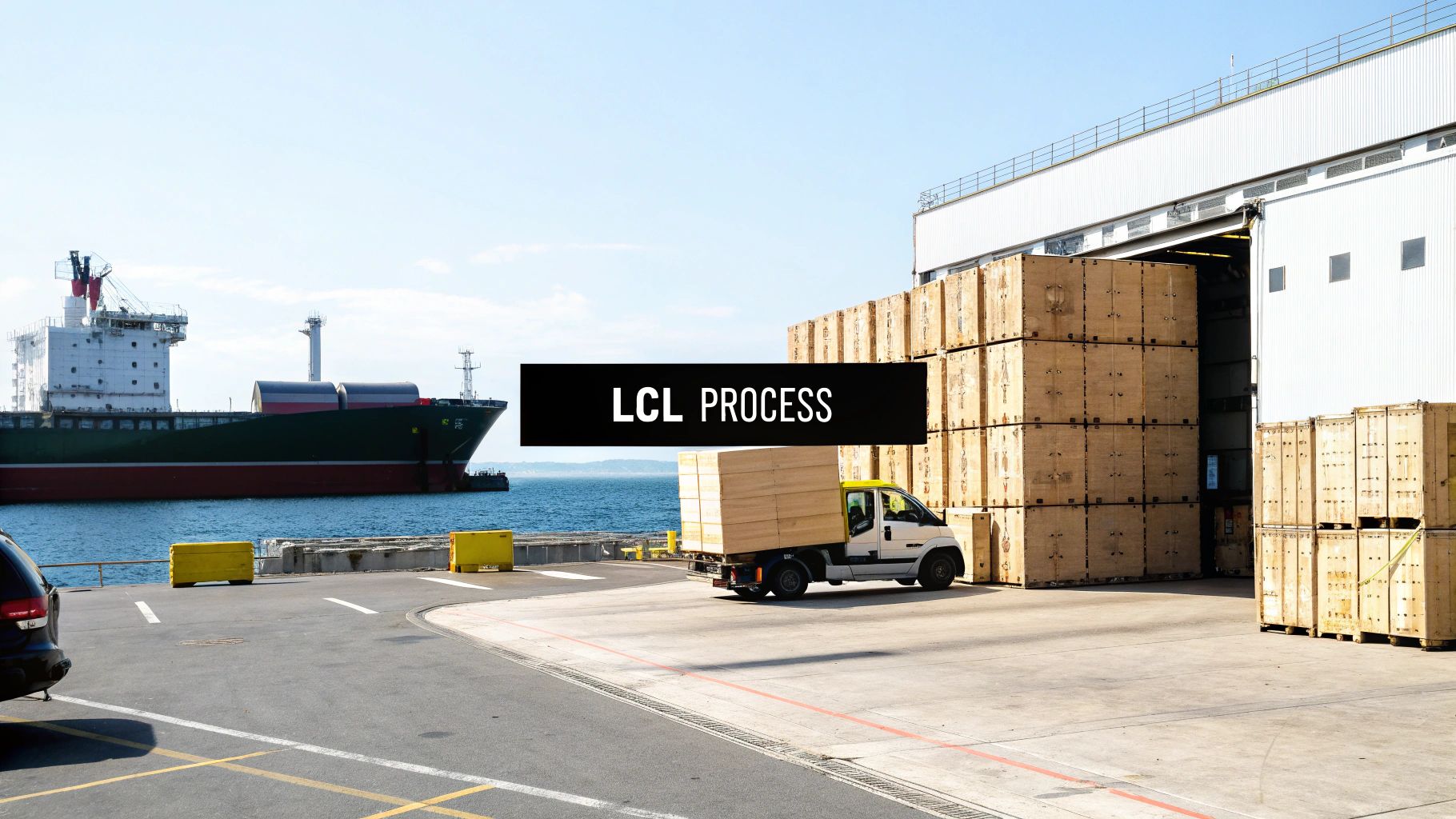
To really get your head around less than container load shipping, think of it as a well-organised carpool for your cargo. Instead of booking a whole bus for yourself (that's an FCL container), your goods share a ride with other shipments heading in the same direction. A freight forwarder acts as the expert coordinator, making sure everyone gets picked up and dropped off smoothly.
The whole process is a logistical dance, moving from separate packages to a single, consolidated unit, and then back again at the other end. Let's walk through what this looks like for a typical LCL shipment, from the moment it leaves the factory to its final destination.
The Journey Begins with Consolidation
The first real stop for your cargo is a specialised warehouse near the port of origin called a Container Freight Station (CFS). Picture the CFS as a busy meeting point where all the individual shipments get acquainted before their long trip.
Your freight forwarder arranges to have your goods brought to this facility. Once there, they’re carefully inspected, measured, and weighed to make sure everything matches the booking details. Then, your shipment is strategically loaded into a shared shipping container alongside goods from other businesses.
This crucial step, consolidation, is the secret sauce of LCL shipping. It’s the art of combining multiple smaller shipments into one full container, which is what makes the ocean journey affordable for everyone involved. To learn more about how this is done, you can check out our guide on effective freight consolidation strategies.
A good freight forwarder is like a master Tetris player during consolidation. They map out the container to use every inch of space, ensure the load is stable, and prevent damage by putting heavier items on the bottom and balancing the weight perfectly.
After the container is expertly packed and sealed, it's off to the port to be loaded onto the vessel for its voyage across the ocean.
Across the Ocean and Deconsolidation
Once the ship docks at the destination port, the container is taken to another Container Freight Station. This is where the reverse process, deconsolidation, happens. The container seal is broken (usually under customs supervision), and the careful job of unloading begins.
Each individual shipment is identified, sorted, and separated from the others. This is a delicate stage where precise handling is vital to make sure every package is accounted for and in perfect condition.
With your shipment separated, it’s ready for the final leg of its journey:
- Customs Clearance: Your freight forwarder hands over all the required documents to local customs officials to get your goods cleared for entry into the country.
- Sorting and Staging: Your cargo is then moved to a specific spot in the CFS, ready for either collection or dispatch.
- Final Delivery: Finally, your shipment is loaded onto a local truck and driven to the address you specified, whether that’s your warehouse, a fulfilment centre, or your own front door.
The Role of Your Freight Forwarder
Your freight forwarder is the conductor of this entire orchestra. From start to finish, they manage every single detail—booking the container space, handling the mountain of paperwork, and coordinating with CFS operators, customs brokers, and trucking companies on both sides of the ocean.
Navigating the rules and regulations is a huge part of the job. Forwarders must adhere to specific legal obligations of transport commissionaires (freight forwarders) to ensure every shipment is compliant and everything runs smoothly. These rules are there to protect you, the shipper, and keep international trade flowing.
From the second your goods leave your supplier to the moment they arrive at your door, your forwarder is your single point of contact, making the complex world of less than container load shipping feel remarkably simple.
Understanding LCL Shipping Costs
Budgeting for less than container load shipping can feel a bit tricky at first, but once you understand how the costs are structured, it all makes perfect sense. Unlike FCL shipping where you pay a flat rate for the whole box, LCL works on a "pay-for-what-you-use" model. This is precisely what makes it a go-to option for smaller shipments.
The main yardstick for LCL costs is the Cubic Meter (CBM). Your freight forwarder will measure the volume of your cargo to figure out the base freight rate. But what happens if your cargo is small but incredibly heavy?
That's where chargeable weight comes in. For dense goods, carriers calculate the cost based on both volume (CBM) and weight (in tonnes). They'll then charge you for whichever is greater. This system ensures that a small, super-heavy pallet doesn't get a disproportionately cheap ride compared to a large, lightweight box.
Beyond the Basic Freight Rate
The CBM rate is just the starting point. A complete LCL quote is an itemised bill covering the entire journey, from the factory door to your warehouse. Knowing what these charges are for helps you build a much more accurate budget.
Here are the key charges you'll typically see on your invoice:
- Origin Charges: These cover all the legwork at the start, like picking up your cargo, handling it at the Container Freight Station (CFS), and sorting out the export paperwork.
- Destination Charges: Once the ship arrives, similar fees apply for the reverse process: breaking down the consolidated container, handling your goods at the destination CFS, and getting them ready for the final delivery.
- Customs Brokerage: This is what you pay a licensed broker to prepare and file all the necessary customs declarations, making sure your goods clear smoothly and legally.
- Documentation Fees: A small but essential fee for the administrative work of issuing documents like the Bill of Lading.
Navigating Potential Surcharges
On top of these standard costs, you might run into various surcharges. These can pop up due to fluctuating fuel prices, busy shipping lanes, or other market conditions. It's good to be aware of these potential extras to avoid any last-minute budget surprises. For a deeper look, check out our guide on the different types of freight surcharges.
The LCL market is not just surviving; it's thriving. The Asia-Pacific region, with China as a powerhouse, saw its LCL market valued at USD 22 billion, and it's expected to more than double to USD 46.2 billion by 2034. This boom is fueled by the growth in global trade and the move towards digital freight management.
Understanding your LCL invoice isn't just about paying the bill. It's about seeing the entire logistics journey reflected in costs, from the hands-on work at the CFS to the critical administrative processes that keep global trade moving.
Finally, while you’re looking at the costs, it's smart to think about liability. For shipments within the United States, for instance, it's helpful to know about regulations like The Carmack Amendment, which sets the ground rules for carrier liability and cargo claims. A transparent quote, combined with a clear understanding of your rights, gives you the confidence to manage your shipping budget effectively.
Choosing Between LCL FCL and Air Freight
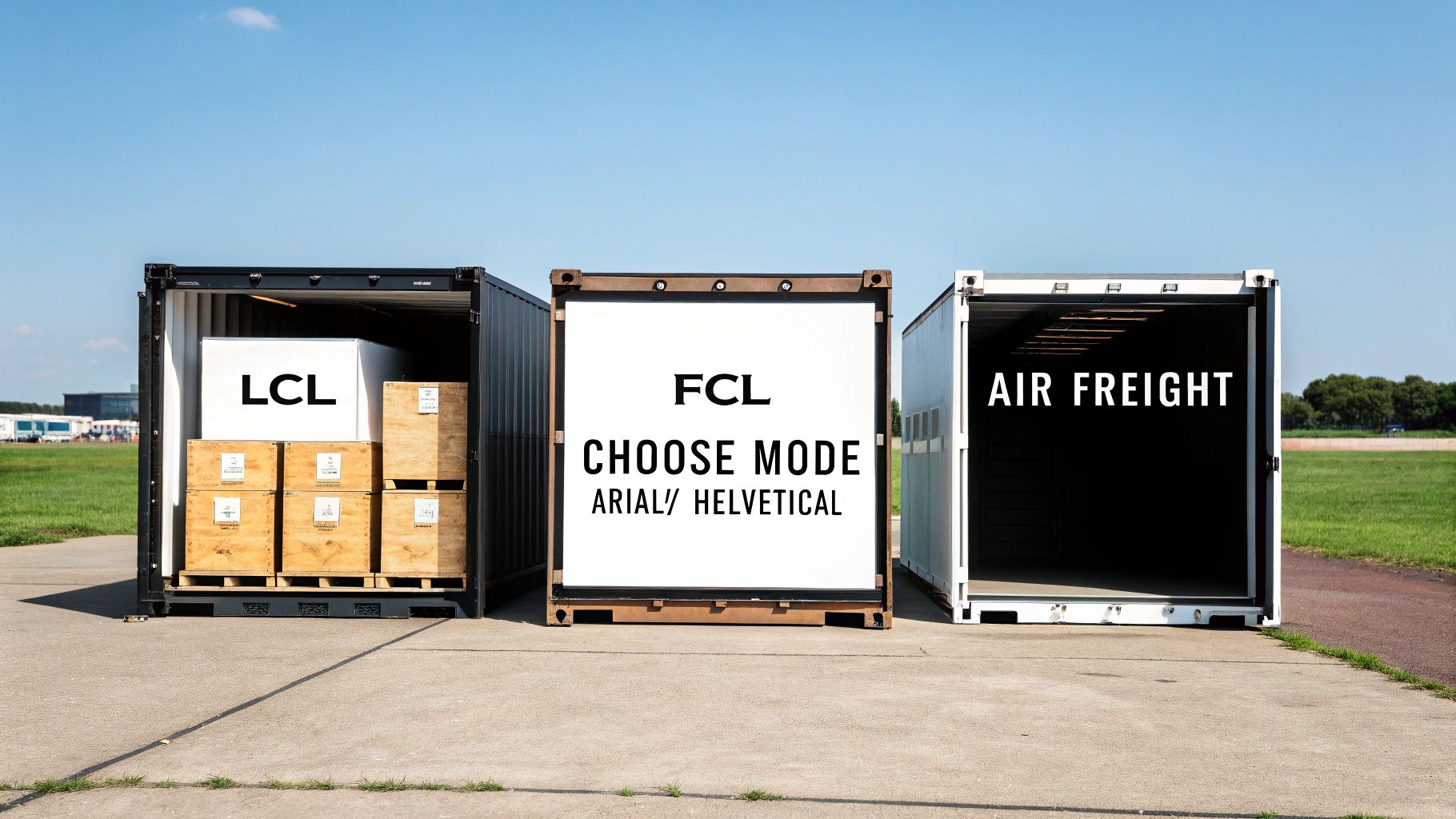
Picking the right shipping method is one of those critical decisions that can make or break your supply chain's budget and timeline. When you're moving goods internationally, your main choices are Less than Container Load (LCL), Full Container Load (FCL), and Air Freight. Each one plays a different role, and knowing which to choose—and when—is key to running a slick operation.
This isn't just about logistics; it's a strategic move that affects your inventory, cash flow, and the final landed cost of your products. So, let’s break down how these three options stack up against each other.
The Comparison at a Glance
Choosing the right shipping method comes down to a trade-off between cost, speed, cargo size, and security. There’s no single "best" option—it all depends on your specific needs for a particular shipment. Here's a clear breakdown to help you see the differences side-by-side.
| Feature | LCL (Less Than Container Load) | FCL (Full Container Load) | Air Freight |
|---|---|---|---|
| Ideal Shipment Volume | 1–15 CBM. Perfect for smaller loads that don't need a full container. | Over 15 CBM. Best for large, bulk shipments. | Small, lightweight shipments, usually under 1 CBM or 150 kg. |
| Cost Structure | Pay-per-CBM. Cheaper for small volumes. | Flat rate per container. More cost-effective for large volumes. | Charged by volumetric or actual weight. The most expensive option. |
| Transit Time | Moderate. Slower than FCL due to consolidation/deconsolidation. | Fast (for ocean freight). Direct shipping from origin to destination. | Extremely fast. Transit in days, not weeks. |
| Security & Handling Risk | Higher. More handling at CFS facilities increases damage risk. | Highest. The container is sealed at the factory and opened by you. | High. Strict airport security and minimal handling. |
| Flexibility | High. Great for managing smaller, frequent inventory top-ups. | Low. Requires a large enough order to justify the cost. | High. Frequent flights and global reach offer scheduling flexibility. |
This table gives you a great starting point, but let’s dive a little deeper into the specific scenarios where each method shines.
LCL The Cost-Effective Balancer
As we've covered, Less than Container Load shipping is the champion of flexibility for smaller shipments. It’s the perfect middle ground when air freight is too expensive, but you don't have enough product to make a full container worthwhile.
Think of it as the go-to for a growing e-commerce brand testing a new product, or a manufacturer sending a regular, smaller batch of parts to an assembly plant. For a deeper look into the world of sea shipping, you can explore our guide on transporting freight by sea.
FCL The Bulk Shipping Powerhouse
When you've got enough cargo to fill a 20-foot or 40-foot container, FCL is your best bet. You’re essentially renting the entire steel box, which means it’s for your goods only.
This is the standard for big retailers stocking up for the season or major importers moving serious volume. The container is sealed at your supplier's door and isn't opened again until it reaches your warehouse, making it incredibly secure. Once your shipment hits a certain size, FCL becomes much cheaper per cubic metre than LCL.
Choosing between LCL and FCL often comes down to a simple calculation. Find the "break-even point"—the volume where the FCL container price becomes cheaper than shipping the same amount via LCL. This sweet spot is typically around 13 to 15 CBM.
Air Freight The Express Option
When time is money and speed is everything, nothing beats air freight. It’s the express lane of global logistics, ideal for high-value, time-sensitive, or perishable goods.
You’d use air freight for that emergency restock of a best-selling item, to ship critical replacement parts to avoid a production shutdown, or to move expensive electronics. The premium cost—often 4 to 6 times higher than ocean freight—is justified because waiting is not an option.
So How Do You Make the Right Call?
Ultimately, your decision hinges on balancing three variables: Cost, Speed, and Volume. Think of them as sliders on a control panel for each shipment.
Need it cheap? Slide towards LCL or FCL. Need it there yesterday? Push the slider to air freight. Got a massive order? FCL is your answer. The best mode is simply the one that fits your priorities for that specific shipment.
An LCL Shipment from China, Step by Step
To really get a feel for how less than container load shipping works, let's walk through a real-world example. We'll follow a typical shipment from a factory in China all the way to its final destination. Seeing the process laid out like this helps you understand the timelines, get your documents in order, and know what to expect at each stage.
Believe it or not, the journey starts well before your goods even get near a port. It all kicks off with solid planning between you, your supplier, and your freight forwarder.
Step 1: Booking and Getting Your Cargo Ready
First things first, you need to book your shipment with a freight forwarder. You'll give them the key details: the dimensions (length, width, height) and weight of your cargo, plus its commercial value. They use this to calculate the volume in Cubic Metres (CBM), which is the basis for your shipping costs.
Once the booking is confirmed, it's over to your supplier to prep the goods. I can't stress this enough: proper packing is non-negotiable for LCL.
- Palletisation: Most LCL cargo needs to be on pallets. This simple step makes it easy to move with a forklift and shields it from the inevitable bumps and scrapes of loading and unloading.
- Crating: If you're shipping anything fragile or high-value, a custom wooden crate is your best friend. It offers serious protection against compression and impact inside the container.
- Labelling: Every single box or pallet must be clearly labelled. Think consignee’s name, destination address, and any special handling instructions. This is crucial for making sure your stuff doesn't get misplaced when the container is unpacked.
A little extra effort here saves a mountain of trouble down the line.
Step 2: The Trip to the Port and Consolidation
With your cargo all packed up, it's time to move it from your supplier’s factory to the Container Freight Station (CFS) near the port of origin, like Shanghai or Shenzhen. Your forwarder will arrange a truck to handle this inland leg.
At the CFS, your shipment meets up with cargo from a bunch of other shippers. This is where the consolidation happens. The CFS team are experts at loading all these different shipments into one container, almost like a game of Tetris. They make sure the space is used efficiently and the weight is perfectly balanced for a safe voyage.
You can think of the CFS as a busy departure lounge for your cargo. It’s where everything is officially checked in for its trip. This is also where the Bill of Lading is issued—the official document confirming the carrier has received your goods in good shape.
Step 3: Export Customs and The Ocean Journey
Before that container can be hoisted onto a ship, it has to clear export customs in China. Your freight forwarder takes care of this complex part, submitting all the necessary documents like the commercial invoice, packing list, and export declaration. Any inaccuracies in this paperwork can bring everything to a grinding halt, so precision is key.
Once customs gives the all-clear, the container is moved to the port terminal, loaded onto the vessel, and begins its long journey across the sea. Transit times vary a lot, usually taking anywhere from 15 to 35 days, depending on the shipping route and final destination. You can keep an eye on its progress with tracking updates from your forwarder.
The scale of this operation, especially out of China's mega-ports, is massive. China is the undisputed leader in the Asia-Pacific LCL shipping market, thanks to its world-class port infrastructure. For small and medium-sized businesses in the region, LCL is a game-changer, often slashing shipping costs by up to 80% compared to air freight for less time-sensitive goods. You can learn more about the trends in the Asia-Pacific LCL market to see just how important it has become.
Step 4: Deconsolidation and Import Clearance
When the ship arrives at the destination port, the container is trucked to another CFS. This is where the deconsolidation process kicks off. The container's seal is broken, and all the individual shipments inside are carefully unloaded, identified, and sorted.
While this is happening, your freight forwarder (or their local agent) gets to work on import customs clearance. They submit another set of documents to the local authorities to declare the goods and handle any duties and taxes owed. Delays here are pretty common, usually because of incorrect paperwork or if customs decides to pull your shipment for a physical inspection.
Step 5: The Final Delivery
Once your shipment has cleared customs, it's released and ready for the home stretch. Your forwarder will arrange for a local truck to pick up your goods from the CFS and deliver them right to your door, whether that's a warehouse, a fulfilment centre, or your own office. This "last-mile delivery" is the final piece of the puzzle, completing the door-to-door LCL journey.
Common Questions About LCL Shipping
When you're diving into the world of less than container load shipping, a few practical questions always seem to pop up. Getting straight answers to these common queries is the key to making your shipping process feel less like a puzzle and more like a plan.
How Are LCL Transit Times Calculated?
You might notice that LCL transit times are a bit longer than for a full container. Why is that? It's all about the extra steps. Your cargo needs to be grouped with other shipments at the origin (consolidation) and then separated at the destination (deconsolidation).
Think of it like a bus making extra stops. These processes can easily add an extra 3 to 5 days to each end of the journey, so be sure to build that buffer into your schedule.
What Is the Best Way to Pack for LCL?
Packing for LCL requires a different mindset. Your goods are sharing a space, so they need to be tough enough to handle the company. It’s all about protecting your cargo from the bumps and shuffles of a shared ride.
- Go for sturdy, new boxes. You don't want them getting crushed under the weight of someone else's shipment.
- Palletise your cargo. Putting your boxes on a pallet makes them easier to move with a forklift and keeps them bundled together securely.
- Label everything. And I mean everything. Every single carton should have the consignee’s details clearly marked. This is your best defence against items getting lost in the shuffle during deconsolidation.
This visual gives you a great overview of the LCL journey, showing how cargo moves from the factory to the consolidation warehouse and finally onto the ship.
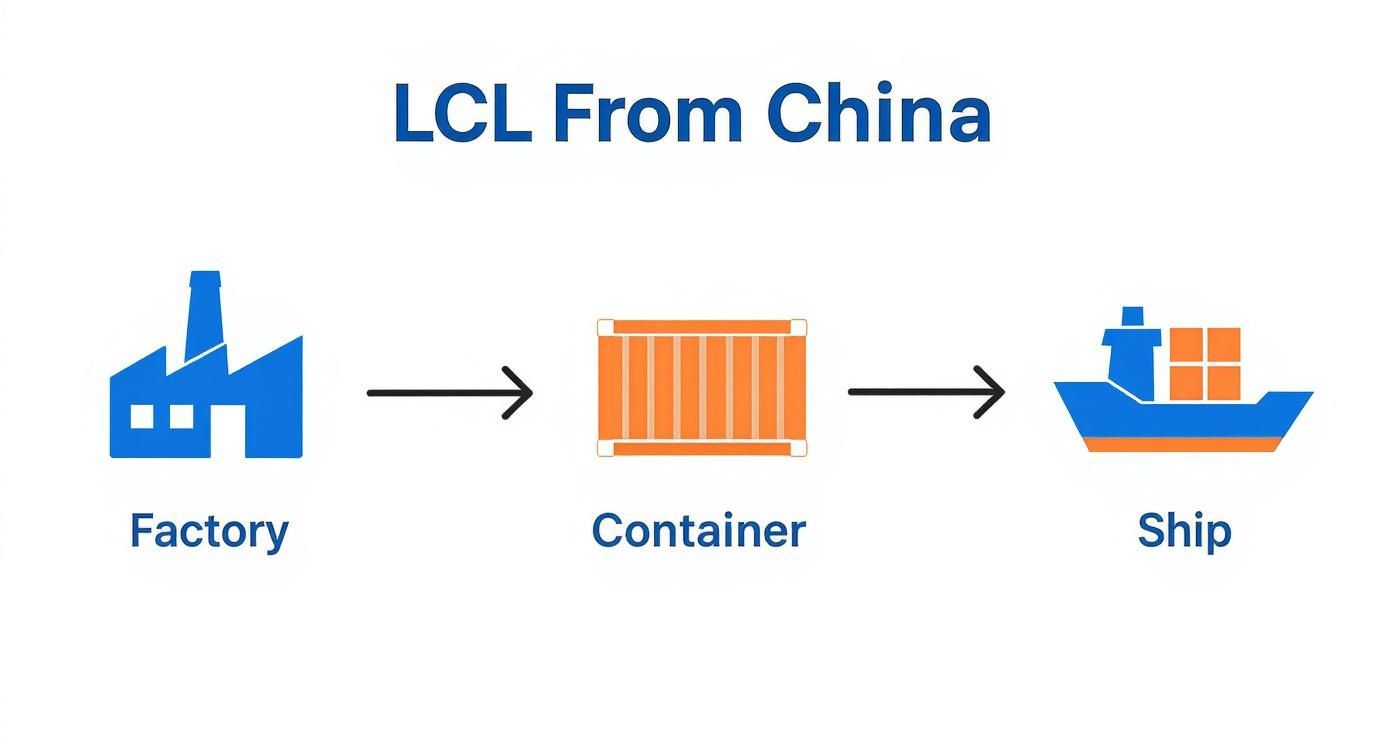
As you can see, there are several distinct hand-off points, each one a critical part of the LCL process.
The biggest risk in LCL is damage from other cargo. Always assume your shipment will be at the bottom of a stack and pack it to withstand significant weight and movement.
Can I Ship Hazardous Goods via LCL?
The short answer is yes, but it comes with a lot of fine print. Shipping hazardous materials requires very specific documentation, handling, and labelling to meet safety regulations.
Not all freight forwarders are equipped or willing to handle hazardous cargo in a shared container. You absolutely must declare these goods upfront. This allows your shipping partner to verify if they can manage it and ensure everything is done by the book to keep everyone safe.