When you see an Ex Works price, or EXW price, you're looking at the most fundamental cost of a product. It's the price for the goods sitting at the seller's factory or warehouse, ready for you to come and get them. Think of it as the 'collect from store' option in international trade.
What the Ex Work Price Definition Really Means
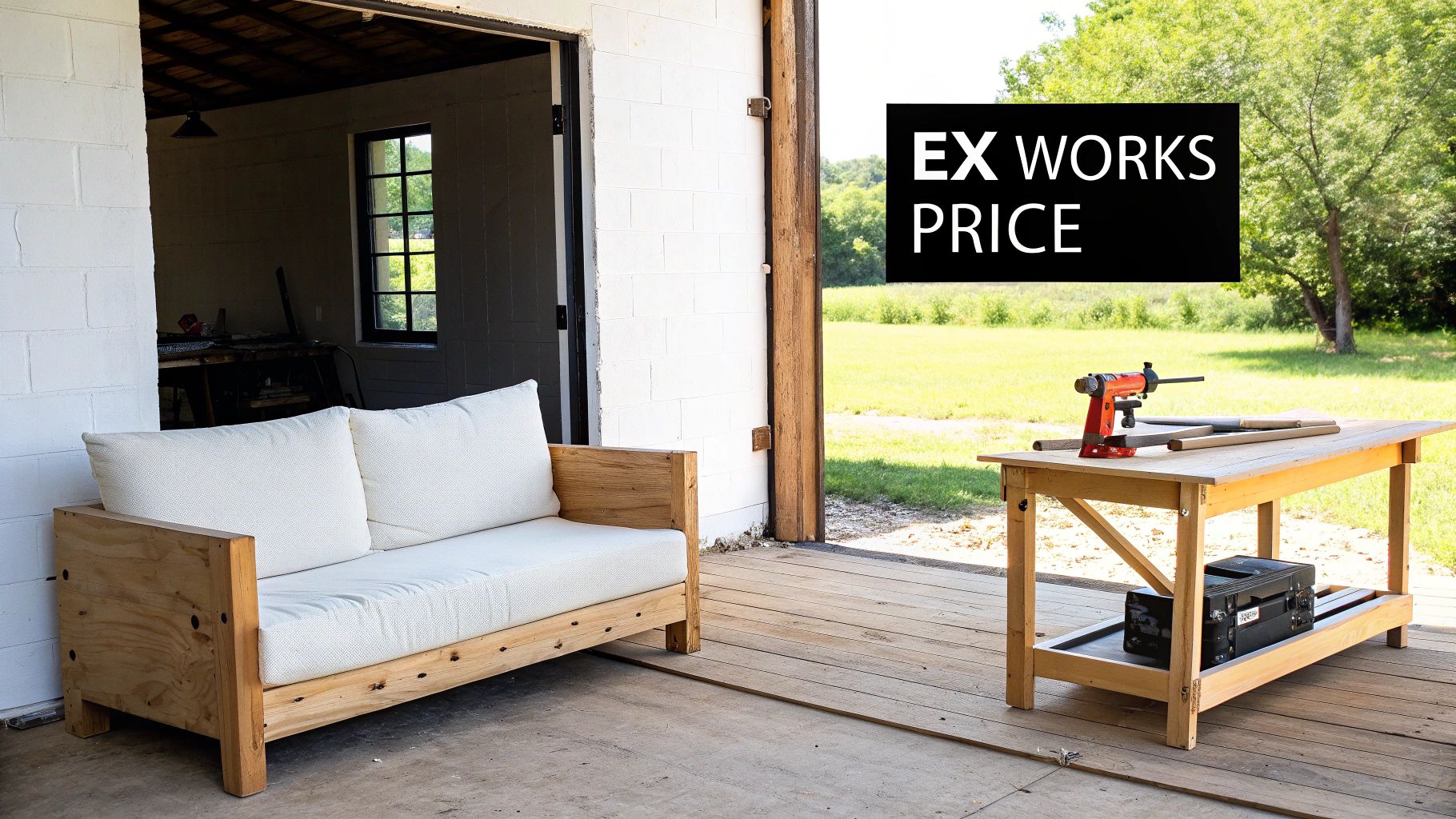
Let's use a simple analogy. Imagine you've commissioned a beautiful, custom-made sofa from a small workshop. The craftsman gives you a price for the finished sofa, wrapped up and waiting just inside his workshop door. That's the EXW price in a nutshell.
It’s the raw cost of your goods at their point of origin—be it a factory, a warehouse, or even an office.
At first glance, this price often seems incredibly low, making it a very tempting offer from a supplier. But it's vital to remember that the EXW price is just the starting block for your total costs, not the finish line.
The Foundation of Your Total Cost
Under the EXW Incoterm, the seller’s job is done once they’ve made the goods available for you to pick up. The moment you (or your agent) arrive to collect them, almost all responsibility—and every single cost from that point on—shifts squarely onto your shoulders as the buyer.
This complete transfer of risk is the most critical detail to grasp about the EXW price.
So, what does that initial price actually cover?
- The cost to manufacture the product
- The seller's profit margin
- Basic packaging just enough for collection
What it absolutely does not include is the cost of loading the goods onto a truck, hauling them to a port, clearing them through customs for export, or any element of the international shipping voyage.
An EXW price is the bare-bones cost of a product at its origin. While it gives the buyer maximum control over the supply chain, it also hands over maximum responsibility for all logistics, risks, and expenses from the factory door onwards.
Getting this concept right is the first, most important step for any importer thinking about using this popular—but demanding—shipping term. It allows you to see past that attractive initial quote and start accurately calculating the true ‘landed cost’ of getting your products all the way from the workshop floor to your own warehouse door.
Who Does What? A Breakdown of Seller and Buyer Responsibilities Under EXW
To really get your head around the EXW price, you have to understand the clear line it draws in the sand. When your supplier in China gives you an Ex Works price, their involvement is minimal. Think of it as the bare-bones cost.
The seller’s job is pretty simple. They produce the goods to your specs, add their profit, and pack them up so they’re ready for you to pick up. Once those boxes are sitting on their factory floor or warehouse dock, their part of the deal is pretty much done.
From that moment on, the baton passes to you, the buyer. This is where things get tricky. That attractively low EXW price can be a bit of a mirage if you aren't ready for the long list of tasks and costs that come next.
The Buyer's Extensive To-Do List
With EXW terms, you are in complete control of the shipping journey from start to finish. That sounds great, but it also means you're on the hook for everything that happens along the way.
Your responsibilities kick in the second your goods are ready for collection. You’ll need to arrange and pay for:
- Loading the Goods: That's right, you need to organise the people and equipment to get your products onto the truck.
- Inland Transport: You'll hire a truck to haul the cargo from your supplier's factory to the port.
- Export Customs Clearance: You are responsible for all the paperwork and procedures to get the goods legally out of China.
- Origin Port Charges: All the terminal handling charges (THC) and other fees at the port of departure fall on you.
This split in duties is what defines EXW. To put it in perspective, let's say you have a $200,000 order for watches in Guangzhou. Shifting from an EXW to an FOB price might add around $1,300 for local transport and port fees. This bumps the unit cost by about 0.65%. It doesn't sound like a lot, but it shows you exactly which logistical tasks—and costs—are being handed back to the seller. You can explore more details on these cost differences when sourcing from China.
EXW Buyer vs Seller Responsibility Checklist
To make sure there's no confusion, let's lay it all out. The table below gives you a clear, at-a-glance comparison of who handles what in an EXW agreement.
| Task | Seller Responsibility | Buyer Responsibility |
|---|---|---|
| Product Manufacturing & Packaging | ✔️ Yes | ❌ No |
| Making Goods Available at Factory | ✔️ Yes | ❌ No |
| Loading onto Collecting Vehicle | ❌ No | ✔️ Yes |
| Inland Transport to Port | ❌ No | ✔️ Yes |
| Export Customs & Duties | ❌ No | ✔️ Yes |
| Origin Port Handling Fees | ❌ No | ✔️ Yes |
| International Freight & Insurance | ❌ No | ✔️ Yes |
| Import Customs & Duties | ❌ No | ✔️ Yes |
| Final Delivery to Destination | ❌ No | ✔️ Yes |
As you can see, the EXW price literally only covers the first two items on the list. Every other checkmark is a cost you need to plan for and a task you need to manage. It really drives home why understanding these responsibilities is absolutely critical before you agree to Ex Works terms.
How to Calculate Your True Landed Cost from an EXW Price
That low number on your EXW quote? It’s tempting, but it’s only the beginning of the story. To figure out what you'll actually spend and protect your profit margins, you need to calculate the landed cost. This is the all-in price to get those products from the factory floor in China all the way to your warehouse door.
Think of the EXW price as the foundation. From there, you have to start layering on all the other costs you, as the buyer, are responsible for. It’s like building a financial roadmap. You're turning a long list of potentially confusing fees into a predictable budget, giving you a clear-eyed view of your real investment before you sign anything.
The diagram below paints a very clear picture of this responsibility split. It shows you exactly where the seller’s job ends—which is very early on—and where your long list of logistical tasks begins.
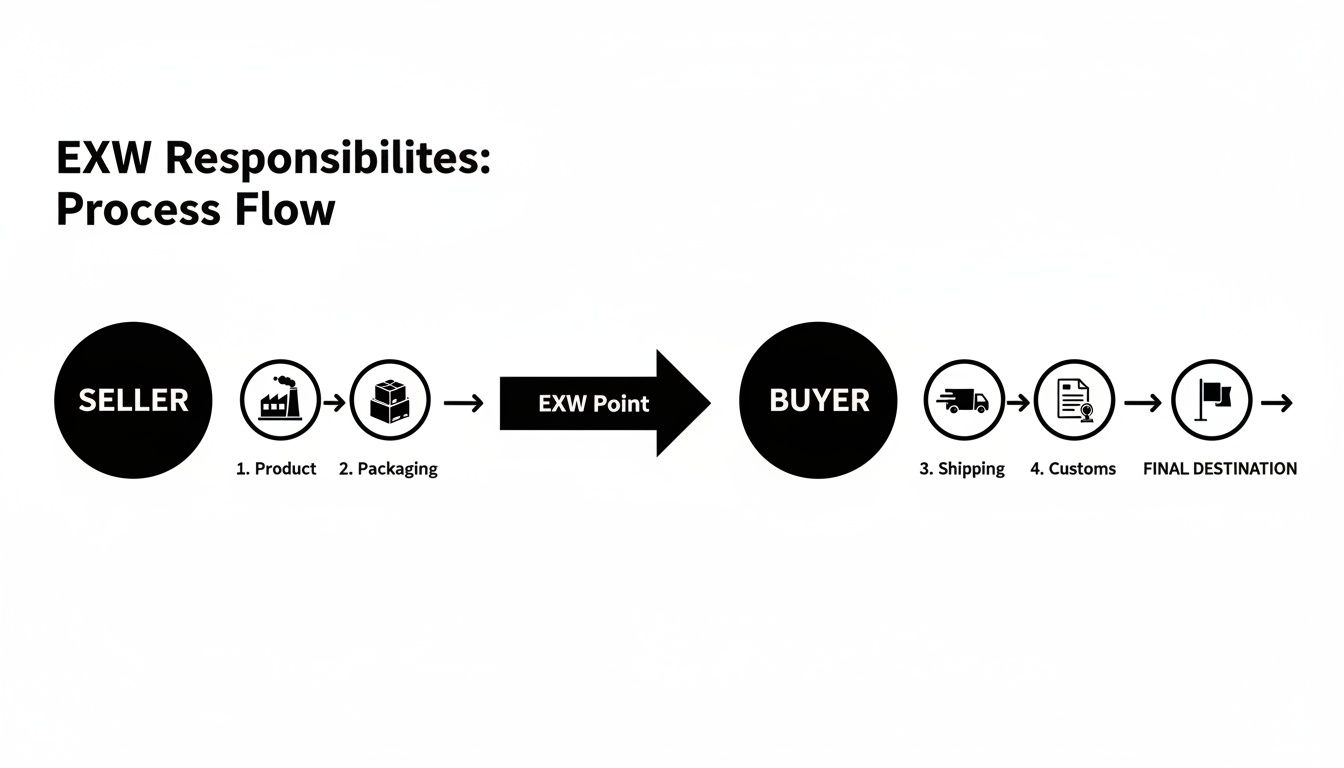
As you can see, the EXW price just covers the product itself and maybe some basic packaging. Everything else—all the shipping, customs, and delivery headaches—falls squarely on your shoulders.
Building Your Landed Cost Calculation
Let's break it down with a practical example. Imagine you’re importing 500 electronic widgets from a factory located in an inland Chinese city. The supplier quotes you an EXW price of $20 per unit.
Here’s how you’d build your landed cost calculation, step-by-step:
- Product Cost (EXW Price): This is your starting block. For 500 widgets at $20 each, your base cost is $10,000.
- Origin Charges: This covers everything needed to get your goods from the factory to the ship. It’s a bundle of costs that includes inland trucking to the port, export documentation fees, and Terminal Handling Charges (THC).
- International Freight and Insurance: This is the big one—the cost of the ocean or air journey from the port in China to your country's port. Don't ever skip the insurance; it's your safety net against loss or damage at sea.
- Destination Charges and Customs: Once your shipment arrives, you're not done yet. You'll have to pay import duties, taxes (like VAT or GST), and fees for the https://upfreights.com/customs-clearance process. These costs can swing wildly depending on your product type and country.
- Final Delivery: This is the last leg, often called "last-mile delivery." It’s the trucking cost to move your goods from the destination port to your final warehouse or business address.
The Landed Cost Formula:
(EXW Price) + (Origin Logistics) + (International Freight & Insurance) + (Customs Duties & Taxes) + (Final Delivery) = Your True Landed Cost
The Hidden Costs of EXW
For importers new to the game, the gap between the EXW price and the final landed cost can be a real shock. In fact, some research shows that a staggering 73% of buyers who use EXW terms get hit with unexpected logistics fees, which average out to around $1,850 per container.
Where do these "hidden" costs come from? A big one is inland trucking within China. Moving goods from a coastal supplier might only cost a hundred dollars, but a factory located deep inland could easily cost you several hundred more. If you don't account for these variables, a seemingly profitable deal can quickly turn into a loss.
And the costs don't stop once the goods are in your warehouse. If you're selling on a platform like Amazon, you have a whole new set of expenses to consider, like understanding Amazon's inventory and operational fees. The only way to guarantee your business stays in the black is to meticulously calculate every single cost, from the factory floor to the final customer.
Comparing EXW with FOB and DDP Shipping Terms
Choosing an Incoterm is a bit like picking a service level for your international shipment. Each one sets a different handover point for who pays for what, and more importantly, who carries the risk. Getting a grip on the most common options—EXW, FOB, and DDP—is absolutely crucial for making smart financial decisions and keeping a handle on your supply chain.
Let's break it down with a simple analogy:
- EXW (Ex Works) is the ultimate "do-it-yourself" option. Once the goods are packed and ready at the factory, they're all yours. Every single step after that is on you.
- FOB (Free On Board) is the more balanced "we'll get it to the ship" package. Here, the seller handles all the local legwork and export paperwork to get your cargo loaded onto the vessel.
- DDP (Delivered Duty Paid) is the full-service, "all-inclusive" experience. The seller manages the entire journey from their door to yours, including import customs and taxes.
Key Differences in Responsibility and Risk
The real difference between these terms comes down to a single point: where does the seller's job end and yours begin? With an EXW price, that handover happens the moment your goods are available at the factory's loading dock. You take on all the risk and costs from that point forward—and that even includes the critical first step of loading the truck.
FOB, on the other hand, pushes that handover point much further. The seller is responsible for getting the goods from their factory to the port, handling all the port fees, and clearing the shipment for export. The risk only transfers to you once the cargo is safely loaded "free on board" the vessel. This is an incredibly popular choice because it leaves the local complexities in the hands of the local expert—your supplier.
For a deeper dive, you can learn more about the meaning of FOB in our detailed guide.
DDP takes things to the complete opposite extreme. The seller arranges and pays for absolutely everything: the international freight, insurance, import customs clearance, duties, taxes, and final delivery. The risk and responsibility stay firmly with the seller until the goods are sitting at your doorstep, ready for you to unload.
Incoterm Comparison EXW vs FOB vs DDP
To make the choice clearer, let’s put these three Incoterms side-by-side and look at what matters most to an importer. The right call really depends on your experience level, your budget, and just how much control you want over the whole process.
| Aspect | EXW (Ex Works) | FOB (Free On Board) | DDP (Delivered Duty Paid) |
|---|---|---|---|
| Cost Responsibility | Buyer pays for everything after factory pickup. | Seller pays until goods are on the ship; Buyer pays from there. | Seller pays for the entire journey, including import duties. |
| Risk Transfer Point | At the seller's factory door, before loading. | When goods are loaded onto the vessel at the origin port. | When goods arrive at the buyer's final destination. |
| Buyer Control | Maximum control over all logistics and costs. | Moderate control, choosing the main carrier and managing import. | Minimum control, relying entirely on the seller's choices. |
When it's all said and done, EXW gives you total control but also hands you the most risk and work, making it a better fit for seasoned importers. DDP is the easiest option by far, but you give up control and it can often hide extra costs. For most businesses importing from China, FOB hits that sweet spot, offering a practical and reliable balance between control and convenience.
When Does EXW Make Sense, and What Are the Risks?
Opting for an Ex Works (EXW) price isn't a decision to take lightly. It's a strategic move that can give experienced importers a serious advantage, but it can just as easily become a financial headache for anyone new to the game. So, when should you actually consider taking on this level of responsibility?
EXW really comes into its own in a few specific situations. Let's say you're sourcing from several different suppliers all located in the same general area. EXW lets you take charge and consolidate all those smaller orders into one single shipment, which can slash your overall freight costs. It’s also often the only option when you're working with smaller factories or craftspeople who simply don't have an export licence or the know-how to navigate international shipping. In those cases, EXW gives you the control you need to get your products out of the country.
Key Situations to Consider EXW
- Consolidating Shipments: You can bundle orders from multiple factories into a single container, all managed by the freight forwarder you trust.
- Supplier Lacks Export Capability: Some fantastic manufacturers are purely focused on production and aren't equipped to handle the complexities of exporting.
- Maximum Control is a Priority: You want to call all the shots—from the carrier and the route to the shipping timeline—to fine-tune your supply chain.
But all that control comes with a hefty dose of risk. The temptingly low EXW price tag can be deceptive, hiding a minefield of potential problems, especially if you aren't familiar with the local customs, regulations, and costs in the country of origin.
The biggest mistake an inexperienced buyer can make with EXW is underestimating the true landed cost. The initial quote is always the lowest, but surprise fees, documentation mistakes, and logistical snags can quickly turn it into your most expensive option.
Common Risks and How to Mitigate Them
One of the most common traps is the mountain of local charges you'll face at origin. These can pop up everywhere, from unexpected trucking fees for a factory tucked away in a remote province to navigating complex export clearance paperwork. For example, picking up goods from a factory near a major port might only add a few hundred dollars to your bill. But if your supplier is located deep inland, you could be looking at an extra $1,500–$4,000+ per container just for transport and special permits. You can get a deeper insight into how procurement service providers view these risks.
Cash flow is another major hurdle. Many Chinese suppliers on EXW terms will demand 100% payment before your goods even leave their warehouse doors. This means your capital is completely tied up long before your products have even started their journey, which can put a massive strain on your finances. The best way to avoid these pitfalls is to either have a trusted agent on the ground or partner with an excellent freight forwarder. A good forwarder acts as your eyes and ears, verifying costs and managing the entire process transparently so you don't get caught out.
Your Most Important Partner in an EXW Shipment
Trying to manage an Ex Works shipment by yourself, especially when you're thousands of miles away, is a near-impossible task. When you agree to an ex work price definition, you're suddenly saddled with a long list of complex and critical jobs inside the origin country. This is precisely why your most important ally is a reliable freight forwarder based in the country of export.
Think of a freight forwarder as your dedicated team on the ground. They are the logistics pros who take over the second your supplier's job is done. Their entire purpose is to handle all the moving pieces you're now responsible for, turning a high-risk situation into a smoothly managed process.
What a Great Forwarder Does for You
A top-notch forwarder does so much more than just book space on a ship. They bring the essential local know-how and operational strength required to make EXW a smart and profitable choice for your business.
Here's what they handle:
- Coordinating Factory Pickups: They'll organise the right kind of truck to pick up your cargo from the supplier's warehouse, no matter how remote that factory might be.
- Managing Export Documentation: They tackle the confusing, and often frustrating, export customs paperwork. This ensures your shipment follows all local regulations, sidestepping costly delays.
- Booking International Transport: Using their extensive network, they find the most efficient and budget-friendly sea or air freight routes to get your goods to you.
- Negotiating Local Charges: A forwarder with boots-on-the-ground experience can check, and often negotiate, local fees at the origin, protecting you from being overcharged.
A freight forwarder is the bridge between the factory floor and your front door. They offer the transparency, expertise, and peace of mind you need to turn the huge responsibility of EXW into a strategic advantage.
In the end, working with the right company gives you a vital safety net, making sure every single step is handled correctly. If you want to dive deeper into what makes a great partner, learning more about a professional freight forwarding service will put you ahead of the game.
Common Questions About Ex Works (EXW)
Diving into the world of Incoterms always brings up a few questions. The basic idea of an EXW price seems simple enough, but how it plays out in the real world has some tricky details every importer needs to get their head around. Let's tackle some of the most common queries.
Is an EXW Price Really the Cheapest Option?
At first glance, yes. The initial EXW quote from a supplier will almost certainly be the lowest price you’ll see. But don't mistake that for your final landed cost.
This is where things can get expensive, fast. If you can't nail down the logistics on the supplier's end, EXW can easily end up costing you more than FOB. Think about it: unexpected local transport fees, mistakes on export documents, and surprise port handling charges can pile up, turning that "great deal" into a financial headache. Your final cost really comes down to how well you can manage all those extra steps.
Who's Actually Responsible for Loading the Truck?
This is a classic 'gotcha' with EXW. Officially, it's the buyer's job to arrange and pay for loading the goods onto the truck. The seller's only legal duty is to have the products ready for you to pick up at their warehouse or factory.
Now, in practice, a lot of suppliers will help you load. It’s a nice gesture. But—and this is a big but—you need to remember that the legal risk for any damage during loading is 100% on you, the buyer. It's a small detail that’s easy to overlook, but it can have major financial consequences if a pallet gets dropped.
I'm New to Importing. Should I Use EXW?
Honestly, I'd strongly advise against it for beginners. The whole process is a minefield if you don't know what you're doing. You'd be responsible for arranging local transport in a foreign country and handling all the export customs paperwork. That’s a steep learning curve with a very high risk of expensive mistakes.
New importers are almost always better off starting with FOB (Free On Board) terms. With FOB, the seller handles all the tricky and risky stuff on their home turf—like getting the goods to the port and clearing them for export. They have the local know-how and contacts to get it done right. This seriously cuts down your risk of delays and surprise costs, making for a much smoother start in international trade.