Think of a freight forwarding service as the master conductor of your international shipping orchestra. They don't own the ships, planes, or trucks, but they're the ones who make sure every instrument plays in harmony to get your cargo from point A to point B without a hitch. The simplest way to put it? They’re a travel agent for your goods, managing every single logistical detail along the way.
Your Strategic Partner in Global Trade
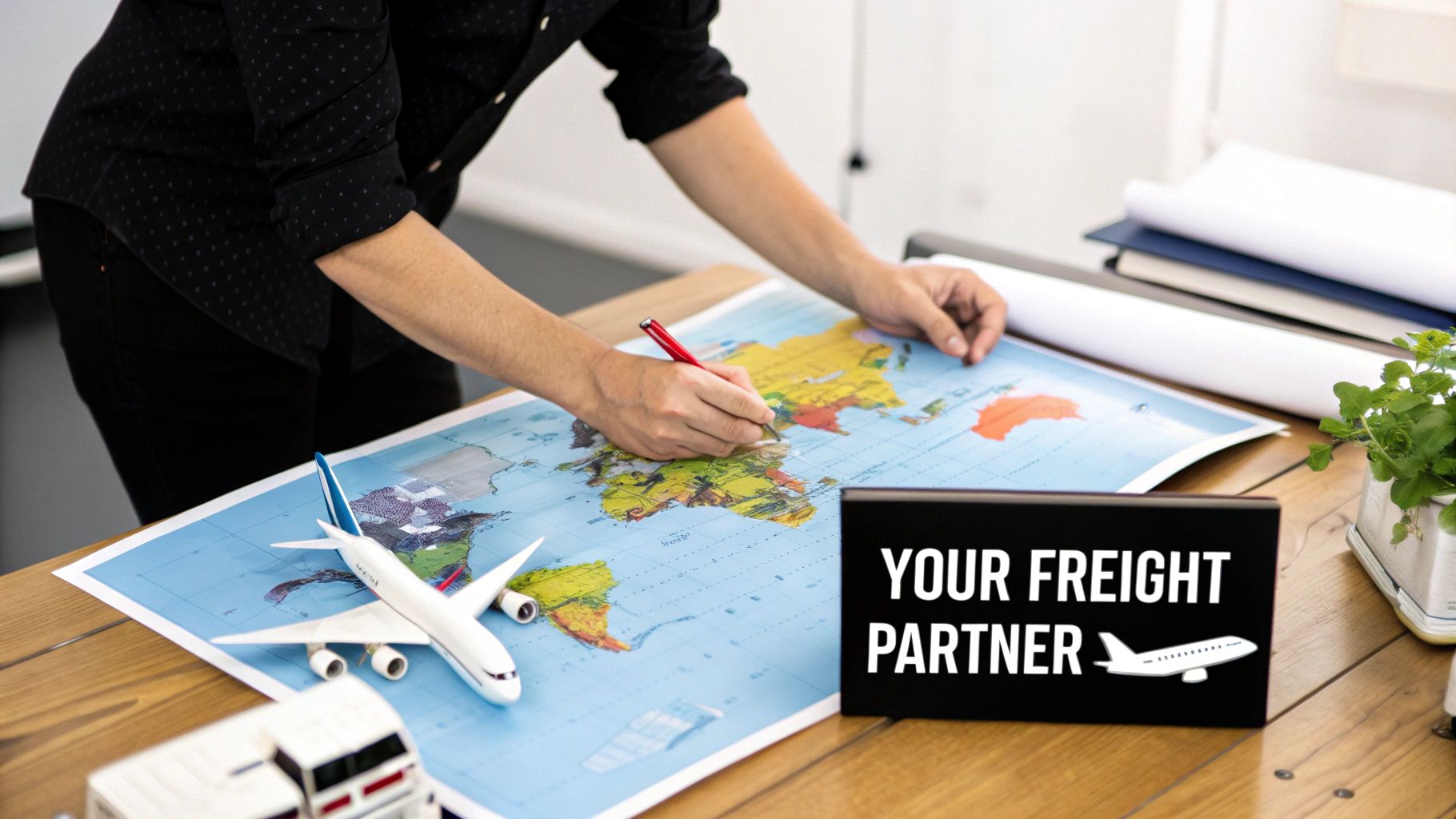
Moving products across borders is a surprisingly complex puzzle. You're juggling multiple carriers, a mountain of paperwork, ever-changing customs rules, and different modes of transport. A freight forwarding service steps in to solve that puzzle for you, acting as your single point of contact and coordination.
Here’s the key difference: they don't physically move your freight. Instead, they tap into their massive network of contacts with air, sea, and land carriers to piece together the smartest and most cost-effective route for your specific shipment. This gives them the power to negotiate better rates and secure space—perks that most individual businesses just can't access on their own.
The Core Role of a Forwarder
At its heart, a freight forwarder is a logistics expert and a problem-solver. Their job is far more than just booking a spot on a container ship. They manage a whole web of interconnected tasks that are absolutely crucial for a shipment to succeed.
Some of their key functions include:
- Carrier Selection and Booking: Finding the right mix of sea, air, or road transport based on your cargo, budget, and deadline.
- Documentation Management: Handling all the essential shipping and customs paperwork, from the Bill of Lading to the commercial invoice and certificate of origin. This alone can be a full-time job.
- Customs Clearance: Acting as your customs broker to make sure your goods meet all import and export regulations, which helps you avoid frustrating and expensive delays at the border.
- Shipment Tracking: Giving you a clear view of where your cargo is, from the moment it leaves your warehouse until it arrives safely at its destination.
A great freight forwarding service isn’t just another vendor—they become an extension of your own team. Their expertise frees you up to focus on running your business, while they navigate the complexities of global shipping and turn a potential logistical nightmare into your competitive advantage.
A Growing and Essential Industry
The need for skilled freight forwarders is booming, especially in major manufacturing centres. Take the freight forwarding market in China, for example. It's already a massive industry, with revenues hitting USD 13,055.9 million. And it's not slowing down; projections show it climbing to USD 18,287.5 million by 2030, largely thanks to the explosion of e-commerce and the demand for faster, time-sensitive shipping. You can dive deeper into these freight forwarding market trends to see what's fuelling this growth.
By teaming up with an expert freight forwarding service, you get direct access to this specialised knowledge. They become your guide through the maze of international trade, helping you sidestep common mistakes, save money, and ensure your products get to your customers on time, every single time. It's a partnership that forms the bedrock of a strong and dependable global supply chain.
Choosing Between Air and Sea Freight
One of the first big decisions you'll make with a freight forwarder is choosing between air and sea. This isn't just about picking a plane or a boat; it's a strategic choice that directly impacts your budget, your timeline, and the promises you keep to your customers.
The right answer depends entirely on what you're shipping, how much you can spend, and how quickly it needs to arrive.
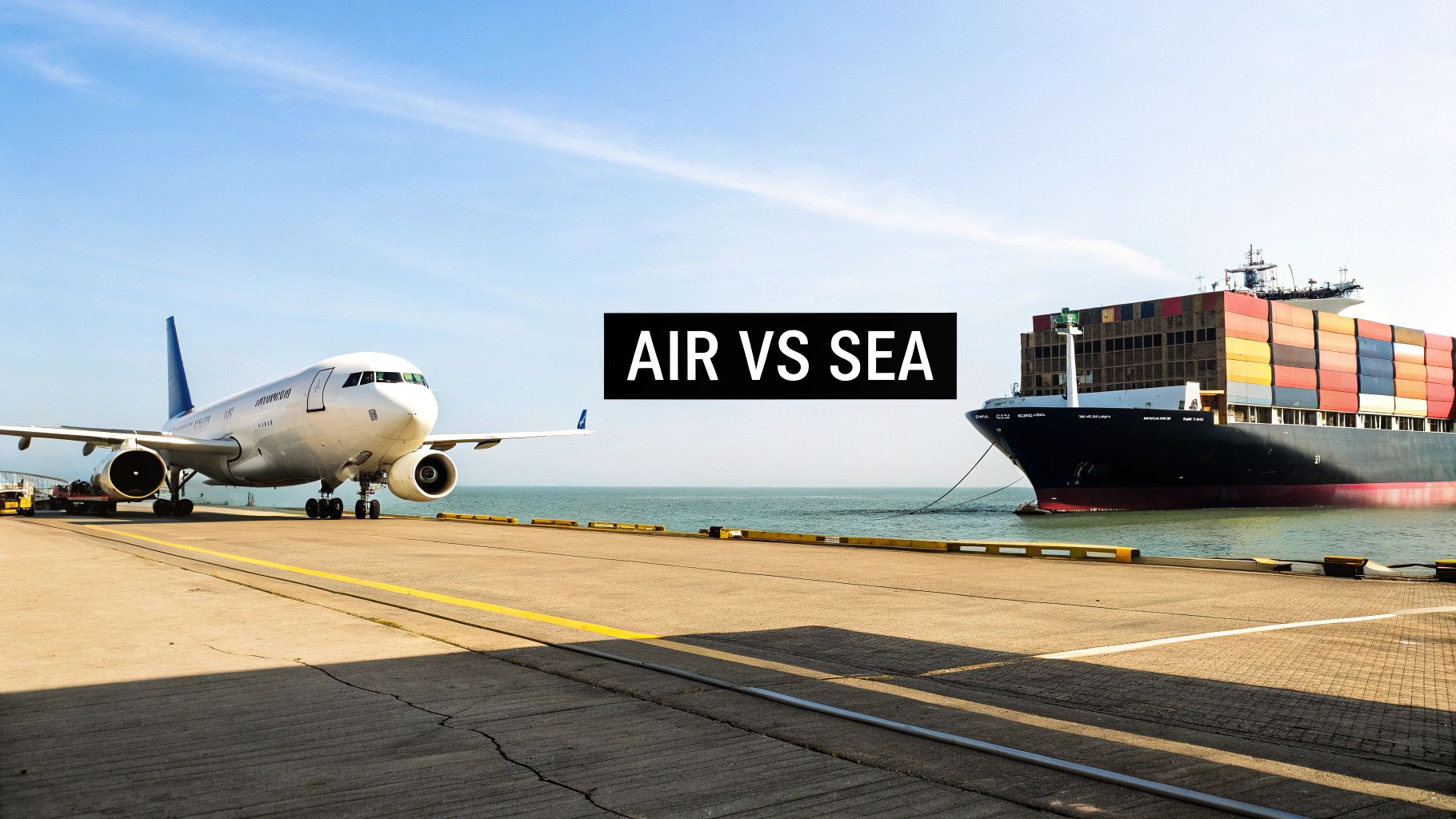
Think of it this way: air freight is like a courier service—blazing fast, but it comes with a premium price tag. Sea freight is more like the reliable postal service—it takes its time but can move incredible volumes for a fraction of the cost. A smart supply chain often uses both.
When To Prioritise Air Freight
The number one reason to choose air freight is speed. When time is everything, nothing else comes close. If you're launching a hot new electronic gadget or shipping the latest fashion collection for an upcoming season, paying extra to be first to market is a no-brainer.
Beyond speed, air travel offers better security and less handling. Airports have strict security protocols and the shorter transit time means fewer opportunities for things to go wrong. This makes it the go-to option for:
- High-Value Goods: Think luxury watches, sensitive electronics, or vital pharmaceuticals.
- Perishable Products: Fresh flowers, produce, or certain chemicals that need fast, temperature-controlled delivery.
- Urgent Restocks: When you've unexpectedly sold out of a popular item and need to replenish your inventory immediately to avoid losing sales.
The main catch? The cost. Air freight can be 4 to 6 times more expensive than sending goods by sea, which makes it a tough sell for bulky or low-margin products. If this is the route you need, it pays to work with specialists. You can learn more about how dedicated air cargo forwarders can help manage the complexities.
The Case For Sea Freight
Sea freight is the undisputed workhorse of global trade, moving a staggering 90% of all goods around the world. Its biggest draws are its massive capacity and incredible cost-efficiency, especially for anything big, heavy, or not in a huge rush. If you’re shipping furniture, car parts, or raw materials in bulk, sea freight is really the only way to go.
Yes, it’s much slower, but its reliability allows for solid, predictable supply chain planning. For any business that can forecast its inventory needs weeks or months out, sea freight offers a stable and budget-friendly foundation. In regions with busy waterways, safety is also paramount; understanding things like essential marine radio communication is a core part of the process for mariners.
Choosing sea freight is a strategic play for cost optimisation. The lower per-unit shipping cost directly translates to better profit margins, allowing businesses to price their products more competitively in the market.
Air Freight vs Sea Freight A Head-to-Head Comparison
Sometimes, seeing the differences laid out side-by-side is the best way to make a decision. Here’s a quick breakdown to help you weigh the factors for your specific shipment.
| Factor | Air Freight | Sea Freight |
|---|---|---|
| Transit Time | Very Fast (1-7 days) | Slow (15-45+ days) |
| Cost | High | Low |
| Capacity | Limited by aircraft size and weight | Extremely high, handles oversized cargo |
| Security | High, with tight airport controls | Moderate, with higher risk of damage |
| Environmental Impact | High carbon footprint | Lower carbon footprint per unit |
In the end, it’s not about which mode is "better" overall, but which one is right for your shipment right now. Many successful businesses use a hybrid approach, relying on sea freight for their planned stock and keeping air freight in their back pocket for urgent needs. A good freight forwarder will help you analyse your goals and find that perfect balance between speed, cost, and reliability.
FCL vs. LCL: How Should You Ship Your Goods?
So, you’ve decided sea freight is the way to go. Smart move. Now for the next big question: how will your cargo travel inside the container? In the shipping world, everything boils down to two key options: FCL and LCL. Getting this choice right is fundamental to balancing your costs and your timeline.
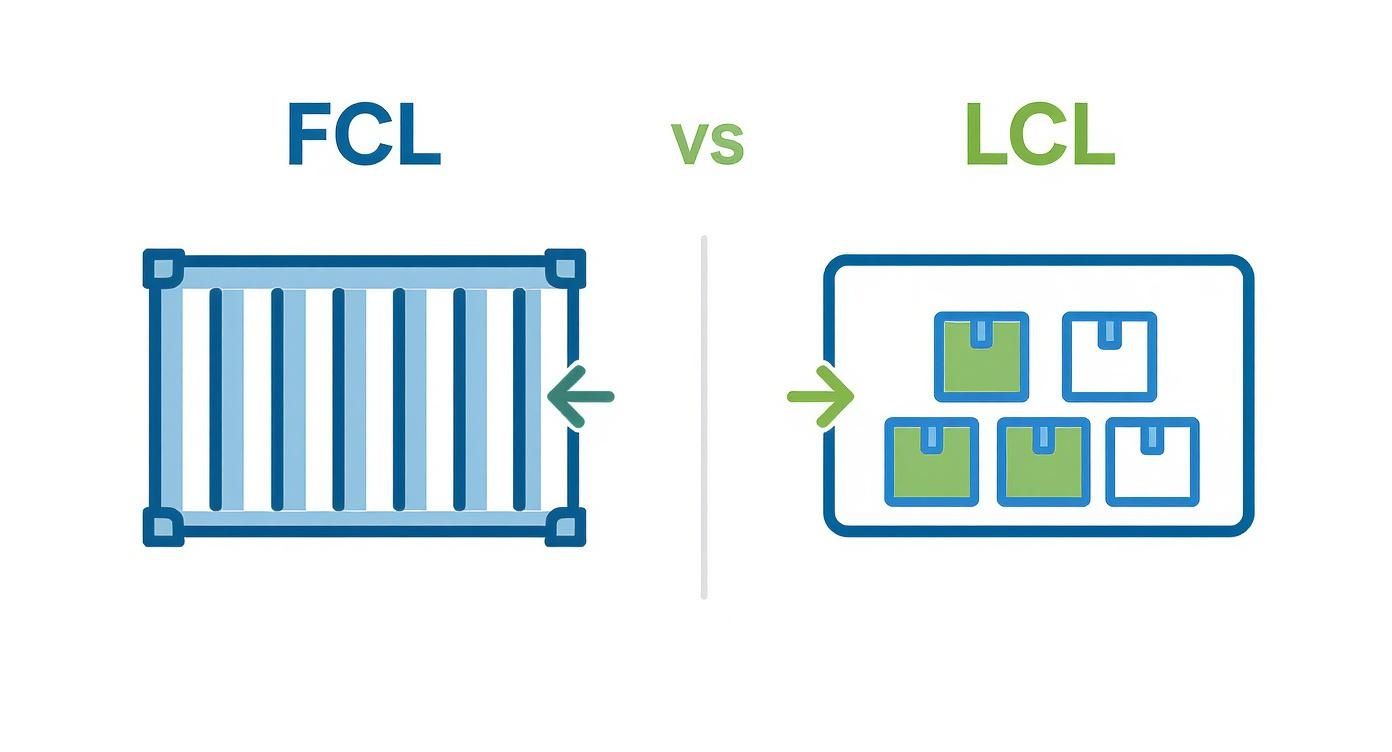
Think of it like hailing a ride. You can book an entire taxi just for yourself, ensuring a direct, private trip to your destination. That’s FCL (Full Container Load). Or, you could opt for a ride-share, splitting the vehicle and the cost with other passengers heading in the same general direction. That’s LCL (Less than Container Load).
FCL: The Direct, Secure Option
When you book an FCL shipment, you're paying for the exclusive use of an entire 20-foot or 40-foot container. Your goods are loaded and sealed at the point of origin, and that seal isn't broken until it arrives at your final destination. This simplicity is its biggest strength.
Because the container is all yours, it doesn't stop to pick up or drop off other cargo. This makes FCL shipping noticeably faster and more predictable than LCL. It's also far more secure since your products aren't being handled alongside other shipments, which dramatically cuts the risk of damage or loss. If you have enough cargo to fill about 75% of a container, FCL is almost always the most cost-effective way to ship.
Choosing FCL means you're investing in speed, security, and simplicity. Your container gets a direct pass, minimising handling and avoiding the delays that can throw your supply chain schedule off track.
LCL: The Smart, Flexible Choice for Smaller Shipments
Don't have enough product to fill a whole container? No problem. LCL shipping is the perfect solution for smaller businesses or anyone with lower-volume shipments. You simply pay for the space you use, calculated by the volume (in cubic metres) or weight of your cargo. This makes global trade accessible without needing a huge budget.
With LCL, your freight forwarder handles the consolidation process, which means they expertly group your cargo with other shipments bound for the same destination. Once the ship docks, the container is taken to a warehouse for deconsolidation, where everything is carefully sorted for its final delivery. These extra steps mean LCL can take a bit longer, but the cost savings are often worth it. For a more detailed breakdown, have a look at our complete guide on the differences between FCL and LCL.
This entire ecosystem is powered by a massive cargo handling industry. Just look at a major hub like China, where the cargo handling sector comprises over 31,486 businesses and recently pulled in an estimated $40.9 billion in revenue. That's the sheer scale of the operation moving all these goods around the globe.
Ultimately, picking between FCL and LCL is a strategic call. A good freight forwarder will walk you through the pros and cons based on your shipment size, budget, and how quickly you need it. Their goal is to find the sweet spot that gives you the best value, making sure you aren't paying for empty space you don't need.
Navigating Customs Clearance and Documentation
If your international shipping journey is a grand adventure, then customs clearance is the final, tricky puzzle you have to solve to reach your destination. It's easily the most rule-heavy and often frustrating part of the entire process. A single mistake—a missing signature or an incorrect code—can get your valuable cargo stuck in limbo for weeks, all while storage fees pile up and your delivery schedule goes out the window.
This is where a professional freight forwarding service truly earns its keep. They don't just move boxes; they're your expert negotiators at the border, making sure your goods have all the right "passports" and "visas" to cross without a hitch. They turn a potential logistical nightmare into just another smooth step in the journey.
A good forwarder has seen it all. They know the common pitfalls and regulatory hurdles and prepare everything to avoid them. They speak the complex language of trade compliance fluently, so you don't have to, and they handle the back-and-forth with customs officials on your behalf.
Your Cargo's Passport: The Essential Documents
Think of your shipment's paperwork as its official travel documents. Each form tells a piece of the story, and together they give customs officials a clear picture of what's inside, where it came from, how much it's worth, and who it belongs to. Getting these documents absolutely perfect isn't just a good idea—it's essential.
You'll always need these three core documents:
- Bill of Lading (B/L): This is the master document. It's the receipt for your goods, the contract with the carrier, and, most importantly, the title of ownership. Whoever holds the B/L owns the cargo.
- Commercial Invoice: This lays out the financial details of the sale between you and the buyer. It lists the goods, their value, and payment terms, and it's what customs uses to figure out the duties and taxes owed. We have a detailed guide on the importance of a commercial invoice that breaks it down further.
- Packing List: This is a detailed inventory of exactly what's in your shipment. It specifies the contents of each package, along with weights and dimensions, helping customs officials verify the cargo quickly without needing to unpack everything.
An experienced freight forwarder acts like a meticulous proofreader for your shipment. They’ll scrutinise every document, cross-checking the commercial invoice against the packing list and the Bill of Lading to make sure every detail lines up. It’s this attention to detail that eliminates the inconsistencies that raise red flags with customs.
Demystifying Duties, Taxes, and Tariff Codes
Once your paperwork is squared away, the next question is what you'll owe at the border. This comes down to duties and taxes, which are calculated based on a specific Harmonised System (HS) code for your product.
An HS code is basically a universal language for classifying goods, telling customs authorities in any country exactly what you're shipping. Using the right code is critical—it ensures you pay the correct tariff. Get it wrong, and you could end up overpaying or, far worse, facing accusations of fraud and hefty penalties. A freight forwarding service has specialists who live and breathe these codes, making sure your goods are classified correctly so you pay exactly what you should.
This process is all about efficiency, especially in the world's major logistics hubs. Take China's freight and logistics market, which is valued at an enormous USD 1,310.98 billion. Mega-hubs like Shanghai and Shenzhen handle a staggering 64% of the country's outbound freight. They rely on incredible precision and technology to speed up the whole chain, even reducing truck waiting times by 18%.
At the end of the day, getting through customs is a game of precision. When you partner with the right freight forwarding service, you’re not just hiring someone to move your freight. You’re bringing on a compliance expert who is dedicated to protecting your shipment, your schedule, and your budget.
How to Select the Right Freight Forwarding Partner
Choosing a freight forwarder isn't just about finding the cheapest quote. Think of it as hiring a critical team member—one who's responsible for the lifeline of your business. The right partner can feel like an extension of your own company, smoothing out the complexities of global trade. The wrong one? Well, that's a fast track to missed deadlines, surprise costs, and unhappy customers.
To find a partner you can truly rely on, you need to dig deeper than the price sheet. You're looking for a combination of global reach, specialised expertise, and the right technology to back it all up.
Assessing Their Network and Specialisation
First things first: look at their map. A forwarder with a strong global network and deep roots in your key markets is a massive asset. This means they have established relationships with carriers and local agents, giving them the leverage to secure space on vessels and negotiate better rates, even when everyone else is scrambling during peak season.
But a big network is only half the story. You need a partner who truly understands your business.
- Trade Lane Know-How: Do they live and breathe the shipping routes you rely on, like China to the US or Europe? A forwarder who specialises in your specific lanes will know the ins and outs of local customs, port quirks, and how to navigate potential bottlenecks before they become problems.
- Industry Experience: Shipping delicate electronics is a world away from moving heavy machinery or fast fashion. A partner with a track record in your industry already speaks your language. They'll understand your product's unique handling, packaging, and documentation needs from day one.
Don't just take their word for it. Ask for case studies or to speak with a current client who ships similar goods. Real-world proof is always the best way to vet their capabilities.
Evaluating Technology and Communication
These days, the data about your shipment is almost as important as the shipment itself. A forwarder's tech platform is a window into their efficiency and transparency. If they're still relying on endless email chains and spreadsheets, you're signing up for communication gaps and a whole lot of guesswork.
You should be looking for a freight forwarding service that provides a modern, intuitive digital platform. Here’s what matters:
- Real-Time Tracking: A non-negotiable. You need a customer portal where you can see live updates and track your cargo’s journey from A to B. You shouldn't have to pick up the phone just to find out where your container is.
- Digital Documentation: A single, secure hub to upload, manage, and access all your shipping documents is a game-changer. It saves countless hours and prevents the nightmare of losing a critical piece of paper.
- Clear Communication Lines: What happens when there’s a delay? Who do you call? A great partner has proactive communication built into their process and offers 24/7 support for when things go wrong outside of office hours.
A forwarder's investment in technology is a direct reflection of their commitment to you. Tools that give you instant visibility and control empower you to manage your supply chain, not just react to it.
Verifying Credentials and Support
Before you sign on the dotted line, it's time for some final due diligence. Trust is the currency of logistics, and it has to be earned with proven qualifications and reliable support.
Start with the basics. Are they properly licenced and certified? Are they members of reputable industry associations? Crucially, ask for proof of their cargo insurance and liability coverage. This is your financial safety net if your goods are lost or damaged in transit.
Finally, ask the tough question: "When a shipment gets stuck or something goes wrong, what's your process?" Their answer will tell you everything you need to know about their culture. A forwarder who stumbles over the question is one who will likely stumble during a crisis. The one who gives you a clear, confident plan is the partner you want in your corner.
To help you put all this into practice, we've created a simple checklist. Use it to compare potential partners and make a decision you can stand behind.
Freight Forwarder Evaluation Checklist
This checklist provides a structured way to assess and compare different freight forwarders, ensuring you cover all the critical areas before making a commitment.
| Evaluation Criteria | What to Look For | Why It Matters |
|---|---|---|
| Global Network & Reach | Offices or strong agent partnerships in your key origin and destination countries. | Ensures seamless local handling, customs clearance, and problem-solving on the ground. |
| Trade Lane Expertise | Proven experience and high-volume traffic on the specific routes you use. | Deep knowledge of carriers, port operations, and potential challenges on your lanes. |
| Industry Specialisation | Case studies or references from businesses in your industry (e.g., electronics, apparel). | They'll understand your product's unique handling, documentation, and compliance needs. |
| Technology Platform | User-friendly portal with real-time tracking, digital document management, and analytics. | Provides transparency, efficiency, and control over your supply chain. |
| Communication & Support | Dedicated account manager, clear protocols for updates, and 24/7 emergency support. | Ensures you're always informed and can get help when you need it most. |
| Licensing & Insurance | Valid government licences, industry certifications, and proof of cargo liability insurance. | Protects your business from risk and ensures they operate legally and professionally. |
| Service Flexibility | Offers a range of services (Air/Sea, FCL/LCL, Door-to-Door) and can customise solutions. | A partner who can adapt and scale with your business as your needs change. |
| Pricing Transparency | Clear, all-inclusive quotes with a detailed breakdown of all charges. No hidden fees. | Builds trust and allows for accurate cost forecasting without surprise surcharges. |
By systematically working through these points, you move from making a guess to making an informed, strategic decision. The time you invest in vetting a forwarder now will pay off tenfold in the form of a smoother, more reliable supply chain down the road.
How a Great Freight Forwarder Solves Real-World Problems
Knowing the theory is one thing, but seeing how a skilled freight forwarder acts under pressure is another entirely. That’s where you see their true worth. Let's step away from the concepts and look at the kind of messy, real-world business challenges that get solved every day with smart coordination and genuine industry know-how.
These aren't just hypotheticals. They're common situations where a partner like Upfreights can turn a potential disaster into a success story. From hitting an impossible deadline to untangling a customs nightmare, the right forwarder isn't just a supplier—they're a vital part of your team.
Scenario 1: The High-Stakes Fashion Launch
The Problem: A fast-growing fashion brand had a new collection ready to go, manufactured across several sites in Vietnam. Their problem? The entire line was tied to a huge marketing campaign and a hard launch date for distribution in the United States. If they were even a few days late, it would mean massive financial losses and broken promises to their major retail partners.
The Solution: Standard sea freight was simply not an option; it was far too slow. Upfreights immediately pivoted to a priority air freight strategy, securing space with reliable carriers on the trans-pacific route. They didn't just book a flight; they orchestrated pickups from multiple factories, consolidated everything at a single airport, and got all the export documents handled well in advance to sidestep any hold-ups.
Thanks to Upfreights’ real-time GPS tracking, the brand's logistics manager could literally watch the shipment move across the globe. Once it landed in the US, a dedicated customs team—already armed with pre-cleared paperwork—was waiting. They pushed the collection through customs in a matter of hours, not days.
The Outcome: The collection arrived a full three days ahead of schedule. This gave them plenty of breathing room for final distribution. The launch was a massive success, leading to a 25% bump in seasonal sales and cementing the brand's reputation for reliability.
Scenario 2: Getting Costs Under Control for a Small Business
The Problem: An e-commerce startup importing artisanal home goods from China was getting hammered by unpredictable shipping costs. Their volumes weren't big enough for a full container (FCL), and their old provider kept surprising them with hidden fees. It was impossible to budget, and their profit margins were getting eaten alive.
The Solution: The team at Upfreights took a close look at their shipping history and introduced them to LCL (Less than Container Load) consolidation. By grouping their smaller shipments with cargo from other businesses heading the same way, they suddenly only had to pay for the exact space they were using. Crucially, Upfreights gave them a clear, all-in quote right at the start, detailing everything from the ocean journey to destination charges. No more guesswork.
The Outcome: The business instantly saw their shipping costs drop by 30% per shipment. The transparent pricing meant they could finally forecast their expenses with real confidence. With that newfound stability, they reinvested the savings back into their products and marketing, which helped fuel their growth.
Scenario 3: Breaking Through a Customs Bottleneck
The Problem: An importer of highly specialised electronic components had a recurring nightmare at the border. Their shipments were constantly being flagged for inspection because of tricky, ever-changing import rules. The final straw came when a critical shipment was detained over an incorrect HS tariff code, threatening to shut down their entire production line.
The Solution: Upfreights’ customs clearance specialists jumped in. They didn’t just fix the immediate problem; they audited the client’s entire product list and corrected all the HS codes before the next shipment was even booked. Drawing on their deep expertise and established relationships with customs officials, they supplied all the technical paperwork needed to back up the new, correct classifications.
The Outcome: The detained shipment was released within 48 hours, avoiding a production shutdown that would have been financially devastating. Every shipment since has cleared customs without a hitch, saving the company thousands in potential storage fees and lost business. Their supply chain is now stronger and more predictable than ever.
Frequently Asked Questions About Freight Forwarding
As you get deeper into global logistics, you're bound to have questions. It's a complex world! To help you get your bearings, we've put together straightforward answers to the questions we hear most often from businesses just like yours.
What’s the Difference Between a Freight Forwarder and a Courier Service?
The easiest way to think about it is this: a freight forwarder is your logistics architect, while a courier is a package delivery specialist.
A freight forwarding service is built for orchestrating large or bulk shipments. They're the experts who figure out the best mix of air, sea, or road transport and handle all the tricky parts, like customs paperwork. They're your go-to for commercial cargo.
On the other hand, courier services like FedEx or DHL are geared towards smaller parcels and documents. They run their own networks and offer a simple, all-in-one service for less complex, smaller-scale shipments.
Do I Really Need Cargo Insurance When Using a Freight Forwarding Service?
In a word, yes. It's a common misconception that the carrier's basic liability will cover you if something goes wrong. The reality is that their liability is legally capped and often pays out just a tiny fraction of your goods' actual value. Relying on that alone is a huge financial gamble.
A good freight forwarder will help you arrange proper cargo insurance that actually protects your investment. This means if the worst happens, you're compensated for the full value of your products, not just the legally required minimum.
Securing proper cargo insurance isn't just a box to tick; it's fundamental risk management. It turns a potential disaster into a manageable business issue, protecting your cash flow and keeping your supply chain intact.
How Are Freight Forwarding Costs Calculated?
There's no single answer, as shipping costs are a mix of different variables. Any trustworthy forwarder will give you a detailed quote that breaks everything down. The main components you'll see are:
- Mode of Transport: Air freight is always going to be faster but much pricier than sea freight.
- Shipment Size & Weight: Costs are calculated based on a combination of your shipment's physical volume and its actual weight (known as chargeable weight).
- The Route: The distance and specific path from your origin port to the destination port play a big role in the final price.
- Extra Fees: You'll also see charges like fuel surcharges, fees for handling at the terminal, and the cost for a professional to manage customs clearance.
How Long Does International Sea Freight Take?
Transit times for ocean shipping can really vary depending on the route. For example, a container sailing from China to the US West Coast might take anywhere from 15 to 30 days. That same container heading to the US East Coast or a port in Europe could be at sea for 30 to 45 days, sometimes longer.
And remember, those are just port-to-port estimates. They don't account for the time it takes to get your goods to the port or transport them from the destination port to your warehouse, nor do they factor in potential customs hold-ups. Your freight forwarder can give you a much more accurate door-to-door timeline for your specific route, which is crucial for planning your inventory.