At its core, the difference is simple. With FCL (Full Container Load), you rent an entire container for your exclusive use. Think of it as chartering a private bus. It’s perfect for large shipments.
LCL (Less than Container Load), on the other hand, is like buying a single seat on that bus. You share container space with other shippers and only pay for the volume your cargo occupies, making it a go-to for smaller consignments. The right choice hinges on what you value more: the speed and security of your own container, or the cost savings of sharing space.
Understanding FCL and LCL Shipping Basics
When you're shipping by sea, your first big decision is almost always FCL or LCL. Each option is built for different shipping needs, and getting this choice right is fundamental to an efficient supply chain. FCL gives you total control over a dedicated container, while LCL means your goods are consolidated with cargo from other businesses.
This single difference creates a ripple effect, influencing everything from cost and transit time to security. For instance, the pricing models are worlds apart. An FCL shipment for a 20-foot container from China to the US West Coast might run you a flat fee between $2,200 and $3,200. But with LCL, you're charged per cubic metre (CBM), often falling in the $70 to $180 per CBM range. For a deeper dive into how these rates fluctuate, check out China's current sea freight trends.
FCL vs LCL at a Glance
The trade-offs become much clearer when you see them side-by-side. While FCL offers a more straightforward, hands-off process once it's loaded, LCL provides a crucial, affordable entry point for businesses that can't fill a whole container. If you're new to the concept, our complete guide on Less than Container Load shipping breaks down all the nuances.
To help you get a quick feel for which path is right for you, here’s a summary of the main distinctions.
FCL vs LCL at a Glance
| Feature | FCL (Full Container Load) | LCL (Less than Container Load) |
|---|---|---|
| Best For | Large shipments, typically 13 CBM or more. | Smaller shipments, usually under 13 CBM. |
| Cost Structure | Flat rate per container. | Priced per cubic metre (CBM) or weight. |
| Handling | Minimal; sealed at origin, opened at destination. | Multiple handling points for consolidation and deconsolidation. |
| Security | High, as the container is exclusive to one shipper. | Lower, due to co-loading with other cargo. |
| Transit Time | Faster and more predictable schedules. | Slower due to consolidation and deconsolidation processes. |
Ultimately, your decision should be guided by your specific shipment's characteristics and priorities.
Key Takeaway: Choose FCL when you have the volume and need speed and security. Opt for LCL when your primary goal is keeping costs down on smaller, less time-sensitive shipments. This first decision really does set the stage for your entire shipping strategy.
Mapping the FCL and LCL Shipment Journey
To really get to grips with the difference between FCL and LCL, you have to look past the container itself and trace the actual journey your goods take. The path from your supplier’s factory to your warehouse isn't the same for both, and these differences have a direct impact on your timeline, security, and potential risks.
Think of it this way: an FCL shipment takes a simple, direct flight, while LCL is more like a connecting flight with a few layovers.
This visual gives a great at-a-glance summary of how FCL and LCL stack up on volume, speed, and security.
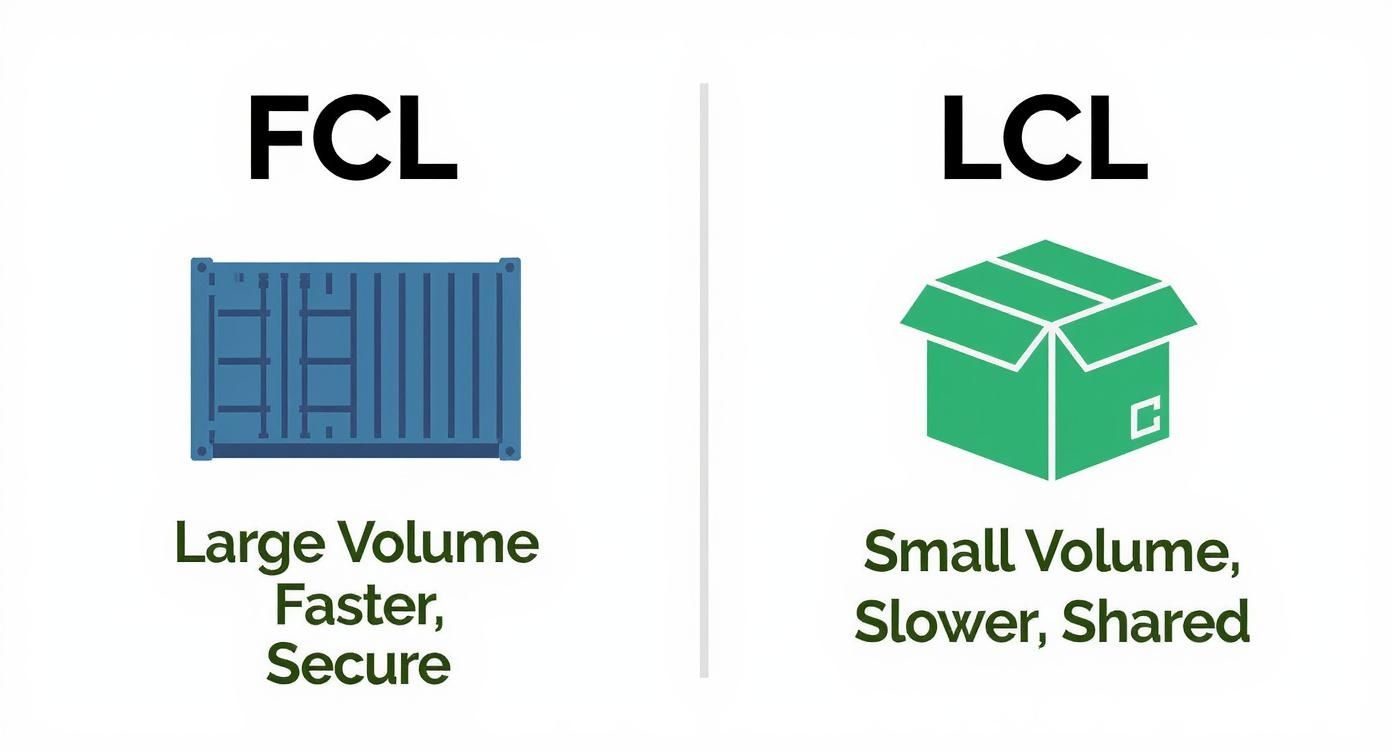
As you can see, FCL offers a dedicated, streamlined path. LCL, on the other hand, is a shared journey with several extra logistical steps built in.
The Direct Path of an FCL Shipment
The journey for a Full Container Load is all about simplicity and exclusivity. It’s a clean point-A-to-point-B operation with minimal handling, which is a big reason it's the go-to for high-value or time-sensitive cargo.
Here’s how it unfolds:
- Container Drop-Off: A carrier delivers an empty container right to your supplier's factory or warehouse.
- Loading and Sealing: Your supplier loads all your goods. Once it's full, the container is locked with a seal.
- Port Transit: That sealed container is trucked to the port, loaded onto the ship, and it’s off.
- Destination: When the ship arrives, the container comes off and is transported to your final destination. Only then do you or your agent break the original seal to unload your goods.
That unbroken seal is the key. It’s a guarantee that from the moment your cargo leaves the supplier, no one else touches it until it reaches you. This massively cuts down the risk of damage, loss, or tampering along the way.
The Multi-Stage LCL Journey
In complete contrast, the Less than Container Load journey has more moving parts and handling points because it’s all about combining cargo from multiple shippers. This consolidation is what makes it cost-effective for smaller shipments, but it also brings in more room for delays and risks.
The LCL trip has several distinct stages:
- Cargo Collection: Your goods are picked up from the supplier and taken to a warehouse known as a Container Freight Station (CFS).
- Consolidation: At the CFS, your cargo gets bundled with other LCL shipments that are all headed to the same destination. This is where everyone's boxes are loaded into one shared container.
- Shipping: The now-full container is sealed and moves to the port, just like an FCL shipment.
- Deconsolidation: Here’s the big difference. Upon arrival, the container isn’t delivered straight to you. It goes to another CFS at the destination.
- Sorting and Final Delivery: At this destination CFS, the container seal is finally broken. All the goods inside are unloaded and sorted by owner. Once your cargo is separated, it's cleared for its final delivery to you.
This process makes it clear why LCL transit times are always longer. Those extra consolidation and deconsolidation steps can easily add one to two weeks to the total journey compared to a direct FCL shipment.
Every time your goods are handled, there's another chance for damage or loss, making good, strong packaging absolutely critical. Understanding the nuances of ocean shipping is vital, and you can learn more about the broader world of freight by sea. Because it's a shared space, your shipment's timeline can even be held up by issues with someone else's cargo, like a random customs inspection on another shipper's goods in the same container.
A Practical Cost Analysis for FCL and LCL

When you're deciding between FCL and LCL, the financial side of things can be deceptive. On the surface, LCL looks like a bargain for smaller shipments, but the final bill—the total landed cost—often tells a very different story. To make the smartest choice for your business, you have to look beyond the initial quote and understand the full cost structure.
An FCL shipment is straightforward: you pay a flat rate for the entire container, whether you fill it to the brim or not. LCL, on the other hand, is priced per cubic metre (CBM) or per tonne, whichever is greater (this is what we call chargeable weight). That per-unit pricing sounds attractive, but it’s just one piece of a much larger puzzle.
Unpacking the Full Cost Structure
The total cost of an LCL shipment is a sum of many parts. Beyond the base ocean freight rate, you need to account for charges at both origin and destination, and these can really add up.
You’ll typically see fees like:
- Origin Charges: This covers everything from picking up your cargo and handling it at the warehouse to the complex process of consolidating it with other shipments at the Container Freight Station (CFS).
- Destination Charges: Once the container arrives, you're on the hook for deconsolidation fees, more CFS handling, and storage costs while your cargo awaits customs clearance.
These handling fees are substantially higher on a per-CBM basis for LCL than for FCL. Why? Because with LCL, multiple shipments are being individually sorted, processed, and managed. FCL skips all that, which is why its destination charges are so much lower.
Key Insight: Don't get drawn in by LCL's low initial freight rate. Always get a full breakdown of origin and destination charges. They can easily inflate the final cost and make a seemingly cheap option much more expensive than FCL.
This brings us to a critical concept in freight forwarding: the "break-even point."
Identifying the Financial Break-Even Point
At a certain volume, the climbing per-CBM costs of LCL finally cross paths with the flat rate of a dedicated 20ft FCL container. This is the tipping point where FCL becomes the cheaper option, even if you don't use every last inch of space.
From my experience, this break-even point usually falls somewhere between 13 and 15 CBM. If your shipment is getting close to that range, it’s always a good idea to ask for an FCL quote. You might be pleasantly surprised to learn that booking a whole container not only saves you money but also gets you the added perks of faster transit and better security.
Remember, market conditions can throw a wrench in the works. During peak seasons, demand for container space skyrockets. We’ve seen rates for a 20-foot container from Shanghai to Los Angeles jump to around $2,340—a staggering 46% increase in just one month. This is driven by high demand and a shortage of capacity, highlighting how volatile pricing can be.
Cost Calculation Scenarios
Let's look at how this plays out in the real world. The table below gives you a clear picture of how the most economical choice shifts as your shipment volume grows. Of course, for figures specific to your cargo, you'll want to use a dedicated tool. You can get a precise estimate with our sea freight cost calculator.
Cost Calculation Scenarios FCL vs LCL
| Shipment Volume (CBM) | Estimated Total LCL Cost | Estimated Total FCL (20ft) Cost | Most Economical Choice |
|---|---|---|---|
| 5 CBM | $950 | $2,400 | LCL |
| 10 CBM | $1,900 | $2,400 | LCL |
| 14 CBM | $2,660 | $2,400 | FCL |
| 20 CBM | $3,800 | $2,400 | FCL |
Notice how once the volume hits 14 CBM, the total LCL cost overtakes the flat FCL rate. At that stage, choosing FCL isn't just about saving money; it's about gaining all the operational advantages that come with having your own dedicated container. Running this quick cost-benefit analysis before you book is the best way to ensure you’re not overpaying.
Comparing Transit Time and Schedule Reliability
In logistics, timing is everything. It can make or break a supply chain. When you’re weighing up FCL and LCL, a common mistake is to assume transit times are the same because the container travels on the same ship, along the same route. But if you look at the total door-to-door journey, you’ll find a huge difference. One method gives you speed; the other requires a lot more patience.
The time your cargo spends on the water is identical for both FCL and LCL. The real divergence happens before the ship leaves and after it arrives. It's these operational steps that explain why an LCL shipment consistently takes one to two weeks longer than an FCL shipment on the exact same trade lane.
This delay is just part of how LCL works. Before your cargo even gets near a ship, the freight forwarder has to gather goods from multiple shippers, bring them all to a Container Freight Station (CFS), and carefully load them into a shared container. That consolidation process alone can easily add several days to the schedule.
Why LCL Schedules Are Less Predictable
The true Achilles' heel of LCL shipping is its shared nature. An FCL container is a self-contained unit, moving from a single origin to a single destination. Think of it as a direct flight. An LCL container, on the other hand, is more like a bus with multiple stops—it’s a collection of separate shipments, and the whole group is only as fast as its slowest member.
If there's a problem with just one small shipment in that consolidated container, it can cause a ripple effect that holds up everyone else's cargo.
Here are the most common culprits that hit LCL reliability:
- Customs Inspections: If customs agents decide to flag one shipper's goods for a random check, the entire container can be held up until the inspection is finished. This can add unexpected days, or sometimes even weeks, to your transit time.
- Documentation Errors: A single mistake on another shipper’s paperwork is all it takes to cause delays for the whole container, either at the port of origin or destination.
- Deconsolidation Bottlenecks: Once the container arrives, it has to be taken to a destination CFS to be "unpacked." Sorting and separating every shipment takes time. If that warehouse is already congested, your cargo sits and waits its turn before it can be processed and released for final delivery.
For businesses with tight production schedules or firm delivery commitments, FCL is the undisputed winner in reliability. Its direct, sealed journey eliminates the variables and potential group delays inherent in the LCL process.
The Impact of Port Congestion
Global supply chains are always being tested by external pressures, and port congestion is a big one. This issue hits LCL's reliability particularly hard. When ports get backed up, all those extra steps involved in LCL shipping just amplify the problem. For example, recent data showed that widespread port delays surged by as much as 300%. During these times, LCL shipments were hit harder because the deconsolidation warehouses also faced their own backlogs, creating a secondary bottleneck that FCL shipments simply bypassed. You can discover more insights about how shipping from China can be delayed.
Ultimately, choosing between FCL and LCL is a strategic decision about how resilient you need your timeline to be. FCL offers a much more controlled and predictable schedule, making it the clear choice for any time-sensitive cargo. LCL is a great way to save money, but it demands that you build a healthy buffer into your supply chain to account for its inherent unpredictability.
How to Make the Right Shipping Decision
Choosing between FCL and LCL isn't just about crunching numbers. It's a strategic call that balances your budget against your timeline and your appetite for risk. To get it right, you need to look past a single quote and really dig into your specific shipment's needs. Let's walk through a framework that will help you pick the right service with confidence.
By asking a few key questions, you'll quickly see whether the speed and security of FCL outweigh the cost-efficiency of LCL, or vice versa. The best answer usually reveals itself once you weigh volume, urgency, and the nature of your cargo.
Evaluate Your Shipment Volume and Budget
The most obvious starting point is the size of your cargo. As we've seen, there’s a clear tipping point where LCL’s per-CBM pricing overtakes the flat rate of a full container. This is your first checkpoint.
- Is your shipment under 13 CBM? If the answer is yes, LCL will almost certainly be your most cost-effective option. It’s the perfect way to get access to ocean freight without paying for space you don't need, making it a go-to for smaller, regular shipments or for trying out new product lines.
- Is your cargo between 13 and 15 CBM? You've hit the break-even zone. This is where you absolutely must get quotes for both FCL and LCL. You might be surprised to find that a 20ft FCL container is cheaper, not to mention faster and more secure, even if you don't fill it to the brim.
- Is your shipment over 15 CBM? The decision is easy: book an FCL container. At this volume, it's cheaper, quicker, and safer. Paying the higher LCL rate per cubic metre simply doesn't make financial sense.
Rule of Thumb: If your cargo takes up more than half of a 20ft container (which holds about 28 CBM), FCL is the logical and financial winner every time.
Assess Your Timeline and Schedule Urgency
Your delivery deadline is the next critical factor. The fundamental differences in how FCL and LCL operate create a pretty significant gap in their door-to-door transit times. If your supply chain runs on a tight schedule, this can easily trump cost savings.
Think about it this way:
- For time-sensitive cargo: Got a hard product launch date, a promotional deadline with a retailer, or a critical stock replenishment? FCL is the only reliable choice. Because it travels on a direct path without stopping for consolidation and deconsolidation, you get a much more predictable schedule.
- For flexible timelines: If you've built some buffer into your supply chain and can handle a potential delay of a week or two, then the cost savings from LCL are well worth it. This is ideal for routine stock orders where hitting a precise date isn't the top priority.
Consider Cargo Security and Integrity
Finally, think about what you're actually shipping. The way your goods are handled has a direct impact on the risk of damage, loss, or even contamination. The exclusive-use nature of an FCL container offers a layer of protection that a shared LCL container just can't.
Let the nature of your goods guide your choice:
- High-Value Goods: For things like electronics, luxury goods, or anything with a high price tag, FCL should be your default. The container gets sealed at your supplier's door and isn't opened again until it reaches its final destination, which dramatically cuts down the risk of theft or tampering.
- Fragile or Sensitive Cargo: If your products are easily broken or could be ruined by contact with other goods, FCL is essential. It completely avoids the multiple handling points of the LCL process, where your cargo is loaded and unloaded at warehouses alongside other shipments.
- Durable and Well-Packaged Goods: For tougher products that can handle a bit of extra movement, LCL is a perfectly sound choice. You just need to be absolutely sure your packaging is robust enough to protect everything during the consolidation and deconsolidation stages.
Common Questions About FCL and LCL Shipping
When you're dealing with the specifics of FCL and LCL, questions are bound to pop up, especially when your cargo isn't exactly standard. Getting these details right is the key to avoiding expensive errors and keeping your supply chain running smoothly. Let's tackle some of the most frequent queries we hear from importers.
Getting a handle on these issues can make a real difference to your shipment's cost, safety, and timing. Think of this as bridging the gap between textbook knowledge and what actually happens on the ground, so you can navigate shipping scenarios with more confidence.
Can I Ship Hazardous Materials via LCL?
In short, it's highly unlikely. Shipping hazardous materials through LCL is extremely restrictive, and most of the time, it's just not an option. Because you’re sharing container space, carriers forbid most dangerous goods to protect the other cargo and comply with stringent safety rules.
For hazardous shipments, FCL is almost always the only way to go. The only way to safely manage the risk is to isolate the materials in their own dedicated container. This makes FCL the standard for dangerous goods transport.
How Is LCL Pricing Calculated for Light but Bulky Cargo?
LCL pricing hinges on a concept called chargeable weight. Your freight cost is determined by whichever is greater: the actual gross weight of your cargo (in tons) or its volumetric weight (in cubic metres, or CBM).
So, if you're shipping something light but large—think styrofoam blocks or a big batch of empty plastic bottles—you'll be billed based on the space it occupies (CBM), not what it actually weighs. This system ensures the price fairly reflects how much valuable container real estate your goods are taking up.
For LCL shipments, volume is often the dominant factor in cost calculation. Always calculate both the actual weight and the CBM of your cargo to accurately forecast your shipping expenses and avoid unexpected charges.
What Happens if My LCL Shipment Gets Damaged?
If your LCL goods arrive damaged, you need to act fast. File a claim immediately with your freight forwarder or the carrier. Be prepared, though—the claims process can be a real headache because of all the different hands your cargo passes through during consolidation and deconsolidation.
This is exactly why cargo insurance is so crucial for LCL. Under international conventions, a carrier's liability is surprisingly limited and often won't come close to covering the full commercial value of your goods.
- Document Everything: Before you touch anything, take clear photos of the damaged items and the state of the packaging.
- Notify Immediately: Get in touch with your forwarder in writing the moment you discover the damage.
- File a Claim: Promptly submit all the required documents, like the commercial invoice, packing list, and bill of lading.
Good insurance is your financial safety net against the higher risk of damage inherent in the LCL process. It's a small upfront cost that can protect your business from a major financial hit.