When you hear a supplier mention the EXW price, think of it as the price tag on a product sitting on their factory floor. It’s the raw cost of the item itself, completely stripped of any shipping or logistics expenses.
What an EXW Price Really Means for Importers
A supplier in China quoting you an "EXW price" is giving you the bare-bones cost for the goods. While that initial number might look tempting, the real story is in what’s _not_ included.
Essentially, the supplier’s only job is to have your order packed and ready for you to pick up from their location—be it their factory, workshop, or warehouse.
Once those goods are ready, everything else falls on you. And I mean _everything_. The responsibility shifts the second your carrier arrives for pickup. This includes costs and risks for:
- Loading the goods onto the first truck at the supplier's premises.
- Paying for the domestic journey from the factory to the Chinese port or airport.
- Handling all the complex export paperwork and clearing customs in China.
- Booking and paying for the main international freight (whether by sea or air).
- Insuring your cargo for the long journey ahead.
- Managing the import customs clearance, duties, and taxes once it reaches your country.
- Organising the final leg of delivery from the port to your warehouse or front door.
You could say the EXW price is just the entry ticket. It gets you in the door, but the entire journey from the factory to your location is a separate, multi-stage marathon you have to run—and fund—yourself. This places the maximum burden squarely on you, the importer. Grasping this is vital to avoid surprise costs that can completely wipe out your profit margins.
Buyer vs Seller Responsibilities Under EXW Terms
When you see an EXW price, think of it as a completely lopsided deal. The seller has almost no obligations, making it the easiest and lowest-risk option for them. For you, the buyer, it's the exact opposite. You take on a mountain of tasks, costs, and risks right from the seller’s doorstep.
The seller’s job is short and sweet. They simply need to package your goods for export and have them ready for you to collect at their factory or warehouse. The moment they tell you the order is ready, their responsibility ends. That’s it.
The Buyer’s Extensive To-Do List
From that point on, you're in the driver's seat for the entire journey. This is where the true cost behind that appealingly low EXW price starts to reveal itself. The price is just the starting block; you're responsible for running and funding the entire logistics race.
As the buyer, your checklist includes:
- Loading the Cargo: You need to arrange for the truck and the labour to physically load the goods at the seller's premises. They won't lift a finger.
- Inland Transport: It's up to you to organise and pay for transport from the factory to the port or airport in China.
- Export Customs Clearance: You have to hire a local agent to handle the paperwork and clear the goods for departure from China—a step many new importers overlook.
- International Freight: You book and pay for the main journey, whether it's by sea or air, to your home country.
- Insurance: Protecting your investment against loss or damage during transit is entirely on you.
- Import Clearance and Duties: Once the goods arrive, you manage all the import customs procedures and pay all the required duties and taxes.
- Final Delivery: You arrange the final leg of the journey, getting the goods from the destination port to your warehouse.
This chart really puts the buyer's costs into perspective, showing how the factory price is just a small piece of the puzzle.
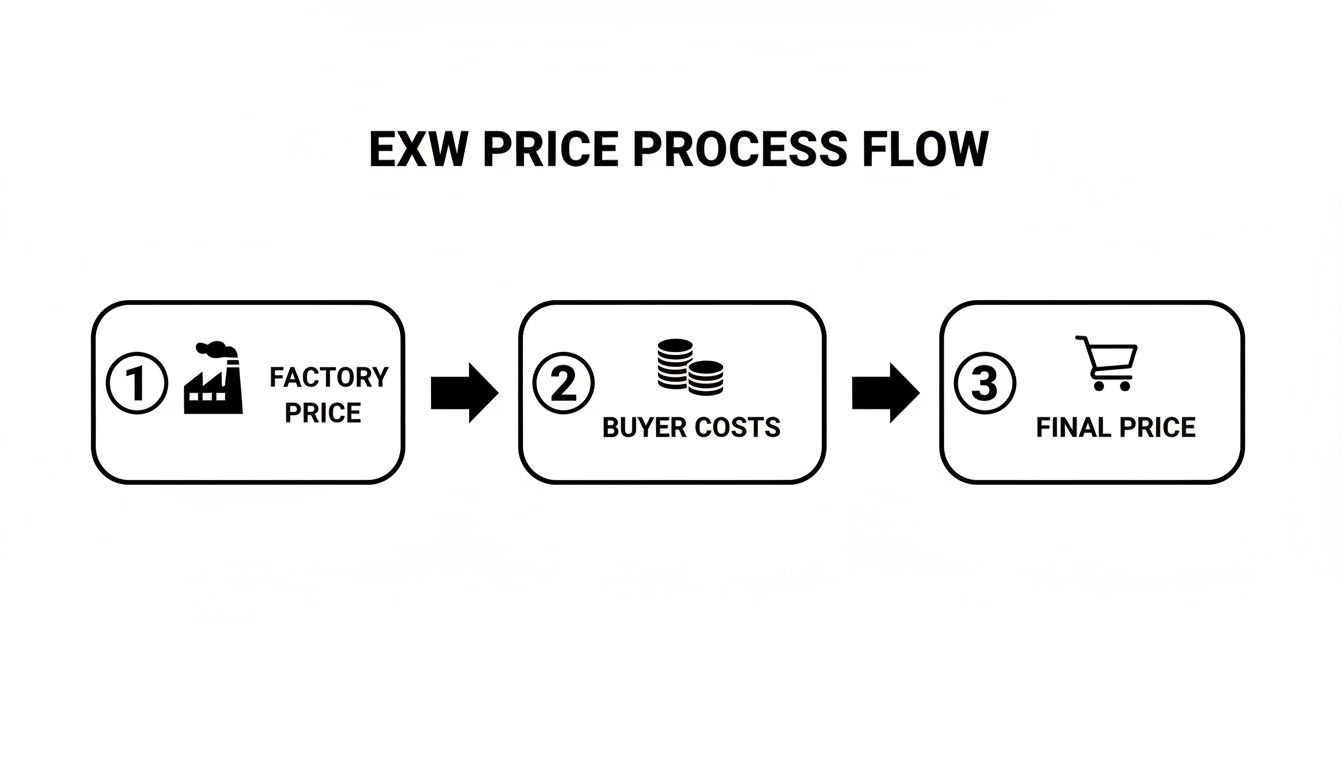
As the diagram shows, your costs make up the bulk of the final price. This massive imbalance of responsibility means you also absorb all the risk and volatility. For instance, recent shocks in China's logistics market have hit EXW buyers hard, with unexpected container rate hikes and tariff changes sometimes increasing total landed costs by over 20% with almost no warning. For more insight, it's worth reading up on recent reports on Chinese export value.
Calculating Your True Landed Cost Beyond the EXW Price
An attractive EXW price is often just the tip of the iceberg. To get a real grip on your total investment, you need to calculate the landed cost. This is the all-in price of getting your product from the factory floor in China all the way to your warehouse door. If you ignore this, that low EXW price is dangerously misleading and can blow your budget to pieces.
Think of it like buying a flat-pack wardrobe. The price tag in the store looks great, but that’s not the end of the story. You still have to factor in the delivery charge, the new tools you might need to assemble it, and even the value of your own time spent putting it all together. The EXW price is exactly like that initial shelf price—it's just the starting line.
Uncovering the Hidden Costs
Your landed cost is the sum of the original product price plus every single logistical expense along the way. These costs pop up at a few key stages, each adding a significant chunk to your final bill.
- Origin Charges: These are all the costs that happen inside China before your goods even get on a ship or plane. We're talking about trucking from the factory to the port, paying for export customs clearance, and various port handling fees.
- International Freight: This is the big one—the main cost of moving your goods from a port in China to a port in your home country. This could be for sea freight (either a full container or a shared one) or the much faster, but pricier, air freight.
- Destination Charges: Once your shipment arrives, another wave of costs hits. This includes import customs clearance, duties and taxes (which can be substantial), more port fees, and the final-mile delivery to your warehouse.
To put this in perspective, let's look at the numbers. A supplier might quote an EXW price of $2,500 for a pallet of goods. But by the time you add inland trucking, export fees, port handling, and ocean freight, your costs can balloon by 80% to over 240% before the shipment even reaches your country's shores.
Let's walk through a quick, hypothetical example to see how an EXW price evolves into the final landed cost.
Sample Landed Cost Calculation from an EXW Price
Cost ItemExample Cost (USD)Who Pays (Under EXW)Product EXW Price$2,500BuyerInland Trucking (China)$200BuyerChina Export Clearance$120BuyerOrigin Port Charges$180BuyerOcean Freight$1,800BuyerInsurance$50BuyerDestination Port Charges$300BuyerImport Customs Clearance$150BuyerImport Duties & Taxes (20%)$500BuyerInland Trucking (Destination)$250BuyerTotal Landed Cost$6,050BuyerAs you can see, the initial $2,500 EXW price more than doubled to a $6,050 landed cost. This is why getting a handle on these numbers _before_ you agree to a price is absolutely critical for your business.
To budget effectively, you have to account for every single one of these expenses. Duties and taxes are especially crucial, as they're calculated based on your product's value and its specific classification code. You can learn more about how to find your product’s tariff classification in our guide to the Harmonized Tariff Code. Once you've accurately figured out your landed cost, understanding how to calculate profit per unit becomes much clearer, ensuring you can price your products both competitively and profitably.
Comparing EXW to Other Incoterms like FOB and DDP
To really get a feel for what EXW means, it helps to see where it fits in the bigger picture. Think of Incoterms as a spectrum of responsibility. On one end, you have total control (and total hassle), and on the other, you have total convenience (at a price).
EXW sits firmly at the "total control" end. It puts nearly all the work on you, the buyer.
A Big Step Up: FOB (Free On Board)
A popular and often smarter choice for many importers is FOB (Free On Board). With FOB, the seller takes on a much bigger chunk of the work. They are responsible for getting your goods from their factory all the way onto the ship at the port in China.
This is a huge deal. It means they handle:
- Trucking the cargo from their facility to the departure port.
- Getting the shipment cleared for export by Chinese customs.
- Covering all the handling fees at the origin port.
Your job, and your costs, only kick in once the goods are safely loaded onto the vessel. This is a game-changer because it takes all the tricky and unpredictable local logistics in China off your plate. For a deeper dive, check out our guide on the FOB price meaning.
The Other Extreme: DDP (Delivered Duty Paid)
At the complete opposite end of the spectrum is DDP (Delivered Duty Paid). This is the ultimate "set it and forget it" option. The seller manages the _entire journey_, from their factory door right to your warehouse, including the main sea freight, insurance, import customs clearance, and all taxes.
While it sounds wonderfully simple, DDP usually costs more and you give up all control over how your goods are shipped.
The choice between EXW, FOB, and DDP really comes down to a strategic trade-off. EXW offers pinpoint control over spending but demands a lot of expertise. FOB is the balanced, middle-ground option, while DDP is all about convenience, not cost-savings or control.
Don't let the initial quotes fool you. A Chinese supplier's EXW quote might look 8–15% cheaper than an FOB quote for the exact same products. But once you start adding up the real costs—inland transport, export documentation, and port fees—that apparent saving disappears. In fact, your final landed cost could end up being 20–40% higher than you planned. You can explore more on choosing the right tariff on resources.yqn.com.
Why a Freight Forwarder Is Your Best Friend for EXW Shipments
Trying to manage an EXW shipment from China on your own, without anyone on the ground, is practically asking for trouble. It's a classic recipe for missed deadlines, surprise costs, and a whole lot of stress. This is exactly why a good freight forwarder isn't just helpful—it's essential.
Think of them as your personal logistics team based in the origin country. They’re the local experts who know how to handle all the tricky details you simply can't manage from thousands of miles away. They take the theoretical challenges of EXW and turn them into a clear, manageable plan.
Your Eyes and Ears on the Ground
When you agree to EXW terms, your freight forwarder is the one who bridges the crucial gap between the seller’s factory floor and the ship setting sail. They do a lot more than just hire a truck; they actively manage the first, and often most complicated, leg of your supply chain.
Here’s what they handle under an EXW agreement:
- Arranging Pickup: They coordinate directly with the factory to collect your cargo, making sure everything is timed perfectly.
- Handling Export Customs: This is a big one. They prepare and file all the paperwork needed for your goods to legally leave China, avoiding a common pitfall for new importers.
- Finding the Best Rates: Thanks to their connections and high shipping volumes, forwarders can get much better carrier rates than an individual business ever could.
- Keeping You in the Loop: They provide tracking and constant updates, so you’re never left wondering where your shipment is.
A great freight forwarder essentially transforms a risky EXW deal into something that feels more like a straightforward FOB (Free On Board) shipment. They take on all the tricky in-country logistics, which is the biggest headache of EXW for any overseas buyer.
To get a better sense of what they do, take a look at our guide on how to pick the right freight forwarder company.
This is especially critical for e-commerce sellers. If you’re selling on a platform like Amazon, getting the logistics right from the factory to the warehouse is everything. This guide on shipping from China to Amazon FBA walks through many of these steps where a forwarder becomes your most valuable player. Partnering with an expert doesn't just make the process smoother—it saves you time, money, and costly errors down the line.
Common Questions About the EXW Price
Getting to grips with Incoterms can feel like learning a new language. Let's clear up some of the most common questions importers have when they first encounter the EXW price.
Can I Still Use EXW If I Don't Have a Presence in China?
Technically, yes, but it’s a risky move unless you have a trusted partner on the ground. Trying to coordinate an EXW pickup, local transport, and export customs clearance from another country is a logistical nightmare waiting to happen.
This is where a good freight forwarder becomes your most valuable player. They act as your hands and feet in China, managing all the local logistics that EXW puts on your plate. Without one, EXW is nearly impossible for an overseas buyer.
Is the EXW Price Always the Cheapest Option?
The initial quote for an EXW price will almost certainly be the lowest number a supplier shows you. But don't be fooled by that low starting figure. It's just the price of the goods sitting at their factory door.
Once you start adding up all the other costs you're responsible for—trucking to the port, clearing export customs, port handling fees, and ocean freight—the total landed cost often ends up being higher than if you had started with a term like FOB.
An EXW price is only the _starting point_. It is rarely the cheapest _total_ cost.
What Is the Biggest Risk with EXW?
Your biggest headache is taking on all the responsibility at the origin, especially export customs clearance in China. This isn't just a bit of paperwork; it requires specific licenses and a deep understanding of local regulations, which most foreign buyers simply don't have.
If there's a single mistake in the export documents, your cargo can get stuck, delayed for weeks, or even seized by customs. A small error can quickly spiral into huge extra costs and completely derail your supply chain. For new importers, this financial risk is a major reason to be cautious with EXW.