Think of a freight forwarder company as the ultimate travel agent for your products. They don't own the planes, ships, or trucks, but they're the experts who orchestrate the entire journey. Acting as a vital intermediary, they use their vast network and deep industry knowledge to handle all the logistics, navigate complex paperwork, and find the best deals with actual carriers. For any business venturing into global trade, this service isn't just helpful—it's essential.
The Architect of Your Global Shipments
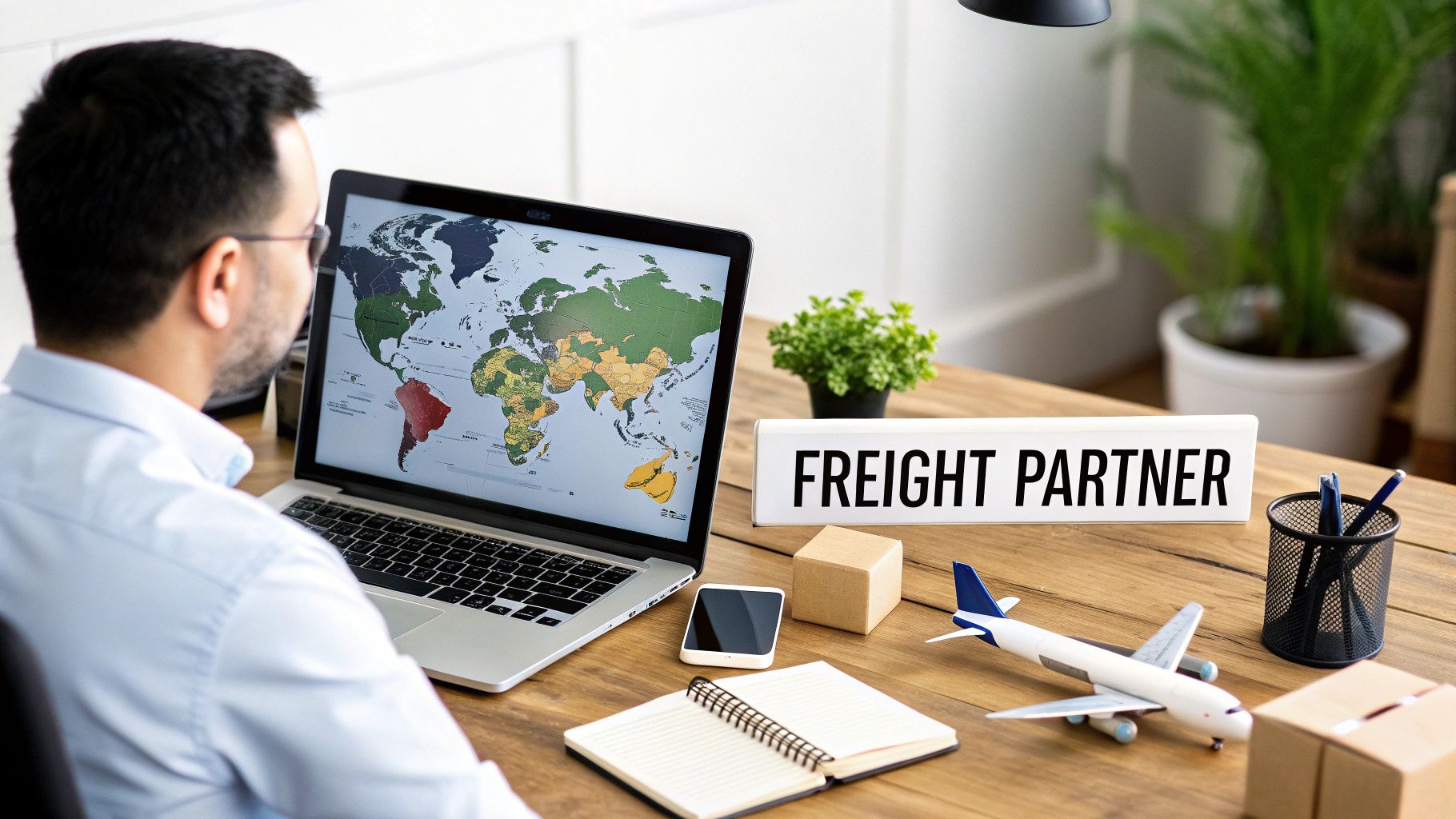
Let's use an analogy. Imagine global shipping is like building a house. You know what you want the final result to be: your goods safely in your customer's hands. But you probably don't know the ins and outs of laying the foundation (customs regulations), wiring the electrics (air freight compliance), or installing the plumbing (ocean freight logistics).
This is where a freight forwarder company steps in. They are your architect and general contractor, all rolled into one. They don't pour the concrete themselves, but they hire, manage, and coordinate all the specialised experts (the carriers) who do. Their whole job is to make a ridiculously complex process feel simple for you. Instead of juggling calls with multiple shipping lines, airlines, and trucking companies, you just make one. Your forwarder takes it from there, making sure every piece of the puzzle fits together perfectly.
So, What Do They Actually Do?
A top-tier freight forwarder company does far more than just book a spot on a container ship. They are logistics pros who manage a whole host of critical tasks to get your shipment from Point A to Point B without a hitch.
- Booking and Negotiating Rates: They leverage their relationships and the sheer volume of cargo they handle to get competitive rates from carriers—prices you'd struggle to get on your own.
- Managing All That Paperwork: International shipping comes with a mountain of documents, from the Bill of Lading to customs declarations. A forwarder ensures every form is filled out correctly and filed on time, preventing hold-ups that can cost you a fortune.
- Coordinating the Entire Journey: This is the real nuts and bolts. They arrange trucking to and from the port, manage warehousing if your goods need to be stored, and map out the most efficient route for your shipment.
- Clearing Customs: Many forwarders either are licensed customs brokers or work hand-in-hand with them. They navigate the maze of export and import regulations to ensure your cargo sails through customs without any issues.
The value here is enormous, especially when you consider massive trade hubs. Take China's freight market, for example, which is expected to reach an incredible USD 1,776.48 billion by 2030. This boom is driven by manufacturing exports, where things like mechanical and electrical goods make up 60% of the total. These items require specialised, secure handling—precisely what a good forwarder provides.
A great freight forwarder doesn't just move boxes; they move your business forward. They become a strategic partner, spotting potential problems before they happen, optimising your supply chain, and giving you the peace of mind that an expert has your back.
Freight Forwarder vs Carrier At a Glance
To make it even clearer, it helps to see the roles side-by-side. A carrier owns the assets (like the ship), while a forwarder organises the entire process.
| Aspect | Freight Forwarder Company | Carrier (e.g., Shipping Line, Airline) |
|---|---|---|
| Primary Role | Logistics architect and coordinator | Owns and operates transport assets (ships, planes) |
| Asset Ownership | Does not own the primary transport vehicles | Owns the vessels or aircraft |
| Client Relationship | Acts as a single point of contact for the shipper | Deals directly with forwarders or large shippers |
| Service Scope | Offers a full suite of services (documentation, customs) | Provides port-to-port or airport-to-airport transport |
| Flexibility | High – can choose from many different carriers | Low – limited to their own network and schedules |
Ultimately, the carrier performs the physical transportation, but the freight forwarder manages the end-to-end strategy, making them indispensable for most businesses.
Why Your Business Needs This Partnership
For small and medium-sized businesses (SMEs), a freight forwarder company is a game-changer. It gives you access to the global marketplace without needing a massive in-house logistics team. They sweat the small stuff so you can focus on what you do best: making great products and serving your customers.
By bundling cargo from multiple clients, they also unlock cost savings that would be impossible to get otherwise. To see how this works in practice, you can learn more about what a comprehensive freight forward service truly involves. In the end, teaming up with the right forwarder isn't just a cost—it's a strategic investment in making your business more efficient, reliable, and ready for growth.
The Core Services That Power Your Supply Chain
Think of a freight forwarder as the director of a complex film production. They don't drive the trucks or fly the planes themselves, but they orchestrate every single moving part to ensure your cargo gets from the factory to its final destination without a hitch. It’s about managing a suite of interconnected services that, when pieced together, form a seamless supply chain.
The whole journey kicks off with one big question: how should your cargo travel? Your forwarder is your guide here, helping you weigh the pros and cons of the two main transport modes.
Air Freight vs. Sea Freight: Speed or Savings?
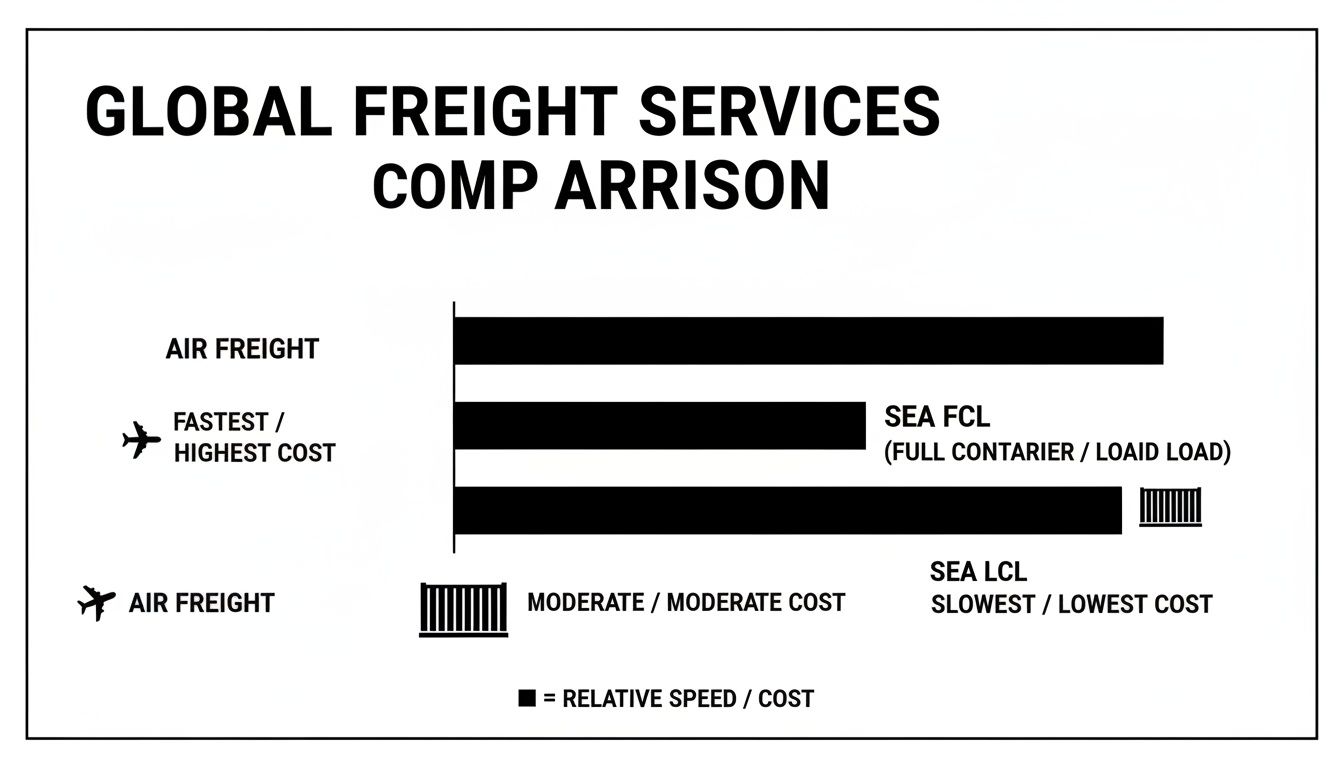
Choosing between air and sea freight boils down to a classic trade-off: time versus money.
Imagine you're launching a hot new electronic gadget. You need to hit the market fast before the hype dies down or a competitor beats you to it. In this scenario, speed is everything, making air freight the obvious choice. Yes, it costs more, but with a transit time of just 1-7 days, your products land on shelves quickly, letting you capitalise on that crucial market window.
Now, picture a different situation. You're restocking a steady-selling, non-perishable item, like ceramic mugs. Time isn't the burning issue here; protecting your profit margin is. This is where sea freight shines. With transit times ranging from 15-35 days (or even longer), it's dramatically cheaper, especially for heavier or bulkier goods. A good forwarder doesn't just present options; they analyse your product, your urgency, and your budget to recommend the mode that makes the most business sense.
FCL and LCL: Decoding Ocean Shipping
Once you've settled on sea freight, the next piece of the puzzle is how your goods will occupy a container. This is where you'll hear the terms FCL and LCL.
- FCL (Full Container Load): This is exactly what it sounds like—you book an entire container just for your shipment. FCL is perfect for larger businesses with enough cargo to fill most of a standard 20-foot or 40-foot container. It’s also generally faster and more secure since your container is sealed at the origin and isn't opened again until it reaches its destination, which means less handling along the way.
- LCL (Less than Container Load): Don't have enough product to fill a whole container? No problem. LCL is your go-to. Your goods are grouped together with other shippers' cargo inside a shared container. It's an incredibly cost-effective way for smaller businesses to access global markets, as you only pay for the specific space you use.
Here’s a simple analogy: FCL is like chartering a private bus for your group, while LCL is like buying a single seat on a public bus. Both will get you where you need to go, but they're tailored for different volumes and budgets.
The Real Value-Add: Services That Prevent Headaches
Moving cargo from Point A to Point B is just the beginning. A truly great freight forwarder provides a host of other essential services that prevent costly delays and add incredible value. This is what separates a genuine logistics partner from a simple booking agent.
Customs ClearanceThis is, without a doubt, one of the most critical parts of the process. Every country has its own maze of import rules, tax codes, and documentation requirements. One tiny mistake on a form can get your shipment stuck in customs for weeks, racking up painful storage fees. Forwarders are customs experts; they ensure every piece of paperwork is filed correctly and on time, paving the way for your goods to clear the border smoothly.
A freight forwarder’s real expertise isn't just in logistics; it's in problem prevention. Proper customs clearance is the difference between a shipment arriving on schedule and one caught in a costly bureaucratic nightmare.
Warehousing and DistributionSo, your goods have arrived at the port. What now? Your forwarder can arrange for them to be moved to a secure warehouse for storage. From there, they can manage the final leg of the journey—breaking down the shipment into smaller orders and distributing them to retail stores, fulfillment centres, or an Amazon FBA facility.
Cargo InsuranceWhile carriers are liable for your goods, their coverage is legally limited and often won't cover the full value if something gets lost or damaged. A freight forwarder will offer comprehensive cargo insurance options that provide real financial protection, giving you peace of mind from start to finish.
When you combine these services with real-time tracking and true door-to-door delivery, you get a complete, end-to-end solution. Instead of you trying to manage a separate trucker, customs broker, and warehouse, your forwarder handles everything. This unified approach transforms a logistical headache into a predictable, streamlined process that lets you focus on growing your business.
Decoding Your Freight Forwarding Costs
Getting your first quote from a freight forwarder can be a bit of an eye-opener. It’s almost never a single, all-in price. Instead, a good quote is a detailed breakdown of every single service needed to get your goods from A to B. This isn't to confuse you; it’s to give you total transparency so you can avoid nasty surprises later on.
Learning to read these components is crucial. It's the only way to accurately compare different offers and keep your budget in check. Think of the final price as being built in layers, with each one covering a specific part of your shipment's journey.
Let's pull back the curtain and look at the most common charges you'll see.
The Anatomy of a Freight Quote
Your total cost is much more than just the price for the boat or plane ride. A trustworthy freight forwarder will itemise everything, making it clear where your money is going.
- Base Freight Rate: This is the big one—the fundamental cost of moving your cargo from the origin port to the destination port. It's usually the largest single line item, but it's far from the final price.
- Terminal Handling Charges (THC): Ports don't work for free. These are the fees charged by port authorities at both ends for handling your container, like lifting it on and off the ship.
- Customs Duties and Taxes: This is what the government charges to allow your goods into the country. Your forwarder will help you calculate this based on your product’s HS code and its value, but the cost is passed directly on to you.
Beyond these core costs, you’ll also find various surcharges. These are designed to manage the unpredictable nature of global shipping.
A detailed quote is the hallmark of an honest freight forwarder. If you get a vague, all-in-one price, be wary. It can easily hide high markups and leave you exposed to unexpected fees down the road. Always insist on a full breakdown.
Many of these extra fees are buffers against market volatility. For instance, the Bunker Adjustment Factor (BAF) is a fuel surcharge that moves up and down with global oil prices. In the same vein, the Currency Adjustment Factor (CAF) helps offset the risk from fluctuating exchange rates. If you want to dive deeper, you can explore the different types of freight surcharges and what you’re really paying for in our handy guide.
Putting It All Together: A Real-World Example
Let's make this real. Imagine you’re shipping a container of electronics from Shanghai, China, to Rotterdam in the Netherlands. A typical quote from a freight forwarder might break down like this:
- Ocean Freight (Shanghai to Rotterdam): The base rate for the sea journey.
- Origin Charges (Shanghai): This bucket includes local costs like THC, documentation fees, and trucking the container to the port.
- Destination Charges (Rotterdam): Covers the costs on the other side, like THC, customs clearance fees, and trucking for final delivery.
- Surcharges: Here you’d see things like the BAF for fuel and maybe a Peak Season Surcharge (PSS) if you’re shipping during a busy time of year.
- Duties & VAT: This is calculated based on the value of your goods when they are officially imported into the Netherlands.
By having each cost listed out, you can now compare quotes from different forwarders on a true like-for-like basis. It helps you see where one might be offering a better deal—is it on their base rate, or are their local handling fees more competitive?
This chart shows how your choice of service—a key factor reflected in your quote—creates a trade-off between speed and cost.
Ultimately, getting comfortable with these cost components gives you power. You can ask smarter questions, spot the hidden fees, and find a freight forwarder who offers genuine value and transparency.
How to Choose the Right Freight Forwarder Company

Picking a logistics partner is one of the biggest strategic calls you'll make. Get it right, and your freight forwarder acts as a genuine extension of your team, stamping out fires before they start and finding opportunities you didn't even know existed. But the wrong choice can trap you in a nightmare of costly delays, damaged goods, and endless headaches.
This isn't just about chasing the lowest price. It’s about finding a true partner—one with the know-how, the network, and the tech to handle what your business throws at them. A little homework now will save you a world of trouble later.
Your Vetting Checklist for Potential Forwarders
Before you even think about requesting quotes, you need a shortlist. Use these non-negotiables to weed out the pretenders and focus on the real contenders.
- Industry-Specific Experience: Do they actually know how to ship your products? Moving fresh produce is a completely different ball game from handling delicate electronics or fashion apparel. Look for a freight forwarder company that gets the specific compliance, handling, and paperwork for your industry.
- A Strong Global Network: A forwarder is only as good as its connections. Ask about their agents and partners in your origin and destination countries. A solid network means smoother handoffs, better local intel, and someone reliable on the ground when you need them.
- Modern Technology Stack: Can they give you a simple online portal to see where your shipment is in real time? Visibility isn’t a luxury anymore; it’s a necessity. A forwarder who invests in good tech is showing you they care about transparency and keeping you in the loop.
- Proper Licensing and Insurance: This is non-negotiable. They must be fully licensed and able to show you proof of their liability and cargo insurance. It’s the safety net that protects you and your goods if the unexpected happens.
Critical Questions to Ask Every Potential Partner
Once you have your shortlist, it’s time to get serious. The way they answer these questions will tell you everything you need to know about how they operate and treat their clients.
- What’s your communication protocol?Will you get a dedicated person who knows your account, or will you be stuck in a generic customer service queue? A single point of contact makes a world of difference.
- How do you handle things when they go wrong?Don't let them off with a vague answer. Ask for specific examples. A great forwarder has contingency plans for everything from port strikes to surprise customs inspections. You're looking for proactive problem-solvers, not excuse-makers.
- Can you provide references from clients in my industry?Talking to their current customers is the best way to get the real story on their reliability and service.
- What’s included in your standard liability coverage?Know exactly what their basic coverage includes and ask about extra cargo insurance options. Never, ever assume you're fully covered. For a full breakdown, check out our guide on freight forwarding services for companies.
This kind of due diligence is essential, especially in complex markets. For instance, the cargo handling industry in China, a vital hub for any global shipper, is made up of 31,486 separate businesses as of 2025. An experienced forwarder knows exactly how to navigate this maze to keep things moving.
A forwarder's true value is revealed when things go wrong. Their ability to communicate clearly, solve problems creatively, and take ownership of a situation is what separates a mere vendor from a genuine strategic partner.
Red Flags to Watch Out For
Knowing what to look for is half the battle; knowing what to avoid is the other. These warning signs should have you running for the hills.
- Suspiciously Low Quotes: If a price looks too good to be true, it is. Rock-bottom quotes are often bait, hiding a swarm of surprise fees, terrible service, or unreliable transit times that end up costing you far more.
- Lack of Transparency: Are their answers vague? Do they refuse to provide a detailed cost breakdown or share references? These are massive red flags.
- Poor Communication: If they’re slow to reply to your emails when they're trying to win your business, just imagine how hard it will be to get an urgent update once they have your cargo.
By using this framework, you can look past the price tag and find a freight forwarder company that delivers reliability, expertise, and a real partnership geared for your success.
Seeing It in Action with Real-World Scenarios
Theory is great, but let's be honest—it’s seeing a freight forwarder solve real problems that truly shows their worth. The challenges of logistics aren't one-size-fits-all, and a forwarder's role shifts dramatically based on who they're working with.
To pull back the curtain, we'll walk through three classic examples: a small e-commerce brand just starting out, a seasoned Amazon FBA seller, and a massive manufacturer. Each story shows how a great logistics partner adapts to drive success.
Scenario One: The Small E-commerce Brand
Picture "Artisan Accents," a new online store importing beautiful, handcrafted ceramics from a small workshop in Vietnam. The owner is brilliant at curating products but knows next to nothing about international shipping. For them, a freight forwarder isn't just a vendor; they're the entire logistics department.
The first thing their forwarder does is recommend the smartest way to ship. Since the ceramics are heavy and don't need to arrive overnight, they suggest using LCL (Less than Container Load) sea freight. This is a game-changer. It means Artisan Accents can ship in small batches without paying for a whole container, keeping their startup costs low.
From there, the forwarder takes over completely:
- Pickup: They arrange a local truck to collect the finished ceramics right from the workshop's door in Vietnam.
- Paperwork: The mountain of export documents and customs declarations? The forwarder handles all of it, avoiding a major headache for the owner.
- Consolidation: The shipment is taken to a warehouse, combined with other small shipments, and loaded into a shared container.
- Final Mile: Once the container lands, the forwarder clears customs and organises the final delivery to the company’s small storage unit.
Without a freight forwarder, the owner of Artisan Accents would be drowning in confusing regulations and paying way too much for shipping. Instead, they get to focus on growing their brand, knowing their products will arrive safely and on budget.
Scenario Two: The Amazon FBA Seller
Next up is "GadgetFlow," an experienced seller using Fulfilment by Amazon (FBA). They source electronic accessories from Shenzhen, China, and ship them directly into Amazon's US warehouses. Their biggest worry isn't just the ocean crossing—it's navigating Amazon's notoriously strict inbound rules.
One tiny mistake in labelling or a missed delivery window can get an entire shipment rejected. That means thousands in lost sales and penalty fees. This is where a forwarder with deep FBA expertise is absolutely essential.
For an FBA seller, the freight forwarder is the guardian of compliance. Their job is to ensure every box and pallet meets Amazon's rigid standards, transforming a high-risk process into a reliable and repeatable workflow.
Here’s what the forwarder’s FBA-specific service looks like:
- Perfect Labelling: They make sure every single item and shipping box gets the right FNSKU and FBA shipping labels before it even leaves China.
- Compliant Pallets: They build pallets according to Amazon's exact size and weight limits. No guesswork involved.
- Booked Appointments: They use Amazon's Carrier Central portal to book a precise delivery appointment at the correct fulfilment centre, which is a process most sellers can't do themselves.
By managing these crucial details, the forwarder ensures GadgetFlow’s inventory flows smoothly into Amazon's network. This prevents stockouts, keeps their products selling, and protects their all-important seller rating.
Scenario Three: The High-Volume Manufacturer
Finally, imagine a huge automotive parts manufacturer shipping components from China to assembly plants all over Europe. We’re talking dozens of containers every single month. Their priorities are all about cost control, efficiency, and building a bulletproof supply chain.
For a client this big, the freight forwarder company becomes a high-level strategic partner. Their main job is to lock in reliable container space at predictable prices. They use their immense buying power to negotiate contracts directly with multiple ocean carriers, getting better rates and guaranteed space that the manufacturer could never get on their own.
But they also act as architects of the supply chain. They might design shipping routes that use a mix of major and secondary ports to dodge congestion. They'll likely build a multi-carrier strategy, so if one shipping line has a delay, cargo can be quickly rerouted to another. On top of that, they provide sophisticated tracking and data analytics, giving the manufacturer total visibility to manage their production schedules down to the day.
In this role, the forwarder isn't just moving boxes—they are an integral part of a complex, high-stakes global operation.
Building a Real Partnership with Your Forwarder
Picking a freight forwarder isn't the finish line; it’s the start. The real magic happens when you stop seeing them as just another vendor and start treating them like a true partner. This means weaving them into your operations until they feel like an extension of your own team—someone who can spot trouble before it starts and fine-tune your supply chain.
This kind of collaboration doesn't just happen. It's built on a bedrock of open communication and solid, repeatable processes. When you nail down an efficient workflow right from the first quote, you're not just buying a service; you're building a powerful asset for your business.
Mastering the Workflow: From Quote to Delivery
A shipment that runs like clockwork is no accident. It’s the result of a clear, well-oiled workflow. When you treat your freight forwarder company like a partner, you give them the crystal-clear information they need to knock it out of the park for you.
Here’s a practical step-by-step guide to making that happen:
- Get Detailed with Your Quote Request: Don't be vague. Give them the specifics—cargo dimensions, weight, HS codes, full origin and destination addresses, and your preferred shipping mode. The better your info, the sharper their quote.
- Get Your Paperwork in Order: Have your commercial invoice, packing list, and any special certificates ready to go. Your forwarder will tell you exactly what’s needed, but having these on hand early on is the best way to avoid frustrating delays.
- Lock in the Booking: Once you've approved a quote, work with them to confirm the spot on the vessel or flight. Be upfront about your cargo-ready date so they can book a slot that actually fits your schedule.
- Team Up on Pickup: Your forwarder handles the cargo collection from your supplier, but this is a three-way conversation. Clear and constant communication between you, your supplier, and your forwarder at this stage is absolutely critical.
- Stay in the Loop: Use the tracking tools they provide. Don’t just set it and forget it. Check in at key milestones, like customs clearance, and be ready to coordinate the final delivery.
A partnership is a two-way street. When you give your forwarder timely and accurate information, you’re empowering them to find you better rates, dodge customs headaches, and keep your supply chain moving smoothly.
Best Practices for Seamless Collaboration
Going beyond the basic workflow is what separates a good relationship from a great one. Working closely together is especially crucial in fast-moving markets. Take China, for example, where the freight forwarding market is expected to hit USD 18,287.5 million by 2030. That growth is fuelled by a colossal road network for e-commerce and rapidly expanding air freight hubs, making a savvy local partner essential. You can dive deeper into these trends with China's freight market outlook on grandviewresearch.com.
To build that kind of rock-solid partnership, focus on these habits:
- Have One Point Person: Getting a dedicated account manager who really gets your business is priceless. It saves you from having to explain your needs over and over again.
- Schedule Regular Check-ins: If you're shipping a lot, a quick weekly or bi-weekly call can keep everyone aligned. It’s the perfect time to review what’s working and tackle potential issues before they grow into real problems.
- Give Honest, Helpful Feedback: If a shipment goes sideways, tell them what happened and why it was a problem. A true partner will take that feedback and use it to make sure it doesn't happen again.
Follow these steps, and you’ll build a resilient, efficient partnership that does more than just move boxes—it helps your business grow.
Common Questions About Freight Forwarding
Even with the basics down, you're bound to have a few lingering questions when it comes time to actually work with a freight forwarder. Let's clear up some of the most common ones so you can move forward with your shipping plans.
Freight Forwarder vs Customs Broker
It's easy to get these two mixed up, especially since their services sometimes overlap. The simplest way to think about it is this: your freight forwarder is the project manager for your entire shipment, coordinating everything from point A to point B.
A customs broker, on the other hand, is a highly specialised expert. They are legally licensed to handle the one critical step of getting your goods cleared through customs. They deal with the paperwork, duties, and all the intricate import regulations. While many forwarders have their own customs brokers in-house, a standalone broker's entire world revolves around that specific checkpoint.
Is Cargo Insurance Necessary?
Absolutely, yes. This is one of those things you don't want to skip to save a few dollars.
While every carrier has some form of liability, it's incredibly limited by law and rarely covers the full value of your products. It's often pennies on the dollar.
Relying solely on carrier liability is a huge financial gamble. Proper cargo insurance gives you "all-risk" coverage, which protects your investment against loss or damage for its full commercial invoice value. It’s a small price to pay for genuine peace of mind.
How Far in Advance Should I Book?
This really depends on how you're shipping and what time of year it is. A good rule of thumb is to book earlier than you think you need to.
- Sea Freight: If you're filling a whole container (FCL), try to book 3-4 weeks ahead. If you're just shipping a few pallets (LCL), you can get away with 1-2 weeks since your goods need to be grouped with others anyway.
- Air Freight: Things move a lot faster here. Booking 5-7 days in advance is usually enough.
Keep in mind, these are just baselines. If you're shipping during a peak season—like right before a major holiday—tack on at least two extra weeks to those estimates. Waiting until the last minute will either cost you a fortune in premium rates or leave you without a spot.