Ever wonder how customs officials in different countries, speaking different languages, all know exactly what's inside a shipping container? They don't rely on a simple description like "cotton shirts." Instead, they use a universal language of numbers: the harmonized tariff code.
This system, often called an HS Code, is a standardized numerical method for classifying traded products. It ensures a box of athletic shoes is identified the same way in Shanghai, Los Angeles, and Hamburg, making global trade possible.
What Is a Harmonized Tariff Code and Why Does It Matter?
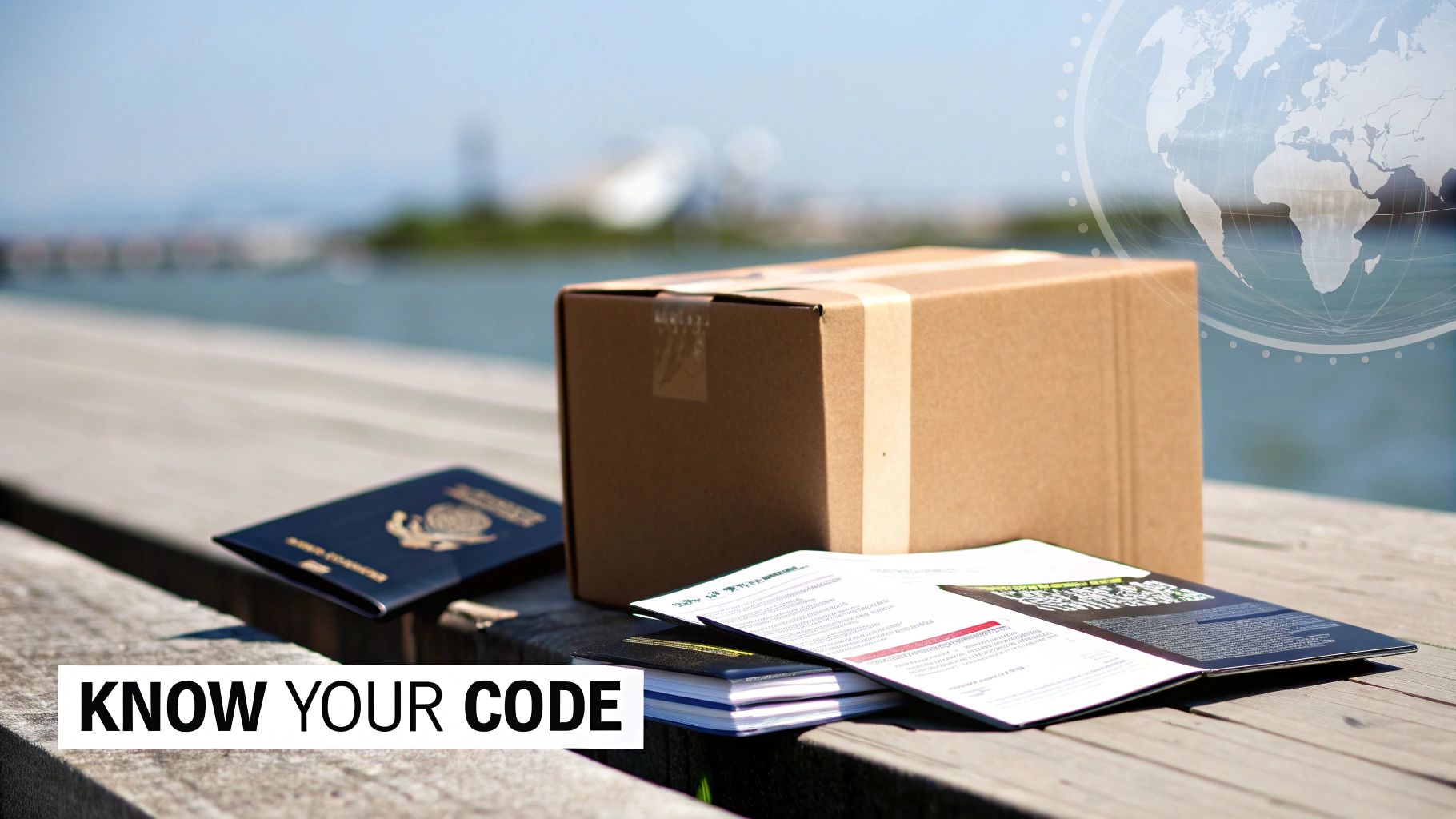
Think of the HS Code as the Dewey Decimal System for everything you can ship. A librarian uses a specific number to locate a book on a shelf, and in the same way, a customs agent uses an HS Code to identify a product and understand how to treat it. It’s a simple concept, but it’s the absolute bedrock of international commerce.
This system is managed by the World Customs Organization (WCO) and is used by more than 200 countries, covering about 98% of all goods in international trade. It's the reason a shipment of "men's cotton t-shirts" isn't held up at the border due to a translation issue or a vague description.
The Core Function of Tariff Codes
At its core, the harmonized tariff code exists to standardise the classification of products globally. This isn't just about keeping things neat and tidy; it has major financial and legal consequences for any business moving goods across borders. The code you declare on your customs forms dictates almost everything that happens next.
Here’s what that code directly controls:
- Determining Duty Rates: This is the big one. The code tells customs exactly which tariffs and taxes apply to your product. A tiny mistake in classification can mean you either overpay by thousands or, worse, underpay and face penalties later.
- Enforcing Regulatory Compliance: Many goods—like food, electronics, or medical devices—are subject to strict government regulations, import quotas, or licensing rules. The HS Code is a flag that tells officials which specific safety and legal standards apply.
- Collecting Trade Statistics: Governments use data from these codes to monitor import and export trends. This information shapes national trade policies and economic strategies.
Why Accuracy Is Non-Negotiable
For any business shipping products, especially from major manufacturing centres like China, getting the harmonized tariff code right is not just another piece of paperwork. It’s a fundamental part of your risk management strategy. A wrong code can set off a chain reaction of costly problems.
Using the wrong harmonized tariff code is one of the most common and expensive mistakes in international shipping. It can lead to shipment seizures, audits, and even the loss of importing privileges, turning a profitable venture into a logistical nightmare.
Getting this code right from the start is crucial for a smooth, predictable supply chain. It ensures your products clear customs efficiently, compliantly, and without surprise costs, laying the groundwork for a successful global business.
Decoding the Harmonized Tariff Code Structure
Think of a Harmonized Tariff Code as a product's international passport. It tells a story, starting with a broad category and narrowing down to a very specific description. It's like a postal address: you start with a country, then a city, a street, and finally, the exact house number. The HS Code works the same way, guiding a product from a general family down to its precise identity.
This numerical language is intentionally layered. It’s a logical system built so that customs officials everywhere—from Shanghai to Southampton—can read it and understand exactly what's inside a container. The first six digits are the universal key to this entire system.
The First Six Digits: A Universal Language
The bedrock of every code is its first six digits. This is the HS Code, and it’s standardised across more than 200 countries that are part of the World Customs Organization (WCO). No matter where your shipment is headed, these first six digits mean the same thing.
This universal part of the code is broken down into three simple pairs:
- Chapter (Digits 1-2): This is the highest-level category. The HS system has 99 chapters, each covering a major product group. For example, Chapter 61 is for "Articles of apparel and clothing accessories, knitted or crocheted."
- Heading (Digits 3-4): The next two digits get more specific. Within Chapter 61, Heading 61.09 narrows it down to "T-shirts, singlets and other vests, knitted or crocheted."
- Subheading (Digits 5-6): The last two digits of the universal code add another layer of detail. Subheading 61.09.10 specifies that the t-shirts are made "Of cotton."
So, with the universal HS Code 61.09.10, any customs agent in the world knows they're looking at a cotton t-shirt. This six-digit sequence is the global standard, forming the very backbone of international trade.
Beyond the Global Standard: Country-Specific Digits
While the first six digits create a common ground, most countries need more detail to handle their own unique tariffs, quotas, and trade rules. To get this extra information, they add more digits to the end of the six-digit HS Code, creating a longer national code.
The United States, for instance, uses a 10-digit system called the Harmonized Tariff Schedule of the United States (HTSUS). The European Union uses an 8-digit Combined Nomenclature (CN) code, and China has its own distinct system.
It's a critical mistake to think the first six digits are enough for a customs declaration. You must always use the full, country-specific code for the destination country to stay compliant and avoid costly penalties.
Let's break down how this works by continuing with our cotton t-shirt example, this time for a shipment arriving in the United States.
The table below shows how a full 10-digit code is built, layer by layer.
Harmonized Tariff Code Structure Breakdown
| Code Digits | Component Name | Level of Specificity | Governing Body |
|---|---|---|---|
| 61 | Chapter | Broadest Category (Knitted Apparel) | WCO (Global) |
| 6109 | Heading | Product Type (T-shirts) | WCO (Global) |
| 6109.10 | Subheading | Material (Cotton) | WCO (Global) |
| 6109.10.00 | Tariff Item | Duty Classification (U.S. Specific) | U.S. Government |
| 6109.10.00.40 | Statistical Suffix | Statistical Tracking (U.S. Specific) | U.S. Government |
In this example, the full 10-digit HTSUS code 6109.10.00.40 tells U.S. Customs not only that it's a cotton t-shirt, but it also gives them the final details needed—like that it's for men—to apply the correct duty rate of 16.5%.
Simply using the six-digit 61.09.10 would lead to an incomplete and incorrect declaration. Understanding this full structure is the first and most important step toward accurate, trouble-free shipping.
How Harmonized Codes Shape Global Trade Policy
A Harmonized Tariff Code is so much more than an administrative detail on a customs form. It's a powerful tool of economic statecraft. Governments use these precise classifications to build and enforce their entire international trade strategy. Think of them as the specific levers that control the flow of goods across borders, making some products more welcome while putting up barriers for others.
When you see headlines about trade wars, tariff hikes, or new free trade agreements, the real fight is happening at the Harmonized Code level. These numbers are the language of economic policy, turning broad government goals into tangible, enforceable rules that directly impact the cost and availability of products around the world.
The Foundation of Tariffs and Duties
At its core, a Harmonized Code’s main job is to determine the duty rate for an imported product. By assigning a specific code to an item, governments apply a corresponding tax. This simple mechanism allows them to protect domestic industries, generate revenue, or discourage certain imports.
Even a tiny difference in classification can lead to a huge change in cost. For instance, a product might initially be classified under a code with a 0% duty rate. But if customs officials decide it fits better under a different code, that rate could easily jump to 25% or even higher. This financial risk is exactly why precise classification isn't just a compliance task—it's a critical part of a company's financial planning.
The infographic below shows how this hierarchical structure works for a simple item like a t-shirt, moving from a general category down to a very specific one.

This top-down logic ensures that every product can be methodically categorised, leaving very little room for ambiguity when it's time to apply trade policies.
An Instrument of Geopolitical Strategy
Harmonized codes are absolutely central to modern economic diplomacy and conflict. Governments use them to roll out a wide array of trade measures designed to achieve very specific political and economic goals.
These policies often include:
- Anti-Dumping Duties: If a country is found to be "dumping" goods in a foreign market at below-production cost, the importing country can impose punitive tariffs on products falling under specific HS codes to level the playing field.
- Import Quotas: Governments can limit the quantity of a specific product that can be imported by tying quotas to its harmonized code. Once the quota is filled, further imports may be blocked or hit with prohibitively high tariffs.
- Free Trade Agreements (FTAs): These landmark agreements rely completely on harmonized codes to define which products get preferential treatment (like lower or zero tariffs) when traded between member nations.
A powerful real-world example is the Section 301 tariffs the United States imposed on Chinese imports starting in 2018. The U.S. government targeted roughly $370 billion worth of Chinese goods by identifying their specific Harmonized Tariff Schedule (HTS) codes and applying tariffs from 7.5% to 25%. These actions, which saw the average U.S. tariff on Chinese imports soar from 2.7% to 17.5%, show just how codes are used to apply precise economic pressure.
Regulating Sensitive and Controlled Goods
Beyond financial penalties, Harmonized Codes are also crucial for national security and public safety. Certain codes act as red flags for customs officials, signalling that a shipment contains goods subject to extra scrutiny or special licensing requirements.
By linking specific Harmonized Codes to regulatory controls, governments can effectively manage the import of sensitive items like firearms, chemicals, advanced technology, and agricultural products, ensuring they meet national standards before ever entering the market.
For example, goods classified under codes associated with dual-use technologies—items with both civilian and military applications—are often cross-referenced against control lists. This system helps prevent the spread of sensitive tech while allowing legitimate commercial trade to continue. To understand more about how this works, check out our guide on the Commerce Control List and its relationship with product classification.
Finding the Right Harmonized Tariff Code for Your Product
Pinpointing the correct harmonized tariff code isn't as simple as punching a keyword into a search bar. It’s more like a methodical investigation—a bit of detective work for your own product. You have to gather all the facts first, because every single detail, from what it’s made of to how it's used, is a crucial clue that leads to the right classification.
The path to an accurate code starts with a deep, honest look at your product's core identity. Before you even glance at a tariff schedule, you need to answer a few key questions with absolute certainty. Getting any of these fundamentals wrong is the number one reason goods get misclassified.
Start with a Product Deep Dive
The very first step is to break down your product from three distinct angles. This initial groundwork is the foundation for everything that follows.
- Composition: What is it made of? You need to be incredibly specific here. Saying it's "plastic" won’t cut it; is it PVC, polyethylene, or another polymer? If it’s a textile, is it 60% cotton and 40% polyester, or is that the other way around? An item's material makeup is often the primary factor that decides which tariff chapter it belongs in.
- Function: What is its primary purpose? This is all about the "essential character" of the item. A phone case might be made of leather, but its main job is to protect a phone, not to be a leather accessory. The intended use can, and often does, override its material composition when it comes to the official rules.
- Condition: How is it packaged or assembled? Is your product shipping whole, as a kit needing assembly, or as part of a set with other items? The state of the product when it crosses the border is governed by specific rules that can completely change its classification.
Once you’ve got these details locked down, you have the evidence you need to start navigating the official classification system.
Using the General Rules of Interpretation
With your product information in hand, it's time to apply the General Rules of Interpretation (GRIs). These six rules are the official, legally binding framework for classifying goods in the Harmonized System, ensuring everyone from Shanghai to Chicago is playing by the same book. They provide a step-by-step logic that helps resolve any classification puzzle.
Think of the GRIs as the official rulebook for the classification game. You must follow them in order. For example, GRI 1 states that classification is determined by the terms of the headings and any related section or chapter notes. This means you should never just jump to a heading because it seems right; you have to read the fine print first.
Navigating the Harmonized Tariff Schedule
Armed with your product details and an understanding of the GRIs, you can now turn to the official Harmonized Tariff Schedule (HTS) of the destination country. For shipments heading to the United States, the ultimate resource is the U.S. International Trade Commission's (USITC) HTS search tool.

The official HTS database lets you search by keyword, but a more reliable approach is to work your way through the chapters methodically.
Start from the top down. First, identify the most logical Chapter for your product based on what it is or what it does. From there, you can drill down into the Headings and finally the Subheadings until you find the most specific description that fits your item like a glove.
Crucial Tip: Always read the Section and Chapter notes before you settle on a code. These notes are packed with critical inclusions, exclusions, and definitions that can completely override what seems like the obvious choice. Skipping them is one of the most common and costly mistakes.
Following this methodical process gives you an accurate and, just as importantly, a defensible classification. If customs ever questions your choice, you can point directly to the GRI, chapter notes, and heading text that led to your decision.
Remember, proper classification is a cornerstone of accurate documentation. For more on the paperwork that goes with it, check out our guide to the commercial invoice. It’s all about building a repeatable, compliant process that shields your business from needless risks and delays every time you ship.
Common Classification Mistakes and How to Avoid Them
Getting a harmonized tariff code wrong might seem like a minor typo, but in the world of global trade, it's a mistake that can set off a chain reaction of expensive problems. The first step to building a solid, compliant supply chain is understanding where shippers most often go wrong. These errors usually start with simple misunderstandings, but the consequences—from surprise duties to seized shipments—are anything but simple.
The point here isn't to scare you; it's to arm you with the right knowledge. When you can spot these common mistakes, you can build a smarter process that protects your budget, your reputation, and your ability to import smoothly.
Overlooking a Product's "Essential Character"
One of the most common slip-ups is classifying a product based on what it's called or a minor feature, instead of its essential character. The official rules—the General Rules of Interpretation (GRIs)—are clear: a product’s main function or what it's primarily made of determines its code.
Take a smartwatch, for example. It's not just a fancy watch. While it does tell time (which falls under Chapter 91), its essential purpose is all about processing data and connecting to other devices. That puts it squarely in Chapter 85, with other electrical machinery. Classifying it as a simple timepiece would attract the wrong duty rate and a lot of unwanted attention from customs.
Misclassifying Kits and Sets
Products bundled together as a kit or set are another classic headache. It’s tempting to classify each item separately or just pick the code for the most valuable piece in the box, but that’s a direct violation of GRI 3. There are specific rules for goods sold together as a set.
The rule of thumb is this: the entire set should be classified under the single code that describes the one component giving the set its essential character. Think of a pasta-making kit with a pasta machine, flour, and sauce. The whole package gets classified under the code for the pasta machine, because that's what defines the kit.
Ignoring the Fine Print in Section and Chapter Notes
The Harmonized Tariff Schedule isn't just a giant list of numbers; it's a legal document. At the beginning of each section and chapter, there are critical notes that provide definitions and spell out what is included or excluded. These notes can completely change what seems like an obvious classification.
Skipping over these notes is like trying to build flat-pack furniture without the instructions—you’re basically guaranteeing a mistake. These notes provide legally binding guidance that clears up confusion and prevents you from making a costly wrong turn.
- Inclusions: These notes will tell you exactly what does belong in a chapter.
- Exclusions: Just as important, these notes specify items that, even if they seem to fit, must be classified somewhere else.
The financial hit from getting this wrong can be huge, especially with shifting trade policies. By September 2025, for example, the average U.S. tariff on Chinese imports is projected to hit 57.6%. At that rate, an incorrect code isn't just a small error—it could be the difference between a routine cost and a crippling expense. You can dive deeper into these dynamics by exploring the impact of tariffs on economic relations in recent trade analyses.
By taking the time to understand what your product truly is, applying the GRIs correctly, and reading the legal notes, you can sidestep these common pitfalls. It’s the key to making sure your shipments clear customs without a hitch.
Getting Customs Right with Expert Classification Support

Let's be honest—untangling the dense web of tariff classifications can drain your team's time and energy. It's a specialised skill, and getting it wrong is costly. This is where a dedicated logistics partner can completely change the game, taking the guesswork and risk out of finding the correct harmonized tariff code.
When you work with an expert, you're no longer on your own trying to decipher complex legal texts and confusing government databases. Licensed customs brokers live and breathe this stuff. They combine years of industry knowledge with powerful tools to make sure every single shipment is classified correctly from the very beginning.
Handing off this critical task immediately cuts your risk of expensive mistakes that lead to fines, shipment holds, and frustrating delays. It's a proactive approach that smoothes out the entire customs journey, fortifying your supply chain and letting your team get back to what they do best: growing your business.
The Real Value of a Professional Partnership
Bringing a freight forwarder like Upfreights on board is about more than just moving boxes; it’s a strategic move in a tough global market. Think of your logistics partner as a shield, protecting you from the financial hits and operational headaches of misclassification.
This kind of support is absolutely vital when trade policies can shift overnight. For example, China’s Ministry of Commerce (MOFCOM) uses HS codes to apply anti-dumping duties with surgical precision. The 74.9% tariff on U.S. POM copolymers, set to protect local industries, is a perfect illustration. It shows just how granular governments can get, making expert classification non-negotiable if you want to avoid these financial traps.
An experienced logistics partner doesn't just find a code; they build a defensible classification strategy. This protects your business from audits and ensures your landed costs remain predictable, which is vital for maintaining healthy profit margins.
Integrated Solutions for Hassle-Free Trade
A true logistics partner weaves classification into a complete package of services. This holistic view ensures that every piece of the puzzle, from the initial paperwork to the final delivery, fits together perfectly. For help with declarations and other import/export documents, specialised UAE documents clearing services can be a great complement to your logistics strategy.
This end-to-end management delivers some serious benefits:
- Less Admin Overload: Experts handle the complex paperwork, freeing up your valuable time.
- Stronger Compliance: Proactive management means you're always ahead of regulatory changes.
- Predictable Costs: Duties are calculated accurately upfront, so there are no nasty surprises.
Ultimately, professional support transforms a potential liability into a smooth, well-managed part of your business. To see how it all comes together, explore our comprehensive guide on Upfreights’ expert customs clearance services.
Got Questions About Harmonized Tariff Codes? We’ve Got Answers.
When you're navigating global trade, it's natural for questions about harmonized tariff codes to pop up. Getting the right answers isn't just helpful—it's essential for staying compliant and keeping your shipments from getting stuck at the border. Let's clear up a few of the most common things shippers ask.
Think of this as your go-to cheat sheet for a few tricky concepts. We'll cut through the jargon and get straight to the point.
What's the Difference Between an HS Code and an HTS Code?
It’s easy to mix these two up, but the difference is pretty simple once you get the hang of it. Imagine the HS code is a product's first name, and the HTS code is its full legal name.
The HS Code (Harmonized System Code) is the universal, six-digit code that acts as a global standard. It’s managed by the World Customs Organization and means the same thing everywhere. So, a cotton t-shirt is classified under 6109.10 whether it’s heading to Shanghai or London.
The HTS Code (Harmonized Tariff Schedule Code) is what an individual country uses. They take the universal six-digit HS code and tack on extra digits for their own customs and statistical purposes. The United States, for instance, uses a 10-digit HTS code. That same cotton t-shirt becomes 6109.10.00.40 when it arrives at a U.S. port.
The takeaway? You must always use the full HTS code required by the destination country. Just using the first six digits won't cut it and will almost certainly cause customs delays.
How Often Do Harmonized Tariff Codes Get Updated?
The HS system isn't set in stone. It has to change to keep pace with new technologies (think drones and 3D printers) and evolving global trade patterns. There are a couple of update schedules to keep on your radar.
The World Customs Organization (WCO) overhauls the entire system every five years. The next big one is slated for 2027. These updates can be significant, adding or deleting codes and completely reorganizing entire product categories.
On top of that, individual countries can tweak their own national tariff lists (like the HTS for the U.S.) more often, sometimes every year. That means the last few digits of your product's code could change annually, even if the first six stay the same. Keeping your codes current is a must.
Can I Just Use the Same Tariff Code for Every Country?
Absolutely not. This is one of the most common and costly mistakes a shipper can make.
While the first six digits of a harmonized tariff code are standardized across most countries, the remaining digits are country-specific. The 10-digit code you use for the U.S. is not the same one you'd use for a shipment going to Canada, China, or the European Union.
Every country attaches its own duties, regulations, and trade agreement benefits to its unique set of codes. You have to do your homework and find the complete, correct code for the specific country you're shipping to. No shortcuts