Think of a sourcing agent in China as your dedicated partner on the ground. They are a professional who steps in to manage the entire, often tricky, process of finding, vetting, and buying products directly from Chinese factories for you.
Essentially, they become your eyes and ears, acting as a strategic ally who knows the local manufacturing scene inside and out. Their job is to protect your interests, negotiate better deals, and make sure the quality of your products is up to scratch. This relationship can turn what feels like a risky gamble into a smooth, reliable part of your business.
Why a Sourcing Agent Is Your Competitive Edge

Many newcomers think they can manage sourcing themselves using sites like Alibaba. And while these platforms are great for initial research, they don't offer the deep, hands-on support you need for serious, long-term manufacturing.
Going it alone on a marketplace is like trying to explore a foreign country with just a tourist map. You'll find the main attractions, sure, but you'll completely miss the hidden gems and local know-how that lead to real success. A professional sourcing agent provides a level of access and security that a website simply can't. They tap into their established relationships—known as guanxi—to connect you with excellent factories that aren't even listed online. These are often the specialised, high-quality manufacturers that can give you a genuine advantage.
Sourcing Agent vs. DIY Sourcing on Alibaba
It’s easy to underestimate the difference between having a professional on your side and navigating the world of online sourcing platforms by yourself. Here’s a practical breakdown of what that looks like in the real world.
| Factor | Dedicated Sourcing Agent | DIY Sourcing (Alibaba) |
|---|---|---|
| Supplier Vetting | In-person factory audits, background checks, and verification of certifications. | Relies on supplier-provided info, online reviews, and platform ratings, which can be manipulated. |
| Negotiation | Expert negotiation in Mandarin, leveraging local market knowledge and relationships for better pricing. | You negotiate directly as a foreign buyer, often leading to higher "foreigner pricing" and miscommunications. |
| Quality Control | On-site inspections during and after production to catch defects before shipment. | You can only inspect goods upon arrival, making it costly and difficult to resolve quality issues. |
| Communication | Fluent, real-time communication that bridges cultural and language gaps effectively. | Potential for significant language barriers, misunderstandings, and slow response times due to time zones. |
| Problem Solving | Proactively resolves issues on the ground, from production delays to quality problems. | You're left to handle disputes from thousands of miles away, with limited recourse. |
| Access to Factories | Connects you to a wider network of unlisted, high-quality factories. | Limited to suppliers who actively market themselves on the platform, not necessarily the best ones. |
The table makes it clear: while DIY sourcing can seem cheaper upfront, a dedicated agent invests in the long-term health and reliability of your supply chain.
Beyond the Browser Window
The true value of an agent really shines when things get complicated.
Picture this: you're developing a new electronic gadget. The supplier on Alibaba sends you a perfect sample, so you place a large order. But when the first mass-production shipment arrives, you discover the circuit boards are faulty. Without someone physically there, your only option is a frustrating and often useless online dispute process from the other side of the world.
A good sourcing agent prevents this kind of disaster before it even starts. They're on the ground performing factory audits, checking initial production samples, and overseeing quality control throughout the manufacturing run. They are your QA team, catching small mistakes before they escalate into huge financial losses. This proactive approach is what building a reliable supply chain is all about.
The Unseen Financial Benefits
Yes, agents charge a commission, but their value almost always outweighs the cost. A skilled agent who speaks the language and understands the culture can often negotiate prices 15-30% lower than what a foreign buyer could get on their own. They know how to navigate the nuances of a business deal in China, avoiding common traps that lead to inflated quotes or bad payment terms.
They also consolidate products from different suppliers, which helps you pack shipping containers more efficiently and cut down on freight costs. An agent handles the mountain of paperwork and coordinates with freight forwarders, ensuring everything moves smoothly from the factory to the port. This expertise frees you up to focus on what you do best—growing your business, not getting tangled in logistics.
A great sourcing agent isn't an expense; they are an investment in risk mitigation, quality assurance, and supply chain efficiency. They pay for themselves by preventing costly mistakes and unlocking opportunities you wouldn't find on your own.
This kind of partnership is especially crucial when you get into more complex production. For businesses needing custom designs or product modifications, it's vital to understand the different manufacturing models available. You can learn more about these methods by exploring our guide on OEM and ODM manufacturing processes.
Ultimately, a sourcing agent in China is much more than just a middleman—they are a core part of your competitive strategy.
Finding Your Agent in China's Manufacturing Hubs

It’s a common mistake to think of China as one enormous factory. In reality, it’s a massive network of specialised industrial clusters. Each region has its own unique strengths, a distinct business culture, and a finely tuned supply chain ecosystem.
This geographical specialisation is exactly why on-the-ground, local expertise is non-negotiable when you're looking for a sourcing agent in China. You wouldn’t look for heavy machinery in a city known for high fashion, and the same logic applies here. An agent’s real value comes from their deep-rooted connections and hands-on experience within the right manufacturing hub for your specific product.
Pinpointing the right region from the get-go is the critical first step. It practically guarantees your potential agent has the right contacts and industry-specific know-how to find the best factories, negotiate like a local, and anticipate quality control issues unique to your product category.
The Electronics Epicentre: Shenzhen
Known globally as the "Silicon Valley of Hardware," Shenzhen is the undisputed king of consumer electronics, telecom gear, and all things tech. The city thrives on an incredibly dense network of component suppliers, assembly lines, and rapid prototyping services that can take an idea to a product in record time.
An agent here isn't just a go-between; they need a solid technical grasp of electronics manufacturing. Their expertise should cover:
- Component Sourcing: They need to know precisely where to find reliable suppliers for everything from PCBs and microchips to casings and batteries.
- Technical Vetting: They must be able to properly assess a factory’s engineering capabilities, check for essential certifications (like CE or RoHS), and understand their production technology.
- Agile Project Management: The tech world moves fast. A good agent has experience managing the quick product development cycles that are standard practice in Shenzhen.
Without this specialised knowledge, an agent is just spinning their wheels, leaving your project wide open to technical mix-ups and costly quality failures.
The Small Commodity Capital: Yiwu
Yiwu is a universe unto itself. It's home to the Yiwu International Trade City—the largest wholesale market for small commodities on the entire planet. This is the place to be if you're sourcing a wide variety of consumer goods, often with very low minimum order quantities (MOQs).
An agent in Yiwu plays a different game. Their core skills involve:
- Supplier Consolidation: They are masters at juggling orders from dozens of different vendors and consolidating everything into a single, efficient shipment.
- Market Navigation: They know the market’s sprawling layout like the back of their hand and have built relationships with the best stall owners and small factories.
- High-Volume Logistics: They have deep expertise in packing mixed containers and managing the complex web of paperwork that comes with it.
If you’re an e-commerce seller looking to source a diverse mix of products—think kitchenware, toys, or fashion accessories—a Yiwu-based agent is an absolute game-changer. For a closer look at sourcing high-quality, affordable jewelry from Chinese manufacturers, which is a perfect example of what a local agent can unlock, this guide is a great resource.
Other Key Hubs and Their Specialties
Let's look at a couple of other major hubs where regional expertise is everything.
Guangzhou and the Pearl River Delta
This region, which includes cities like Dongguan, is an absolute powerhouse for apparel, textiles, and fashion accessories. You’ll find massive fabric markets and countless garment factories. An agent here needs a sharp eye for fashion trends, material quality, and the tiny details of apparel production, from pattern making to the final stitch. Many of these agents are regulars at the Canton Fair; you can get a feel for this massive event with our detailed Canton Fair map and guide.
Foshan for Furniture and Building Materials
Just a short trip from Guangzhou, Foshan is the heart of China’s furniture industry. Whether you're after home furniture, office chairs, or ceramics and tiles, this is your destination. A sourcing agent in Foshan needs experience handling large, bulky items, a solid understanding of wood and metal grades, and the ability to oversee production that demands a high degree of craftsmanship.
Remember, you aren't just hiring a person; you're gaining access to an entire regional network. The right agent in the right city opens doors to the best suppliers, better prices, and a much smoother production process designed around your product.
How to Properly Vet Your Sourcing Agent
Finding a few potential sourcing agents online is the easy part. The real work—the part that separates a successful partnership from a costly disaster—is the vetting process. You’re not just hiring a contractor; you’re bringing on a partner who will be your eyes, ears, and hands on the ground thousands of miles away. A quick Google search and a nice-looking website just won't cut it.
Think of this as a deep background check. You need to dig past the sales pitch and look for hard evidence of their experience, reliability, and, most importantly, their integrity. I’ve seen countless importers get burned by skipping this step, and it's an expensive lesson to learn.
First, Build Your Shortlist
Before you can vet anyone, you need a solid pool of candidates. My advice is always to cast a wide net initially and then aggressively narrow it down.
- Lean on Your Network: Start here. Ask other importers, brand owners, or anyone in your professional circle for a referral. A warm introduction from someone who has already worked with an agent is worth its weight in gold.
- Use LinkedIn Like a Pro: Don't just browse. Use targeted searches for titles like "Sourcing Agent" or "Procurement Manager" and filter by key manufacturing hubs like Shenzhen, Yiwu, or Guangzhou. Look for detailed profiles, real endorsements, and experience that matches your product category.
- Check Out Virtual Trade Shows: These have become a fantastic way to meet agents who are actively working in your niche. They’re already dialed into the latest trends and have current factory connections.
Once you have a shortlist of three to five candidates who look promising on paper, it's time to put them to the test.
The Vetting Checklist: Your Non-Negotiables
This is where you shift into interview mode. You need a methodical approach to gather the same information from each candidate so you can make a true apples-to-apples comparison. Don't be afraid to ask for proof.
Your first email should be short, professional, and clear about your product. The goal is to get them on a video call. Once you're face-to-face (virtually), you need to verify a few critical things.
Core Verification Points
- Business Licence & Registration: This is your first and most important check. Ask for a copy of their official Chinese business licence. Any legitimate company will have this on hand and will provide it immediately. This simple document proves they are a real, registered business, not just a freelancer working from a cafe.
- Relevant Industry Experience: General sourcing experience is one thing, but you need someone who knows your product category. If you’re making high-spec electronics, an agent who mostly sources textiles won't have the right factory network or technical know-how. Ask them for specific examples of similar products they've managed.
- Real Client References: Ask for contact details for two or three clients, ideally from your own country. A good agent with happy clients will be proud to share them. If they hesitate, make excuses, or flat-out refuse, that's a huge red flag.
- Communication & Reporting: How will they keep you in the loop? Do they use WeChat for quick updates? Email for formal reports? A project management tool? Get a clear picture of their communication process for factory audits, production updates, and quality control. You need an agent who is proactive, not one you have to chase for information.
A refusal to provide a business licence or client references should be an instant disqualification. Experienced, legitimate agents expect these requests and see them as a sign of a serious client.
Powerful Questions That Reveal the Truth
With the basics covered, you need to ask questions that reveal how they think, how they solve problems, and where their loyalties lie. Their answers—and how they answer—will tell you everything you need to know.
Questions About Their Process
- "Walk me through your factory audit. What specific things are you looking for beyond just a price list?"
- "How do you handle quality control? Is it you personally visiting the factory, or do you use a third-party service?"
- "Tell me about a time a production run went wrong for a client. What was the issue, how did you handle it, and what was the final result?"
Questions About Transparency & Ethics
- "How do you guarantee I'm getting the true factory price? Will I see the original proforma invoice from the supplier?"
- "What is your policy on accepting commissions or 'kickbacks' from factories?"
Pay close attention to how they answer that last question. The only acceptable answer is a quick and firm, "We don't accept them." An ethical agent works for you, and their fee is their only compensation. Any hesitation or a vague answer about "standard industry practice" is a massive warning sign.
A professional sourcing agent in China knows their reputation for trust and transparency is their most valuable asset. This vetting process isn't about being difficult; it's about protecting your business and laying the groundwork for a profitable, long-term partnership.
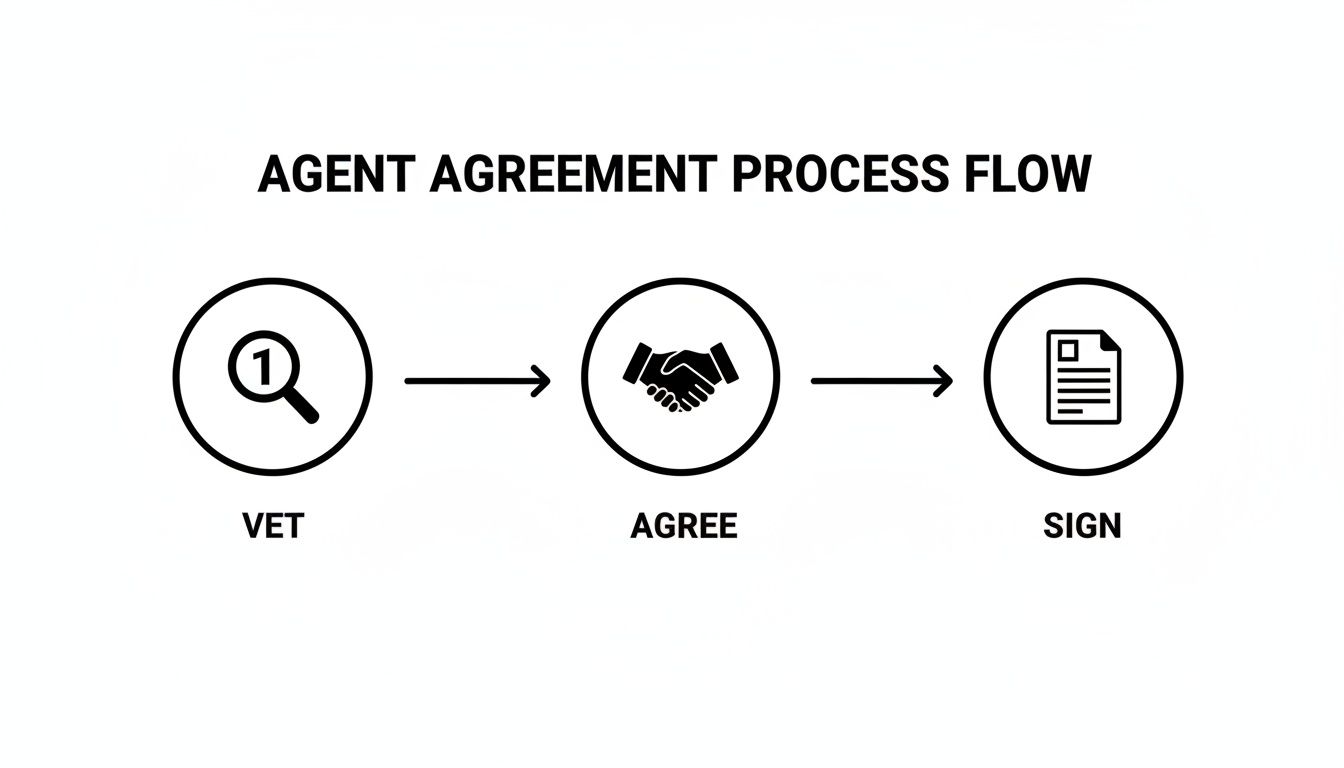
Getting the Paperwork Right: Your Sourcing Agreement and Costs
Once you've found a sourcing agent who seems like a great fit, it’s time to make it official. Don't rely on a handshake and good faith. A solid, well-defined agreement is the bedrock of a successful partnership, protecting both you and your agent in China.
Think of it as the rulebook for your relationship. It lays out exactly what you expect, how they’ll get paid, and what happens if issues pop up. Skipping this step is a rookie mistake that can lead to blown budgets, surprise fees, and a whole lot of frustration down the road.
How Sourcing Agents Get Paid: Decoding the Fees
Understanding your agent’s fee structure is key to managing your costs and making sure your goals are aligned. While the specifics can vary, most agents use one of a few standard models.
The most common arrangement by far is a commission-based fee. This is typically a percentage of the total factory order value, usually hovering between 5% to 10%. That figure isn’t set in stone, though. For massive orders, you might see it drop to as low as 1-3%, while small or highly complex sourcing projects could push it higher. The appeal of this model is that the agent’s income is tied directly to your business volume—they do well when you do well.
But you have to be crystal clear on what that percentage is calculated on. Is it just the raw factory price, or does it also include things like local shipping and taxes in China? For example, understanding the definition of EXW price is crucial, as it helps you confirm if your agent’s commission applies only to the product cost before any other logistics expenses are tacked on.
A few other payment models you might encounter include:
- Flat Fee: Perfect for a one-off, clearly defined project. If you just need someone to find a supplier for a single product and oversee the first production run, a fixed price gives you budget predictability.
- Monthly Retainer: For businesses needing constant, ongoing support—like managing multiple factories or sourcing new products every month—a retainer makes more sense. This is common for established brands with a steady workflow.
- Hybrid Model: Sometimes you’ll see a mix, like a small monthly retainer to keep the agent on call, plus a lower commission percentage on any orders placed.
Expert Insight: There’s no single "best" fee structure—it all comes down to what makes sense for your business. A startup launching its first product will likely lean toward a commission model to keep initial cash outlay low. In contrast, a larger company with a continuous production pipeline might prefer the predictable cost of a monthly retainer.
The Must-Have Clauses in Your Sourcing Agreement
Your sourcing agreement is your shield. It needs to be clear, thorough, and written in plain language that leaves no room for interpretation. Any professional agent will not only expect a formal contract but will see it as a sign that you’re a serious and organised client.
Your agreement should be a detailed playbook for how you'll work together. Make sure these key areas are covered to prevent any "he said, she said" moments later on.
Key Components to Insist On
- Scope of Work (SOW): This is the core of the contract. It needs to be incredibly specific. List out every single task you expect the agent to handle, from factory identification and audits to price negotiations, sample coordination, quality control inspections, and helping with logistics.
- Compensation and Payment Terms: Clearly define the fee structure (commission percentage, flat rate, etc.) and the payment schedule. When are commissions due? How will you pay them? Spell it all out.
- Confidentiality and Non-Disclosure: Your product designs, supplier contacts, and business plans are your secret sauce. A rock-solid non-disclosure agreement (NDA) clause is absolutely non-negotiable to protect your intellectual property.
- Transparency and Factory Invoices: This is a big one. The contract must state that the agent will provide you with the original proforma invoices from the factory whenever you ask. This is your best defense against shady agents adding secret markups or taking kickbacks. It ensures you’re paying the real factory price.
- Termination Clause: Things don’t always work out. The agreement should clearly outline how either you or the agent can end the partnership, including the required notice period and how any works-in-progress or final payments will be settled.
Your On-the-Ground Workflow From Sourcing to Shipping
Once the agreement is signed, your sourcing agent shifts from a prospect to a critical extension of your team in China. This is where the real work kicks off—the process of turning your product concept into a high-quality, physical good, all ready for shipment. It's a structured journey designed to stamp out risks and boost efficiency at every turn.
It all begins with your product brief. This document is the absolute foundation, and it needs to be packed with detail. Don't just send a picture; include technical specs, materials, specific Pantone colours, dimensions, and your target price. The more clarity you provide upfront, the quicker your agent can zero in on genuinely qualified suppliers.
This initial precision is non-negotiable. A fuzzy request like "I want a high-quality backpack" will only lead to a scattered search and a pile of useless quotes. A detailed brief, on the other hand, lets your agent tap into their network with purpose, shortlisting only the manufacturers who can actually meet your standards.
From Supplier Shortlist to Golden Sample
Armed with your detailed brief, your agent gets to work finding and vetting suppliers for you. They’ll dive into their local network, contacting factories they trust from past experience while also scouting for new potential partners. This isn't just a quick online search; it involves real conversations and initial qualification calls to weed out the pretenders.
Pretty quickly, you should get back a curated shortlist of three to five potential factories. Your agent will give you a full rundown on each one, including their initial quotes, production capacity, and any preliminary audit notes. This keeps you in the driver's seat, letting you make an informed decision without feeling overwhelmed.
Once you’ve picked the most promising factory, the next crucial phase is getting samples made. Your agent will coordinate the creation and delivery of these pre-production samples, which serve as your first physical reality check on the factory's abilities. This is your moment to hold the product, test its function, and scrutinise the material quality before you even think about committing to a full production run.
The "golden sample" is the final, perfect version of your product that you approve. This single sample sets the benchmark for quality, and every single unit in the mass production run will be measured against it during inspections. Never, ever give the green light for mass production until you are 100% satisfied with this sample.
Quality Control: The Three-Tiered Safety Net
Here is where a top-tier sourcing agent truly proves their worth. They don’t just hope for the best; they implement a multi-stage quality control (QC) process to spot problems early, safeguarding both your money and your brand’s reputation.
This process typically includes:
- Pre-Production Inspection (PPI): Before a single item is made, the agent confirms the factory has sourced the correct raw materials and components, matching them exactly to your golden sample.
- During Production Inspection (DPI): About halfway through the production run, the agent or their team will show up at the factory. They pull products right off the assembly line to check for any deviations, catching systemic mistakes before thousands of faulty units are produced.
- Final Random Inspection (FRI): Once production is finished and at least 80% of the goods are packed, a final inspection happens. A random selection of products is meticulously checked against a detailed QC checklist covering everything from appearance and function to packaging.
To make this process concrete, you should provide your agent with a clear checklist. It removes any ambiguity and ensures they are checking for the exact things you care about.
Sample Quality Control Checklist for Your Agent
Here is a basic template you can adapt. The more specific you are in the "Required Specification" column, the better the outcome will be.
| Inspection Point | Required Specification | Pass / Fail | Agent Notes |
|---|---|---|---|
| Product Colour | Must match Pantone 285 C exactly. | ||
| Logo Application | Screen-printed logo; centred, no smudges or cracks. | ||
| Stitching & Seams | Straight, even stitches, no loose threads >5mm. | ||
| Functionality Test | Zipper must open/close smoothly 10 times without sticking. | ||
| Packaging & Labelling | Each unit in a polybag with correct barcode SKU label applied. | ||
| Drop Test (for packaged goods) | Survive a 1-metre drop onto concrete without product damage. |
This structured inspection workflow is your best defence against catastrophic quality failures, ensuring the products that get shipped are the ones you actually paid for.
Coordinating Logistics From Factory to Port
The agent's job isn't over once the last box is taped shut. They are the essential bridge between the factory floor and your freight forwarder, managing the often-tricky handover. A good agent ensures all export documents are filled out correctly and that your cargo is ready for pickup right on schedule.
This coordination is especially important in massive sourcing hubs. In Yiwu, for example—a city with an export value of around $90 billion a year—agents are masters of the local market procurement model. They can consolidate small orders from dozens of different vendors into a single container, a strategy that drastically slashes shipping costs for buyers.
To keep your operations running smoothly, especially when you need to review inspection reports or approve shipments from afar, having reliable internet access is key. Using one of the best VPNs for China ensures your communication lines stay open. From there, your agent liaises with a freight forwarder like Upfreights to manage the final, critical leg of the journey to your warehouse, whether by sea or air.
Answering Your Top Questions About Sourcing Agents
Even with the best-laid plans, you’re bound to have some nagging questions before you hire a sourcing agent. Getting straight answers to these common queries is often the last step before you can confidently move forward. Let's tackle the questions that come up time and time again.
What’s a Fair Commission for a Sourcing Agent in China?
The industry standard is a commission based on the total order value, often called the FOB (Free On Board) price. You’ll typically see this commission fall somewhere between 5% and 10%.
But that number isn't fixed. The final percentage really hinges on the size and complexity of your order. For a massive, straightforward order of a simple product, an agent might agree to a commission as low as 1-3%. On the flip side, if you have a small, highly customised order that requires extensive sourcing, complex negotiations, and hands-on quality control, expect the rate to be on the higher end.
The most important thing? Make sure you know exactly what that percentage covers. Is it just the product cost, or does it include other domestic fees within China? A good agent will spell this out clearly in your agreement, so there are no nasty surprises down the road.
How Do I Know If an Agent Is Taking Kickbacks from Factories?
This is a legitimate fear and one of the biggest risks for importers. If an agent is taking a secret payment from a factory, their loyalty is to the factory, not to you. Your best defence here is to demand total transparency from day one.
A trustworthy sourcing agent in China won’t flinch when you ask for the original proforma invoices from the manufacturer. That document reveals the true factory price. If you’re still feeling uneasy, you can even ask for the factory’s contact details to verify things yourself.
Key Takeaway: Reputable agents build their business on trust and a solid reputation. That long-term asset is worth far more to them than a quick, shady kickback on one order. Ask them directly about their policy on factory commissions during your interviews and pay close attention to their response.
When you're vetting potential agents, just ask them point-blank: "What is your policy on factory commissions?" The only answer you want to hear is a confident, "We don't accept them." Any hesitation or attempt to sidestep the question is a massive red flag.
Does a Sourcing Agent Also Handle Shipping and Customs?
This is where things can get a bit blurry. While many sourcing agents will help coordinate logistics, they are almost never licensed freight forwarders. Their main job is to manage everything up to the point the goods are ready to leave China.
Here’s what you can typically expect an agent to handle on the logistics front:
- Making sure your products are packed correctly and ready to go on the agreed-upon date.
- Gathering and organising all the necessary export documents from the factory.
- Coordinating the handover of your cargo to the shipping company, acting as the main point of contact.
Think of them as the crucial link between your factory and your freight forwarder. The smoothest operations happen when your sourcing agent and a dedicated freight partner, like Upfreights, work as a seamless team. This ensures a clean handoff from production management to final, reliable delivery.
What's the Real Difference Between a Sourcing Agent and a Trading Company?
Nailing this distinction is critical because it defines your entire relationship. It all boils down to loyalty and transparency.
A sourcing agent works for you. You pay them a clear fee for their service, and their one and only job is to protect your interests. They are your feet on the ground, finding the best factory for your unique needs.
A trading company, on the other hand, is basically a middleman. They buy products from a factory, slap on a margin, and sell them to you. In that setup, the trading company is the seller, not your partner. You often have no visibility into who the actual manufacturer is or what the real cost of the goods was.
Trading companies might be convenient for simple, one-off buys. But for building a serious, long-term business, a sourcing agent gives you far more control, transparency, and a much better price. You get a direct line to the source, empowering you to build a supply chain that's both more resilient and cost-effective.