When you're looking to get a product made, you'll constantly hear the terms OEM (Original Equipment Manufacturer) and ODM (Original Design Manufacturer). They might sound similar, but they represent two completely different ways to bring your product to life.
With OEM, you’re the architect. You give a factory a unique design to build exclusively for you. With ODM, you’re more like a curator, picking a ready-made product from a factory’s catalogue and simply adding your brand's logo.
Your Blueprint or Theirs? Understanding OEM and ODM
Think of it like building a house. Your choice here will define everything—your creative control, the final cost, and even how quickly you can launch. One path is like hiring an architect to build a custom home from your own unique blueprints. The other is like choosing a beautiful model home and just personalising the paint and fixtures.
That's the real difference between OEM and ODM manufacturing.
Original Equipment Manufacturer (OEM)
An OEM is your custom home builder. You hand them detailed plans, exact specifications, and a clear vision for something brand new. They then use their machinery and manufacturing expertise to build your product precisely to your design.
This route gives you total control and results in a product that's truly yours, something no competitor can just copy off a shelf. It's the perfect path for innovators with a proprietary design or a unique take on a product.
Original Design Manufacturer (ODM)
An Original Design Manufacturer (ODM), on the other hand, is like the developer of a new housing estate. They’ve already done all the hard work—the design, the engineering, and the prototyping. You just browse their catalogue of proven products, pick one that fits your brand, and ask them to put your logo on it.
This "white-label" or "private-label" approach is much faster and requires a significantly smaller upfront investment in research and development.
Key Takeaway: The decision really comes down to who owns the design and the intellectual property. With OEM, the design is yours. With ODM, the design belongs to the factory, and you're essentially licensing it under your brand name.
Getting this distinction right is the first, most critical step in building a smart sourcing strategy. It impacts everything that follows, including the financial side of things and what's included in an EXW price. So before you get into cost comparisons or logistics, you have to ask yourself the main question: are you bringing the blueprint, or are you just choosing from the gallery?
OEM vs ODM: A Head-to-Head Breakdown
Picking between an OEM or an ODM partner is one of the biggest calls you'll make as an importer. This isn't just about finding a factory; it's a strategic move that will shape everything from your launch budget and lead times to your brand's unique place in the market.
To get it right, we need to put these two models side-by-side and look at how they really stack up on the factors that matter most.
If you're wondering where to even start, this decision tree offers a simple gut check. The big question is: do you have a completely original product design ready to go?

As you can see, having a unique blueprint is the fork in the road. If you have one, you're on the OEM path. If you don't, the ready-made ODM route is your most logical starting point.
For a more detailed comparison, let's look at the key differences in a quick-reference table.
OEM vs ODM Key Differences at a Glance
This table breaks down the most critical factors you'll need to weigh when deciding which manufacturing model fits your business goals.
| Factor | OEM (Original Equipment Manufacturer) | ODM (Original Design Manufacturer) |
|---|---|---|
| Product Design | You provide the complete design specifications. The product is 100% yours. | The factory provides a pre-existing product design. You choose from their catalogue. |
| Intellectual Property (IP) | You own all IP rights, including patents and schematics. It’s your asset. | The factory owns the core product IP. You only own your branding and minor tweaks. |
| Upfront Costs | High. Includes full R&D, prototyping, and expensive tooling/moulding costs. | Low. The factory has already paid for R&D and tooling, so your entry cost is minimal. |
| Customisation | Virtually unlimited. You control every material, feature, and component. | Limited. Mostly cosmetic changes like colour, logo, and packaging. |
| Time to Market | Long. Development can take months or even years from concept to production. | Fast. You can go from product selection to market in a matter of weeks. |
| Minimum Order Quantity (MOQ) | Generally much higher, as the factory needs to cover custom setup costs. | Typically lower, as the product is already being mass-produced for other clients. |
Ultimately, the choice hinges on your priorities. OEM is about building a unique, defensible product from the ground up, while ODM is about getting to market quickly and affordably with a proven product.
Cost Structure and Initial Investment
Your budget is usually the first reality check, and the financial paths for OEM and ODM couldn't be more different.
- OEM Cost: Get ready for a significant upfront investment. You're footing the entire bill for research and development (R&D), creating multiple prototypes, and paying for tooling—the custom moulds and machinery needed for production. These costs can run into the tens of thousands of dollars before a single unit is made.
- ODM Cost: This route is far lighter on the wallet to start. The factory has already absorbed all the R&D and tooling expenses. Your main costs are simply the per-unit price and any small fees for modifications.
The Trade-Off: With OEM, you invest heavily at the start to create something unique and maintain long-term control. With ODM, you trade that uniqueness for a much lower barrier to entry and a faster path to revenue.
Intellectual Property Ownership
Who owns the design? This is the absolute core difference between OEM and ODM, and it has massive long-term implications.
With an OEM partnership, the intellectual property (IP) is all yours. The design, the patents, the schematics—it's your asset. This gives you the power and freedom to take your product to a different manufacturer anytime you want, without losing what makes it special.
In the ODM world, the factory keeps ownership of the core product design. You own your logo and any minor customisations, but the fundamental product IP belongs to them. This means the factory can, and often will, sell the exact same base product to other brands, potentially even your direct competitors.
Customisation and Brand Differentiation
How different does your product really need to be? The answer to this is directly tied to the ownership model you choose.
OEM manufacturing offers almost total freedom. You bring the blueprint, so you call the shots on everything—internal components, materials, overall shape, and specific functions. This is how you build a truly differentiated brand that stands out from the crowd.
ODM customisation, on the other hand, is quite limited. You can usually choose colours, slap on your logo, and design your own packaging. Some factories might offer minor functional tweaks for an extra fee, but the core product is what it is. This can make it tough to stand out in a saturated market.
Take the small kitchen appliance market, for instance. It's a booming space projected to grow from USD 53.55 billion in 2024 to over USD 81.07 billion by 2030. China is a production powerhouse here, and brands must choose: do they design a revolutionary new air fryer (OEM) or just rebrand a factory's existing toaster model (ODM) to grab a slice of that market? You can explore more insights into the small kitchen appliance market to see how this plays out in the real world.
When to Choose an OEM Partner
Going the route of an Original Equipment Manufacturer (OEM) is a serious move. It’s not just a sourcing strategy; it’s a commitment. This is the path you take when your goal is to launch a product that is entirely your own—built from a unique design that you own and control, down to the last screw.
Think of it this way: OEM is for innovators. It’s for brands whose entire identity is built on a piece of groundbreaking tech or a one-of-a-kind aesthetic. If you're building something the world hasn't seen before, or a vastly superior version of an existing product, OEM is really the only way forward. You bring the detailed blueprints, and the factory becomes your hands, executing your vision precisely as you designed it.
You Are Ready for an OEM Partnership If…
An OEM partnership takes more than a brilliant idea on a napkin. It requires a solid foundation of preparation and resources. You should only be seriously considering this path if you can tick these boxes:
- You Own the Intellectual Property: This means you have finalised, detailed product schematics, CAD files, and technical specs ready to go. We're not talking about a rough sketch here; this is a complete, production-ready design.
- Brand Differentiation is Your North Star: Your long-term game plan is to have a product that competitors simply can't copy. You’re building a lasting brand, not just moving a product.
- You Have a Healthy R&D Budget: Be prepared for significant upfront costs. This isn't cheap. You'll be paying for custom tooling and moulds, multiple rounds of prototyping, and extensive testing, which can easily run into the tens of thousands of pounds before a single unit is mass-produced.
Navigating the Challenges of OEM
While the OEM model gives you total control, it definitely comes with its own set of hurdles. The development timelines are much, much longer. It can easily take months—or even a year or more—to get from a concept to a market-ready product. This demands a long-term vision and the financial runway to get you through a lengthy pre-revenue period.
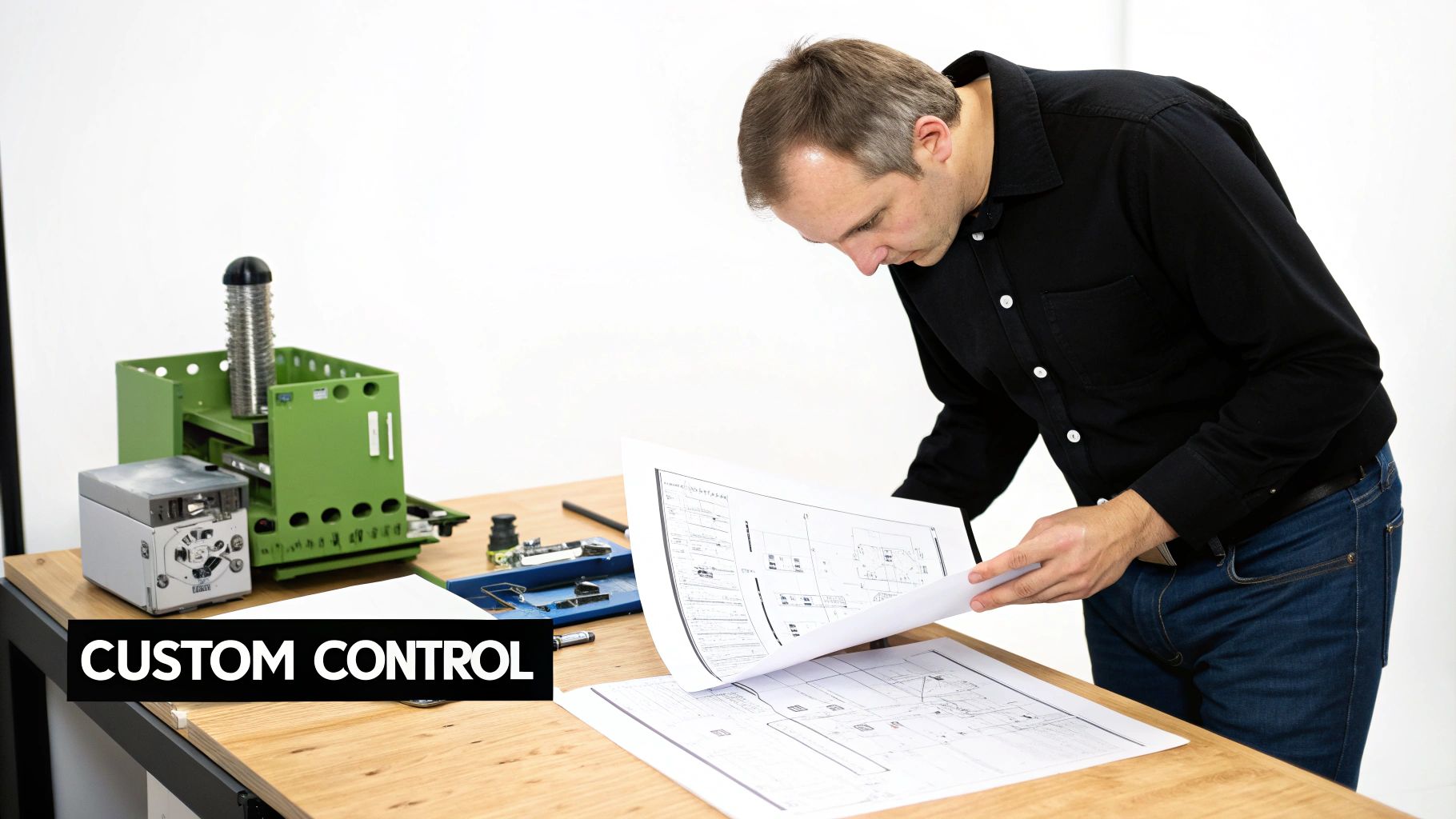
The initial investment is also a big one, which can be a major barrier for many businesses. Getting over these hurdles means planning every detail and, most importantly, finding a manufacturing partner you can truly trust. The electronics industry is a perfect example of this in action, where China's massive manufacturing ecosystem has become a global powerhouse for bringing complex OEM projects to life.
The OEM path is a long-term investment in your brand’s future. It’s about carving out a real competitive advantage through genuine innovation, leaving you with a product that is exclusively yours and legally protected by your IP.
Choosing the right partner is absolutely critical to making this work, especially when you're sourcing from major hubs. For a little more guidance on what's currently hot, have a look at our guide on the top product categories to source from China. It's a demanding road, for sure, but a successful OEM partnership can cement your place in the market for years to come.
When an ODM Manufacturer Makes Sense
Going the ODM route is often a smart, strategic play, especially for businesses that value speed and efficiency. If your main goal is to get a product to market fast without pouring a huge amount of cash into development, this is the path for you.
Think of it this way: for well-established, popular product categories, you don't need to reinvent the wheel. Why start from scratch on a new set of headphones or a kitchen gadget when a factory already has a fantastic, market-tested design ready to go? An ODM lets you pick a pre-designed, pre-engineered product right out of their catalogue. This completely sidesteps the long, expensive research and development phase, freeing up your time and money to focus on what really matters: building your brand and connecting with customers.
When to Go with an ODM Partner
So, when does an ODM partnership really shine? It's the perfect fit if you find yourself in one of these situations:
- Speed to Market is Your Top Priority: You need a product on the shelves in a matter of weeks, not years.
- You Have a Limited Upfront Budget: You want to avoid the hefty costs of custom tooling, moulds, and extensive prototyping.
- You Lack In-House Design Expertise: Your team excels at marketing and sales, but product engineering isn't your strong suit.
- You Are Entering a Proven Market: The product you're envisioning already has solid demand, and a few clever tweaks are all you need to stand out.
Capitalising on Existing Infrastructure
One of the biggest wins with the ODM model is that you get to piggyback on the factory's existing setup. They've already done the heavy lifting—investing in expensive moulds, sorting out tooling, and securing essential product certifications. This means you can get started almost immediately with a product that's already compliant and ready for mass production.
By partnering with an ODM, you are essentially buying into their entire ecosystem. You gain access to their optimised supply chains, their manufacturing expertise, and a product that has likely already had its production kinks worked out, massively reducing your risk.
This approach is incredibly common and effective in industries like cosmetics. To give you an idea of the scale, the Asia-Pacific cosmetics OEM/ODM market was valued at around USD 16.489 billion in 2021 and is expected to climb to USD 21.312 billion by 2025. China is a major player here, with brands regularly using ODMs to quickly launch new skincare or makeup lines by simply choosing from a catalogue of proven formulas. You can discover more about the cosmetics OEM/ODM market to see just how big this opportunity is.
Sure, you might share a base design with a few competitors, but that's where your unique branding and smart marketing come in. For many businesses, the trade-off is a no-brainer. The ability to enter the market quickly and with less risk makes the ODM manufacturing model a clear winner.
Finding and Vetting the Right Factory Partner
Let’s be honest: choosing a factory is probably the biggest decision you'll make in this whole OEM and ODM game. A great partner can bring your vision to life and even improve on it, but a bad one? That’s a fast track to missed deadlines, budget blowouts, and a whole lot of stress. Think of the vetting process as your insurance policy against future headaches.
Your search might start on a platform like Alibaba, but that's just scratching the surface. The real work begins when you start filtering through potential suppliers. You need to look past the slick marketing photos and get to the heart of what they can actually do. For businesses needing a hand on the ground, local experts can be a massive help. You can learn more about how sourcing agents in China can cut through the noise for you.
Key Questions for Potential Partners
Once you've narrowed down your list, it's time to start asking some direct questions. The way they answer will tell you everything you need to know about their professionalism, experience, and whether they're the right fit for your project. Don't be shy—be thorough.
Here's a quick checklist of what you should be asking:
- Certifications: "Can you show me your quality management certifications, like ISO 9001?" This isn't just a piece of paper; it's proof they have solid, repeatable processes in place.
- Production Capacity: Ask them straight up about their monthly output. You need to know if they can handle your order volume now and, just as importantly, if they can grow with you.
- Export Experience: Find out which countries they already ship to. If they have a track record of exporting to your target market, they’ll already know the ropes when it comes to regulations and paperwork.
- IP Protection: This is a big one. Ask them, "What specific measures do you take to protect my intellectual property?" A serious factory will have a standard NNN (non-disclosure, non-use, non-circumvention) agreement ready to go.
A good manufacturer won't just tolerate these questions—they'll welcome them. If you get vague answers or a lot of hesitation, that’s a major red flag. Don't ignore it.
At the end of the day, you're not just looking for a supplier; you're looking for a long-term partner who will be a genuine asset to your business. To get a better feel for the wide range of skills potential partners can offer, it's worth exploring fields like electronic manufacturing services for a deeper understanding. A solid partner will help you navigate the tricky worlds of production and international shipping, making your life a whole lot easier.
Got Questions About OEM and ODM? We’ve Got Answers.
Jumping into manufacturing can feel like learning a new language, and terms like OEM and ODM are at the top of the list. It's totally normal to have questions. Getting the right answers upfront can save you a world of headaches down the line. Let's tackle some of the most common ones we hear.
What's the Real Difference, in Plain English?
It all boils down to one simple thing: who owns the design?
If you go with an OEM (Original Equipment Manufacturer), you’re the one bringing the blueprint. You've designed a unique product from scratch, and you're hiring them to be the hands that build it. Think of it as commissioning a custom-built house—it's your vision, they just make it a reality.
On the flip side, with an ODM (Original Design Manufacturer), you're essentially picking a ready-made product from their catalogue and putting your logo on it. It’s their design, your brand. This is like buying a fantastic model home and just moving your furniture in—way faster and less complicated.
Can I Start with ODM and Later Switch to OEM?
Yes, and honestly, it's a brilliant strategy many successful brands use. It’s a classic "walk before you run" approach. Kicking things off with an ODM product lets you get your foot in the door, test the market, and start generating revenue without a massive upfront investment in R&D.
Once you’ve proven your concept and have cash flow, you can reinvest that into creating your own unique product. Making the switch to an OEM partner at that stage is a natural next step. It lets you build a truly distinct brand and take full control over your product's future.
Pro Tip: Think of ODM as your market validation tool. Once you know customers love what you're selling, you have the confidence—and the capital—to double down on a custom OEM product. You get the speed of an ODM first, then the brand power of an OEM later.
How Do I Stop an OEM Factory from Stealing My Idea?
This is a huge concern, and rightly so. Protecting your intellectual property (IP) has to be your top priority. Your first line of defence is a rock-solid manufacturing agreement, sometimes called an NNN (Non-Disclosure, Non-Use, Non-Circumvention) agreement. This legal document makes it crystal clear that you, and only you, own the IP. Crucially, it must be enforceable in the manufacturer’s home country, not just yours.
Don't stop there. Filing for patents and trademarks in the country of manufacture and in the countries you plan to sell in adds another powerful layer of protection. Finally, do your homework. Partnering with a reputable factory that has a long history of protecting their clients' designs is just common sense. A good reputation is often the best security you can ask for.