When you see an EXW price, think of it as the 'factory gate' cost. It’s the pure price of the product itself, sitting at the seller's location, ready for you to collect. Nothing more is included.
Imagine buying a custom-made sofa directly from the artisan's workshop. You pay for the sofa, but figuring out how to get it from their workshop to your living room—the truck, the loading, the transport—that's all on you. That’s the core idea of an EXW price.
What an EXW Price Really Means for Your Business
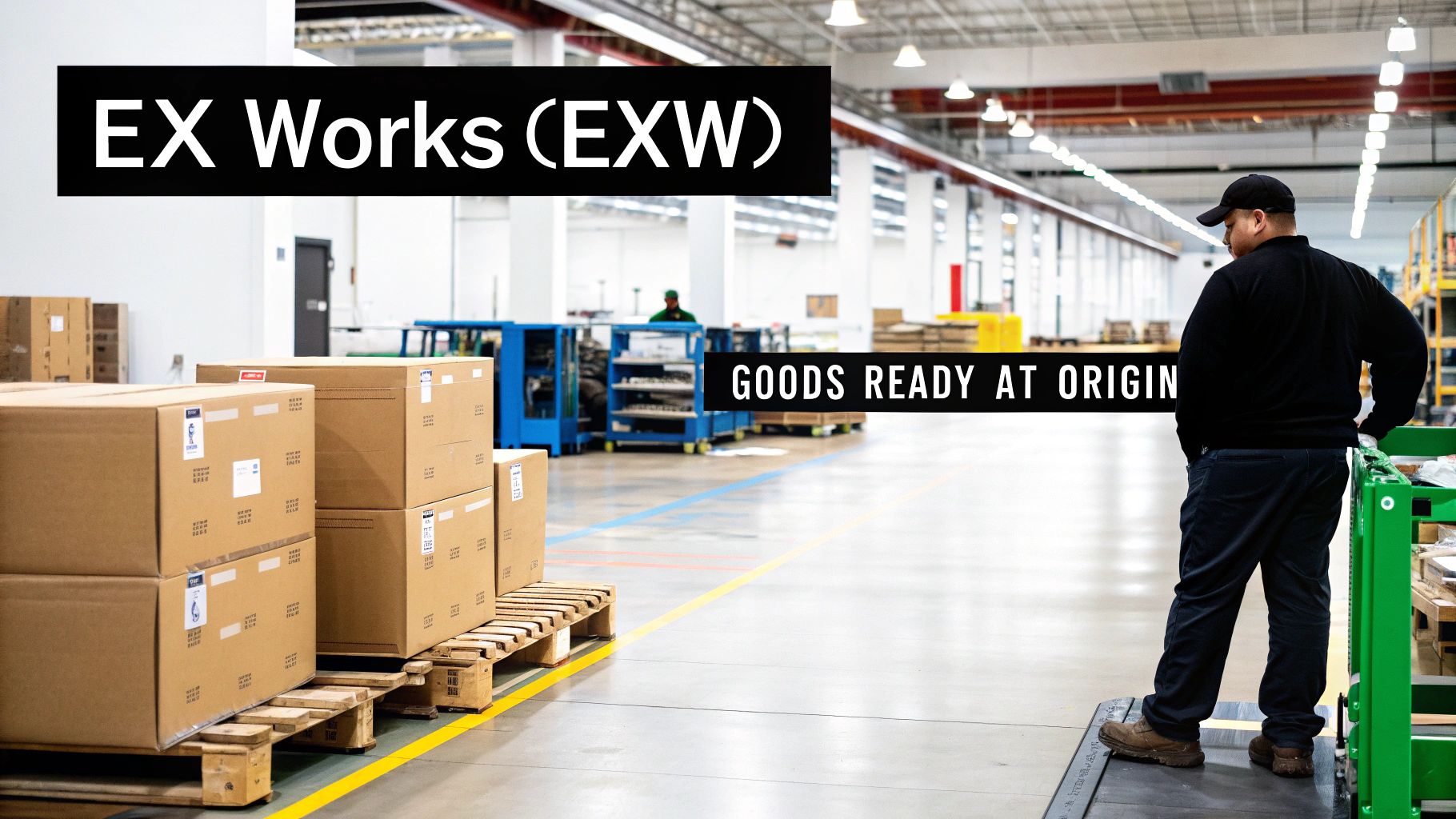
The term EXW stands for Ex Works. It's one of the official Incoterms set by the International Chamber of Commerce, which are essentially the universal rules for global trade. They spell out exactly who is responsible for what between a seller and a buyer.
Of all the different Incoterms, EXW is the one that puts the least responsibility on the seller and the most on you, the buyer.
When a supplier gives you an EXW price, they’re only committing to three things:
- Manufacturing your goods to spec.
- Packing them properly for collection.
- Having them ready for pickup at their premises (like their factory or warehouse).
And that's where their job ends. The second those goods are available, every cost, risk, and logistical headache becomes yours. This even includes the physical act of loading the goods onto the truck, a step many importers are surprised to learn isn't the seller's problem under EXW.
Under Ex Works terms, the buyer shoulders nearly all risks and costs associated with the entire shipping journey. This level of control can be powerful for experienced importers but presents significant challenges for those new to international logistics.
Why Suppliers Offer EXW Prices
So, why do suppliers like offering EXW prices? It’s simple: it makes their life easier and their price look lower. The EXW price you get from a supplier in China is just the cost of the goods themselves, stripped of all other expenses. All the logistics, export documents, and shipping fees are left for you to handle.
This arrangement can seem attractive to buyers focused on getting the lowest initial product cost. After all, the seller only has to make the goods available at their door, which often leads to a lower quote compared to terms like FOB (Free On Board), where the seller has more duties and costs. You can learn more about how EXW works when shipping from China to grasp the local nuances.
It’s absolutely vital to remember that the temptingly low number on an EXW quote is just the first step. It's the starting block for your total landed cost, not the finish line.
Mapping Out Seller and Buyer Responsibilities
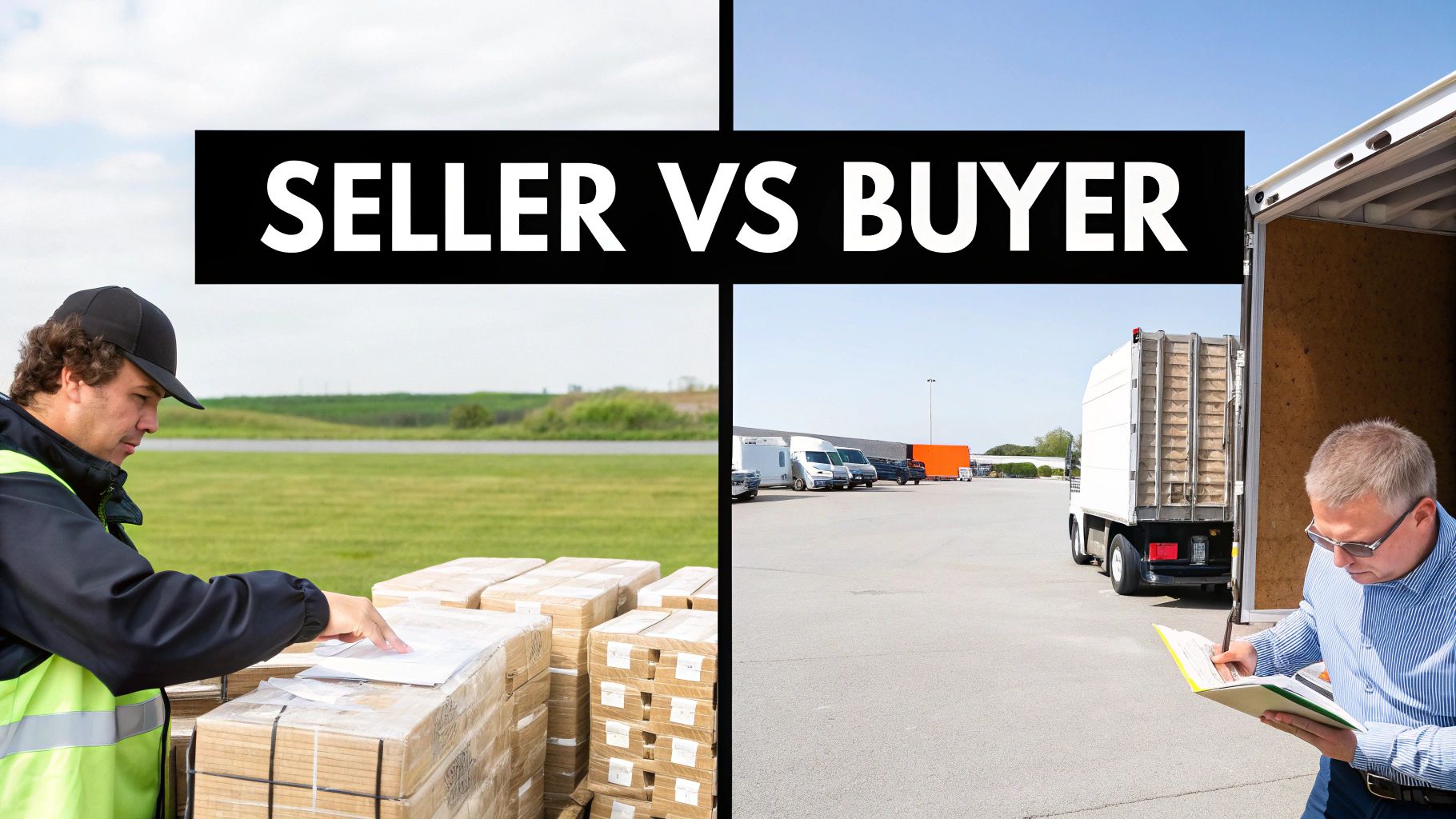
Knowing the definition of an EXW price is one thing, but truly grasping the vast difference in responsibilities is what really matters. When you agree to Ex Works terms, the division of labour is one of the most one-sided in global trade.
It heaps an enormous weight onto the buyer while leaving the seller with very little to do. It’s like a relay race where the seller just hands over the baton at the starting line, and the buyer has to run the entire marathon alone.
The Seller's Minimal Obligations
The seller’s duties are incredibly simple and wrap up right at the beginning of the shipping process. Their whole job is just to get the goods ready for pickup.
Under EXW terms, the seller only has to:
- Produce the Goods: Make the products exactly as specified in the sales contract.
- Package for Transport: Make sure the goods are packed properly so they can be collected safely.
- Make Goods Available: Have the packaged goods ready at the agreed location (usually their factory or warehouse) on the agreed date.
Once these three boxes are ticked, the seller's legal responsibility is over. They don't even have to load the goods onto the buyer's truck or deal with a single piece of export paperwork.
The Buyer's Extensive Workload
The buyer's to-do list, on the other hand, is long and complicated. It covers every single step of the journey, from the factory floor right through to the final destination. This all-encompassing responsibility is a core part of what defines the EXW price.
A Critical Misconception: Many first-time importers assume the seller will at least help load the truck. Under the official EXW rules, even this first physical step is the buyer's responsibility. If the seller does lend a hand, it's done entirely at the buyer's own risk.
The buyer must handle all of the following:
- Loading at Origin: Arranging and paying for the team and equipment to load the goods from the seller's premises onto the first truck.
- Inland Transport: Organising and covering the cost of trucking from the factory to the port or airport.
- Export Formalities: Preparing and filing all export customs documents. Successfully navigating the complexities of customs clearance at this stage is absolutely vital.
- Origin Port Charges: Paying all terminal handling charges (THC) and other fees at the port of departure.
- Main Freight: Finding and contracting a carrier for the main sea or air journey.
- Insurance: Arranging and paying for cargo insurance to cover the shipment from the moment it leaves the seller’s door.
- Destination Charges: Paying all fees and charges at the destination port.
- Import Formalities: Managing the import customs process, including paying all duties and taxes.
- Final Delivery: Organising and paying for the final leg of transport from the destination port to their own warehouse.
The sheer number of tasks makes it clear just how much the buyer takes on. It's crucial for buyers to be aware of any potential international shipping restrictions that could affect their shipment, as they are solely responsible for compliance.
This stark division is precisely why an EXW price is just the starting point of your total landed cost.
EXW Responsibility and Cost Breakdown
To make this crystal clear, let's break down who does what in a simple table. This visual guide shows every major step and assigns responsibility to either the seller or the buyer.
| Task/Cost Item | Seller Responsibility | Buyer Responsibility |
|---|---|---|
| Product Manufacturing | ✔️ Responsible for producing goods as per the contract. | ❌ None. |
| Export Packaging | ✔️ Responsible for basic packaging to make goods ready. | ❌ None. |
| Loading at Origin | ❌ Not required to load the goods. | ✔️ Responsible for all loading costs and risks. |
| Export Customs | ❌ Not required to handle export paperwork or fees. | ✔️ Responsible for all export documents, licenses, and clearance. |
| Transport to Port | ❌ Not required to arrange or pay for inland freight. | ✔️ Responsible for arranging and paying for transport to the port/airport. |
| Origin Port Charges | ❌ Not responsible for Terminal Handling Charges (THC). | ✔️ Responsible for paying all fees at the port of origin. |
| Main Carriage | ❌ Not responsible for booking or paying for freight. | ✔️ Responsible for contracting and paying for the main sea or air freight. |
| Cargo Insurance | ❌ Not obligated to provide insurance. | ✔️ Responsible for insuring goods from the seller's door to the final destination. |
| Destination Port Charges | ❌ Not responsible for any fees at the destination. | ✔️ Responsible for all charges at the arrival port (THC, etc.). |
| Import Customs | ❌ Not responsible for import clearance or duties. | ✔️ Responsible for all import documents, duties, taxes, and fees. |
| Final Delivery | ❌ Not responsible for transport from the arrival port. | ✔️ Responsible for arranging and paying for the final leg of delivery. |
As the table shows, the seller's involvement ends almost immediately, while the buyer picks up every subsequent task and cost. Understanding this imbalance is the key to successfully using EXW terms.
The Hidden Costs Lurking Behind an EXW Price
An EXW price can look incredibly tempting on paper. It's almost always the lowest figure a supplier will quote, but that number is a classic "tip of the iceberg" scenario. What you see is just a fraction of the real cost; the bulk of the expense is hidden beneath the surface, waiting to surprise unprepared importers.
Think of it like buying the raw ingredients for a cake. You’ve paid the shop for the flour, sugar, and eggs, but that's it. You still have to figure out how to get them home, pay for the electricity to run your oven, use your own mixing bowls, and spend your own time baking. The final cost of that cake is far more than just the price of the ingredients.
In the same way, the EXW price is just your starting point. To get a true picture of your total financial outlay, you need to map out every single step from the seller’s door to your own and add up all the costs along the way.
From the Factory Gate to the Port
The first wave of costs hits you the second the goods legally become yours. These are often called "origin charges," and they're a common pitfall for anyone new to EXW terms. They add up fast.
- Loading Charges: The seller's only job is to make the goods available. They have no obligation to load them onto your truck. You’ll need to arrange and pay for the labour and any equipment, like a forklift, to get the job done.
- Inland Transport: This one’s a huge variable. Trucking your container from a factory deep in western China to a major coastal hub like Shanghai can easily add hundreds of dollars to your bill.
- Export Documentation and Licences: The seller won't touch the export paperwork. That responsibility falls squarely on your shoulders. You, or an agent you hire, have to navigate all the export clearance procedures, which can be a minefield of bureaucracy and sometimes require specific, expensive licences.
These first few steps are where a seemingly great deal can start to fall apart. That cheap EXW price from a factory far from the coast can quickly lose its appeal once you calculate the long and expensive haul to the port.
Origin Port and Freight Charges
Once your shipment finally arrives at the port, you're hit with another round of fees before it even gets near a ship.
An EXW price is not your total cost; it is simply the starting point for calculating your total landed cost. Ignoring the subsequent expenses is one of the most common and costly mistakes an importer can make.
For example, an EXW price from a Chinese supplier will almost always be lower than their FOB price. However, the final landed cost for you, the buyer, can end up being much higher. Studies and industry experience show that many importers get blindsided by these "hidden" origin fees. Costs like local trucking, export clearance, and port charges can swell your total procurement cost by 10–20% for a standard container. To see a detailed breakdown of these potential expenses, you can explore more insights about EXW costs.
Here are the key charges you'll face at this stage:
- Terminal Handling Charges (THC): These are the fees the port authority charges for moving your container around their terminal at the origin port.
- Customs Clearance Fees: Your freight forwarder or customs broker will charge a professional fee to prepare and submit the export declaration.
- Freight Forwarder Fees: Your logistics partner has their own service fees for managing and coordinating all these moving parts for you.
Only after every one of these origin costs is settled can your container finally be loaded onto the vessel. Getting a handle on these often-overlooked expenses is crucial if you want to accurately understand the real financial impact of an EXW price definition and steer clear of any nasty surprises.
Calculating Your True Landed Cost with EXW
That low number on an EXW price quote can be tempting, but it's just the tip of the iceberg. To get a real grip on your total investment, you need to calculate the landed cost. This is the all-in price to get a product from the factory floor in one country to your warehouse door in another. It’s how you turn the abstract risks of Ex Works into cold, hard numbers.
Let's walk through a real-world example. Say you're importing a container of goods from a supplier in China. They've given you an EXW price of $15,000. That’s your starting point, but we’re about to stack a lot more costs on top before those goods ever reach you.
Step-by-Step Cost Breakdown
Here’s a realistic look at the extra expenses you’d be on the hook for in this scenario. Keep in mind these are just estimates—the final figures can swing based on your specific locations, the carrier you choose, and even the time of year.
- EXW Product Cost: $15,000 (This is the "factory gate" price from your supplier.)
- Origin Loading Charges: $150 (You have to pay for the labour and equipment to get the container loaded at the factory.)
- Inland Trucking in China: $450 (This covers the cost of trucking the container from the factory to the port of export.)
- Export Customs Clearance: $125 (The fee you’ll pay a customs broker to handle all the necessary export paperwork.)
- Origin Port Fees (THC): $250 (Known as Terminal Handling Charges, these are the fees at the departure port.)
- Ocean Freight: $2,200 (The big one—the cost to ship your container across the ocean.)
- Cargo Insurance: $100 (Absolutely essential. This covers your risk from the second you take ownership at the factory.)
- Destination Port Fees: $300 (More handling charges, but this time at the port of arrival.)
- Import Customs Brokerage: $200 (Fee for a local broker to manage the import clearance process.)
- Duties and Taxes (e.g., 10%): $1,500 (This is a major expense, calculated based on the value of your goods.)
- Final Mile Delivery: $550 (The last leg of the journey—trucking from the destination port to your warehouse.)
The infographic below really drives home how quickly these hidden costs start piling up, right from the moment the goods leave the factory.
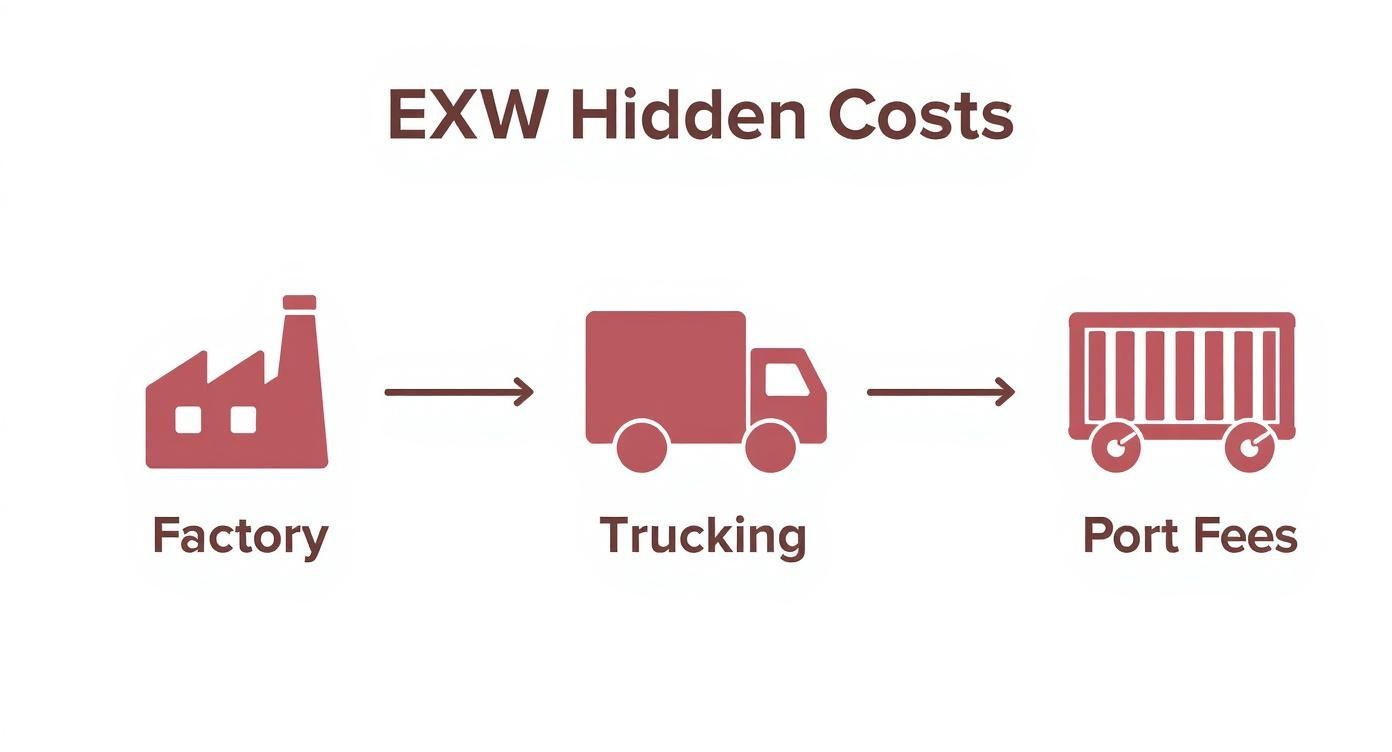
As you can see, a huge chunk of your total cost is added long before your shipment even hits the water.
The Final Tally
So, what does the true financial picture look like when we add it all up?
Initial EXW Price: $15,000
Additional Logistics Costs: $5,825
Total Landed Cost: $20,825
That’s right. The final cost is almost 39% higher than the initial EXW price you were quoted. This simple example shows exactly why you need to understand what "EXW" truly means before you agree to it. For more complex shipments, it's a good idea to use a detailed sea freight cost calculator to get a more precise estimate.
Don't forget about currency, either. When calculating your landed cost for international shipments, you have to account for conversions and exchange rate swings. A solid understanding the global currency exchange market is crucial for budgeting accurately and protecting your profit margins from nasty surprises.
Deciding When to Use EXW and When to Avoid It
Choosing an Incoterm isn't just a box-ticking exercise; it’s a strategic move that can make or break your shipment. Ex Works is a very specific tool in the logistics toolbox. While it gives you maximum control, it also demands a lot of hands-on expertise. Knowing when it’s the right call—and when to walk away—is crucial for keeping your supply chain and budget safe.
Think of it like this: EXW is the equivalent of driving a high-performance manual race car. In the hands of a seasoned pro, that level of control is exactly what you need to win. But for a learner driver? It's a recipe for stalling on the starting line. The same logic applies here; your experience and resources dictate whether EXW is a smart choice or a costly mistake.
Ideal Scenarios for Choosing EXW
For some importers, the complete control that comes with an EXW price is a massive advantage. This term usually shines when you already have a strong, established foothold in the seller’s country.
You might want to go with EXW if:
- You Have a Trusted Local Partner: If you’ve got a reliable freight forwarder in the seller's country, they can be your local expert. They’ll handle everything from picking up the goods to getting them through export customs.
- You Are Consolidating Shipments: Buying from several different suppliers in one area? EXW is perfect. Your forwarder can collect all the separate orders, bundle them into one larger shipment, and save you a bundle on freight costs.
- You Possess Deep Logistics Expertise: If you’re an experienced importer with a solid logistics network, you can often get better deals on trucking and shipping than your supplier can. In that case, EXW can be a genuinely cost-effective option.
When to Steer Clear of EXW
For most businesses, especially newcomers to international trade, the risks tied to EXW often dwarf the potential benefits. That super-low initial price can be tempting, but it can quickly lead to a flood of unexpected costs and frustrating delays.
Key Takeaway: If you're new to importing or don't have a trustworthy logistics partner in the origin country, avoid EXW. The risk of getting overcharged for local services or tangled in documentation issues is just too high.
In China, you'll see EXW pop up a lot, particularly with smaller factories in industries like electronics or textiles that don't have the licenses or know-how to handle exports themselves. This reality often pushes the term on buyers who then underestimate the true total cost and complexity. It’s a classic example of the gap between a simple product price and the messy reality of getting it home.
To get a better handle on this, you can discover more insights about EXW shipping from Freightos.com. Ultimately, making the right call comes down to a clear-eyed look at your company's capabilities and how much risk you’re willing to take on.
Comparing EXW with Other Common Incoterms
To really get a feel for what an EXW price definition means in practice, it’s helpful to place it alongside other common Incoterms. You can think of it as a spectrum of responsibility. EXW sits at one extreme, handing nearly all the work to the buyer, while other terms gradually shift those duties back to the seller.
Seeing these terms side-by-side helps you understand the critical trade-offs you're making between risk, cost, and control. It’s the key to picking the right term for your shipment.
EXW vs Free on Board (FOB)
One of the most widely used alternatives to EXW is Free on Board (FOB). If EXW is like picking up a package from inside the seller’s warehouse, FOB is where the seller does the legwork to get it to the starting line—the ship at the port of origin.
With FOB, the seller’s job is much bigger than under EXW. They are on the hook for:
- Loading the goods onto the truck at their factory.
- Arranging and paying for the journey to the designated port.
- Clearing the goods through export customs.
- Covering all origin port charges until the cargo is safely loaded "on board" the vessel.
Responsibility (and the bill) only transfers to you once your goods are securely on that ship. This is a massive difference. It means you don’t have to worry about the complexities of local transport and export paperwork in a foreign country.
EXW vs Delivered at Place (DAP)
Now, let's look at the other end of the scale with Delivered at Place (DAP). Here, the seller takes care of almost the entire shipping journey, bringing the goods all the way to a named location in your country, ready for you to handle the final import steps.
Under DAP, the seller manages and pays for everything from their factory to your destination city, including the main international freight. Your primary tasks are to clear import customs, pay the necessary duties and taxes, and arrange for unloading.
DAP offers maximum convenience for a buyer, but it comes at the cost of control. You have very little say in the shipping process or which carrier is used. While this hands-off approach is easy, it can sometimes inflate your total costs if the seller’s freight choice isn’t the most cost-effective.
To help you visualise these differences, here’s a quick comparison of the three Incoterms.
EXW vs FOB vs DAP Key Differences
| Incoterm | Risk Transfer Point | Who Pays for Main Transport | Who Handles Export Customs | Who Handles Import Customs |
|---|---|---|---|---|
| EXW | At the seller's premises, before loading | Buyer | Buyer | Buyer |
| FOB | Once goods are loaded on board the vessel at origin port | Buyer | Seller | Buyer |
| DAP | When goods arrive at the named destination, ready for unloading | Seller | Seller | Buyer |
As you can see, the point where risk and cost are handed over is the single biggest differentiator. Understanding these hand-off points is crucial for managing your supply chain effectively.
Incoterms are also periodically updated, so it's always smart to keep up with the latest versions. For a more comprehensive look, you can explore detailed guides on Incoterms explained to see how these rules continue to evolve.
Frequently Asked Questions About EXW Price Terms
When you're getting to grips with the EXW price definition, a few practical questions always seem to pop up. Nailing down the answers is the key to avoiding expensive mistakes and making sure your shipment gets off to a smooth start.
Let's walk through some of the most common sticking points importers run into with Ex Works terms.
Does the Seller Load My Truck with EXW?
This is a big one, and the answer often catches people by surprise: no. Under the official rules for EXW Incoterms, the seller's only job is to have your goods ready for pickup at their location—be it their factory, warehouse, or office.
It's entirely up to you, the buyer, to sort out the labour and equipment needed to get those goods onto your truck. Even if the seller lends a hand, any damage during the loading process is technically your problem unless you've agreed to something different in your sales contract.
Is EXW a Good Idea for All Types of Shipments?
While you can use it for any mode of transport, EXW can be a real headache for international sea or air freight. This is especially true if you don't have a reliable team or any kind of presence in the seller's country.
The real challenge with EXW is that the buyer is on the hook for handling all the tricky export customs procedures and paperwork in a foreign country. That’s why it’s often a better fit for domestic shipping, or for seasoned importers who have a trusted freight forwarder on the ground to manage everything at the origin.
Why Would a Supplier Only Offer an EXW Price?
It often comes down to one of two things. First, many smaller or highly specialised factories simply don't have an export licence, which is a legal must-have for clearing goods to leave the country. By offering an EXW price, they pass that entire administrative and legal responsibility over to you.
Second, it's just the easiest, lowest-risk option for them. Their responsibility ends the moment your product is packed and waiting for collection. This lets them concentrate on what they do best—making your product—without getting bogged down in the complexities of global logistics.