When you're sourcing products from China, a sourcing agent is your professional partner on the ground. They're the ones who find you reliable manufacturers, hammer out the best prices, and make sure the quality is up to snuff—all on your behalf. Think of them as your local team, navigating the massive, often confusing world of Chinese manufacturing for you.
Your On-the-Ground Partner in China
Imagine walking into a sprawling, chaotic marketplace in a country you've never visited. You don't speak the language, and you certainly don't know the unwritten rules of business. You might spot what looks like a great product, but are you getting a fair deal? Is the quality any good? Is the person selling it even legitimate? That's pretty much what it feels like for businesses trying to source from China on their own.
A sourcing agent is your expert guide through that maze. They're not just a translator or a go-between; they're a strategic part of your business. Their whole job is to close the gaps in culture, language, and logistics that can easily trip up anyone trying to buy from overseas.
More Than Just a Translator
A lot of people think an agent is just there to translate conversations. That’s a tiny part of the picture. Their real value comes from their deep industry know-how and the network of contacts they’ve built over years. A top-notch sourcing agent in China offers a whole range of services designed to protect your money and keep your supply chain running smoothly.
Here’s a taste of what they handle:
- Finding and Vetting Suppliers: They don’t just find any factory. They dig deep to make sure a potential partner is legit, has the right capabilities, and is someone you can count on.
- Negotiating Prices: Armed with local market intelligence and existing relationships, they can often secure prices far better than you could ever get on your own.
- Controlling Quality: They’ll be at the factory, checking on your products during and after production. This ensures everything meets your standards before it gets packed up and shipped out.
- Coordinating Logistics: They manage all the little steps needed to get your goods from the factory to your freight forwarder, making sure the handoff is seamless and the paperwork is perfect.
Why Going It Alone Is Such a Gamble
China is still the world's factory, hands down. That means incredible opportunities for cost savings and scale, but it also comes with its own set of headaches—shifting trade policies and unpredictable supply chain hiccups, to name a few. This is where having an expert on your side becomes essential. You can find more deep-dives on navigating this market over at mindensourcing.com.
Trying to manage everything in China from thousands of miles away without local help is a huge risk. You're leaving yourself open to problems like "quality fade" (where the product quality slowly drops over time), major production delays, communication meltdowns, or even outright scams. A good sourcing agent is your insurance policy. They're there to protect your interests and turn the potential chaos of manufacturing overseas into a smooth, profitable operation.
Choosing Your Partner: Sourcing Companies vs Freelance Agents
So, you’ve decided you need a sourcing agent in China. Great move. But now comes the next big question: what kind of partner do you want? The landscape really boils down to two main camps: established sourcing companies and independent freelance agents. This isn’t just about what you’ll pay; it’s a decision that will define how you communicate, the level of support you get, and how much risk you’re taking on.
Let's use an analogy. Think of it like building a house. A sourcing company is the general contractor. They manage a whole team of specialists—the plumbers, electricians, and carpenters—and make sure the entire project runs smoothly from start to finish. You pay for that project management and coordinated oversight. A freelance agent, on the other hand, is like hiring a master carpenter directly. You get deep, specialised expertise and a direct line of communication, often for less money, but you're the one responsible for bringing in the other trades.
This flowchart lays out the core reasons businesses start looking for an agent in the first place—it almost always comes down to saving time, cutting costs, and sleeping better at night.
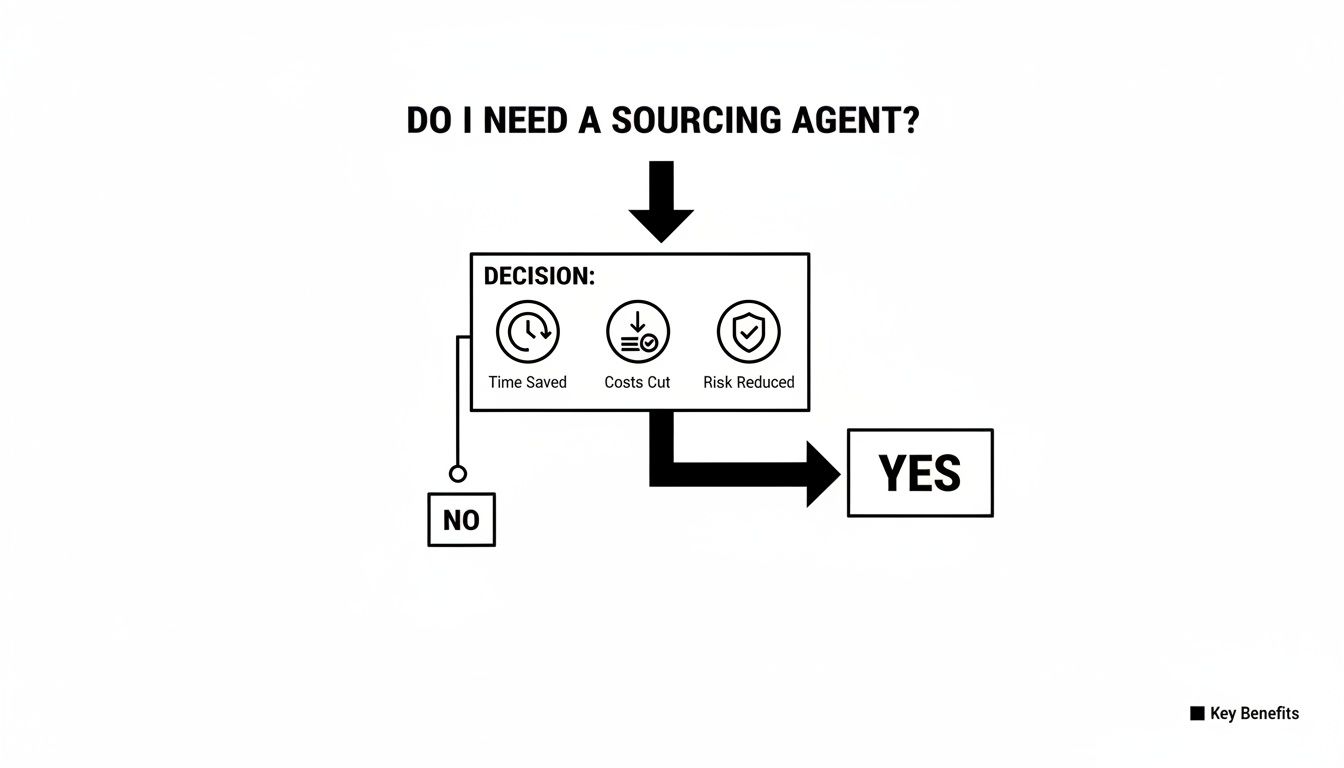
As you can see, efficiency and security are the big drivers. Both sourcing companies and freelancers aim to deliver on these fronts, but they go about it in very different ways.
The Case for a Sourcing Company
Sourcing companies are fully-fledged organisations. They have dedicated teams for everything from finding and vetting suppliers to quality control, logistics, and project management. Their biggest selling point is a complete, all-in-one service package.
Here’s what that looks like in practice:
- Broader Expertise: With multiple specialists on staff, they can tackle complex projects and have a much deeper collective knowledge base across different product categories.
- Built-in Redundancy: If your main contact gets sick or goes on holiday, someone else from the team steps in without missing a beat. That continuity is crucial for keeping your production schedule on track.
- Robust Systems: These firms usually have proven, documented processes for factory audits, quality inspections, and supplier management, which adds a serious layer of accountability.
This structured, systematic approach makes sourcing companies a fantastic fit for medium to large businesses, companies juggling multiple product lines, or any importer who values security and a solid process more than just the lowest possible price.
The Appeal of a Freelance Agent
A freelance sourcing agent is usually a one-person show. This means you get a much more direct and personal service. Their main draw is their agility and lower cost, which makes them a go-to choice for startups and small businesses.
Freelancers often give you a direct line of communication and can be incredibly flexible. Since they don't have the overheads of a big company, their commission rates or fees can be significantly more competitive.
But this model has its own trade-offs. A freelancer’s network might be incredibly deep in one specific niche, but it's almost always narrower than a company's. You're also putting all your eggs in one basket—relying on a single person’s availability and integrity. This can introduce risk if they get ill, become swamped with work, or simply lack the formal accountability you’d get from a registered company.
Sourcing Company vs Freelance Agent: A Head-to-Head Comparison
To really nail this decision, it helps to put the two models side-by-side and compare them on the things that matter most. Your choice will ultimately come down to your business size, budget, how much risk you’re comfortable with, and the complexity of what you’re trying to source.
| Attribute | Sourcing Company | Freelance Agent |
|---|---|---|
| Service Scope | Comprehensive, end-to-end services with dedicated teams. | Often specialised in a specific product niche; services can be more limited. |
| Cost & Pricing | Generally higher fees or commissions due to overheads. | Lower fees and more flexible pricing structures. |
| Accountability | Formal corporate structure provides clear legal and financial accountability. | Accountability rests solely on the individual; recourse can be more difficult. |
| Communication | Communication may go through a project manager or multiple contacts. | Direct, one-on-one communication with your agent. |
| Flexibility | Processes can be more rigid and less adaptable to small changes. | Highly flexible and can adapt quickly to client requests. |
| Risk Factor | Lower risk due to established processes, team redundancy, and legal standing. | Higher risk if the agent is unvetted, becomes unavailable, or lacks integrity. |
At the end of the day, there's no single "best" answer. A sourcing company offers a safety net and structured support that’s ideal for a scaling business. A freelancer provides a cost-effective, nimble partnership that’s perfect for those with simpler needs and a more hands-on approach.
What Sourcing Agents Actually Do (and How They Get Paid)
When you bring a sourcing agent in China onto your team, you're doing a lot more than just hiring a translator. You’re engaging a specialist who acts as your boots on the ground, your project manager for the entire manufacturing process. Their job is to make sure everything stays on track, on budget, and meets your quality standards from thousands of miles away.
Think of it this way: their services are designed to tackle specific risks at each stage of the production cycle. Without them, you'd be flying blind.
Core Services: What a Good Agent Brings to the Table
A skilled sourcing agent provides a whole suite of services, guiding you from a product idea all the way to a shipped container. While the exact menu can differ, any partner worth their salt will handle these critical tasks. Getting these right is the key to avoiding expensive mistakes and crippling delays.
- Finding and Vetting Suppliers: This isn't just about a quick search on Alibaba. A great agent taps into their personal network to find factories with a solid reputation. They'll then do the initial legwork—verifying business licenses, checking production capacity, and making sure their quality control systems are up to scratch.
- Negotiating Prices and Terms: With deep knowledge of the local market, agents don't just haggle over the unit price. They negotiate the things that really matter, like Minimum Order Quantities (MOQs) and fair payment schedules. Their experience is priceless when dealing with complex cost structures. For a deeper dive into one of the most common terms, check out our guide on the EX Work price definition.
- Managing and Consolidating Samples: Instead of you trying to coordinate samples from multiple potential suppliers, your agent handles it all. They'll collect the pre-production samples, bundle them into a single package, and ship them to you. This alone saves a ton of time and money on international courier fees.
- Monitoring Production: Your agent is your eyes and ears on the factory floor. They should be sending you regular updates, photos, and videos to confirm production is on schedule and that the factory isn't cutting corners to save a few yuan.
- Inspecting for Quality Control: This is arguably their most important job. They perform on-site inspections at crucial moments—before production, during production (DUPRO), and right before shipment—to catch defects before you've paid for the full order.
- Coordinating Logistics and Shipping: The final hurdle. They manage the process of getting your finished products from the factory to your freight forwarder, making sure the paperwork is perfect and the cargo is packed and loaded correctly.
Decoding How Sourcing Agents Charge
You absolutely must understand how your agent makes their money. It's the foundation of a transparent relationship. There are generally three pricing models, and the right one for you will depend on your order size, business scale, and how complex your products are.
- Commission-Based FeeThis is the most popular model by far. The agent takes a percentage of your total order value, typically somewhere between 3% and 10%. It’s simple, and it seems to align their interests with yours—the bigger your order, the more they earn.
But watch out. This model creates a potential conflict of interest. A shady agent might be tempted to accept a higher price from the factory just to inflate their own commission. That’s why you must insist on seeing the original factory invoices.
- Project-Based Flat FeeHere, you agree on a fixed fee for a specific task or project. This is a great fit for one-off jobs, like finding and vetting one specific supplier or overseeing a single, straightforward production run.
The big win here is predictability. You know exactly what the service will cost, no matter the final order value. It’s perfect for businesses needing targeted help without wanting to lock into a long-term relationship.
- Fixed Monthly RetainerLarger companies with a steady stream of high-volume orders often go this route. You pay the agent a set monthly fee for their ongoing support. In effect, they become a dedicated, remote part of your procurement team in China.
Key Takeaway: No matter which model you land on, demand total transparency. A trustworthy agent will never hesitate to show you original factory invoices or provide a clear breakdown of their fees. If they refuse, it’s a massive red flag. It almost certainly means they're adding hidden markups to your product cost.
Finding and Vetting the Right Sourcing Agent

Choosing a sourcing agent in China is a lot like hiring a senior partner for your business. It's a critical decision. Get it right, and you've secured your supply chain. Get it wrong, and you're in for a world of costly headaches, delays, and quality nightmares.
This isn’t the time for a quick Google search and a handshake. You need a rock-solid vetting process to sift through the noise and find a genuinely reliable partner. It’s about looking past the slick websites and confident sales pitches to find someone with real-world expertise and unwavering transparency.
Start Your Search in the Right Places
Your first challenge is finding high-calibre candidates. While a web search will give you endless options, the best agents are rarely the ones with the flashiest ads. They're usually found through trusted networks and industry connections.
Here’s where the pros look:
- Industry Referrals: This is the gold standard, plain and simple. Ask other importers, check out dedicated LinkedIn groups, or tap into e-commerce forums. A warm introduction from someone who has already worked with an agent is worth its weight in gold.
- Trade Shows: Nothing beats a face-to-face meeting. Events like the Canton Fair are prime hunting grounds for meeting potential agents and getting a feel for their professionalism on the spot. If you're heading to a trade show, our guide on Canton Fair registration has some great tips to get you started.
- Professional Sourcing Companies: For those who need a more structured, all-in-one service, established sourcing firms are a solid choice. They have established processes and a reputation to protect, which often translates to a safer bet.
The Interview: Time to Ask the Tough Questions
Once you've got a shortlist, the real work begins. Your initial emails and calls should be designed to quickly weed out anyone who isn't a good fit for your specific product. If their response feels generic or copy-pasted, move on.
The interview is where you dig deep. You’re not just listening to what they say, but how they say it. Are they confident and direct, or do they give you vague, evasive answers? The latter is a massive red flag.
A truly professional sourcing agent will welcome your detailed questions. They know that trust is the foundation of a good partnership, and they'll be eager to prove their expertise right from the start.
Using a consistent checklist for every interview is key. It keeps you focused and allows you to compare candidates on an apples-to-apples basis, removing guesswork from the equation.
Here is a simple but effective checklist to guide your interviews. The goal is to separate the real experts from the pretenders.
Vetting Checklist for Your Potential Sourcing Agent
| Checklist Item | Question to Ask | Ideal Response/Red Flag |
|---|---|---|
| Industry Experience | Can you show me examples of products like mine that you've sourced before? | Ideal: Shares specific case studies, photos, and talks about challenges they solved. Red Flag: Claims to be an expert in everything or gives vague, generic answers. |
| Supplier Network | How do you actually find and qualify a new factory? Walk me through your process. | Ideal: Outlines a clear, multi-step process: license checks, on-site audits, quality system reviews. Red Flag: Says they "just use Alibaba" or has no documented vetting method. |
| Communication | Who will be my day-to-day contact? How quickly can I expect a response? | Ideal: You get a dedicated account manager and a guaranteed response time, typically within 24 hours. Red Flag: The communication structure is unclear, or they're slow to reply to your initial emails. |
| Transparency | Will you provide the original factory invoices for my records? | Ideal: A confident "Yes, of course." Red Flag: Any hesitation, refusal, or excuse. This is an absolute deal-breaker. |
| Quality Control | What does your quality inspection process look like? Can I see a sample report? | Ideal: Details their QC checks (pre-production, in-line, and pre-shipment) and provides a thorough sample report. Red Flag: They have no formal QC process, or their "report" is just a few blurry photos. |
This checklist is your first line of defence, helping you filter out unqualified candidates before you invest any more time.
Final Due Diligence and the All-Important Trial Order
Once an agent passes the interview stage, it's time for the final, non-negotiable checks. Don't skip these steps.
- Verify Their Business Licence: Ask for a copy of their Chinese business licence and have it verified. Make sure the company name on the licence matches the name on their website and the bank account you'll be paying.
- Check Their References: Ask to speak with 2-3 of their current clients, ideally businesses in a similar niche to yours. A great agent will have a list of happy clients ready to go. If they can't provide any, that's a problem.
- Place a Small Trial Order: This is the ultimate test drive. Before you commit to a major production run, start with something small. This low-risk order will tell you everything you need to know about their communication, efficiency, and problem-solving skills in a real-world scenario. It’s a small price to pay to avoid a massive disaster later.
Spotting Red Flags and Avoiding Common Sourcing Scams
Knowing what can go wrong is your best defence when sourcing from overseas. A great sourcing agent in China can be a massive asset, but a bad one can absolutely cripple your business with hidden fees, shoddy quality, and legal headaches. The key to protecting your investment is learning to spot the warning signs before they turn into expensive problems.
Think of it like this: a scammer can pretend to be a manufacturer, and the results can be devastating. In one recent, high-profile case, a US company ended up overpaying by a staggering $2.4 million over three years. Why? Their trusted "manufacturing partner" was actually just an agent secretly slapping a nearly 40% markup on the real factory's price. That’s not just lost profit—it's a complete betrayal that can sink a business.
The Hidden Kickback Scheme
A much sneakier, but just as damaging, red flag is the hidden kickback. Here’s how it works: you agree to pay your agent a commission, let's say 5%, to find you a great factory. What you don't know is that the agent is also getting a secret payment from the factory for bringing them your business.
The factory just rolls that extra cost into your product price, so you end up footing the bill without ever realising it. The agent is essentially getting paid by both sides. This completely skews their loyalty; they’re no longer working for you, but for the factory that’s lining their pockets. Inevitably, this leads to quality issues because the agent will always side with the factory to protect their secret income.
The single most effective way to fight this is to demand total transparency. A legitimate sourcing agent will have zero issues showing you the original, untouched proforma invoices from the actual manufacturer. If they hesitate, make excuses, or flat-out refuse, walk away. It's an immediate deal-breaker.
Communication and Behavioural Red Flags
It's not all about the money, though. An agent's day-to-day behaviour can tell you everything you need to know. Pay close attention to how they communicate and operate—these patterns often give the game away.
Keep an eye out for these tell-tale signs:
- Refusal of Factory Visits: A classic excuse is that the factory is "too busy" or has "strict IP protection rules." The real reason is often that they don't want you to find out they're just a middleman, or worse, see the terrible conditions at the low-quality supplier they've chosen.
- Vague Technical Answers: When you dig into the details—asking about production methods, material grades, or machine capabilities—a dishonest agent will get fuzzy. They’ll deflect or say they need to "check with the engineers." A real partner should know their factory's capabilities like the back of their hand.
- Mismatched Company Names: This one is huge. Look at all your documents carefully. If the company name on your contract is different from the name on the invoice or the business licence, you're likely dealing with a shell company set up to limit their liability if things go wrong.
- Payment to Personal Accounts: Never, ever send money to a personal bank account. The same goes for an offshore account in a different region, like a Hong Kong account for a mainland China business. Real companies have corporate bank accounts that match their registered business name. Period.
Protecting Yourself with Smart Practices
Avoiding these scams isn't about blind trust; it's about being proactive and diligent. You need to set clear ground rules and build safeguards into your process right from the start.
First, always insist on having the direct contact information for the factory manager. An honest agent's job is to make communication easier, not to block it. Second, make sure your agreement includes clauses that guarantee transparency, like the right to bring in your own third-party team for unannounced quality inspections. An independent QC check is your best insurance policy against declining quality and is the ultimate way to hold your agent accountable. By staying vigilant, you ensure your sourcing partner in China is truly on your team.
Connecting Your Agent with Shipping and Logistics
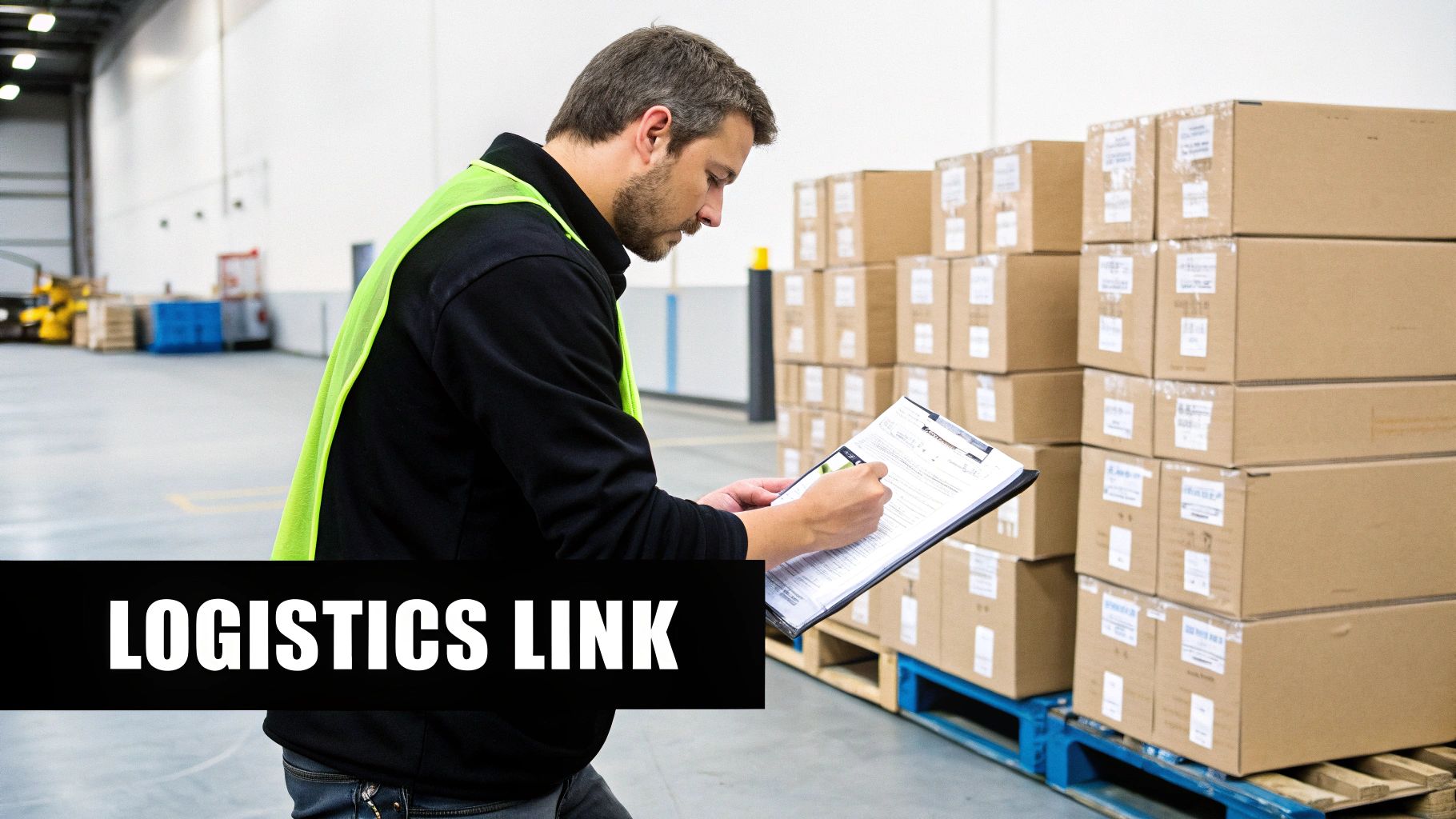
Getting your product manufactured is a massive win, but don't pop the champagne just yet. That’s only half the battle. Now you have to get those finished goods from the factory, across the ocean, and into your warehouse. This is where your sourcing agent in China truly shines, acting as the critical link between the production line and your logistics partner.
A good agent doesn't just find a supplier and disappear. They stick around to manage the entire hand-off, ensuring a smooth transition from the factory to your freight forwarder. This coordination is what stops small hiccups from turning into expensive, supply-chain-crippling disasters.
Bridging the Gap to Your Freight Forwarder
Think of your agent as the on-site director for the final, crucial scene of production. They are your eyes and ears on the ground, making sure everything is ready for pickup, all the paperwork is in order, and the goods are loaded correctly before they begin their long journey.
This isn't a small task. Here’s what they’re actually doing:
- Scheduling Factory Pickups: The agent gets on the phone with both the factory and your freight forwarder to nail down the exact time for the truck to arrive and collect your cargo. No guesswork.
- Supervising Container Loading: They’ll be there in person, watching as your cartons are loaded. This is vital for making sure the container is packed tightly to prevent damage and that you're using every inch of space you paid for.
- Verifying Paperwork: They double-check that the commercial invoice, packing list, and other customs documents are perfectly accurate. A single typo here can cause major headaches at the port.
A proactive sourcing agent saves you money long before your products even set sail. By giving your freight forwarder precise carton dimensions and weights, they help you get accurate shipping quotes upfront, which means no nasty surprise fees later on.
Understanding Key Shipping Terms
To make this whole process work, you, your agent, and your freight forwarder all need to speak the same language. That language is Incoterms. These are the universal rules that define who is responsible for the goods at every step of the journey. Knowing them clarifies exactly what your agent needs to do.
The two you’ll run into most often are:
- EXW (Ex Works): With EXW, the factory’s only job is to have your goods ready for pickup at their door. That's it. Your agent then has to manage everything else—arranging the truck, handling export customs, and getting the cargo to the port. Their role is huge here.
- FOB (Free On Board): This is more common. The factory is responsible for transporting the goods to the port and loading them onto the ship. Your agent’s job is to ensure this is done correctly and on time, coordinating the final handover to your freight forwarder, who takes over from that point.
Want a deeper dive? Check out our detailed guide on freight forwarder services.
At the end of the day, your sourcing agent is the logistical glue that holds your operation together. They make sure your products are packed for a rough journey and that they start their trip home with flawless execution.
Frequently Asked Questions About Sourcing in China
Diving into overseas manufacturing can feel like navigating uncharted territory, and it's natural to have a lot of questions. Let's tackle some of the most common queries businesses have when they're thinking about hiring a sourcing agent in China. This should give you the clarity you need to move forward confidently.
What Is a Fair Commission Rate for a Sourcing Agent?
You'll find that most sourcing agent commissions land somewhere between 3% and 10% of your total factory order value. The final number really hinges on the size and complexity of your order.
For a straightforward, high-volume order, you should be looking at the lower end of that scale, maybe 3-5%. But for smaller, more intricate projects that demand more hands-on work, a rate of 8-10% is perfectly reasonable. The key isn't the rate itself, but total transparency—a good agent will have no problem showing you the original factory invoices.
Should My Agent Handle Payments to Suppliers?
While it might seem easier to let your agent manage payments, I'd strongly advise against it. When you let an agent act as a financial middleman, you lose a critical layer of transparency. It opens up the possibility for them to inflate the factory price and keep the difference without your knowledge.
The gold standard is to pay the factory directly from your company's bank account. This creates a clean paper trail and solidifies your direct relationship with the manufacturer, which is vital for holding them accountable. Your agent's job is to be a facilitator, not a bank.
Do I Still Need to Visit China if I Hire an Agent?
For most routine orders, a good agent makes a trip to China unnecessary. They are your trusted presence on the ground, handling everything from factory audits and production oversight to final quality control checks. That's what you hire them for.
However, especially at the beginning of a long-term partnership, visiting in person can be incredibly valuable. Meeting your agent and your main suppliers face-to-face builds a level of trust and rapport that emails just can't match. It's not a must-do, but it can certainly pay off.
How Can I Protect My Product Idea or IP?
Protecting your intellectual property (IP) is non-negotiable. Don't leave it to chance. The first rule is to make sure your contracts are with the factory itself, not just your agent. This is your foundation for any legal action, should you need it.
You’ll want to work with a lawyer who understands Chinese law to put some key protections in place:
- Patents and Trademarks: Get your patents and trademarks filed and registered in your company's name before you show your designs to anyone.
- NDAs and NNNs: A standard NDA isn't enough. You need a Non-Disclosure, Non-Use, and Non-Circumvention (NNN) agreement drafted specifically to be enforceable in China.
- Direct Contracts: Your manufacturing agreement must explicitly state that all IP related to your product belongs to you, and only you.