Think of a container load calculator as a strategic tool, not just a simple measurement device. It's what translates the raw dimensions and weight of your cargo into a concrete, visual stuffing plan. This allows you to see exactly how your goods will fit inside a container, helping you pick the most economical shipping option and stop paying for empty space.
Why Precise Container Loading Is a Game Changer
In international shipping, particularly when sourcing from manufacturing hubs like China, every cubic metre of container space comes at a cost. Wasting it is like leaving money on the table. That’s why precise load planning, guided by a reliable container load calculator, is an absolutely essential part of any modern logistics strategy. Without it, you're essentially shipping blind.
The financial hit from poor load planning can be immediate and surprisingly severe. Imagine you’ve booked a Full Container Load (FCL), but when all is said and done, your cargo only takes up 70% of the container. You've just paid to ship a significant amount of air across the ocean. On the flip side, trying to wing it with a Less than Container Load (LCL) shipment isn't always a safe bet. If you miscalculate your volume, you can be hit with unexpected fees when the consolidation warehouse measures your cargo and finds it’s bigger than what you were quoted for.
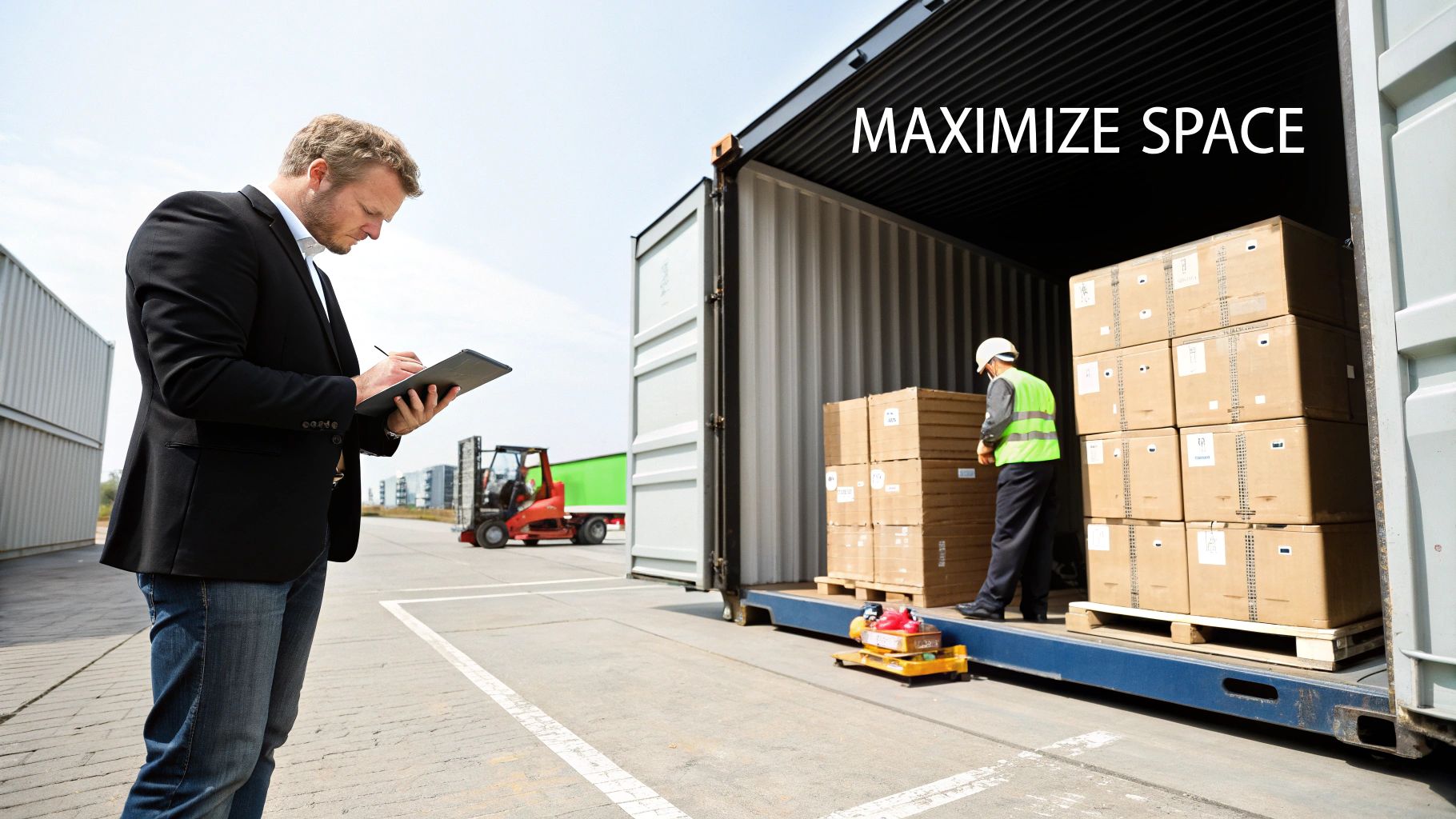
A Real-World Scenario
Let's look at a common situation. A business owner is stocking up for a big seasonal rush. They estimate their order of 500 cartons will fit snugly into a 20ft container. What they forget to factor in are the dimensions of the pallets they'll be using and the slight, almost unnoticeable bulge of each individual box. When the cargo actually arrives for loading, it doesn't fit.
This single, small miscalculation sets off a chain reaction of expensive problems:
- Split Shipments: The cargo that doesn't fit now has to be sent separately. This often means a last-minute, more expensive LCL shipment or, even worse, costly air freight to meet deadlines.
- Inventory Gaps: The full order doesn't arrive at once. This leads to stockouts, lost sales, and unhappy customers right in the middle of a peak sales season.
- Unexpected Costs: While the cargo is held up and a new plan is figured out, demurrage and detention charges can start to pile up, adding hundreds of dollars to the final bill.
A container load calculator is designed to prevent these exact scenarios. It’s not just about fitting boxes into a larger box; it’s about creating predictability in your supply chain and shielding your profit margins from completely avoidable logistics mistakes.
The Metrics That Matter
A calculator is only as smart as the information you give it. Before you can build an effective load plan, you need to gather precise, accurate data. These are the core metrics that will make or break the success of your shipment.
The table below outlines the crucial data points you need to gather before using any container load calculator.
Essential Metrics for Container Load Planning
| Metric | What It Measures | Its Role in Your Calculation |
|---|---|---|
| Cargo Dimensions | The exact length, width, and height of each individual packaged item or pallet. | This is the foundational data used to calculate the total volume (CBM) of your entire shipment. |
| Cargo Weight | The gross weight of each packaged item, including all packaging materials. | This is critical for making sure you don't go over the container's maximum payload limit. |
| Quantity | The total number of identical items you're planning to ship. | The calculator multiplies the CBM of one item by this number to get the total shipment volume. |
| Container Type | The specific container you plan to use (e.g., 20ft GP, 40ft HC). | This defines the internal dimensions and capacity limits that your load plan must work within. |
By feeding the calculator with accurate numbers, you're empowering it to create a realistic and executable loading plan. What was once a complex puzzle becomes a simple, visual guide.
CBM and Dimensional Weight: The Building Blocks of Your Load Plan
Before you can even think about fitting your cargo into a container, you need to get a handle on the two most important metrics in shipping: Cubic Metres (CBM) and dimensional weight. These aren't just logistics jargon; they're the core numbers that determine how much space your goods take up and, ultimately, how much you'll pay. Getting these wrong is a surefire way to get an unexpectedly high freight bill.
Think of CBM as the pure physical footprint of your cargo. It's a straightforward volume measurement that tells the carrier exactly how much space you're booking inside their container.
Getting a Handle on Cubic Metres
Calculating the CBM for a single box is simple enough—it's just length times width times height. The trick, and where many people stumble, is in the units. All your calculations need to be in metres.
Your supplier will likely give you dimensions in centimetres or maybe even inches. You have to convert them before you do anything else.
- From centimetres: Just divide by 100. So, a 50 cm length becomes 0.5 m.
- From inches: Multiply by 0.0254. A 20-inch length becomes 0.508 m.
Once your units are sorted, the formula is easy:
Length (m) x Width (m) x Height (m) = CBM per Carton
Got the CBM for one carton? Great. Now just multiply that number by how many cartons you're shipping to get your total volume. For a more detailed breakdown, you can always check out our guide on how to calculate CBM for shipping.
Let's Run Through an Example:
Say you’re shipping 200 cartons, and each one is 50 cm x 40 cm x 30 cm.
- First, convert everything to metres: 0.5 m x 0.4 m x 0.3 m.
- Calculate the CBM for one carton: 0.5 x 0.4 x 0.3 gives you 0.06 CBM.
- Find the total volume: 0.06 CBM/carton multiplied by 200 cartons comes to a total of 12 CBM.
Now you know your shipment needs 12 CBM of space. This is the number you'd plug into a container load calculator to see how it fits in a 20-foot container, which typically has a usable capacity of around 28-30 CBM.
Why Dimensional Weight Matters
CBM tells us about space, but it doesn't say anything about weight. That's a problem for carriers. Imagine a container stuffed with pillows—it's full, but it weighs almost nothing. On the flip side, a single small pallet of lead ingots could hit the container's weight limit while leaving most of the space empty.
This is exactly why dimensional weight (also called volumetric or DIM weight) exists. It's a way for carriers to charge for bulky, lightweight cargo that fills up their vessel without contributing much to the total tonnage. They create a minimum expected weight based on the volume of a shipment.
A common formula you'll see for sea freight is:
(Length (cm) x Width (cm) x Height (cm)) / 6000 = Dimensional Weight in kg
The carrier will look at your shipment's actual, physical weight (the gross weight) and its dimensional weight. They will then charge you based on whichever number is higher. This is known as the chargeable weight.
Chargeable Weight in the Real World
Let's look at two different shipments that both take up 10 CBM of space to see how this plays out.
- Shipment A: Crates of Lightweight Textiles
Actual Gross Weight: 800 kg
- Dimensional Weight: For LCL sea freight, a common ratio is 1 CBM = 167 kg. So, 10 CBM x 167 = 1,670 kg.
- Chargeable Weight: 1,670 kg. The dimensional weight is much higher than the actual weight, so that's what you'll be billed for.
- Shipment B: Pallets of Dense Machinery Parts
Actual Gross Weight: 2,500 kg
- Dimensional Weight: Still 1,670 kg for the same 10 CBM volume.
- Chargeable Weight: 2,500 kg. Here, the actual weight is the heavier of the two, so it becomes the basis for your freight cost.
Understanding this balance between volume and weight is crucial. It directly impacts your shipping costs and is a key factor in deciding whether an LCL or FCL shipment makes more financial sense for your cargo.
A Practical Walkthrough for Common Container Types
Okay, you've got the basics of CBM and weight down. Now let's get our hands dirty and see how this plays out in the real world. A container load calculator is a great tool, but it's only as good as the information you feed it. To get it right, you need to understand the containers you're working with.
We'll run through the three most common boxes you'll encounter shipping out of China: the 20ft GP, the 40ft GP, and the 40ft High Cube. Each one has specific internal dimensions and a maximum payload—these are the hard limits you absolutely cannot exceed. Knowing these numbers is the first step to building a smart, cost-effective load plan.
Calculating for a 20ft General Purpose Container
Think of the 20ft container as the workhorse of global trade. It's perfect for those smaller to medium-sized shipments. While it's half the length of its bigger brother, you'd be surprised how much you can pack in there. For a closer look at the exact specs, you can check out our deep dive on 20 foot container dimensions and what you can fit inside.
Let's run a quick scenario. Imagine you're shipping 450 cartons of electronics.
- Carton Dimensions: 60 cm (L) x 40 cm (W) x 35 cm (H)
- Carton Weight: 18 kg
- Container Capacity (Approximate): 33 CBM and a max payload of around 28,000 kg.
First up, we need the CBM for a single carton: 0.60 m x 0.40 m x 0.35 m = 0.084 CBM.
Then, let's find the total volume for the whole lot: 450 cartons x 0.084 CBM/carton = 37.8 CBM.
And finally, the total weight: 450 cartons x 18 kg/carton = 8,100 kg.
The Verdict: The total weight of 8,100 kg is no problem; it's well below the container's limit. But here's the catch: the total volume of 37.8 CBM is more than the 33 CBM a 20ft container can hold. This shipment simply won't fit. You'd either have to shrink your order or make the jump to a 40ft container.
Visualising the CBM Calculation
Sometimes a picture makes it all click. This simple guide breaks down the process of measuring your cargo and finding its total CBM.

This visual really drives home the most important step: convert everything to metres before you multiply. Get that right, and you’re on your way to an accurate load plan.
Planning a Load for a 40ft High Cube Container
Now for something a bit more complex: a palletised shipment going into a 40ft High Cube (HC). That extra foot of height in an HC is a game-changer, especially for stacking taller pallets. It bumps the usable capacity up to around 76 CBM, which is a huge advantage.
Let's say you're shipping textiles stacked on standard pallets.
- Pallet Base: 1.2 m (L) x 1.0 m (W)
- Loaded Pallet Height: 2.4 m
- Loaded Pallet Weight: 750 kg
- Total Pallets to Ship: 20
First, let's figure out the volume of one pallet: 1.2 m x 1.0 m x 2.4 m = 2.88 CBM.
Next, the total volume for all 20 pallets: 20 pallets x 2.88 CBM/pallet = 57.6 CBM.
And finally, the total weight: 20 pallets x 750 kg/pallet = 15,000 kg.
This load works. The total volume of 57.6 CBM fits easily within the 76 CBM capacity of the 40ft HC, and the 15,000 kg total weight is well under the typical payload limit.
From here, a good container load calculator would help you map out the best arrangement. For these 20 pallets, you'd likely place them two-wide down the length of the container, creating a stable and efficient load. This kind of careful planning is essential for preventing shifting and damage during a long sea voyage.
Choosing Your Shipping Strategy: FCL vs. LCL
So, you've got your cargo volume calculated. Now for the big question: how do you actually ship it? This brings you to a classic crossroads in logistics—choosing between a Full Container Load (FCL) and a Less than Container Load (LCL).
This isn't just about how much space your goods need. It’s a strategic decision that hits your wallet, your delivery schedule, and even the safety of your products.
With FCL, you're essentially renting an entire container for your exclusive use. It doesn't matter if you fill it to the rafters or only use half the space; it's all yours. LCL, on the other hand, is a bit like a carpool. Your cargo gets grouped with shipments from other importers at a warehouse to fill a shared container. Each has its own place, and the right choice depends entirely on what your business needs.
When FCL Makes Financial Sense
The most straightforward reason to go with FCL is having enough cargo to nearly fill a 20ft or 40ft container. But it's often more nuanced than that. There's a "break-even point" where booking your own FCL container actually becomes cheaper than shipping a large LCL load, even if you leave some space empty.
From my experience, that tipping point usually lands somewhere between 13 and 15 CBM. If your total shipment volume is in this ballpark, you should always get a quote for a 20ft FCL. You might be surprised. The flat rate for your own container can easily beat the per-CBM LCL rate, which always has extra handling and consolidation fees baked in.
But it’s not just about the money. FCL brings some serious operational perks to the table:
- Faster Transit Times: Think about it. Your container gets sealed at the factory, heads straight to the port, gets loaded on the ship, and comes directly to you. It completely skips the time-sucking consolidation and deconsolidation steps that are mandatory for LCL. This can easily shave several days off your total transit time.
- Enhanced Security: With fewer hands touching your goods, the risk of damage, loss, or theft drops significantly. The container is sealed and stays that way until it reaches its destination, which means your products aren't being shifted around with someone else's.
The day an importer upgrades from LCL to FCL is a real milestone. It signals a move from small, tentative orders to stocking inventory at a scale where cost-per-unit and a predictable supply chain become absolutely critical.
The Flexibility and Value of LCL
While FCL is the goal for many, LCL is the workhorse that powers countless small to medium-sized businesses. Its biggest selling point is pure flexibility. You only pay for the volume you use, which is a perfect fit for smaller orders, product samples, or when you need to keep a tight rein on cash flow.
For the SMEs and e-commerce sellers who rely on Upfreights for their shipments out of China, getting these calculations right is everything. A good container load calculator helps you plan the cargo stuffing perfectly, making sure every cubic metre of a standard container is put to good use. In a competitive market, miscalculations can lead to 15-20% wasted space, which translates to wasted money. Getting it right avoids overpacking fines and underutilisation costs, which is a key factor in how we maintain our 98.5% on-time delivery rate.
Of course, LCL comes with trade-offs. Your cargo is handled more frequently and shares space with others, so transit times are inherently longer, and the risk of damage is a bit higher. You can dive deeper into these differences in our complete guide comparing FCL and LCL shipping options.
Making the Right Call for Your Business
So, how do you make the final decision?
Let’s imagine a growing e-commerce brand. In the beginning, LCL was a no-brainer for their small test orders—low cost, low commitment. But then sales took off, and they suddenly needed to import a shipment totaling 14 CBM. The LCL quote was steep because of the high volume, and the longer transit time created a real risk of stocking out.
By running the numbers, they found that a 20ft FCL shipment was only slightly more expensive. The real kicker? It would arrive a full week earlier and with far less risk of something going wrong. For them, the speed and peace of mind were well worth the small difference in price. This is exactly the kind of strategic calculation every growing business eventually has to make.
Secrets to Maximizing Your Container Space
Getting your cargo's volume calculated is just step one. The real art and science of logistics come into play when you turn those numbers into a perfectly packed, stable, and cost-effective container load. It's not just about making everything fit; anyone can play Tetris. A poorly arranged container is a recipe for damaged goods, safety hazards, and wasted money.
Experienced freight forwarders will tell you that strategic packing is a discipline. It goes far beyond what a container load calculator can tell you, demanding a real-world understanding of weight distribution, cargo stability, and how to use every last bit of space. Nailing this means your products arrive looking exactly as they did when they left the factory.
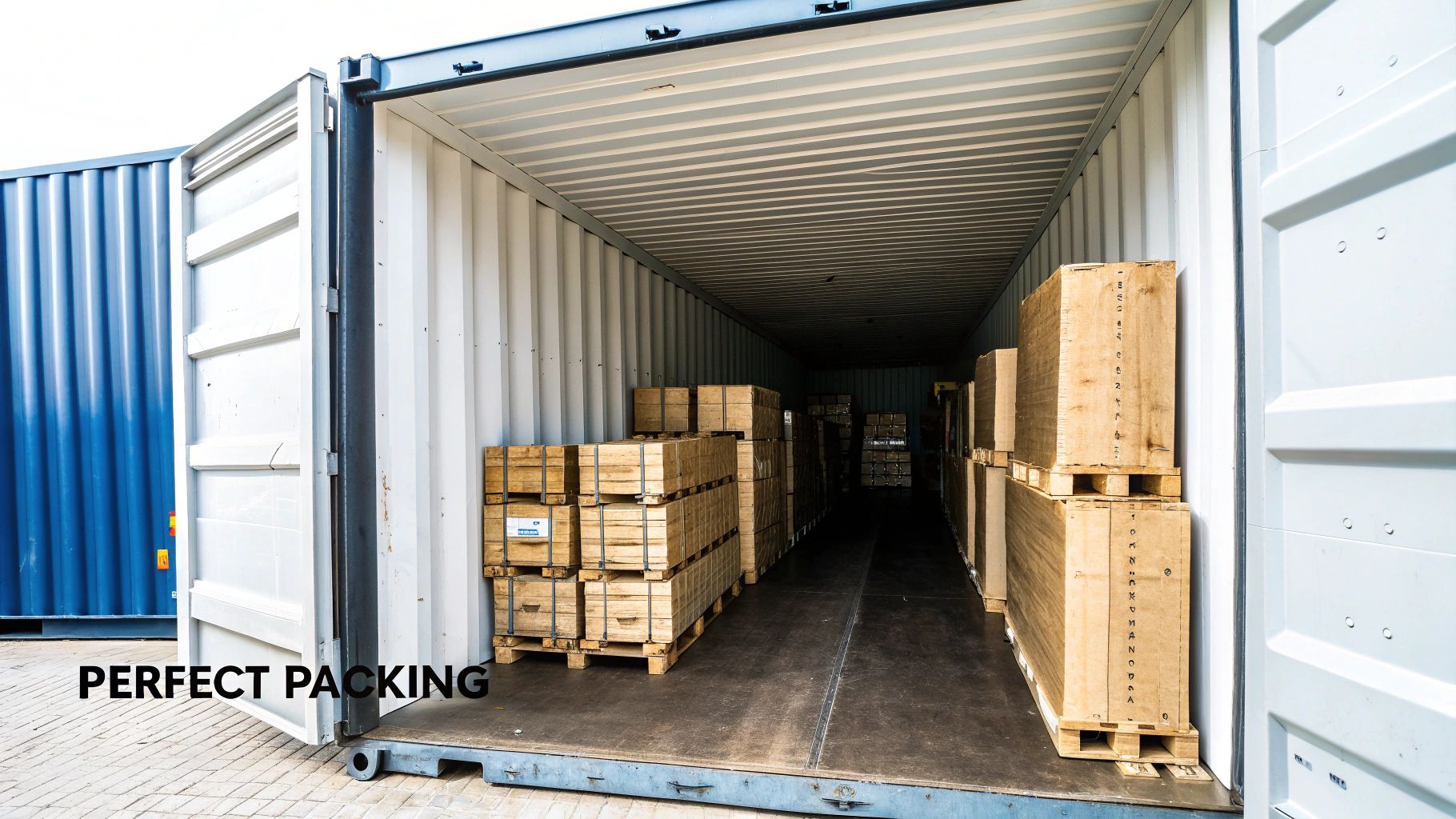
Mastering Weight Distribution
Let’s start with the golden rule of container stuffing, and it’s non-negotiable: heavy goods always go on the bottom. This isn't just a friendly suggestion—it's a core principle of safety. Placing dense, heavy items on the floor gives the container a low centre of gravity, which makes the entire unit massively more stable on its journey across potentially rough seas.
Think about it. Stacking heavy machinery on top of fragile electronics is an obvious disaster waiting to happen. But the risk goes deeper. An imbalanced, top-heavy load can cause the container to tilt precariously during lifting or even contribute to the instability of the entire vessel. For this reason, you have to ensure weight is spread evenly across the container floor, not just piled up in one spot.
The Big Debate: To Palletise or to Floor-Load?
One of the most common decisions you'll face is whether to ship your goods on pallets or to "floor-load" them by stacking cartons directly onto the container floor. Each approach has its own set of trade-offs affecting your costs, efficiency, and the safety of your cargo.
- Floor-Loading: This technique lets you use every cubic centimetre of available space. By ditching the pallets, you can often cram 10-15% more cargo into the container. The downside? It's incredibly labour-intensive to load and unload, and it exposes your bottom-layer cartons to any moisture that might be on the container floor.
- Palletising: Shipping on pallets is a game-changer for speed and safety. Forklifts can do all the heavy lifting, making the process much faster. Pallets also keep your goods off the floor and away from moisture, and less manual handling means a lower risk of damage. The only real trade-off is the space the pallets themselves take up.
For most businesses, especially if you're shipping to fulfilment centres like Amazon FBA, palletising is the hands-down winner. The efficiency gains and added product protection are almost always worth the slight loss of space. Floor-loading is generally reserved for specific cargo, like tyres or baled textiles, that can be packed tightly without needing a pallet base.
Securing Your Cargo with Dunnage
No matter how well you stack your goods, they will shift during a long ocean voyage. That movement is where the damage happens. To stop this from happening, logistics pros use dunnage—various bracing materials used to fill empty spaces and lock the load in place.
Common types of dunnage include:
- Inflatable airbags, which are wedged in the gaps between pallets.
- Wooden blocks and braces, often nailed to the container floor.
- Simple materials like foam, cardboard, or even old blankets to cushion items.
Using dunnage properly is critical. It effectively stops your cargo from turning into a battering ram inside the container, protecting your products, other cargo, and the container itself.
The need for these smart packing techniques has skyrocketed. For instance, a tariff-driven export rush saw container throughput at China's major ports hit new highs, which in turn boosted the demand for tools like a container load calculator to help Upfreights' clients optimise every shipment. For retailers, these tools were essential for using a 20ft container's 28-ton limit to its full potential, helping them stack goods to hit 90%+ efficiency and slash their door-to-door shipping costs. You can read more on these trends in the latest container shipping data from China.
A Perfect Packing Checklist for Your Supplier
The secret to a perfectly packed container often comes down to clear communication with your supplier. Don’t assume anything. Give them a simple checklist to follow so your standards are met before those container doors are sealed for good.
Essential Packing Checklist:
- Container Inspection: Is the container clean, completely dry, and free of any damage or weird smells?
- Weight Distribution: Are the heaviest items on the bottom and centred?
- Secure Stacking: Are cartons stacked neatly without overhanging the pallets? Is the shrink wrap tight?
- Dunnage Check: Have all gaps been filled with dunnage to stop the load from shifting?
- No Headspace: Is the container loaded as close to the ceiling as safely possible to prevent tumbling?
- Photo Proof: Have they taken photos of the fully packed container right before sealing it?
Sharing this checklist helps get everyone on the same page and gives your supplier a clear roadmap for packing your goods for a safe and successful journey.
Answering Your Top Container Calculation Questions
Even with a solid plan and a good container load calculator, some questions always seem to come up. These are the little details that, from experience, can make or break a shipment. Let's run through the most common ones I hear from clients to make sure you're covered.
Getting these specifics right is how you bridge the gap between a plan on paper and what actually happens on the loading dock.
How Do I Account for Packaging in My Calculations?
This is a huge one, and it's where people often go wrong. You have to calculate using the outer dimensions of your packaged cartons, never the dimensions of the product itself. That sliver of space for cardboard and packing tape might seem insignificant, but multiply it by hundreds or thousands of boxes, and you'll quickly find your cargo won't fit.
Trust me, forgetting this is probably the number one reason a "perfectly" calculated load fails in the real world.
The same rule applies if you're shipping on pallets. Your CBM calculation must include the pallet's dimensions, especially its height. A standard wooden pallet eats up about 15 cm of vertical space before you've even placed a single box on it. That's valuable real estate you have to account for.
What If My Cargo Exceeds the Weight Limit but Not the Volume?
Every container has two non-negotiable limits: its internal volume (CBM) and its maximum payload weight. Shippers often get laser-focused on not running out of physical space, or "cubing out." But it's just as easy to hit the weight limit first, known as "weighing out," especially if you're shipping heavy, dense goods like machinery, stone, or metal parts.
A standard 20-foot container, for instance, can typically hold a max payload of around 28,000 kg.
Don't even think about trying to sneak an overweight container past the port. It's illegal, incredibly dangerous, and will be flagged immediately. The result? Hefty fines, extra drayage fees to haul it away, and a nightmare of delays as you figure out how to unload and re-stuff everything.
As the shipper, it's your job to know both your total CBM and your total gross weight. You have to respect whichever limit you hit first—volume or weight. A calculator is fantastic for figuring out the volume, but you always have to manually check that final weight against the container's payload capacity.
Can a Calculator Guarantee My Cargo Will Fit Perfectly?
A container load calculator is an essential planning tool, but it's crucial to know what it's giving you: a theoretical maximum. It runs the numbers assuming a perfect world where every box is a perfect cube, nothing bulges, and the loading team stacks with geometric precision.
Of course, the real world is a bit messier. You'll have slight variations in carton shapes, you'll need dunnage like airbags or straps to secure the load, and there's always the human factor during stuffing.
The best way to use a calculator's output is to see it as your ideal target, not a 100% guarantee. A good rule of thumb that we use in the industry is to plan your load to fill about 90-95% of the container's calculated capacity. This buffer is your safety net. It accounts for all those little real-world imperfections and gives the loaders some breathing room, preventing that awful moment when the last few boxes just won't go in. It's what turns a good plan into a successful shipment.