Shipping your goods from China can feel like a massive undertaking, but it’s the lifeblood for thousands of businesses around the world. This guide is designed to be your playbook, breaking down the entire China ocean shipping process so you can get a handle on costs, nail down reliability, and manage paperwork without the usual stress.
Your Guide to Mastering China Ocean Shipping
Think of this as an inside look at how international logistics really works. We'll walk through everything from picking the right container to getting through customs, transforming what seems like a complex puzzle into a straightforward, manageable process that actually makes your supply chain stronger. For any business that relies on imports, getting this right isn't just an operational chore—it's a massive competitive edge.
At the heart of any successful ocean freight operation are three things you have to get right: cost, reliability, and documentation. Understanding how these three elements work together is the first real step toward creating a supply chain you can count on.
Key Pillars of a Successful Shipment
First up, cost. Keeping your budget in check is obviously critical. Ocean freight rates aren't static; they swing with fuel prices, container availability, and peak shipping seasons. A good freight forwarder is worth their weight in gold here, helping you lock in decent rates and dodge surprise fees that can blow up your budget.
Just as important is reliability. A shipment that’s two weeks late can throw your entire inventory management into chaos and leave customers waiting. When you work with a logistics partner that has a solid track record for hitting their deadlines, you get peace of mind and your business keeps humming along without interruption.
Finally, there’s the paperwork. Meticulous and accurate documentation isn't just a good idea—it's non-negotiable.
Your Bill of Lading, Commercial Invoice, and Packing List are the absolute cornerstone of customs clearance. One small mistake on these forms can trigger costly delays, physical inspections, or even fines, leaving your cargo stuck at the port.
The infographic below shows how these three critical pieces fit together to support the entire China ocean shipping journey.
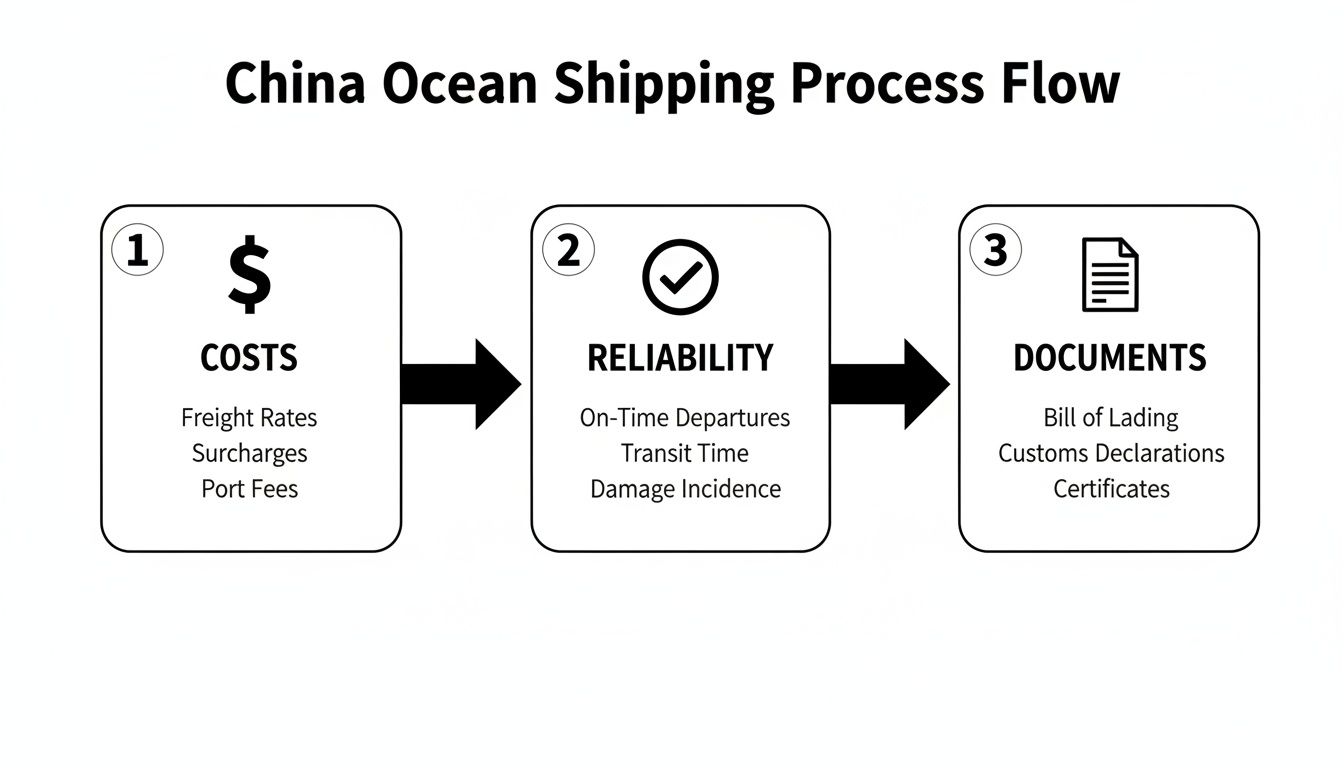
As you can see, a smooth shipment is a masterful blend of smart financial planning, consistent operational performance, and strict regulatory compliance.
Navigating China's Key Ports and Shipping Routes
Think of China's coastline as a network of massive superhighways leading directly to global markets. Every major port is a crucial on-ramp, a bustling gateway that connects the world's factory floor to your front door. Deciding which port to use for your China ocean shipping isn't just about picking the closest dot on a map; it's a strategic move that has a real impact on your shipping times, costs, and the overall health of your supply chain.
Your freight forwarder will pick a port based on a few key factors: how close it is to your supplier's factory, which shipping lines call there, and what the port is known for handling. Some are powerhouses for electronics, while others are geared up for bulky items like furniture or textiles. Nailing this decision early on is your first step to a smooth, predictable shipping journey.
The Powerhouses of Chinese Trade
China has plenty of ports, but a handful of titans handle the lion's share of its global trade. These aren't just docks with a few cranes; they're massive, self-contained logistical cities that run 24/7.
The sheer scale is hard to wrap your head around. In 2023, China's ports handled a staggering 279,793,800 TEU (Twenty-foot Equivalent Units)—a 4% jump from the previous year. To give you a sense of that number, if you lined up all those containers, they'd circle the planet more than ten times. It's a powerful reminder of China's central role in keeping global commerce moving.
Knowing the main players helps you understand why your cargo might ship from one port and not another.
- Port of Shanghai: Year after year, it's the busiest container port on the planet. Shanghai is the main artery for goods coming out of the Yangtze River Delta, offering an incredible number of direct connections to just about anywhere in the world.
- Port of Shenzhen: This is actually a cluster of ports in the Pearl River Delta, serving as the main export gate for China's tech and electronics heartland. If you're sourcing gadgets, drones, or any kind of consumer electronics, odds are they'll ship from here.
- Port of Ningbo-Zhoushan: Famous for its mind-blowing efficiency and deep-water harbours that can accommodate the world's biggest container ships, Ningbo-Zhoushan is a key hub for everything from textiles and industrial goods to car parts.
Key Takeaway: The departure port is chosen to minimise inland transport costs (trucking from the factory) and align with the most efficient ocean vessel schedule for your final destination. A well-chosen port saves both time and money.
Mapping Major Maritime Highways
Once your container is loaded and leaves the port, it joins one of several major maritime highways that connect China to the rest of the world. These shipping lanes are the lifeblood of international trade, each with its own rhythm, typical transit times, and selection of carriers. You can review our overview of all routes to see how these networks connect globally.
To give you a better idea of how this works in practice, here’s a quick-reference table matching major Chinese ports with what they typically ship and where it's going.
Major Chinese Export Ports and Their Specialities
| Port | Primary Exports | Key Shipping Lanes To |
|---|---|---|
| Shanghai | Electronics, machinery, textiles, auto parts | USA (West & East Coasts), Europe, Australia |
| Shenzhen | Consumer electronics, mobile phones, toys | USA (West Coast), Europe, Southeast Asia |
| Ningbo-Zhoushan | Textiles, industrial goods, furniture, plastics | USA (East Coast), Europe, Middle East, South America |
| Qingdao | Tyres, appliances, agricultural products | USA, Europe, Korea, Japan |
| Xiamen | Stone, footwear, canned goods, electronics | Southeast Asia, Middle East, USA |
This well-established network means that no matter where your goods are manufactured in China, there’s an efficient route to get them to you. A good freight forwarder uses their deep knowledge of these routes and their relationships with carriers to build a supply chain for you that is both reliable and cost-effective.
Choosing Between FCL and LCL Shipping
One of the first big decisions you'll face when shipping from China is whether to go with a Full Container Load (FCL) or a Less than Container Load (LCL). It sounds technical, but the concept is pretty straightforward and has a massive impact on your costs, timing, and the safety of your goods.
Think of it like moving house. FCL is like hiring the entire moving truck for yourself—it's all yours, whether you fill it to the brim or not. LCL, on the other hand, is like booking a spot in a shared truck with a few other people. You only pay for your corner of the space. Your choice really boils down to what you're shipping, how much of it you have, and how quickly you need it.
What Is Full Container Load FCL?
With FCL shipping, you're paying for the exclusive use of an entire container, usually a 20ft or 40ft one. Your supplier loads your products, the container is sealed, and it isn't opened again until it reaches its final destination. This "one-shipper, one-container" setup brings some serious benefits.
For starters, it's faster. Since your container doesn't need to be opened and sorted with other shipments, the whole process is more direct. This usually means quicker transit times from port to port. It also dramatically cuts down on the risk of damage, as your goods aren't being handled multiple times along the way. FCL is the go-to for security and speed.
The main driver, though, is usually cost-effectiveness for larger shipments. You pay a single flat rate for the container. If you have enough cargo to fill most of it, the cost per cubic metre often works out to be much cheaper than LCL.
What Is Less than Container Load LCL?
LCL shipping is your flexible, pay-as-you-go option. If your shipment is too small to make a full container worthwhile, LCL lets you book just the space you need inside a shared container. Your cargo is picked up and taken to a warehouse, where it gets loaded in with goods from other businesses heading to the same destination port.
This is a game-changer for smaller companies, e-commerce sellers testing a new product, or anyone who doesn't want to pay for empty space. You're only billed for the volume your cargo takes up, which is measured in cubic metres (CBM).
The trade-off for that cost saving is a bit of extra time and handling. LCL shipments have more steps—they need to be consolidated at the port of origin and then deconsolidated (sorted out) at the destination. This can add a few days to the total journey and means your boxes get moved around more, slightly increasing the risk of bumps and bruises. For a deeper dive, check out our comprehensive guide on the differences between LCL and FCL.
The 15 CBM Rule of Thumb: A handy guideline we use in the industry is the 15 cubic metre mark. Once your shipment gets bigger than 15 CBM, the total cost for LCL can start to creep up and might even be more expensive than just booking your own 20ft FCL container. It's always smart to get quotes for both options to see where you hit that break-even point.
FCL vs LCL At a Glance
So, how do you make the final call? It's all about weighing your shipment's specific needs against what each method offers. This table breaks it down to help you decide at a glance.
| Factor | FCL (Full Container Load) | LCL (Less than Container Load) |
|---|---|---|
| Best For | Shipments over 15 CBM, high-value or fragile goods. | Smaller shipments, typically 1-15 CBM. |
| Cost Structure | Flat rate per container. More cost-effective for large volumes. | Priced per cubic metre (CBM). Cost-effective for small volumes. |
| Transit Time | Faster. No consolidation/deconsolidation delays. | Slower. Requires extra time for sorting at both ends. |
| Security | Higher. Container is sealed at origin and opened at destination. | Lower. Goods are handled more frequently, sharing space with others. |
| Flexibility | Less flexible. Requires a full container's worth of cargo for best value. | Highly flexible. Ideal for frequent, smaller shipments. |
In the end, choosing between FCL and LCL is a core part of your supply chain strategy. FCL is your best bet for speed, security, and value on larger shipments. LCL offers incredible flexibility and cost control for smaller, less urgent cargo. By looking at your shipment's volume, value, and timeline, you can confidently pick the right path for your China ocean shipping needs.
Getting a Grip on Your Shipping Costs and Transit Times
Worried about surprise fees and frustrating delays throwing a wrench in your China shipping plans? Let's pull back the curtain on the real costs and timelines you can expect. Once you understand how a freight quote is built and what really drives transit times, you can budget accurately and manage your inventory like a pro.
Think of a shipping quote less like a single price tag and more like an itemised bill. Each line item has a specific purpose, and knowing what you're paying for is the best way to avoid nasty surprises down the road.
Breaking Down a Typical Freight Quote
When your freight forwarder sends you a quote, it might look like a jumble of acronyms and charges. Don't worry, it's not as complex as it seems. Most of the costs fall into a few key buckets. Getting familiar with them is your first step toward mastering your shipping budget.
Here’s what you’ll almost always see:
- Ocean Freight Rate: This is the big one—the fundamental cost of moving your container from a port like Shanghai to a port like Los Angeles. It’s the carrier's baseline charge for the sea journey itself.
- Terminal Handling Charges (THC): Ports on both ends of the journey charge these fees. They cover the cost of lifting your container on and off the ship, moving it around the yard, and other essential port-side logistics.
- Bunker Adjustment Factor (BAF): You can just think of this as a fuel surcharge. Oil prices are always on the move, and the BAF is how carriers adjust for those swings without having to constantly renegotiate their base rates.
- Customs Clearance Fees: This is what you pay your freight forwarder or customs broker for their expertise. They handle the mountain of paperwork required to get your goods legally cleared by customs officials in the destination country.
- Duties and Taxes: These aren't shipping fees, but they are a massive part of your total cost. Governments charge these based on what you're importing and its value. You absolutely must factor these into your budget to understand your true "landed cost."
What Really Drives Your Shipping Costs?
The price you're quoted for sea freight from China is rarely set in stone. Market forces are constantly at play, pushing rates up or down, sometimes with very little warning. Knowing what these forces are helps you ship smarter.
Seasonality, for instance, is a huge factor. The peak season kicks in around August and runs through October as businesses worldwide rush to stock their shelves for the holidays. More demand means higher prices and fewer available containers. You'll also see a smaller spike just before the Lunar New Year as companies try to get shipments out before factories shut down for the celebrations.
A Word From the Wise: The only constant in ocean freight is change. Global economic shifts, unexpected political events, or even carriers deciding to pull ships from a route can all ripple through to your final invoice. A good freight forwarder keeps a close eye on these trends for you, helping you decide on the best times to ship.
Fuel prices are the other major wild card. When crude oil costs more, carriers pass that along through the Bunker Adjustment Factor (BAF). So, even if the base ocean freight rate hasn't changed, your total bill can still climb.
How Long Will It Actually Take?
After cost, the next big question is always, "When will it get here?" For planning purposes, you need to understand the difference between the various transit times you'll hear quoted.
You'll typically see two key estimates:
- Port-to-Port: This is purely the time the vessel is at sea. For example, a container ship sailing from Shenzhen to Long Beach, California, will typically take about 14-20 days.
- Door-to-Door: This is the full journey time, from the moment the truck picks up your goods at your supplier's factory to the moment it arrives at your final destination. This includes trucking on both sides, customs clearance, and potential waiting time at the ports. It easily adds another 7-14 days to the port-to-port time.
A big reason these schedules are even possible is the staggering efficiency of China's ports. They are true logistical powerhouses, consistently snagging six of the top 10 spots in global performance rankings in the first half of 2025, even when global trade was sluggish. This operational muscle, seen in places like the booming Port of Shenzhen, helps keep schedules reliable and costs predictable, even as Asia-US West Coast rates reached $2,096/FEU in late 2025. You can dive deeper into these port performance trends and see how they shape global shipping.
By truly understanding both the costs and the timelines, you shift from simply reacting to shipping issues to strategically planning your entire supply chain. This knowledge gives you control, turning the headache of international logistics into a real competitive edge for your business.
Mastering Customs and Essential Shipping Documents
Let's be honest: for many importers, customs clearance feels like the most intimidating part of the entire shipping process. But it doesn't have to be. With a bit of know-how and solid preparation, you can sail through it.
Think of your shipping documents as your cargo's passport. Without everything in perfect order, your goods are simply not getting into the country. This isn’t just about filling out a few forms; it’s about giving customs officials a clear, accurate, and totally consistent story of what’s in your container, who sent it, and what it’s worth. Any little discrepancy can raise a red flag and bring your entire shipment to a screeching halt.
Your Essential Document Checklist
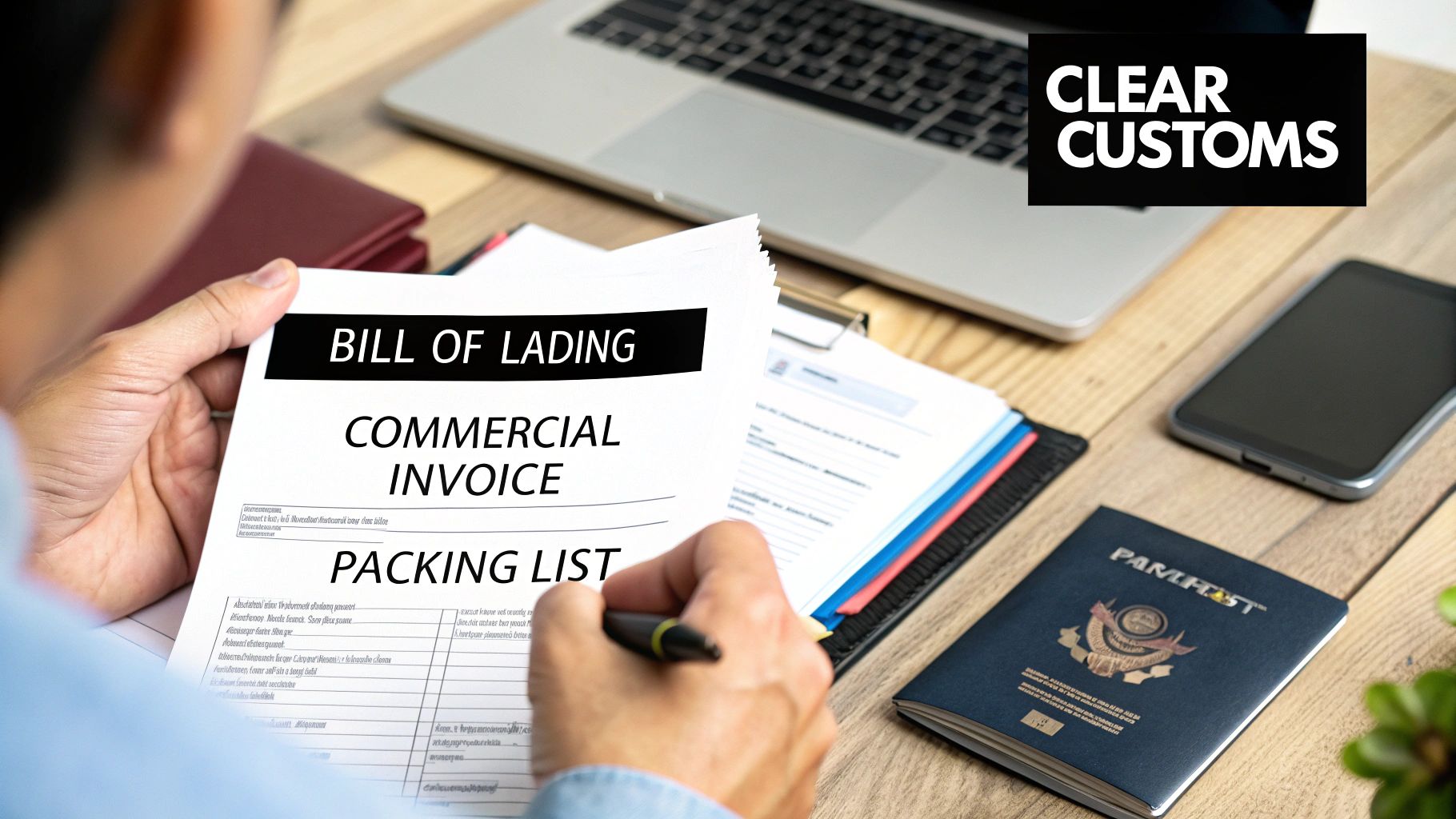
While some products or countries might ask for extra paperwork, a few core documents are the foundation of every single international shipment. Get these three right, and you're already halfway to a smooth customs experience.
- Bill of Lading (B/L): This is the king of shipping documents. It serves three critical functions: it's a receipt from the carrier confirming they have your goods, it's the contract for their transport, and—most importantly—it’s the legal title of ownership. Whoever holds the original B/L can legally claim the cargo at the destination port.
- Commercial Invoice: This is simply the official bill from your supplier. It needs to clearly list the seller and buyer, provide a detailed description of the goods, quantities, and the price you actually paid. Customs uses this invoice to figure out the shipment's value, which is what they'll base your import duties and taxes on.
- Packing List: Think of this as a detailed inventory. The Packing List breaks down what’s inside every carton, including individual weights, dimensions, and piece counts. It's what customs agents use to verify the contents of your shipment without having to physically rip open every single box.
A classic rookie mistake is having a mismatch between the Commercial Invoice and the Packing List. If the invoice says 500 units and the packing list adds up to 501, that's an immediate red flag for customs. Absolute consistency across every single document is non-negotiable.
Avoiding Common and Costly Pitfalls
Getting the big three documents in order is a fantastic start, but a couple of specific details can easily trip up even seasoned importers. Paying extra attention here will save you a world of headaches and money down the line.
The two biggest culprits for customs delays? Incorrect HS codes and valuation errors. An inaccurate declaration can get your shipment stuck in port for weeks, racking up eye-watering storage fees while you sort it out. In the worst-case scenarios, your goods could even be seized.
The Importance of Correct HS Codes
Every product imaginable, from cotton t-shirts to computer microchips, is classified under a specific Harmonised System (HS) code. This universal numeric code tells customs officials precisely what you're importing.
Why is this so important? Because the HS code you use directly determines the rate of duty you'll pay. Get it wrong, and you're in a tough spot. If you use a code with a lower duty rate, you could face hefty penalties for underpayment. Use a code with a higher rate, and you're just giving away money by overpaying taxes. For a deeper dive, you can explore our guide to understanding the Harmonised Tariff Code.
Declaring the Correct Value
Another major pitfall is undervaluing your goods on the Commercial Invoice. I get it—it can be tempting to declare a lower value to try and shrink your import duty bill. But trust me, it's a bad idea.
Customs authorities are experts at spotting this. They have massive databases on the typical values of goods from every country in the world. If your declared value looks suspiciously low, they will almost certainly challenge it, triggering a full inspection and a demand for proof of payment. Always declare the true, accurate price you paid. Being upfront and preparing your paperwork with care is the surest way to navigate international trade with confidence.
How to Select the Right Freight Forwarder
Picking a freight forwarder for your shipments out of China is probably the single most important decision you’ll make in this whole process. This isn’t just about shopping for the lowest price; it’s about finding a genuine partner who can either streamline or completely snarl up your entire supply chain.
A great forwarder is your quarterback on the ground in China. They’re the ones navigating the maze of global trade for you, handling the details you don’t have time for. Think of them less as a vendor and more as a crucial extension of your own team. They do far more than just book a spot on a container ship; they provide the expertise, network, and communication that will save you headaches and money down the line.
Evaluating Potential Partners Beyond Price
Look, cost is always going to be important. We all have budgets. But choosing your forwarder based only on the cheapest quote is a classic rookie mistake, and it often ends up costing you more in the long run. That suspiciously low price can easily hide terrible service, limited options, or a string of surprise fees that pop up later.
What you're really after is a balance of competitive pricing and solid, reliable service.
So, how do you find that? You have to dig a bit deeper. A top-tier forwarder has strong, established relationships with multiple ocean carriers. This gives them the leverage to not only negotiate better rates but also to secure space on vessels, which is absolutely critical during peak season when containers are scarce.
Pro Tip: When you're talking to a potential forwarder, flat out ask them about their carrier network. A forwarder with deep connections can offer more sailing schedules and, crucially, has backup options ready if your first-choice vessel gets delayed. This flexibility is what keeps your cargo from getting stuck on a dock.
A forwarder's capability is often tied to the global networks they can tap into. Take COSCO Shipping Ports, for example—they are a massive player in China's shipping world, operating 375 berths across 39 ports worldwide. This kind of massive infrastructure, backed by China's industrial might, lets a good forwarder offer consistent service on over 270+ routes. This gives you the kind of resilient supply chain every importer dreams of. You can see how this network plays out in this analysis of COSCO's port operations.
The Freight Forwarder Scorecard
To avoid getting swayed by a slick sales pitch, it helps to be systematic. I recommend using a simple "scorecard" to compare potential partners on the things that actually matter for a smooth shipping experience from China.
Here are the key things to put on your scorecard:
- Local Expertise in China: Do they have their own office or a dedicated, experienced team in China? You cannot overstate the value of local knowledge for dealing with factories, arranging trucking, and stamping out small problems before they become big, expensive ones.
- Customs Brokerage Capabilities: Does the forwarder handle customs clearance themselves, or do they just hand it off to someone else? An integrated service, where the same company handles your freight and your customs paperwork, is always better. It means fewer communication gaps and less risk of costly errors delaying your shipment.
- Technology and Visibility: What kind of tracking can they offer you? In this day and age, you should expect real-time visibility. A modern forwarder will have a platform that gives you door-to-door updates, so you always know where your stuff is. This information is vital for managing your inventory and keeping your own customers happy.
- Customer Support Quality: What happens when something goes wrong or you just have a question? Test their communication right from the start, during the quoting phase. If you get clear, timely answers from a dedicated person, that’s a great sign. It shows they're a customer-focused company that will actually be there to help when you need them.
Using a simple framework like this helps you move past just comparing prices. It equips you to find a freight forwarder that will truly act as a partner—someone reliable, knowledgeable, and genuinely invested in helping your business succeed.
Common Questions About China Ocean Shipping
Even the most well-thought-out shipping plan runs into real-world questions. We get asked about the nuts and bolts of sea freight from China all the time, so we've put together some straight answers to the most common queries. Think of this as your go-to cheat sheet for navigating those specific little details.
How Far in Advance Should I Book My Shipment?
This is a big one. As a rule of thumb, you'll want to book your ocean shipment at least 2-4 weeks before your cargo is ready to go, especially if you're using LCL. This gives your freight forwarder enough breathing room to lock in space on a vessel, coordinate the pickup from the factory, and get the initial paperwork sorted without having to pay extra for a last-minute rush.
Now, if you're shipping during peak season (which usually runs from August to October) or right before a major holiday like the Lunar New Year, it's smart to push that timeline out to 4-6 weeks. Booking early is your best defence against the chaos of space shortages and sudden price hikes.
What Is the Difference Between a Bill of Lading and a Sea Waybill?
Getting this right is absolutely critical because it controls who can take possession of your goods. The main difference comes down to ownership and control.
- Bill of Lading (B/L): Think of this as the deed to your cargo. It’s a document of title, which means whoever physically holds the original B/L owns the goods. To get the cargo released at the destination port, the original document has to be presented.
- Sea Waybill: This is more like a receipt for the shipment and a contract for transport. It is not a document of title. The cargo is simply released to the person or company named on the waybill once they prove their identity. No original paper needs to be handed over.
A Sea Waybill makes the release process much faster and simpler. It’s perfect when there's a lot of trust between the shipper and receiver, like a parent company sending goods to a subsidiary. For new business relationships, the Bill of Lading provides far greater security for both sides.
Are There Items I Cannot Ship Via Ocean Freight?
Yes, absolutely. Some goods are flat-out prohibited, while others are just restricted. It is essential to declare everything in your shipment with 100% accuracy to avoid having your goods seized by customs and facing some pretty hefty fines.
Prohibited items are usually what you’d expect—illegal drugs, weapons, counterfeit products, and dangerous chemicals. What trips most people up are the restricted items, which need special permits, specific packaging, or careful handling. These often include:
- Batteries (lithium-ion batteries are a big one)
- Liquids and powders
- Certain types of food products
- Anything with powerful magnets
If you have any doubt, talk to your freight forwarder before you ship. They can check the latest export rules in China and the import requirements in your country to make sure your shipment is compliant. An experienced partner makes navigating these complex rules feel much more straightforward.