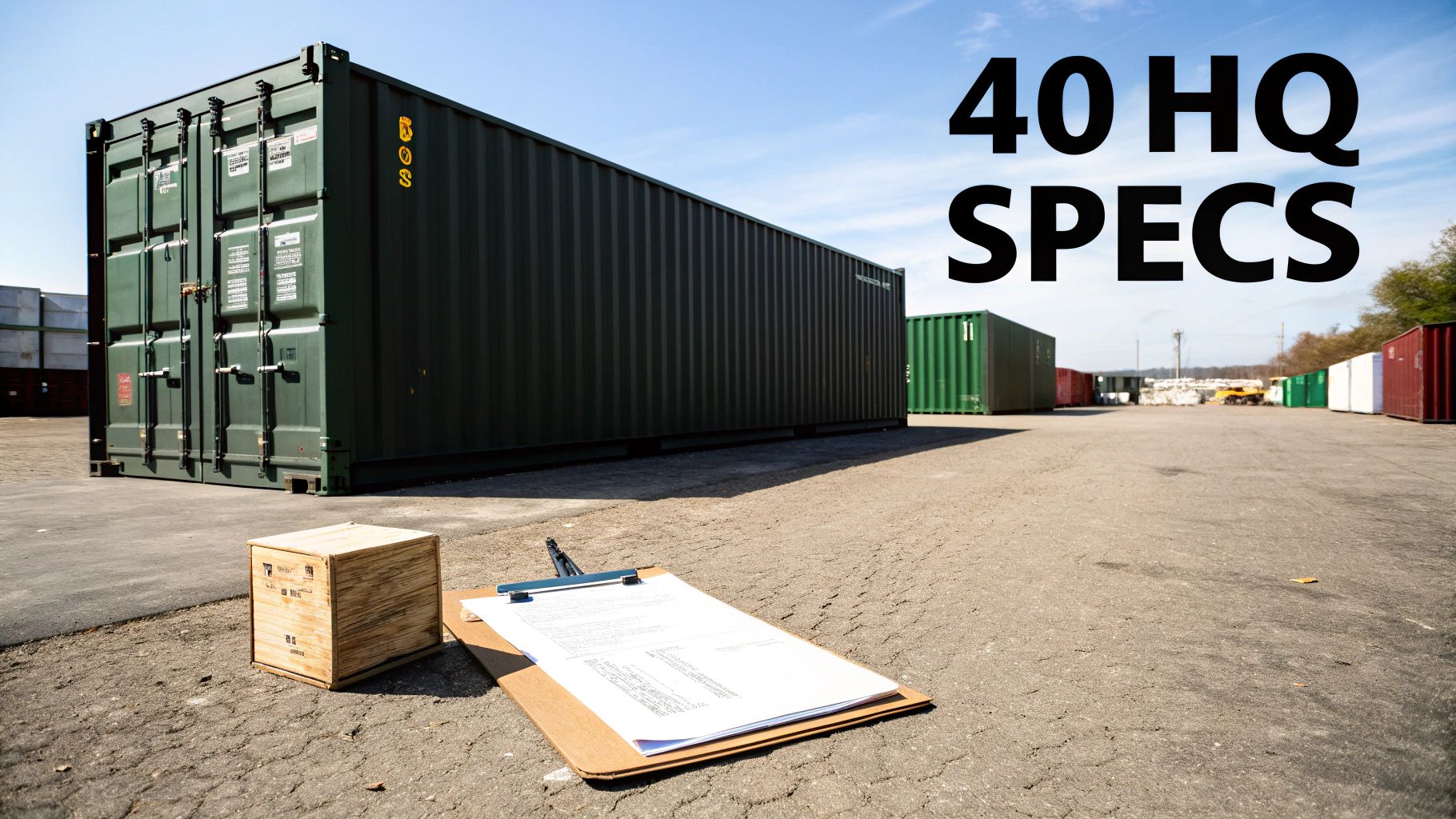
A 40HQ container, or high-cube, gives you an internal height of 2.70 metres (8' 10"). That's a crucial foot taller than a standard 40-foot container. This extra height boosts its total volume to around 76.4 cubic metres (2,698 cubic feet), making it the go-to choice for shipping bulky, lightweight cargo.
Understanding Key 40HQ Container Specifications
For any logistics manager or importer, getting the 40hq container size right is the foundation of efficient, cost-effective shipping. While its external length and width are the same as a standard 40-foot unit, the high cube's real advantage lies in that vertical space. For the right kind of goods, this can dramatically reduce your per-unit shipping costs.
Think of this as your quick reference guide for initial planning. It’s here to help you quickly decide if a 40HQ is a good fit for your cargo before you get into the finer details of pallet configurations and weight distribution.
Core Metrics At A Glance
To help you with your load planning, here’s a breakdown of the key specifications for a standard 40-foot high-cube container.
40HQ Container Key Specifications
The table below gives you the standard dimensions, capacity, and weight limits you'll need for most freight calculations. It's important to remember that these figures can vary slightly depending on the container's manufacturer and age, but they represent the industry standard. Always confirm the exact specs of your specific container if your cargo has tight tolerances.
| Specification | Metric | Imperial |
|---|---|---|
| External Length | 12.19 m | 40' 0" |
| External Width | 2.44 m | 8' 0" |
| External Height | 2.90 m | 9' 6" |
| Internal Length | 12.03 m | 39' 6" |
| Internal Width | 2.35 m | 7' 9" |
| Internal Height | 2.70 m | 8' 10" |
| Cubic Capacity | 76.4 m³ | 2,698 ft³ |
| Max Payload | 28,560 kg | 63,000 lbs |
These numbers are your starting point for everything from quoting freight to ensuring your goods will physically fit. The internal dimensions and maximum payload are particularly critical for day-to-day logistics planning.
Getting to Grips with 40HQ Container Specifications
To get the most out of every shipment, you need to look past the generalities and get familiar with the exact numbers that define a 40HQ container. These aren't just abstract figures; they are the hard data you'll use for load planning, staying compliant with regulations, and ultimately, making sure your shipment is profitable. For anyone in logistics, understanding every metric, from the internal clearance to the maximum payload, is absolutely essential.
The external dimensions are standardised across the industry, which is how they fit seamlessly onto ships, trains, and truck chassis. A 40HQ measures 12.19 metres long, 2.44 metres wide, and 2.90 metres high. While those numbers are key for making sure the box fits the transport mode, it's what's on the inside that really counts for your cargo.
Internal Dimensions and Usable Space
The real value of a 40HQ container is the usable space inside. These measurements take the container's wall and floor thickness into account, giving you the practical, real-world area you have to work with.
- Internal Length: You get about 12.03 metres of clear, usable floor space.
- Internal Width: There's roughly 2.35 metres between the container's corrugated side walls.
- Internal Height: This is the big one. You have a full 2.70 metres of vertical clearance.
That extra foot of height is what makes a high cube different from a standard 40-foot container, giving you a serious boost in cubic capacity. It's the main reason shippers opt for a 40HQ, especially when dealing with high-volume, lightweight cargo. Don't forget the door opening, though. It's always slightly smaller than the internal dimensions, usually about 2.34 metres wide and 2.58 metres high—a critical detail to remember when you're trying to load bulky equipment or tall pallets.
The total internal volume of a 40HQ container comes out to roughly 76.4 cubic metres (m³), or 2,698 cubic feet. This translates to a very useful 10-12% increase in capacity over a standard 40-foot unit, often for just a small bump in price.
Critical Weight Specifications
Volume is only half the story; weight is the other critical piece of the puzzle. Every container has strict weight limits that you absolutely must follow for safety and to stay on the right side of the law, whether it's moving by sea, rail, or road.
These figures are non-negotiable for calculating your shipment's total weight and steering clear of hefty fines. The tare weight—the weight of the empty container—is usually around 3,940 kilograms. The maximum weight of your cargo, known as the payload, can't go over 28,560 kilograms. Together, this gives you a maximum gross weight (container plus cargo) of 32,500 kilograms. As a major logistics partner for Chinese exports, DSV confirms these industry standards are vital for accurately planning shipments out of hubs like Shanghai and Shenzhen.
Comparing 40HQ High Cube vs. 40FT Standard Containers
When you're booking a shipment, deciding between a 40HQ and a standard 40FT container is a common crossroads for any logistics manager. They share the same footprint—the length and width are identical—but the crucial difference is height. That single distinction has a massive knock-on effect on your cargo capacity and, ultimately, your shipping costs. The right choice always comes down to the nature of your goods.
The core difference is simple: a 40HQ container gives you an extra foot of height. That might not sound like much, but it translates to about 10-12% more internal cubic capacity. This extra space is a game-changer when you're shipping bulky but relatively light goods. Think furniture, apparel, or electronics. You'll often fill every last inch of space long before you get anywhere near the maximum weight limit—a situation we call "cubing out."
Head-to-Head Specification Breakdown
To really see how these containers stack up, let's put their key specs side-by-side. This table clearly shows how that extra foot of height in a 40HQ translates directly into more usable volume, which is its main selling point.
40HQ High Cube vs. 40FT Standard Container Comparison
This side-by-side comparison of key specifications is designed to help shippers choose the right 40-foot container for their needs.
| Feature | 40HQ High Cube | 40FT Standard |
|---|---|---|
| External Height | 2.90 m (9' 6") | 2.59 m (8' 6") |
| Internal Height | 2.70 m (8' 10") | 2.39 m (7' 10") |
| Cubic Capacity | ~76.4 m³ | ~67.7 m³ |
| Best For | Bulky, lightweight cargo | Dense, heavy cargo |
As you can see, the High Cube offers a significant advantage in volume. To get an even deeper look into the standard unit's capabilities, our guide on the 40 ft container size provides a full breakdown, helping you make a truly informed comparison.
Practical Implications For Your Cargo
The choice between these two containers hits your bottom line directly. If you're shipping dense, heavy items—think machinery parts, raw metals, or tiles—you'll likely hit the maximum payload weight long before you run out of physical space. In these cases, paying for the extra volume of a 40HQ is just wasted money. A standard 40FT container is the smarter, and usually cheaper, option.
A 40HQ container is the obvious winner when your shipping cost is driven by volume, not weight. For products like furniture, textiles, or consumer electronics, that extra foot of height can mean fitting hundreds or even thousands more units into a single shipment. This dramatically lowers your per-unit freight cost.
In the end, it all boils down to a simple calculation. You need to know if your cargo is more likely to "weigh out" (hit the weight limit first) or "cube out" (run out of space first). If space is your bottleneck, the 40HQ provides excellent value. But if weight is the limiting factor, the standard 40FT remains the most efficient and economical choice for your supply chain.
How to Maximise Space with Pallet Loading Configurations
Knowing the theoretical 40HQ container size is one thing, but actually filling it efficiently is another game entirely. To get the most out of every cubic metre, you need a smart pallet loading strategy. A well-planned load doesn't just prevent wasted space; it also stops cargo from shifting during transit and brings down your per-unit shipping cost.
The trick is to match your pallet type to the container’s internal dimensions. In international trade, you'll most often encounter Standard pallets and Euro pallets, and each one demands a unique loading pattern to achieve maximum density.
Loading Patterns for Standard Pallets
Standard pallets, which measure 1.2m x 1.0m, are a great fit for the 2.35m internal width of a 40HQ. The best way to load them is by alternating how they're oriented.
- Single Layer Capacity: You can lay down 20-21 Standard pallets on the floor of the container.
- Loading Method: Think of it like a puzzle. Place one row with the shorter 1.0m side facing the door, then the next row with the longer 1.2m side facing the door. This interlocking or "pinwheel" pattern is fantastic for minimising gaps on the floor.
If your cargo is stackable and not excessively heavy, the extra foot of height in a 40HQ is your best friend. It makes double-stacking possible, potentially doubling your count to 40-42 pallets and using the container's full volume.
The image below gives you a clear visual on how that extra height in a 40HQ translates to more cargo space compared to a standard 40-footer.

As you can see, that extra vertical space is what makes a huge difference, especially when you're looking to double-stack pallets.
Loading Patterns for Euro Pallets
Euro pallets are a bit smaller at 1.2m x 0.8m, which actually makes arranging them inside a 40HQ a little more straightforward. Their dimensions work really well with the container's internal width.
By planning your load carefully, you can often turn what might have been two separate shipments into one. This is especially true for businesses shipping high-volume, low-density goods where space, not weight, is the primary constraint.
For a deeper dive into container volume, you can learn more about how many CBM are in a 40 ft container to really nail down your shipment planning.
With Euro pallets, you can typically fit 23-24 pallets on a single layer. The go-to method is simply placing them side-by-side down the length of the container. If you can double-stack, a 40HQ can hold an impressive 46-48 Euro pallets, as long as you stay under the maximum payload limit. Just remember to always secure your load properly to prevent any movement.
When to Choose a 40HQ Container for Your Shipment
Picking the right container is one of those decisions that can make or break your shipping budget. When it comes to the 40HQ container size, it offers a real edge, but only if your cargo is a good fit. The core of the decision is simple: will your shipment 'cube out' (run out of space) before it 'weighs out' (hits the weight limit)?
If your products are bulky but don't weigh much, the 40HQ is almost always the smarter, more cost-effective option. That extra foot of height gives you a solid 10-12% more cubic space than a standard 40' box, which can seriously drive down your cost per unit. It's the go-to choice for a reason in many industries.
Ideal Cargo for a 40HQ
Think of the 40HQ as your best friend for high-volume, low-density goods where space, not weight, is the main challenge.
- Furniture and Homewares: Things like sofas, dining tables, and large light fixtures eat up a ton of space but are rarely heavy enough to worry about payload limits.
- Apparel and Textiles: You can stack boxes of clothing, rolls of fabric, or cartons of shoes right up to the ceiling without getting anywhere near the maximum weight.
- Electronics and Toys: Most consumer electronics, plastic toys, and similar lightweight manufactured goods are perfect candidates for the extra volume a 40HQ provides.
Getting a handle on container capacity is especially vital for businesses doing large-scale imports, like when you're sourcing products from Alibaba for FBA. The extra room in a 40HQ lets you place bigger orders and consolidate them into a single shipment, which is a big win for your logistics chain.
Strategic Shipping Decisions
On the flip side, if you're shipping dense, heavy cargo—think machinery, metal parts, or slabs of stone—the 40HQ's extra volume won't do you any good. You'll likely hit the maximum payload with plenty of empty space left over, making a standard 40FT container the more sensible financial choice. You can dig deeper into these kinds of shipment decisions in our guide to FCL and LCL shipping.
It's no accident that the 40HQ is so dominant in certain trade lanes, particularly for exports out of China. Industry data suggests that 40HQ containers account for a staggering 40-50% of all containers used for exports from the region. This isn't a coincidence; it's a direct response to the nature of the goods being manufactured there—often light but bulky products where maximising every last cubic metre is key to an efficient shipment.
Best Practices for Loading and Securing Your Cargo
Making the most of the impressive 40hq container size is one thing, but getting your cargo to its destination in one piece is the real goal. Proper loading and securing aren't just suggestions; they're essential for preventing damage, ensuring safety during transit, and keeping your shipment moving smoothly through the supply chain.
The foundation of a stable shipment is smart weight distribution. You should always load your heaviest goods on the container floor, positioned directly over the chassis beams. This simple step creates a low centre of gravity, which is absolutely critical for maintaining stability on a rocking ship or a turning truck.
From that base, work on spreading the weight evenly across the container—not just front-to-back, but also side-to-side. A lopsided container is a genuine hazard for cranes and transport operators, so a balanced loading plan is non-negotiable.

Core Securing Techniques
Once your goods are inside, you need to make sure they stay put. Even a few centimetres of movement can cascade into serious damage over the course of a long sea journey.
- Blocking and Bracing: This is about creating physical barriers. Use lumber or other robust materials to construct a frame that stops cargo from shifting in any direction.
- Lashing: For heavy machinery or oddly shaped items, use high-tensile polyester straps or even chains to anchor them to the container's built-in lashing points.
- Dunnage: Think of this as filling the gaps. Inflatable airbags, foam inserts, or even heavy-duty cardboard can be wedged between cargo items to cushion them and absorb shock.
Managing the Extra Height of a 40HQ
That extra foot of height in a 40HQ is a fantastic bonus, but it brings its own set of challenges, particularly when you're double-stacking pallets. Taller loads are naturally more prone to tipping if they aren't secured with care.
When stacking, it's vital to make sure the bottom layer can handle the weight of what's on top. Placing slip sheets between layers can add friction and stability, and running vertical straps around stacked columns helps turn them into a single, solid unit.
Ultimately, keeping your cargo safe means following established international standards. For example, shippers can look to comprehensive guidelines like the FMCSA Load Securement Regulations for detailed rules on transport safety. At the end of the day, a securely packed container isn't just a best practice—it's a protected investment.
Common Questions About the 40HQ Container
Even with all the specs laid out, importers and logistics managers often run into the same practical questions when deciding if a 40HQ is the right fit. Let's tackle some of the most common queries we see.
Getting these details right can make a huge difference in whether the extra space in a 40HQ container is a genuine advantage or a potential headache.
How Many CBM Is A 40HQ Container?
A 40HQ container gives you about 76.4 cubic metres (CBM) of total internal volume.
That might not sound like a huge jump, but it's a solid 10-12% more than the standard 40-foot container, which clocks in at around 67.7 CBM. That extra space comes purely from the additional foot of height, making it perfect for cargo that's bulky but not necessarily heavy. If you're constantly finding your shipments "cubing out" before they "weigh out," the 40HQ is your best friend.
Is A 40HQ Container More Expensive Than A 40FT?
You’d think so, but not always. While the base rate for a 40HQ can sometimes be a touch higher, it's often negligible or even the same as a standard 40-footer. The final price really comes down to the shipping lane, carrier availability, and what the market is doing at that moment.
When you factor in the extra volume you're getting, the 40HQ almost always works out to be a better deal on a per-CBM basis. For anyone shipping voluminous goods, it’s a smart way to get more for your money.
Key Takeaway: Don't just look at the freight rate. Always calculate your cost per cubic metre. For bulky cargo, the 40HQ consistently delivers better value and can significantly lower your per-unit shipping costs.
Are There Inland Transport Restrictions For A 40HQ Container?
Yes, and this is a big one to watch out for. The extra height of a 40HQ, which stands at 2.9m (9'6") tall, can create real problems once it's off the ship and on a truck or train.
Certain routes have height restrictions due to low bridges, tunnels, or overhead power lines. Before you book a 40HQ, you absolutely must confirm the entire inland journey with your freight forwarder. Getting this wrong can lead to your container getting stuck, causing expensive delays and rerouting nightmares.