The real difference between DDU and DDP shipping boils down to one simple question: who pays the import duties and taxes? With DDU (Delivered Duty Unpaid), that responsibility falls on you, the buyer, once the goods arrive. But with DDP (Delivered Duty Paid), the seller handles everything—transport, customs, and all those final import fees.
Understanding DDU and DDP Incoterms at a Glance
When you're shipping internationally, you live and die by Incoterms. They’re the global rules of the road that spell out exactly who is responsible for what, and when. For that final leg of the journey, DDU and DDP are two of the most critical terms to understand, as they define where the final handover of cost and risk happens.
Think of Delivered Duty Paid (DDP) as the seller taking on the maximum level of responsibility. They agree to get the goods all the way to your named destination, fully cleared through customs, with every last duty and tax paid. It’s a clean, all-in price for you.
On the flip side, Delivered Duty Unpaid (DDU) means the seller’s job is done once the goods are available at the destination port or terminal, but before they've gone through customs. From that point on, it’s up to the buyer to sort out the import clearance, pay the duties, and handle any taxes.
An Important Note on DDU
You should know that DDU isn't technically an official term under the latest Incoterms 2020 rules. It was actually replaced by DAP (Delivered at Place) back in 2010. But in the real world, especially when dealing with suppliers in China, you'll still see DDU pop up in quotes all the time. That's why it’s still crucial to know exactly what it means for your wallet and workload.
At its core, the distinction is straightforward. DDP is a true "door-to-door" service where the seller shoulders all the logistical headaches. DDU (or DAP) stops short, leaving the final—and often unpredictable—financial and administrative hurdles at the buyer's feet.
Key Responsibility Shift DDU vs DDP
This table breaks down exactly who is responsible for what during those critical final stages of the shipment. It’s the clearest way to see where the handover point really is.
| Responsibility | Delivered Duty Unpaid (DDU) | Delivered Duty Paid (DDP) |
|---|---|---|
| Import Customs Clearance | Buyer | Seller |
| Payment of Import Duties | Buyer | Seller |
| Payment of Taxes (e.g., VAT) | Buyer | Seller |
| Final Delivery to Destination | Seller (to named place) | Seller (to named place) |
The choice here isn't just about preference; it reflects a major shift in global trade. DDU used to be common, but it often caught buyers off guard with unexpected customs bills and delays. As China’s export machine ramped up, sellers realised they could offer a much better experience with DDP. In fact, by the early 2020s, over 60% of e-commerce exporters were opting for DDP to provide a seamless service.
To get a better grasp on how this all works in practice, you can explore our in-depth guide on https://upfreights.com/blog/delivery-duty-paid-shipping.
A Detailed Breakdown of Core Responsibilities

To really get to grips with ddu and ddp incoterms, you have to look past the simple definitions and dig into how the responsibilities are split. This isn't just about who pays for the freight; it's about who manages every logistical headache, who carries the financial risk if something goes wrong, and who deals with the mountain of paperwork that comes with international trade.
Each term pinpoints the exact moment operational control—and all the stress that comes with it—flips from the seller to you, the buyer. Understanding this transfer point is everything, as it directly shapes your workload, final costs, and legal liabilities.
The Critical Transfer of Risk
In shipping, "risk" is a simple but scary concept: who pays if your goods get lost, damaged, or completely destroyed on their way to you? The exact point this risk transfers is a fundamental difference between DDU (now officially DAP) and DDP.
With both DDU and DDP, the seller is on the hook for all the risk during the main international leg of the journey. That covers everything from their factory floor, to the port of origin, and all the way across the ocean or through the air to your country. For both terms, the risk transfer happens very late in the game—specifically, when the goods arrive at the named destination, ready for you to unload.
The devil, as always, is in the details. The subtle but massive difference comes down to customs clearance. With DDP, the seller also shoulders the risk of import delays or seizures. If customs holds up the shipment because the seller’s paperwork was a mess, it's their problem and their cost to fix.
Transportation and Cost Allocation
Dividing up the costs is a bit more black-and-white, but just as important. Both DDU and DDP are "delivered" terms, which means the seller is responsible for arranging and paying for the main freight to get the goods into your country and to a specific final address, like your warehouse.
Here’s a rough sketch of how the costs are split:
- Seller's Costs (for Both DDU & DDP)
Export packaging and labelling
- Loading charges at their end
- Trucking to the port or airport
- Export customs clearance fees
- The main sea or air freight charges
- Destination terminal handling charges (THC)
- Final delivery to the named destination
The path diverges the second the shipment hits the import stage. Under DDU, the seller's financial responsibility ends right there. But with DDP, the seller still has a few more bills to pay.
The Great Divide: Import Customs and Duties
This is where the real-world differences between ddu and ddp incoterms truly hit home. Import clearance isn't just one step; it's a complex dance of documentation, potential inspections, and back-and-forth with government agencies.
Under a Delivered Duty Paid (DDP) agreement, the seller doesn’t just pay the duties and taxes. They must also act as the Importer of Record (IOR) in the destination country. This is a massive legal and administrative burden that many overseas sellers are simply not equipped to handle.
It's a responsibility that's easy to underestimate. To be the IOR, a seller might need a legal business registration in your country or a designated fiscal representative, which is a hard requirement in many regions. A seller offering DDP without having this setup is a recipe for disaster, leading to major delays or shipments that never arrive at all.
When you choose a DDU shipment, you take full control of this final, crucial stage. Your to-do list includes:
- Hiring a Customs Broker: You'll need to find and hire a licensed professional to manage the clearance for you.
- Providing Documentation: You’re responsible for getting the commercial invoice, packing list, and bill of lading to your broker.
- Paying All Fees: All import duties, taxes (like VAT or GST), and your broker's fees are paid directly by you.
This approach gives you complete control over the customs process and can sometimes save you money, as you can shop around for your own broker. The trade-off is that it demands more of your time and expertise as soon as the shipment lands, turning the "last mile" into a significant hands-on task.
Calculating the True Financial Impact of Your Shipment
Choosing between DDU and DDP goes well beyond the initial quote from your supplier. To get a real sense of the numbers, you have to look at the landed cost—the final, all-in price to get a product from the factory floor to your warehouse. A low upfront DDU price can be very misleading, often hiding a string of fees that will show up later and inflate your final bill.
On the other hand, a DDP quote packages everything into a single price. It might look higher at first glance, but it gives you something incredibly valuable: budget certainty. You're protected from surprise costs popping up during customs clearance. To make the right call, you need to dig into the hidden costs that come with each option.
The Hidden Costs of a DDU Shipment
When you opt for DDU (or its modern replacement, DAP), you're on the hook for all costs once the goods land in your country. That attractive DDU quote can get expensive fast if you’re not ready for what’s coming.
Here’s a quick rundown of what you’ll need to budget for:
- Customs Brokerage Fees: You'll have to hire a customs broker to file your import declaration. Their fees can change depending on how complex your shipment is.
- Import Duties: These are the government taxes based on your product’s HS code and where it came from.
- Value-Added Tax (VAT) or Goods and Services Tax (GST): This tax is slapped on top of the total value of your goods, plus the freight and duty costs.
- Demurrage and Storage Charges: If your customs paperwork isn't perfect or clearance gets delayed for any reason, your shipment can start racking up daily storage fees at the port or airport.
These aren't just fixed line items; they're variables. An unexpected change in customs rules or a simple mistake on a document can cause delays, leading to storage costs that spiral out of control and were never part of your original plan.
The real risk with DDU is the unknown. You're not just paying for duties and taxes; you're also absorbing the financial shock of any delays or problems that come up during import. It can turn a predictable shipment into a real financial headache.
How Sellers Structure DDP Pricing
When a seller quotes you DDP, they’re shouldering all the risks you'd face with DDU. To make that worthwhile, they build a buffer into their price. A DDP quote isn't just freight cost plus an estimate for duties; it's a carefully calculated figure that includes a premium for managing the whole headache-inducing process for you.
This price usually covers:
- The actual cost of freight and insurance.
- An accurate calculation of import duties and taxes for your country.
- A service fee for handling the entire customs clearance process.
- A risk premium to cover themselves against potential delays, surprise inspections, or changes in duty rates.
This is especially true in a shifting trade environment. For example, in the US-China trade disputes, some punitive tariffs have hiked import duties by 20-30% above standard rates. For Chinese exporters offering DDP, this means they have to absorb massive, unpredictable costs. To manage this, customs brokers in China can charge between 2.5% to 5% of the duty amount just for advancing the payment, adding yet another layer to the seller's costs. You can get more insights on how trade dynamics influence shipping costs on tgl-group.net.
A Real-World Scenario: DDU vs DDP from China
Let's say you're importing £5,000 worth of electronics from Shenzhen to London. You get two quotes:
- Quote A (DDU): £800 for shipping.
- Quote B (DDP): £1,300 for shipping.
At first, the DDU quote looks like a no-brainer, saving you a clean £500. But hold on. Once the goods hit the UK, the bills start rolling in: customs brokerage (£100), import duty at 4% (£200), and VAT at 20% on the total value (£1,040). All of a sudden, your total landed cost with DDU is your initial product cost plus an extra £2,140 in fees.
That DDP quote, while higher upfront, already had all of those charges baked in. The seller's logistics partner would have sailed through customs without you lifting a finger. For a less experienced importer, DDP offers peace of mind and cost certainty. In the end, avoiding the stress and potential delays of customs could easily have made the DDU shipment the more expensive choice.
Navigating Customs and Regulatory Compliance
This is where the rubber really meets the road for ddu and ddp incoterms: the border. Customs clearance isn't just one step; it's a minefield of paperwork, regulations, and financial hurdles. How this stage is handled is what truly separates the two terms, defining who carries the workload and the liability.
For any shipment, getting the details right is everything. A single mistake on a form can trigger long delays, unexpected inspections, or even hefty fines. Your choice of Incoterm is really a strategic decision about who is better positioned to manage this critical part of the journey.
The Seller's Burden Under DDP
When a seller signs up for Delivered Duty Paid (DDP), they're taking on the whole nine yards. This goes way beyond just paying the final bill. They essentially have to become an expert on importing goods into a foreign country, acting as if they were a local business.
This creates some serious challenges for the seller:
- VAT/GST Registration: In many places, like the UK and EU countries, a seller acting as the Importer of Record might need to register for Value-Added Tax (VAT) or Goods and Services Tax (GST). That’s a massive administrative headache that many suppliers simply aren't equipped for.
- Navigating Unfamiliar Regulations: The seller has to get to grips with the destination country's import laws, which can be incredibly complex and are constantly changing.
- Accurate Duty Calculation: They are on the hook for calculating and paying every last penny of duties and taxes. This requires deep knowledge of tariff classifications and valuation rules.
Handling these international fees is the core of DDP. Check out these 5 ways to navigate customs and VAT to get a better sense of what's involved.
The Importer's Role Under DDU
Choosing Delivered Duty Unpaid (DDU), or its modern counterpart DAP, flips the script. The moment the goods hit the destination country, the entire compliance burden lands squarely on the buyer's shoulders. This gives you more control, but it also means you have to be on top of your game.
As the importer, you’ll be responsible for:
- Engaging a Customs Broker: You'll need to find and hire a licensed customs broker to file the import declaration for you.
- Ensuring Correct Classification: It's up to you to provide the right Harmonized System (HS) code for your products. This code determines the duty rate, and getting it wrong can lead to penalties and hold-ups. You can learn more in our guide to the Harmonized Tariff Code.
- Preparing Documentation: You have to get all the necessary paperwork—commercial invoice, packing list, bill of lading—to your broker without delay.
The real upside of DDU for the buyer is control. You pick your own logistics partners and manage the clearance process yourself, which can often lead to cost savings if you know what you're doing. But with that control comes the full weight of responsibility for any slip-ups.
The Impact of Digital Customs Platforms
The good news is that technology is smoothing out some of these rough edges. China’s State Taxation Administration and Customs, for example, have rolled out digital systems that allow more than 75% of import declarations to be processed electronically. This provides instant duty and tax calculations, a massive help for sellers trying to manage DDP shipments.
This tech, combined with stricter consumer protection rules, has pushed sellers to be more transparent with DDP costs. In fact, buyer complaints about surprise fees have dropped by 20% in recent years. This trend is making well-managed DDP a much more realistic option for sellers who are willing to do their homework.
How to Choose the Right Incoterm for Your Business
Picking the right Incoterm is far more than a simple box-ticking exercise. It's a strategic move that directly affects your cash flow, risk level, and day-to-day workload. The best choice between DDU and DDP Incoterms really boils down to your own experience, resources, and how much risk you're comfortable taking on. What simplifies shipping for one business can easily become a costly nightmare for another.
To get this right, you have to look past the textbook definitions and get real about your own situation. Are you a first-time importer who just needs a predictable, hands-off process? Or are you a seasoned logistics pro focused on shaving every possible dollar off your costs and fine-tuning your supply chain? The answer will point you in the right direction.
This flowchart gives a great visual for how to think about this based on your experience level.
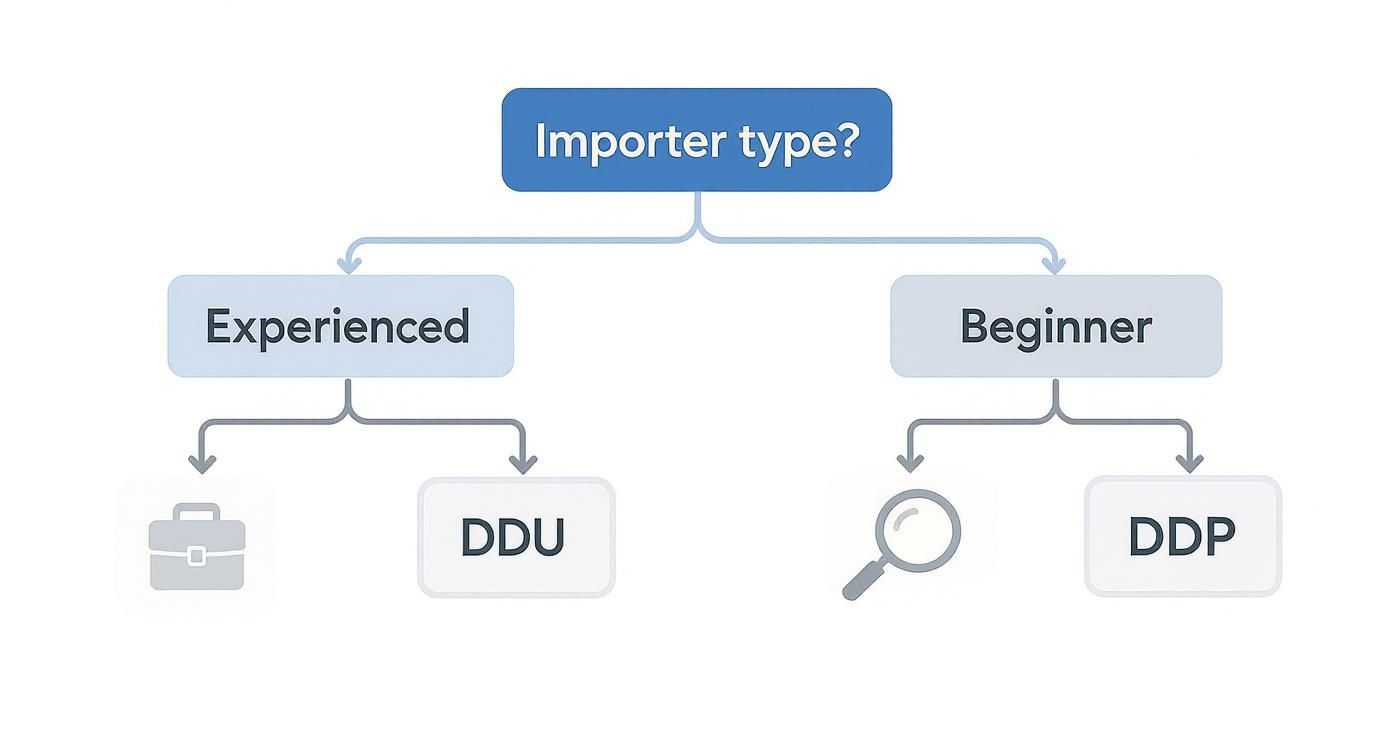
The takeaway is pretty clear: DDP offers a straightforward path for beginners, while DDU (or its modern equivalent, DAP) gives more control to those who know their way around logistics.
Scenario One: The First-Time Importer
Let's say you're a small e-commerce brand, about to import your very first shipment from China. You've never dealt with international shipping, you don't have a customs broker on speed dial, and your budget is tight—you absolutely cannot afford surprise fees. Your top priority is simplicity and knowing the final cost upfront.
Recommendation: In this case, Delivered Duty Paid (DDP) is almost always the way to go.
By choosing DDP, your supplier gives you a single, all-in price. That one number covers everything: the freight, insurance, customs clearance, and all the duties and taxes. No nasty surprises or unexpected bills when your goods hit the border. The seller handles the whole complicated journey, delivering the shipment right to your door, ready for you to sell.
For new importers, DDP provides priceless peace of mind. It effectively turns a complex international shipment into something that feels more like a simple domestic delivery, freeing you up to focus on your business instead of getting bogged down in customs paperwork.
Yes, the upfront cost might look a bit higher, but it completely removes the financial risk of customs hold-ups, incorrect filings, or sudden changes in duty rates. That kind of certainty is worth paying a premium for when you're just starting.
Scenario Two: The Experienced Importer with an Established Team
Now, picture a bigger operation. You have a dedicated logistics team that handles dozens of containers a year. You've built a solid relationship with a customs broker you trust and have a freight forwarder who knows your business inside and out. Your main objective is to minimise your total landed cost and keep a firm grip on your supply chain.
Recommendation: Delivered Duty Unpaid (DDU), or more accurately DAP (Delivered at Place), brings some serious advantages to the table.
Here, your team has the know-how to handle customs clearance like pros. By managing it yourself, you can often get better rates from your own broker than the flat fee your supplier would bake into a DDP price. It also gives you a direct line of sight into the clearance process, so you can jump on any issues immediately.
This level of control can lead to big savings over time. On top of that, managing your own import process gives you much better visibility into your supply chain, which is crucial for managing inventory. You’re not just saving a bit of cash; you're actively managing your logistics to be as efficient as possible. While DDU offers this control, it's always smart to compare it with other terms; our guide on FOB and CIF Incoterms breaks down how risk and cost transfer points differ.
Scenario Three: Shipping Highly Regulated or Complex Goods
Finally, what if you're importing something that comes with a lot of red tape? Think medical devices, cosmetics, or specialised electronics. These products often need specific import permits, certifications, and inspections that can be wildly different from one country to the next.
Recommendation: This one is a bit more nuanced—it really depends on your seller's expertise.
If your Chinese supplier has a proven track record of exporting these specific products to your country and can show they have all the necessary registrations (like local VAT/GST numbers) and knowledge, DDP can be a smart, strategic choice. Their expertise becomes a huge asset, ensuring a smooth customs process that you might struggle to handle on your own.
On the other hand, if the seller is green when it comes to your country's regulations, a DDP agreement is a huge gamble. They could easily make a mistake that gets your goods seized or stuck in customs for weeks. In that situation, DDU/DAP is the safer bet. It puts you and your specialist customs broker in the driver's seat, allowing you to make sure every last detail is handled correctly to protect your shipment.
Decision Matrix DDU vs DDP for Different Importer Profiles
To help pull all this together, this table offers a quick guide to selecting the best Incoterm based on your business profile and specific needs. It's designed to help you match your situation with the most logical shipping term.
| Importer Profile / Scenario | Recommended Incoterm | Primary Rationale |
|---|---|---|
| New or Inexperienced Importer | DDP | Provides a single, all-inclusive cost, eliminating the risk of unexpected fees. The seller handles all logistics and customs complexities. |
| Small Business / E-commerce Start-up | DDP | Simplicity and budget predictability are paramount. Allows focus on sales and marketing rather than logistics management. |
| Experienced Importer with Logistics Team | DDU/DAP | Allows for greater cost control by using preferred brokers and forwarders. Provides direct oversight of the customs process for efficiency. |
| Large-Scale, High-Volume Importer | DDU/DAP | Maximises cost savings on duties and fees at scale. Enables tight supply chain integration and visibility. |
| Importing Standard, Low-Regulation Goods | Either (Depends on cost) | The choice can be purely financial. Compare a DDP quote against a DDU quote plus your own estimated import costs. |
| Importing Highly Regulated Goods | Depends on Seller | DDP if the seller is a proven expert in your market. DDU/DAP if the seller lacks experience, to ensure compliance. |
Ultimately, the goal is to choose the Incoterm that aligns with your business's capabilities and strategic priorities. DDP offers convenience at a premium, while DDU/DAP offers control and potential savings for those equipped to handle the import responsibilities.
Steering Clear of Common DDU and DDP Pitfalls
When you're dealing with DDU and DDP Incoterms, the process can seem straightforward, but a few common missteps can easily spiral into costly delays and heated disputes. Knowing where the traps lie is the first step to making sure your cargo arrives without any nasty surprises on the invoice or timeline. Both sides of the transaction—buyer and seller—need to be on their toes.
For sellers offering DDP, the biggest mistake is almost always underestimating the destination country's customs complexities and costs. It's easy to give a quote based on incomplete data, only to be slapped with much higher duties and taxes than anticipated. This often leads to the seller trying to push these extra costs onto the buyer after the fact, which completely defeats the purpose of a DDP arrangement and is a sure-fire recipe for a dispute.
Another landmine for DDP sellers is the legal requirement to act as the Importer of Record (IOR). Many don't realise this role can demand a legal business entity or a VAT registration in the buyer's country. If the seller can't legally fulfil this duty, the shipment grinds to a halt at customs, leaving everyone's goods stuck in limbo.
Mistakes Buyers Make with DDU Shipments
On the flip side, buyers opting for DDU often get caught out by simply being unprepared. The classic error is not having a customs broker ready to jump into action the second the goods land. This kind of oversight is a direct ticket to delays.
When a DDU shipment arrives and the buyer isn't ready to handle customs, those goods don't just wait patiently for free.
Every single day of delay racks up demurrage or storage fees. These charges can snowball surprisingly quickly, turning what looked like a good deal into a very expensive lesson in logistics. A buyer might save a little on the initial freight quote but end up paying far more in unplanned port charges.
Your Commercial Contract: The Ultimate Safety Net
No matter which term you choose, your most crucial defence against problems is a rock-solid commercial contract. This becomes even more critical if you're still using the old 'DDU' term instead of its official replacement, 'DAP'. Your contract needs to spell out every single responsibility with zero ambiguity.
Make sure it clearly outlines:
- Who is responsible for finding and paying the customs broker.
- Who is on the hook for all import duties, taxes, and any potential storage fees.
- The precise point where all risk and cost are handed over from the seller to the buyer.
Getting these details down in black and white creates a clear roadmap for the transaction. It protects both parties from misunderstandings and lays the groundwork for a smooth, predictable shipment.
Common Questions About DDU and DDP
When you’re wading through the details of DDU and DDP Incoterms, a few key questions always seem to pop up. Let's tackle some of the most frequent queries we hear from importers trying to choose the right shipping terms for their business.
Is DDU Still a Valid Incoterm?
Officially, the answer is no. The International Chamber of Commerce (ICC) phased out DDU (Delivered Duty Unpaid) and brought in DAP (Delivered at Place) in its Incoterms 2010 revision. The change was meant to clear up exactly who is responsible for what.
That being said, you’ll still see "DDU" all the time, especially on quotes from Chinese suppliers who are used to the older term. If you do go with DDU, it’s crucial to spell out every single buyer and seller responsibility in your contract to avoid any misunderstandings, since it's no longer an officially defined term.
Why Would a Seller Refuse to Ship DDP?
There are a few solid reasons a supplier might push back on a DDP shipment. At its core, DDP saddles the seller with all the risk. They're on the hook for any costs that come from unexpected customs delays or a sudden hike in duty rates.
The real sticking point is often the need for the seller to be the Importer of Record (IOR). This can be a huge administrative headache, sometimes forcing the seller to register for VAT or GST in the destination country—a step many simply aren't equipped or willing to take.
Does DDP Always Mean a Higher Total Cost?
Not always, and this is where it gets interesting. A DDP quote will definitely look higher at first glance because it bundles in all the shipping, customs, and tax costs. But what you're paying for is total cost certainty.
With a DDU shipment, you, the buyer, have to handle separate payments for brokerage fees, duties, and taxes as they come up. Sometimes, these add-on costs can actually end up being more than the premium a seller bakes into a DDP price, particularly if you're new to importing. For anyone who values a predictable budget and minimal hassle, DDP can often be the smarter, more cost-effective choice in the long run.