The real difference between FOB (Free On Board) and CIF (Cost, Insurance, and Freight) comes down to a simple, yet critical, question: who is in the driver’s seat for the main part of the shipment? With FOB, the buyer takes the wheel, arranging and paying for the ocean freight and insurance once the goods are loaded. Under CIF, the seller handles all of that on the buyer's behalf. This one distinction has a ripple effect on everything from cost transparency to your control over the supply chain.
Understanding the Basics of FOB and CIF
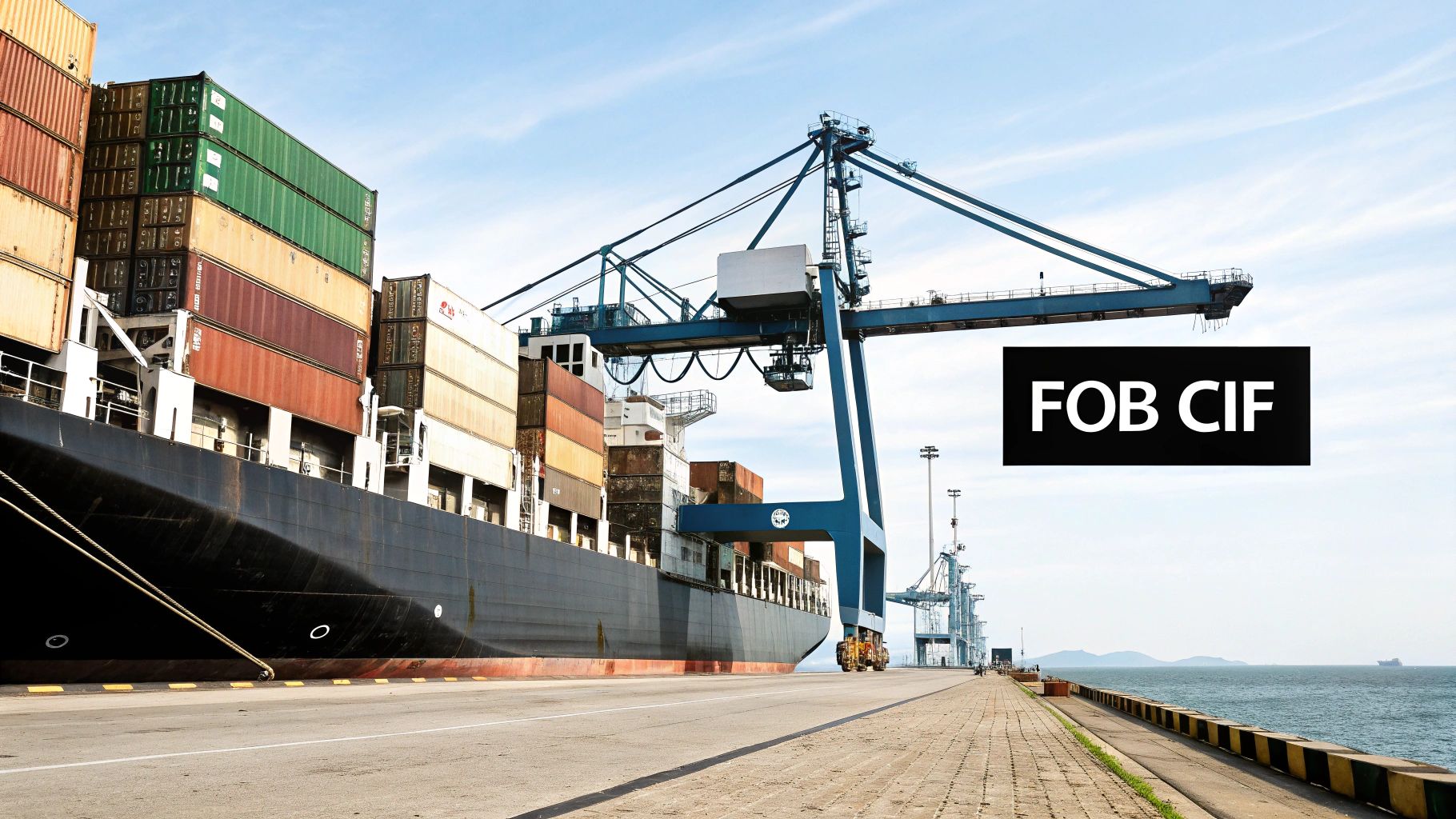
When you’re importing goods, the choice between FOB and CIF is one of the most fundamental decisions you'll face. These terms are part of the Incoterms framework, a set of globally recognised rules published by the International Chamber of Commerce (ICC) that standardise trade language. For a deeper dive into the complete set of rules, check out our guide on Incoterms 2025 Explained.
Getting this choice right is crucial. It dictates who is responsible for the cargo—and the costs—at every step of the journey. A key document that formalises these responsibilities is the Bill of Lading, which acts as a contract, receipt, and document of title all in one.
Core Differences at a Glance
It's important to remember that FOB and CIF are designed specifically for transport by sea or inland waterways. Their main job is to define the exact point where responsibility, risk, and costs are handed over from the seller to the buyer. This transfer point is the cornerstone of your logistics planning, insurance coverage, and overall shipment strategy.
For instance, the value of goods at this point is a significant economic indicator. Many of the world’s largest exporting nations, including China, use FOB values to report their trade statistics. This reflects the value of the goods at the port of origin, just before international shipping begins.
Here’s a quick breakdown of how they compare:
| Feature | FOB (Free On Board) | CIF (Cost, Insurance, and Freight) |
|---|---|---|
| Main Freight | Arranged and paid for by the Buyer | Arranged and paid for by the Seller |
| Insurance | Arranged and paid for by the Buyer | Arranged and paid for by the Seller |
| Risk Transfer Point | When goods are loaded onto the vessel | When goods are loaded onto the vessel |
| Control | Buyer controls the carrier and schedule | Seller controls the carrier and schedule |
| Cost Transparency | High, as freight costs are separate | Low, as freight is bundled into the price |
This table gives you a high-level view, but the devil is in the details. In the sections that follow, we'll get into the weeds of the specific obligations, hidden costs, and strategic advantages of each term to help you make the right call for your business.
Comparing Buyer and Seller Responsibilities

When you're deciding between FOB and CIF, it really boils down to a simple question: who's responsible for what? These aren't just acronyms on a contract; they're the rules of the road that determine who’s in control of the shipment, who’s on the hook if something goes wrong, and who’s buried in paperwork.
Getting this right is crucial for keeping your supply chain running smoothly and your budget in check. Let's break down the practical differences across the four areas that matter most in any FOB and CIF deal.
Cost Allocation: Who Pays for What?
The most immediate difference you'll feel is in your wallet. The way costs are split in FOB and CIF hinges on the main sea journey, and it's a very clear line in the sand.
With FOB (Free On Board), the seller's job is to get your goods safely loaded onto the ship you've chosen at the port of origin. They pay for everything up to that point.
These seller costs typically include:
- Inland Transport: Getting the cargo from their factory to the port.
- Loading Charges: The cost to physically load the goods onto the vessel.
- Export Customs Clearance: Handling all the fees and paperwork to get the goods out of their country.
The moment the goods cross the ship's rail, the financial responsibility flips to you, the buyer. You'll handle the ocean freight, insurance, unloading at your end, import duties, and final delivery. It’s a clean handoff that gives you great visibility into your shipping costs.
On the other hand, CIF (Cost, Insurance, and Freight) puts more of the financial burden on the seller. They handle everything an FOB seller does, but they also arrange and pay for the main sea freight and a basic insurance policy. This gives you a single, landed price to your destination port, which can make initial budgeting feel a lot simpler.
Key Differentiator on CostUnder FOB, you control the main freight costs because you book and pay for it directly. This puts you in the driver's seat for negotiating rates. With CIF, the seller's freight cost is baked into your invoice, which can sometimes mask the true shipping expense.
Logistics Control: Who Chooses the Carrier?
Who gets to pick the shipping line? This is a huge deal. The carrier and route you choose directly impacts how quickly and reliably you get your products.
In an FOB agreement, you, the buyer, call all the shots. Since you’re footing the bill for the freight, you get to nominate your own freight forwarder and shipping carrier. For any experienced importer, this is a massive advantage. You can use partners you trust, lock in better rates, and secure schedules that actually work for your business. It’s why so many seasoned buyers insist on FOB.
Under CIF, you hand that control over to the seller. They choose the carrier and manage the booking. While this is certainly easier if you want a hands-off approach, it means you're trusting them to make the best choice. Often, a seller will simply pick the cheapest option, which might not be the fastest or most reliable, leading to potential delays and poor communication.
Risk Transfer: The Exact Moment of Handover
This is where a lot of people get tripped up. Despite all their differences in cost and control, the point where risk transfers from seller to buyer is exactly the same for both Incoterms.
For both FOB and CIF, the risk of your goods being lost or damaged passes from the seller to you the moment they are loaded on board the vessel at the origin port. Once that container is on the ship, it's your problem—even while it’s in the middle of the ocean.
This creates a slightly strange situation with CIF. The seller pays for the freight and insurance, but if the ship hits a storm and your cargo is damaged, the risk is all yours. You are the one who has to file the insurance claim.
Insurance Coverage: Who Arranges Protection?
Insurance is the final piece of the puzzle and a major dividing line between these two terms.
With FOB, it's straightforward. The risk becomes yours once the goods are on the ship, so you're responsible for arranging and paying for your own cargo insurance. This is a good thing—it allows you to get comprehensive, all-risk coverage that fully protects your investment, not just the bare minimum.
Under CIF, the seller is required to buy insurance for you. The catch? The Incoterms rules only obligate them to get the most basic coverage (known as Institute Cargo Clauses C). This typically only covers major disasters like the ship sinking. It almost never covers more common issues like water damage or breakage from rough handling, leaving you dangerously exposed if something goes wrong.
To make this even clearer, here’s a quick-reference table that lays out who does what.
FOB vs CIF Responsibility Breakdown
This table breaks down the primary responsibilities for both the buyer and seller across the key stages of a shipment, making it easy to see the direct comparisons.
| Responsibility | FOB (Free On Board) | CIF (Cost, Insurance, and Freight) |
|---|---|---|
| Export Customs | Seller | Seller |
| Origin Handling | Seller | Seller |
| Main Freight (Sea/Air) | Buyer | Seller |
| Insurance | Buyer | Seller (minimum cover) |
| Risk Transfer Point | On board the vessel | On board the vessel |
| Destination Handling | Buyer | Buyer |
| Import Customs | Buyer | Buyer |
| Final Delivery | Buyer | Buyer |
As you can see, the core differences are who arranges and pays for the main freight and insurance. However, the risk transfer point remains identical, a crucial detail to remember.
Evaluating Risk Transfer and Insurance Coverage
When it comes to risk and insurance, we see the most crucial—and most frequently misunderstood—differences between FOB and CIF. Both terms pinpoint the exact same moment for risk transfer, but the way they approach insurance coverage creates two wildly different scenarios for a buyer's financial safety. Getting this right isn't just a contractual footnote; it's how you protect your investment.
For both FOB and CIF, the handover of risk is clear-cut. It happens the moment your goods are loaded 'on board' the vessel at the port of origin. From that point on, if the ship runs into a storm, gets boarded by pirates, or your container is damaged at a layover port, the financial responsibility falls squarely on you, the buyer.
The Critical CIF Insurance Paradox
Here’s where the CIF arrangement gets tricky. The seller is responsible for arranging and paying for an insurance policy, but they're doing it for a period when they no longer bear any risk. Since the risk has already passed to you, it’s you who has to file a claim against a policy you had no hand in choosing or negotiating.
This disconnect creates a dangerous gap in your protection. The Incoterms 2020 rules only require the seller in a CIF deal to provide the bare minimum level of insurance. This is usually Institute Cargo Clauses (C), which is the most basic coverage you can get.
So, what does this minimal coverage actually protect against?
- Loss or damage from major events like a fire or explosion.
- The vessel sinking, grounding, or being stranded.
- General average sacrifice (when cargo is deliberately thrown overboard to save the ship).
Notice what's missing. It does not cover more common—and expensive—problems like theft, water damage from rough seas, or breakage from poor handling during the voyage. If your container of high-value electronics gets soaked by seawater, a standard Clauses (C) policy probably won't cover your loss.
The Hidden Liability of CIFUnder CIF, your seller's goal is to fulfil their contractual duty as cheaply as possible, not to provide you with the best protection. They're just ticking a box, which can leave you seriously underinsured and exposed if anything short of a total vessel loss happens.
FOB Puts You in Control of Protection
This is exactly why seasoned importers almost always favour FOB agreements. Under FOB, the insurance responsibility is perfectly aligned with the transfer of risk. Since the risk is yours once the goods are on board, you’re the one who arranges the insurance policy.
Having this control is a massive advantage. You can work directly with your freight forwarder or a trusted insurance broker to get a comprehensive, "all-risk" policy, such as Institute Cargo Clauses (A). This level of coverage protects your shipment against a much broader range of potential damages, giving you real peace of mind.
Better still, by managing your own insurance, you also control the claims process. If something does go wrong, you're dealing directly with an insurer you chose and trust—not trying to navigate a complex claim through your seller's unknown (and potentially unhelpful) overseas insurance company. For a complete look at your choices, exploring the different insurance options for international shipping is a smart move.
Ultimately, the decision between FOB and CIF is about control versus perceived convenience. CIF might look simpler on paper, but that ease comes at the high price of weak protection. FOB requires one extra step from you, the buyer, but it guarantees your valuable cargo is properly insured, putting you firmly in control of your supply chain’s financial security.
When to Choose FOB and When to Choose CIF
Deciding between FOB and CIF isn't just a box to tick on a contract; it's a strategic choice that pits convenience against control. The right Incoterm for you really hinges on your experience in international trade, the volume of goods you're moving, and just how much command you want over your supply chain.
For seasoned importers, the answer is almost always a foregone conclusion. They lean heavily towards FOB because it puts them squarely in the driver's seat. On the other hand, if you're new to the game or only handle small, infrequent shipments, the all-in-one nature of CIF can look pretty attractive at first glance.
Let's break down the scenarios where each term truly shines.
The Case for Choosing FOB
Experienced importers and businesses with well-oiled supply chains almost universally prefer FOB. Why? It all boils down to one word: control. When you're the one arranging the main international freight, you get to pick your partners, set the timeline, and see exactly where every dollar is going.
You should definitely choose FOB when:
- You want to manage your shipping costs. By appointing your own freight forwarder, you can get competitive quotes and find the best value. Sellers offering CIF terms often bake a healthy margin into the freight cost or simply pick the cheapest, and often slowest, carrier to boost their own profit.
- You need reliable delivery schedules. FOB gives you the power to select a carrier known for its on-time performance. This is non-negotiable if you have tight production deadlines or need to keep store shelves stocked. You won't be left guessing or hoping your seller's budget carrier comes through.
- You require solid insurance coverage. With FOB, you arrange your own cargo insurance. This allows you to secure comprehensive, "all-risk" coverage (like the Institute Cargo Clauses A) that actually protects your investment, instead of the bare-minimum policy a seller typically provides under CIF.
- You have a freight forwarder you trust. If you're already working with a logistics partner like Upfreights, using FOB lets you play to your strengths. Your forwarder is your advocate, fighting for the best routes, rates, and handling of your documentation.
This simple flowchart gets to the heart of the matter.

As the visual shows, if having direct control over your logistics and insurance is a top priority, FOB is the way to go. CIF is really only a consideration when that level of hands-on management isn't necessary.
The Case for Choosing CIF
While most experienced buyers steer clear of CIF, it does have its place, especially for newcomers to importing or businesses dealing with very small shipment volumes. The main appeal of CIF is its apparent simplicity.
You might consider CIF when:
- You're a new or infrequent importer. If you're just starting and don't yet have a relationship with a freight forwarder, a CIF agreement simplifies things by giving you one price from the seller that includes shipping and insurance.
- You are shipping low-volume LCL cargo. For a few small boxes (Less than Container Load), the time spent sourcing separate freight and insurance quotes might feel like overkill. A CIF quote gives you a fast, all-inclusive price to your destination port.
- Your main goal is a simple, upfront number. CIF provides a single invoice covering the goods, shipping, and insurance. This can make your initial budgeting feel more straightforward, but beware—it often masks hefty fees on the other end.
A Critical Word of Caution on CIFThe convenience of CIF often comes at a steep price. You surrender control over the carrier, the schedule, and the quality of your insurance. Worse, you're frequently hit with surprisingly high terminal handling charges and other destination fees levied by the seller's chosen agent, which can completely wipe out any savings you thought you were getting.
Making the Final Decision
At the end of the day, choosing between FOB and CIF is a business decision rooted in your priorities. For the vast majority of companies serious about building a resilient and cost-effective supply chain, FOB is the clear winner. It delivers the control and transparency needed to manage logistics effectively, cut costs, and properly protect your goods.
Think of it this way. With CIF, you're buying a pre-built house where the seller picked the builder and all the materials. It's easy, but you have no say in the quality. With FOB, you're the general contractor, hand-picking every expert to ensure the final result is built to your exact specifications. It takes more involvement, but the outcome is almost always better and more aligned with your long-term success.
Avoiding Common Pitfalls in Your Contracts
When you're dealing with FOB and CIF agreements, getting the contract right is everything. It's about more than just knowing the definitions; it's about paying close attention to the small details that can save you from big headaches. A tiny oversight can easily spiral into surprise costs, delayed shipments, and painful disputes.
Learning to spot the common traps beforehand is the key. This way, you can build agreements that truly protect your business and keep things moving smoothly. Most of the expensive mistakes I've seen come from one place: ambiguous contract language. Just writing "FOB" or "CIF" on a document and calling it a day is a recipe for disaster.
The Danger of Vague Contract Terms
The single biggest mistake? Failing to specify the exact location and which version of the Incoterms rules you're using. A contract that simply states "FOB" is practically begging for a fight. Is that FOB the seller’s factory gate? FOB a warehouse somewhere in the port city? No, the rule is meant to be applied at the named port of shipment.
Your contract needs to be airtight to avoid this confusion.
- Specify the Named Port: Be precise. Instead of "FOB China," your contract should read "FOB Shanghai Incoterms® 2020." This leaves no doubt about the exact point where the seller’s responsibility ends and yours begins.
- State the Incoterms Version: The rules get updated every decade or so. Naming the version, like Incoterms® 2020, makes sure everyone is on the same page and working from the same internationally accepted playbook.
Without these specifics, you're setting yourself up for an argument over who pays for trucking the container to the port or the terminal handling fees—costs that can add up fast.
Contract Clarity is Non-NegotiableThink of your purchase order and sales contract as your first line of defence. Vague terms create grey areas, and that's where expensive problems love to hide. By explicitly stating the full Incoterm rule, the named place, and the governing version, you shut the door on misinterpretation.
Uncovering Hidden CIF Destination Charges
Now, let's talk about a classic trap, and this one is almost exclusively a CIF problem: the shock of hidden destination fees. A seller might dangle a very tempting CIF price that looks a lot cheaper than what you were quoted for an FOB shipment. The catch is that this low price often hides a nasty surprise waiting for you when your cargo arrives.
Here's how it works. When the seller arranges shipping under CIF, their freight forwarder has a partner agent at your destination port. This agent can hit you with inflated bills for local services—charges that would be far more reasonable if you'd booked the shipment yourself under FOB terms. These often include things like:
- Terminal Handling Charges (THC)
- Documentation Fees
- Container Service Charges
- Customs Clearance Administration Fees
These jacked-up fees can completely wipe out any savings you thought you were getting with the CIF quote. That "great deal" quickly becomes a very expensive lesson. With an FOB shipment, you choose your own freight forwarder, who gives you a clear, transparent breakdown of all destination costs upfront. You know your total landed cost before the ship even leaves the port.
Misunderstanding Risk and Insurance
Another critical point of confusion is the link between risk transfer and insurance, especially under CIF. As we’ve covered, risk in both FOB and CIF transfers to you, the buyer, the moment the goods are loaded onto the vessel. With CIF, the seller is obligated to purchase insurance, but it's almost always the absolute minimum coverage available, known as Institute Cargo Clauses C.
This creates a huge and often overlooked gap. This basic policy really only covers major catastrophes, like the ship sinking or catching fire. If your goods are damaged in a storm or from rough handling, you're probably not covered. You'd be stuck with the loss for goods that are completely unusable.
Always assume the seller's CIF insurance is not enough. You should either negotiate for better coverage (like Clauses A) directly in the sales contract or, better yet, arrange your own supplemental cargo insurance. When you ship FOB, you control the insurance policy from the get-go, so you can be confident your investment is properly protected.
Partnering with a Freight Forwarder for Success
Trying to manage FOB and CIF on your own can be a real headache. This is where bringing in an experienced freight forwarder makes all the difference. Think of them as your logistics quarterback, advocating for your shipment and making sure everything runs smoothly, no matter which Incoterm you've agreed to. Their job isn't just about finding space on a ship; it’s about providing the strategic guidance you need to keep costs in check and sidestep potential risks.
For anyone using FOB, a reliable forwarder is non-negotiable. Once you take charge of the main freight, you need someone in your corner who can help you make the right calls. A good forwarder taps into their network of over 200+ carriers to find you competitive rates, dependable schedules, and the most efficient route for your goods.
Maximising Control with FOB
Under an FOB agreement, your forwarder takes the reins on all the critical steps after your cargo is loaded. This typically means:
- Booking the primary ocean or air freight.
- Arranging solid, all-risk cargo insurance that actually covers your investment.
- Giving you full visibility with end-to-end tracking from the port all the way to your door.
This kind of partnership turns FOB from a list of obligations into a genuine strategic advantage. It puts you firmly in the driver's seat of your supply chain.
A great freight forwarder does more than move boxes. They provide the expertise and network access that allows you to operate like a major importer, even if you're just starting out. They level the playing field, ensuring you get fair rates and reliable service.
Navigating CIF with Expert Support
Even if you go with CIF and the seller handles the main freight, a freight forwarder is still one of your most important assets. Remember, the seller’s responsibility stops the moment your cargo hits the destination port. That leaves you to sort out the final, and often surprisingly expensive, part of the journey. This is precisely where your own logistics partner proves their worth.
For any CIF shipment, your forwarder can:
- Handle the import customs clearance process, steering you clear of expensive delays.
- Scrutinise and often challenge the high destination charges that the seller’s appointed agent might try to pass on to you.
- Organise affordable and reliable inland transport to get your goods from the port to your warehouse.
In the end, it doesn't matter if you choose FOB for greater control or need help managing the final leg of a CIF shipment—the right partner is essential. To get a better feel for everything a forwarder can handle, it's worth looking into these key freight forwarding services. Their expertise is what ensures a seamless process, protecting your bottom line and saving you from the logistical nightmares that can sink an otherwise perfect shipment.
Your FOB and CIF Questions, Answered
When you're dealing with the nitty-gritty of international shipping, a few questions about FOB and CIF pop up time and time again. Let's clear up some of the most common points of confusion so you can manage your shipments with confidence.
Can I Use FOB or CIF for Air Freight?
That's a common misconception, but the short answer is no. Both FOB (Free On Board) and CIF (Cost, Insurance, and Freight) were specifically created for transport by sea or inland waterway. The very language of the terms is built around the act of loading goods "on board" a vessel.
If you're shipping by air, you need to use the right tools for the job. The correct equivalents are:
- FCA (Free Carrier) is the modern counterpart to FOB for air transport.
- CIP (Carriage and Insurance Paid To) is the direct equivalent of CIF for air freight.
Sticking to the correct Incoterm isn't just a technicality; it prevents major legal headaches and logistical mix-ups down the line.
Who Is Responsible for Unloading the Ship?
This is a big one. Under both FOB and CIF agreements, the buyer is always responsible for paying to unload the goods from the ship at the destination port. The seller's job under a CIF contract is done once the vessel arrives at the named port—but crucially, before the cargo is actually unloaded.
A Word of WarningDon't ever assume your CIF price includes unloading. These costs, known as Terminal Handling Charges (THC) at the destination, are on the buyer's tab. They're a frequent source of surprise bills for importers who haven't budgeted for them.
Which Incoterm Is Better for Amazon FBA Sellers?
If you're selling on Amazon FBA, the choice is clear: FOB is almost always the superior option. The FBA model demands tight control over your supply chain, from the freight booking all the way to the final delivery appointment at an Amazon fulfilment centre.
Choosing FOB gives you, the buyer, complete control over the shipping carrier, the sailing schedule, and the final delivery timeline. This is absolutely essential for hitting Amazon's strict receiving windows. A CIF shipment, on the other hand, puts your supplier in the driver's seat, often leading to unpredictable arrivals and inflated destination fees that can throw your inventory management into chaos and hurt your seller metrics.