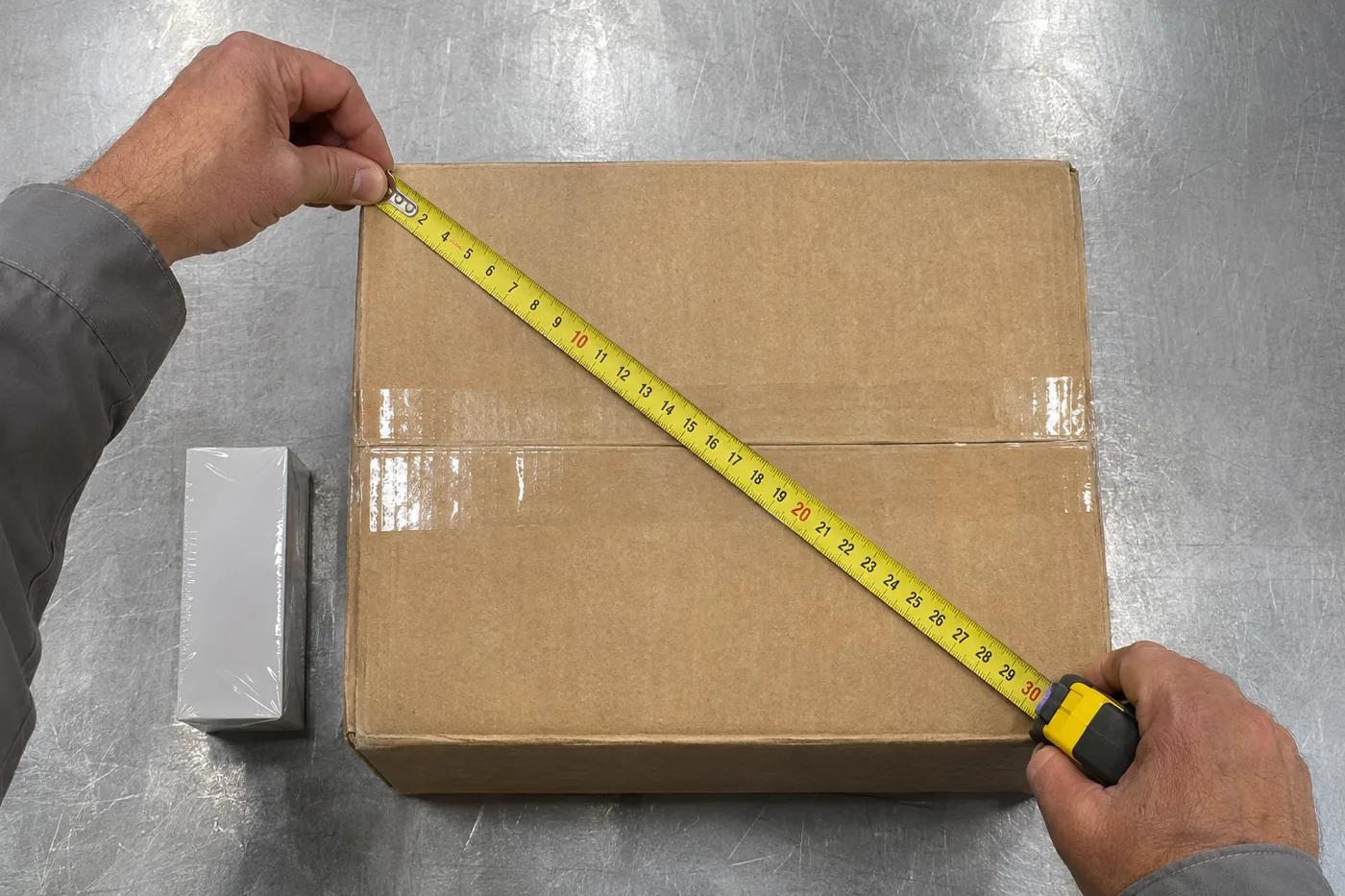
The short answer: Chargeable weight is whichever is greater: the shipment's actual gross weight or its volumetric weight. For air freight, multiply length × width × height in centimeters, divide by 6,000 (the IATA standard) and multiply by the number of packages of that size. The result is the volumetric weight in kilograms. Express couriers such as DHL, FedEx and UPS usually divide by 5,000, which gives a higher figure.
Twenty cartons, 12 kg each on the scale, make 240 kg of goods. Pack them in cartons of 60 × 40 × 40 cm, send them by air, and the airline bills 320 kg.
The extra 80 kg is space. Airlines charge on whichever is bigger: what your goods weigh, or the room they take up. A packing list shows you the first number and leaves you to work out the second.
The calculator above this guide gives you that second number in seconds. Treat the result as an estimate: the airline sets the final figure after it weighs and measures your cargo, and it rounds by its own rules. To get close to its number, you need the right divisor and honest outer measurements, and you should keep a record of how you got them.
What does chargeable weight mean, and why do airlines bill on size?
Chargeable weight is the number of kilograms your air freight is priced on. The airline takes two figures and charges on whichever is greater:
- the actual weight on the scale, called the gross weight
- the volumetric weight, worked out from the carton sizes
Forwarders didn't invent this. IATA, the airline industry body that sets air cargo rules, says the higher of the two "is the amount that will be used for pricing the air freight cost." LATAM Cargo says nearly the same: "The weight subject to charge is the highest between the gross weight and the volume weight." When a quote says billable weight, it means this figure.
The reason is space. Shinya Iino runs an international logistics group in Thailand and explains freight on YouTube as IINO san. He explains that airlines sell a limited amount of room. If they billed on the scale alone, light, bulky cargo would fill the plane and pay too little.
"Water is heavy but not bulky. The cotton is light and very bulky." (IINO san, freight forwarder)
IATA makes the same point with feathers and steel. The rule matters most for lightweight items that take up significant space. If your cartons are mostly air and cardboard, treat yourself as shipping cotton until the numbers say otherwise.
How do you calculate volumetric weight for air freight?
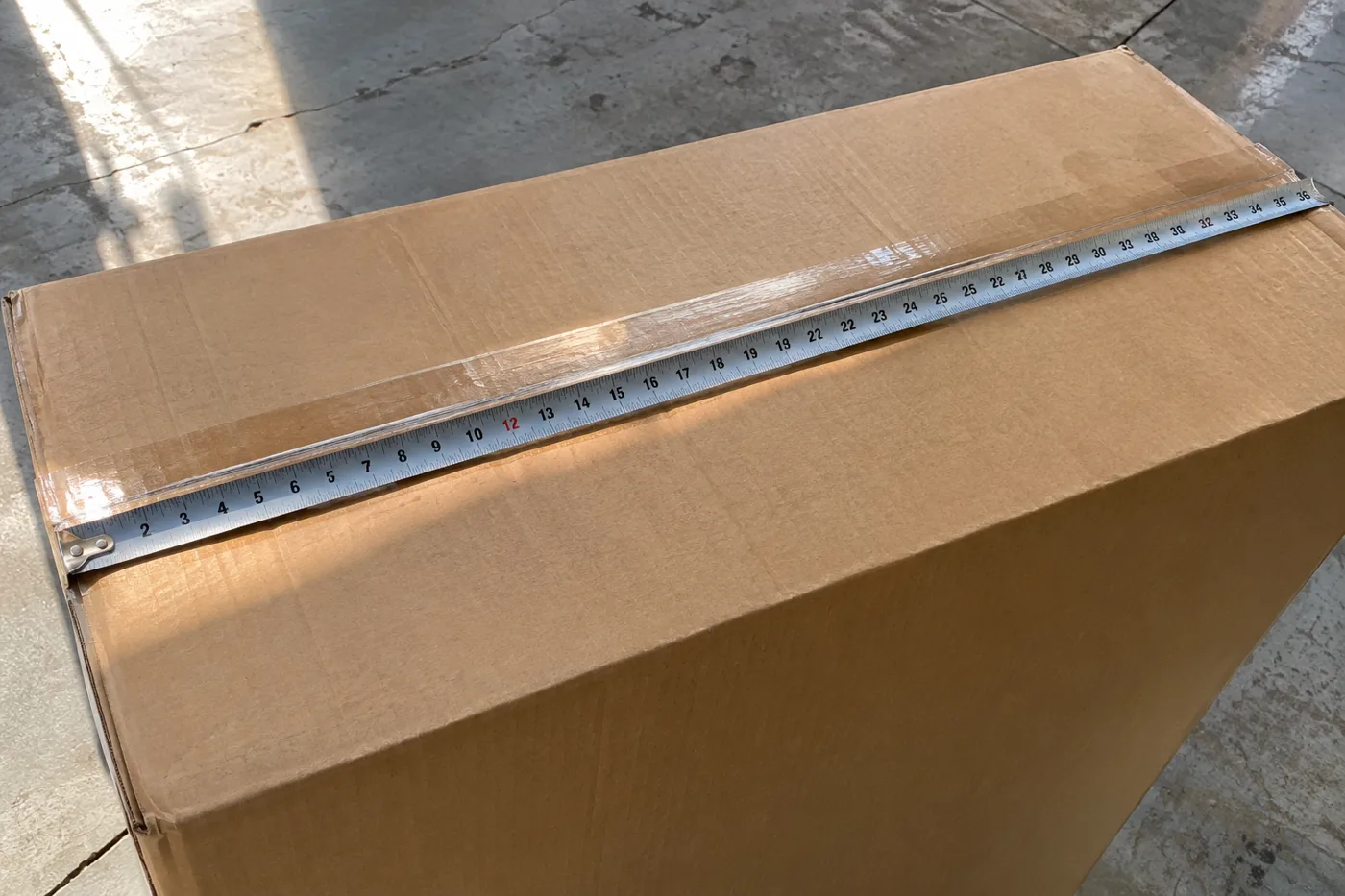
IATA's general rule is to divide the shipment's volume in cubic centimeters by 6,000. To apply it to your supplier's carton list:
- Take each carton's outer length, width and height in centimeters. If the list gives meters, multiply each figure by 100 first.
- Multiply length × width × height in cm. That gives the volume in cubic centimeters.
- Divide by 6,000. The answer is that carton's volumetric weight in kilograms.
- Multiply by the number of cartons that size. Repeat for each carton size on the list and add the results.
- Compare that total with the total gross weight. The bigger number is your chargeable weight.
Here's an example. A 60 × 40 × 40 cm carton weighing 12 kg has a volume of 96,000 cm³. Divided by 6,000, that's 16 kg. It bills at 16 kg, not 12, because size wins. On an order of 20 cartons, a quarter of the kilograms you pay for is empty space.
How do you calculate dimensional weight in inches and pounds?
Multiply length × width × height in inches. Then divide by 166 to get pounds, or by 366 to get kilograms. LATAM Cargo and Korean Air Cargo both publish these figures in their own terms as the inch versions of the 6,000 rule.
You may also see a divisor of 139, and it causes trouble. 139 is the pound version of the 5,000 courier divisor, not the 6,000 air divisor. Wikipedia's entry on dimensional weight gives "139 cubic inches per pound (5,000 cm3/kg)" as the UPS and FedEx standard for most services. You can check it with NIST's conversion factors:
- 6,000 cm³ per kg works out to 366.1 cubic inches per kg, or 166.1 per pound.
- 5,000 cm³ per kg works out to 138.4 cubic inches per pound, which is published as 139.
Here's what that does to a 24 × 16 × 16 inch carton weighing 30 lb. Its volume is 6,144 cubic inches.
- Divide by 166 and you get 37.01 lb. Korean Air rounds any fraction of a pound up, so it bills at 38 lb.
- Divide by 366 and you get 16.79 kg, which Korean Air bills at 17 kg.
- Divide by 139 by mistake and you get 44.2, billed at 45 lb. That's about 18% more than the correct figure, on one carton.
Will your shipment be billed on weight or size? A quick density test
You can tell from the packing list alone. Divide the total gross weight in kg by the total volume in CBM. CBM means cubic meters: one CBM is a box 1 m on each side.
If you get less than about 167, you'll pay on size. If you get more, the scale sets the bill. ExFreight, a forwarder, describes the 6,000 divisor as exactly this kind of 167 kg per cubic meter line, where "bulky, lightweight shipments" switch to space-based billing.
In US units, divide total pounds by total cubic feet. The line is about 10.4. Wikipedia lists 166 cubic inches per pound as matching 10.4 lb per cubic foot for IATA shipments.
Run the 20 cartons from earlier through the test. Each carton is 0.096 CBM, so 20 of them make 1.92 CBM. At 240 kg, that's 125 kg per CBM, well under the line, so they bill on size. If your result lands close to 167, measure carefully. A small error in carton size can change which number wins.
Where size takes over under the 6,000 rule
- 166.7 kg per cubic meter
- 366.1 cubic inches per kg
- 166.1 cubic inches per lb
- 10.4 lb per cubic foot
Which divisor does your quote use, 6,000 or 5,000?
Ask before you compare quotes. Airline cargo works to 6,000. DHL Express uses "length x width x height / 5000," which treats one cubic meter as 200 kg. The 139 figure used by UPS and FedEx is the same 5,000 rule in inches.
The table shows what each divisor does to the 20-carton order, all 60 × 40 × 40 cm and 240 kg in total:
| Divisor | Who uses it | Chargeable weight |
|---|---|---|
| 6,000 | IATA standard for air cargo | 320 kg (baseline) |
| 5,000 | Express couriers such as DHL | 384 kg (+20%) |
| 4,000 | Hypothetical only | 480 kg (+50%) |
We found no carrier that divides by 4,000. The row is a what-if, because the figure turns up in freight videos.
The per-kg rate doesn't change with the divisor. Only the kilograms do, so freight on size-billed cargo rises by the same 20% or 50%. For goods billed on the scale, the divisor usually changes nothing. The exception is density between 167 and 200 kg per CBM: a 5,000 divisor moves that cargo onto size billing.
How to measure a carton for chargeable weight: outer size and pallets

Measure the outside of the carton, at its biggest point in each direction. Korean Air's conditions state the rule: "Greatest rectangular dimensions shall be based on the greatest length times greatest width times greatest height of the consignment." SEKO Logistics puts it more briefly: "Always measure at the widest points, including any pallet overhang."
What that means for your shipment:
- Cartons: use the outer carton dimensions.
- Pallets: measure the whole loaded pallet as it will ship, including any overhang.
Is chargeable weight worked out per carton or for the whole shipment?
For airline cargo, it's worked out on the shipment. Cargolux's conditions say charges "depend on the higher of the total weight or total volume." This matters when your order mixes heavy and light cartons. On totals, the shipment's whole gross weight is set against its whole volumetric weight, so the heavy cartons' extra weight and the light cartons' extra size can cancel out.
Mixed cartons, added up two ways
- Carton A: 60 × 40 × 30 cm, 30 kg actual, 12 kg on size
- Carton B: 60 × 40 × 60 cm, 5 kg actual, 24 kg on size
- Carton by carton: 30 + 24 = 54 kg chargeable
- On shipment totals: 35 kg actual against 36 kg on size, so 36 kg
Consolidation adds a layer. A forwarder can combine several shippers' cargo under one master air waybill, the airline's contract for the whole load. Each shipper then gets its own house air waybill from the forwarder, as GoFreight explains. ExFreight notes that grouping lets forwarders buy space at lower per-kg rates, which helps shipments under 500 kg.
So the airline rates the whole load, and your forwarder rates your share. Ask how they compare yours: on totals, or carton by carton. Express couriers work carton by carton: DHL, FedEx and UPS all work out chargeable weight for each package and add the results together.
Why your China supplier's packing list weight may not be the one you pay on
The weight and size declared for your cargo don't always match the actual cargo. GoFreight names this the most common air waybill error, one that leads to "customs holds, reweighing fees, and billing disputes." Its fix is a weight and dimension check every time cargo comes into the warehouse.
Even an airline's own calculator gives only a provisional answer. LATAM Cargo says its values are approximate and "the final value will be calculated once the cargo is received in our warehouse."
So whatever the packing list says, the warehouse figures are the ones you pay on. Before the shipment flies, ask your forwarder for the origin warehouse's measured weight and dimensions.
Why is your air freight invoice higher than your quote?
Your quote was built on your numbers, and your invoice is built on the carrier's. Cargolux states that if the weight or measurement "as measured by CARRIER or any AGENTS… exceeds" the figures the charges were based on, it "shall be entitled to require payment of the charge on such excess based on its tariff." Korean Air gives itself the same right. Disputes run on a clock, too: Cargolux treats an invoice as accepted unless the shipper objects in writing within 30 days of its date, with the invoice number and the full reason.
Parcel sellers who have been hit by re-measured bills give simple advice. One reseller on Reddit wrote: "You need to buy a tape measure and scale, so this never happens again." Your own tape and scale won't settle a dispute with an airline, but they let you, or your supplier, catch a wrong packing list before you book.
Keep these records, so you have something to set against the carrier's measured figures if a dispute comes up:
- the supplier's packing list
- the forwarder's intake figures from origin
- any other measurement records your forwarder says it needs (ask before you ship)
How much can you save by making the carton smaller?
Cutting one side cuts the volumetric weight in proportion, but only until size stops being the bigger number. Take the 60 × 40 × 40 cm carton weighing 12 kg:
- At 40 cm high, it bills at 16 kg.
- At 35 cm high, it bills at 14 kg, 12.5% less. Across 20 cartons, that's 280 kg instead of 320.
- At 30 cm high, size and scale meet at 12 kg each.
- Below 30 cm, there's nothing left to save. The scale sets the bill.
Rounding means small cuts can save nothing. Korean Air bills in half kilograms. Atlantic Packaging, a packaging distributor, reports that from August 18, 2025, FedEx rounds every fraction of an inch up to the next whole inch, and that UPS made the same change. With those couriers, shaving a few millimeters off a carton changes nothing unless it takes a side below a whole inch.
Before you cut, protect the goods. In a Reddit thread, one seller said they had already cut their box as far as they could without packing the item unsafely. Another suggested moving to a slightly smaller box with lighter filler. How much cushioning your goods need is a question for your supplier, and the risk is yours. Under Article 18(2)(b) of the Montreal Convention, the international treaty on air carriers' liability, the airline doesn't have to pay for damage it can show was caused by poor packing done by someone other than the airline or its own staff or agents. Settle it before the carton size goes into the order.
When does sea freight cost less than air for the same goods?

Photo: Solømen on Unsplash
For light, bulky cargo, sea freight is often cheaper, because sea and air count a cubic meter so differently. Sea shipments that share a container are called LCL, for less than container load. They're priced per revenue ton, which Airlift USA defines as "one cubic meter or one metric ton (1,000 kg), whichever gives the larger number." IINO san makes the same point: sea and warehousing work on one cubic meter to one ton, so an air quote and a sea quote are priced on different bases.
By sea, a cubic meter counts as 1,000 kg. By air, it counts as about 167 kg. So by sea, anything lighter than 1,000 kg per cubic meter pays on cubic meters. By air, the same cubic meter turns into about 167 billed kilograms.
You can do the comparison yourself with two quotes. Take the 20 cartons from earlier:
- By air: 320 kg chargeable × your air rate per kg.
- By sea LCL: 1.92 CBM against 0.24 metric tons, so 1.92 revenue tons × your LCL rate per revenue ton.
Ask for both as dated quotes for the same goods, because rates change.
Two things can upset the comparison. First, transit time: ask for it with each quote and check it against your selling dates. Second, LCL usually has a minimum of one revenue ton. Portlogics notes that a 50 cm cube comes to about 20.8 kg by air but only 0.125 of a revenue ton by sea. A box that small would still pay the full sea minimum.
What to send your forwarder once you have your chargeable weight
Send the raw figures as well as your answer, so the forwarder can check your work:
- the number of cartons of each size
- the outer length, width and height of each carton size, measured at the widest point, in cm or inches
- the gross weight of one carton of each size, plus the total gross weight of the whole shipment
- whether the cartons go loose or on pallets, and the loaded pallet sizes if they're on pallets
- your density result: kg per CBM, or lb per cubic foot
Then ask two questions:
- Which divisor is the quote built on?
- Do you compare my shipment on total weight and total volume, or carton by carton?
Treat your number as a forecast. Ask your forwarder to send you the origin warehouse's measured figures before the flight leaves, while there's still time to query them.
The bottom line
Start with the density test on the packing list you already have. Divide total kilograms by total CBM. If you get less than about 167, size decides your bill, and the carton spec matters as much as the weight (subject to the carrier's rounding).
If you're shipping on size, ask for a sea LCL price alongside the air quote on our quote page. If you're shipping on weight, check the gross weights instead, because those are what will be re-weighed.
Either way, put the divisor question in your first message to any forwarder, before rates come up at all.
Questions people also ask
Is the air freight divisor 6,000 or 5,000?
The IATA standard for air cargo is 6,000, and express couriers such as DHL Express divide by 5,000. IATA describes 6,000 as the general rule, and LATAM and Korean Air publish it in their own conditions. DHL Express uses 5,000, which raises the volumetric weight by 20%. Ask which one your quote uses.
How do I calculate chargeable weight in inches and pounds?
Multiply length × width × height in inches, then divide by 166 to get pounds or by 366 to get kilograms. These are LATAM Cargo's published figures for the 6,000 rule. The 139 divisor is the pound version of the 5,000 courier rule, as Wikipedia's entry shows, so don't use it on an air cargo quote. Compare the result with the actual weight and pay on the higher figure.
Is chargeable weight calculated per box or for the whole shipment?
For airline cargo, it's usually calculated on the whole shipment, while express couriers such as FedEx and UPS work it out per package and add the results. Cargolux bills on "the higher of the total weight or total volume." If your order mixes dense and light cartons, comparing totals can bill noticeably less than comparing each carton on its own. In a consolidation, your forwarder rates your share, so ask which method they use.
Why is my air freight invoice higher than my quote?
Usually, the carrier measured or weighed your cargo and got bigger numbers than the quote used. Airlines such as Cargolux and Korean Air keep the right to charge on the excess. GoFreight names mismatched weights or dimensions as the most common air waybill error behind reweighing fees and billing disputes.
Do airlines round up chargeable weight?
Some do, but the rule comes from each carrier rather than from one universal standard. Korean Air charges half a kilogram or less as a half kilogram, rounds anything over that up to the next whole kilogram, and rounds any fraction of a pound up to the next pound. DHL UK says parcel weight "is rounded up to the nearest half kilo." Check the tariff or quote for your own carrier.
Is it cheaper to ship bulky goods by sea instead of air?
Often, yes, for light, bulky cargo. Sea freight counts a cubic meter as about 1,000 kg, while air counts it as about 167 kg. Sea LCL is priced per revenue ton, whichever is larger of one cubic meter or one metric ton, usually with a one-revenue-ton minimum. To compare, multiply your air chargeable kilograms by your air rate per kg, and your revenue tons by your LCL rate per revenue ton. Ask for the transit time with each quote too, and check it against your selling dates.