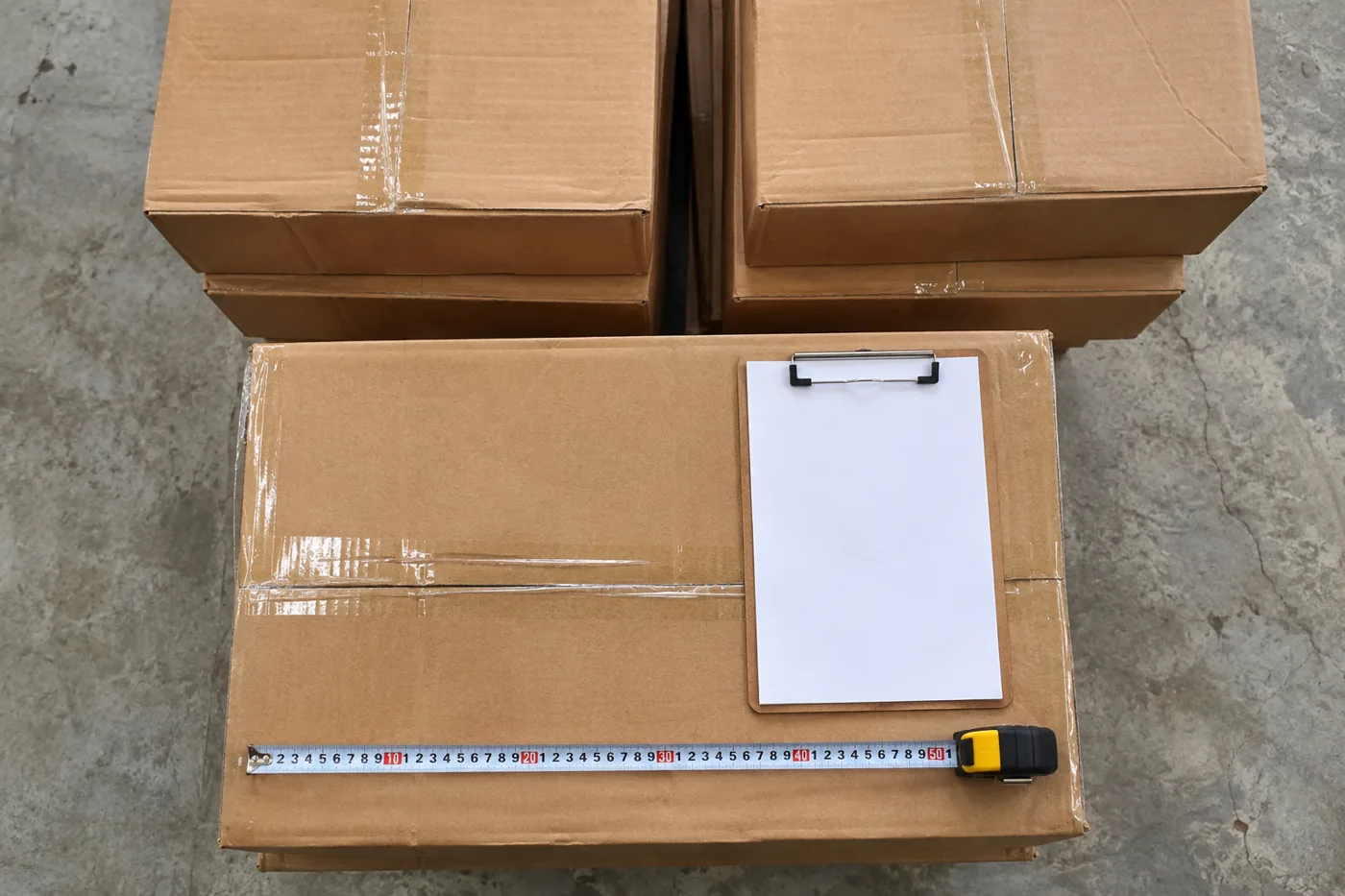
The short answer: CBM (cubic meters) is a carton's length times width times height, measured in meters. With centimeters, multiply the three sides and divide by 1,000,000; with inches, divide by about 61,024. Multiply the result by the number of cartons, working out each carton size separately before adding them together. A 60 × 40 × 40 cm carton comes to 0.096 CBM, so 40 of them make 3.84 CBM.
Your supplier's packing list sets most of your freight bill. It's a few rows of carton sizes, weights and counts.
The CBM calculator above this guide turns those rows into cubic meters in a second. It can't tell you what the forwarder does with that number next. It won't show which figure they bill on, the minimum they charge, how air freight swaps volume for weight, or why a container holds less than its label says.
Those steps are where quotes go wrong, and each one is easy to check. Below, one example order is worked through by sea and by air, so you can check any quote line by line and know your freight cost per unit before you order.
What is CBM, and how do you calculate it?
CBM stands for cubic meter (m³), the unit forwarders use to measure how much space your cargo takes up. Ship4wd's glossary calls it "a standard unit for measuring cargo volume in international and domestic shipping."
The CBM formula is length × width × height, each in meters, times the number of cartons. Use the outer carton's measurements.
A 60 × 40 × 40 cm carton is 0.6 × 0.4 × 0.4 meters, which is 0.096 CBM. Forty of them make 3.84 CBM.
One habit saves arguments later: round up, never down. Ship4wd's advice is to "round measurements up instead of down to avoid underestimating." The carrier rounds its own way too, as you'll see further down.
How to calculate CBM from inches, feet or centimeters
With carton sizes in centimeters, the job is multiplying the three sides and dividing by 1,000,000. If your supplier or your own tape measure works in inches or feet, you need a different divisor. The factors below come from the US National Institute of Standards and Technology, which lists the inch and foot factors as exact.
Take a 24 × 16 × 16 inch carton. That's 6,144 cubic inches, which comes to about 0.1007 CBM. Worked in feet, the same carton is 3.556 cubic feet, which also lands on 0.1007 CBM. If your two answers don't match, one of the sides was typed wrong.
Quick unit conversion
- Centimeters: multiply the three sides, then divide by 1,000,000
- Inches: multiply the three sides, then divide by 61,024
- Cubic feet to CBM: multiply by 0.02831685
- 1 CBM = 35.31 cubic feet
What carton details should you get from your supplier?
Ask for the packing list, and ask before the goods ship. The International Trade Administration describes it as the document that "itemizes the contents of each package," with "weights, measurements and detailed lists of the goods." It also notes that forwarders use it "to determine weights and freight costs."
So the packing list is the input to your quote. Make sure it gives you:
- Length, width and height of each shipping carton, in centimeters
- Gross weight of each carton in kilograms, meaning the weight with all its packing
- How many cartons there are of each size
- How many units go in each carton
Crescent Kao, an Amazon private-label seller whose channel covers shipping from China, starts in the same place in his video on shipping costs: get the size and weight of each shipping carton, and the total number of cartons.
Then check that the figures describe the packed outer carton as it will actually leave the factory. Flexport's quote terms say charges are set on "the actual weight and dimensions of the cargo as tendered." A carton spec drawn up before packing can be wrong once the goods go in. For anything that ships unboxed or oddly shaped, Ship4wd says to measure at its longest points.
A costly mix-up is using the retail box instead of the shipping carton. In the same video, Kao warns that beginners often confuse the shipping carton's size and weight with the single unit's, and that this causes problems with their listing. If you sell on Amazon, the unit size feeds your marketplace fees and the carton size feeds your freight. The next section shows how big that gap can be.
How do you add up cartons that aren't all the same size?
Work out each carton size on its own, then add the totals together. Suppliers often pack full cartons and one part-filled carton at the end. If that last carton has different outside measurements, it counts as a second carton size. Kao makes the same point in his video: when a supplier packs uneven cartons, each size gets its own line.
Here's an example order, used from here on:
| Carton | Details | CBM |
|---|---|---|
| Full | 40 cartons at 60 × 40 × 40 cm, 15 kg and 24 units each | 3.84 |
| Part | 1 carton at 60 × 40 × 25 cm, 9 kg, 12 units | 0.06 |
| Total | 41 cartons, 609 kg, 972 units | 3.90 |
Weight works the same way: count times weight for each size, then add.
Two shortcuts give the wrong answer. Multiplying all 41 cartons by the full size gives 3.94 CBM, a little high. Multiplying all 41 by the small carton's 0.06 gives 2.46 CBM, which leaves more than a third of the cargo off your estimate.
Now back to the retail-box mix-up. Say each of these 972 units sits in a 20 × 15 × 10 cm retail box. Added up, those boxes come to 2.92 CBM. The cartons they actually ship in come to 3.90 CBM. That's about a quarter of your cargo missing from your own estimate, on a bill you'll pay in full.
CBM calculation for shipping by sea: how is LCL billed?
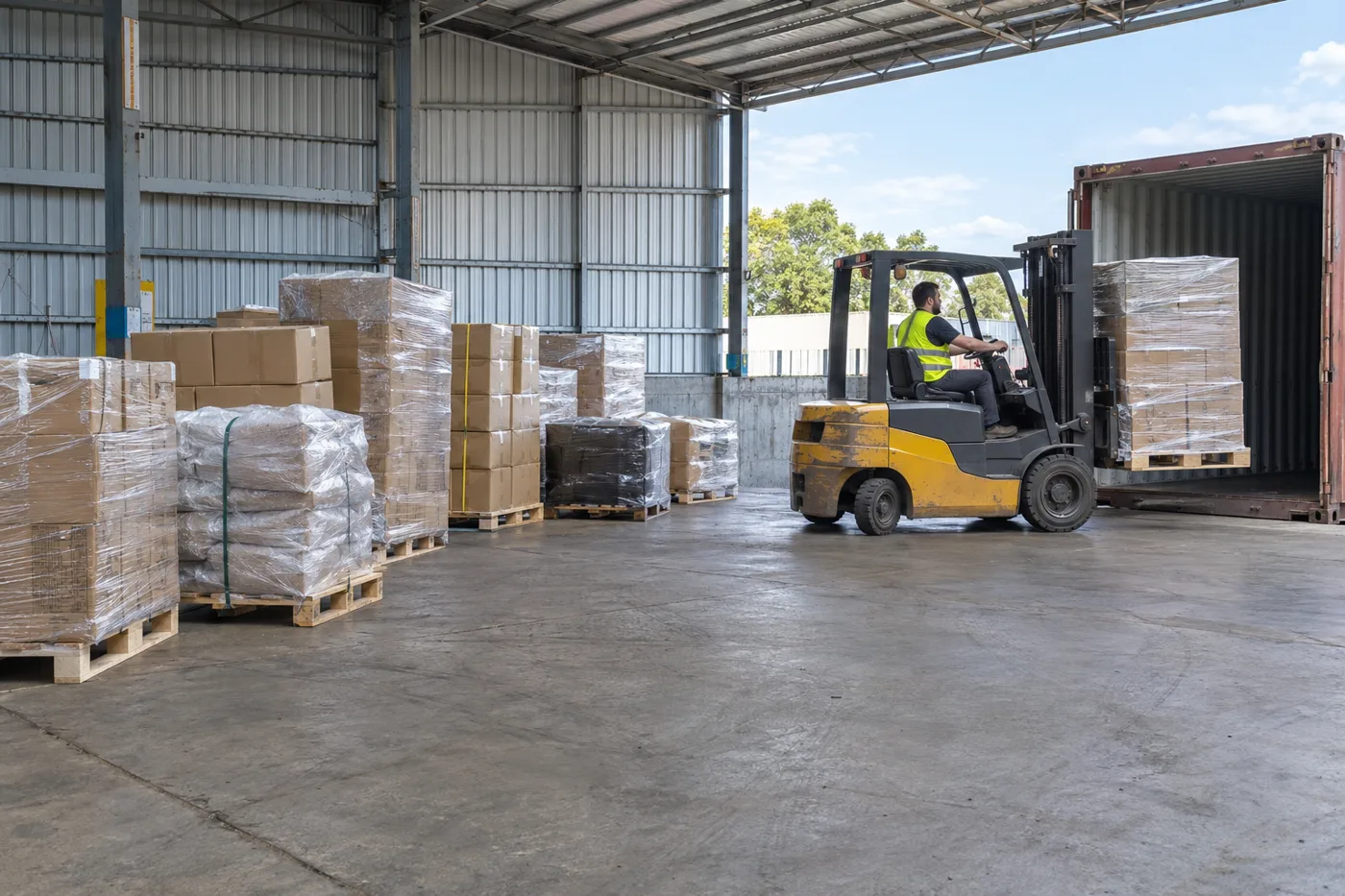
LCL, short for less than container load, means your cartons share a container with other people's cargo and you pay for your share. The forwarder doesn't bill on volume alone. Freightos explains that the carrier compares your total CBM with your gross weight in metric tons and charges on whichever is larger.
The trade calls this W/M, short for weight or measure. Each cubic meter, or each metric ton if that's bigger, counts as one revenue ton, the unit the sea bill is worked in. GoFreight's glossary puts it bluntly: the charge uses whichever "produces the higher revenue."
That answers a question a new Amazon private-label seller asked on r/AmazonFBA: whether shipping charges are based on weight, volume, or both. For LCL it's both. The two are compared and the bigger one sets the bill.
The test: divide your gross weight in kg by your CBM. Under 1,000 kg per CBM, volume sets the bill. Over it, weight does.
The example order is 3.90 CBM and 609 kg, or 0.609 metric tons. Volume wins easily, so it's billed on 3.90 revenue tons. That's why Freightos describes LCL cost as "dimensional (usually referred to as 'per CBM')," and why the freight rate per CBM is the headline figure on most quotes.
The "CBM × rate" shortcut works for most goods. For cargo denser than a ton per cubic meter, the weight side takes over, and multiplying your CBM by the rate will undercount the bill.
Why do small shipments cost more per CBM?
Small sea shipments pay for space they don't use. Freightos says it plainly: "When you ship LCL, you will be charged for a minimum of 1 CBM." So a 0.3 CBM sample order is billed as a full cubic meter, and working its volume out to three decimals won't change that.
Typical minimum charges
- LCL sea: usually 1 CBM, or "one weight or measure equivalent" in Flexport's terms, which also add a dollar minimum freight charge
- Some LCL consolidators (the companies that group many shippers' cargo into one shared container): 1 or 2 CBM, according to GoFreight
- Air freight: a minimum charge per air waybill, the airline's shipping document for your cargo (called the "M" rate in the airlines' rate classes)
- Air shipments under 45 kg chargeable: billed at the higher "N" rate
Floors vary by forwarder, so ask which one applies. Patrick, who presents videos for JingWholesale, a China-based wholesale and sourcing business, tells viewers on TikTok that when cargo is under 0.1 cubic meters, many freight companies simply bill it as 0.1 cubic meters.
Be careful with that 0.1 figure. Suaid Global, a forwarder that advertises a 0.1 CBM starting point, also says "Most LCL quotes carry a minimum of one CBM." The smallest load a forwarder accepts and the smallest amount it bills can be two different numbers.
Air has its own price steps on top of the floor. Under the airlines' rate classes, Tools2Ship explains, cheaper per-kg rates start at breaks of 45, 100, 300, 500 and 1,000 kg. If your shipment sits just under a break, pricing it at the next break up can cost less overall.
The two systems pull apart as orders grow. Under a 1 CBM sea minimum, a small order can grow quite a lot before the sea bill moves at all. By air, every extra kilo of chargeable weight is billed. Ask for both quotes on the same packing list and compare.
How does air freight turn CBM into chargeable weight?
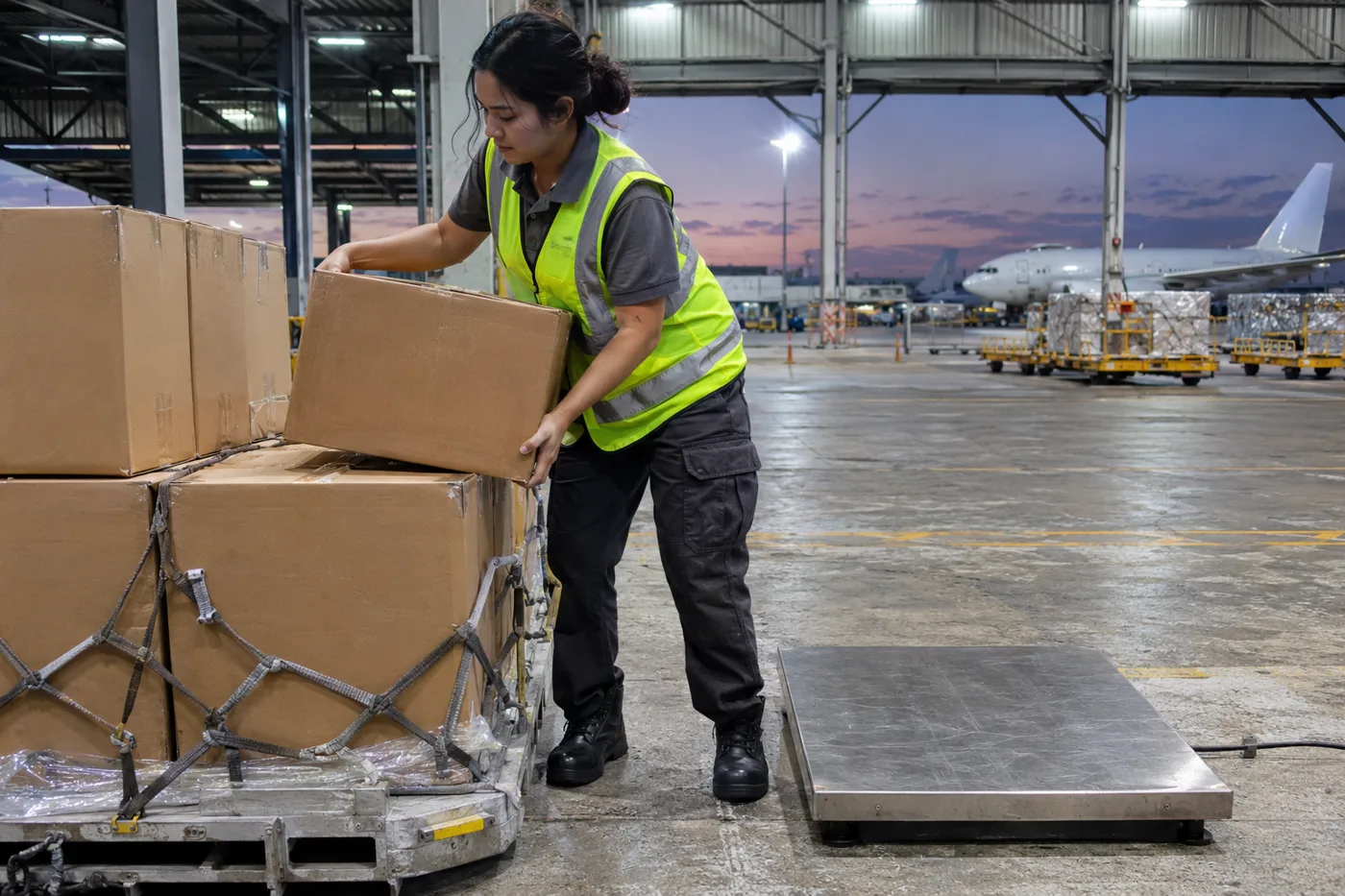
Airlines charge for the space light cargo takes up as well as its weight. IATA, the airline industry body, gives the classic example: a metric ton of feathers costs more to fly than a metric ton of steel.
The method has two steps:
- Work out volumetric weight, the weight the airline assigns to your cargo's size. IATA's general rule is to "divide the volume of the shipment in cubic centimeters by 6000."
- Compare it with the actual weight. In IATA's words: "Whichever is higher, the volumetric weight or actual weight, that is the amount that will be used for pricing." That higher figure is your chargeable weight.
Courier express uses a smaller divisor, so the same box counts as heavier. DHL Express uses "Length x Width x Height ÷ 5,000," rounds parcel weight up to the nearest half kilo, and bills "the greater of the two weights."
| Service | Rule | 1 CBM counts as |
|---|---|---|
| Air freight | cm³ ÷ 6,000 | 166.67 kg |
| Courier express | cm³ ÷ 5,000 | 200 kg |
| Sea LCL | CBM vs metric tons | 1,000 kg |
Run the example order through it. One full carton is 96,000 cm³, which works out to 16 kg against its 15 kg actual weight, so volume wins carton by carton. Across the whole order, 3.90 CBM comes to 650 kg chargeable, against 609 kg on the scale. You'd pay air freight on 650 kg.
Price one shipment by sea and by air
Put the three billing figures side by side before you look at any rates.
Same shipment, three ways
- Sea LCL: billed on 3.90 revenue tons, because 3.90 CBM beats 0.609 metric tons
- Air freight at ÷6,000: 650 kg chargeable against 609 kg actual
- Express at ÷5,000: 780 kg chargeable
To turn those into money, multiply each billing figure by the matching rate on your quote. Use the per-CBM rate for sea and the per-kg rate for air or express. Then add the origin, destination and customs fees, which most per-CBM rates leave out.
Here's a quick test that works whenever volume sets the bill by both sea and air, as it does here. By air, every CBM of this order is billed as about 167 kg. Multiply your air rate per kg by 167 and set it next to your sea rate per CBM. That compares what it costs to fly each cubic meter with what it costs to ship it. For express, multiply by 200.
The test stops working for dense goods. If your cartons weigh more than 166.67 kg per CBM, actual weight sets the air bill, so use the scale weight on the air side instead.
One more check: 650 kg sits past the 500 kg break in the airline rate classes. An air quote for this order should be priced at that break or better.
What does freight add to each unit you sell?
Freight per unit is the full delivered freight bill divided by the units in the shipment. It's the number that tells you whether the product still makes money once freight is on the cost sheet.
To get the number for your margin sheet:
- Get the all-in quote: freight plus origin, destination and customs fees.
- Divide it by the units in the shipment. In the example, that's 972.
- Add duties and taxes as a separate line. Flexport's terms say its rates exclude them unless stated.
You can estimate before any quote arrives. The example order bills 3.90 CBM across 972 units, which is about 0.004 CBM per unit. Multiply your sea rate per CBM by 0.004 and you have one unit's sea freight. By air, each unit carries about 0.67 kg of chargeable weight.
Trial orders cost the most per unit. A single carton of 24 units is 0.096 CBM, but under a 1 CBM minimum it's billed as a full cubic meter. That's about 0.042 CBM per unit, roughly ten times the full order's 0.004.
Bulky, light products like pet beds or bean bags pay on volume in both modes. Anything lighter than 166.67 kg per CBM pays on volume by air, and anything under 1,000 kg per CBM pays on volume by LCL. For goods like these, a smaller carton does more for your freight cost than a lighter one.
How many cartons fit in a 20ft or 40ft container, and when should you ask for FCL?
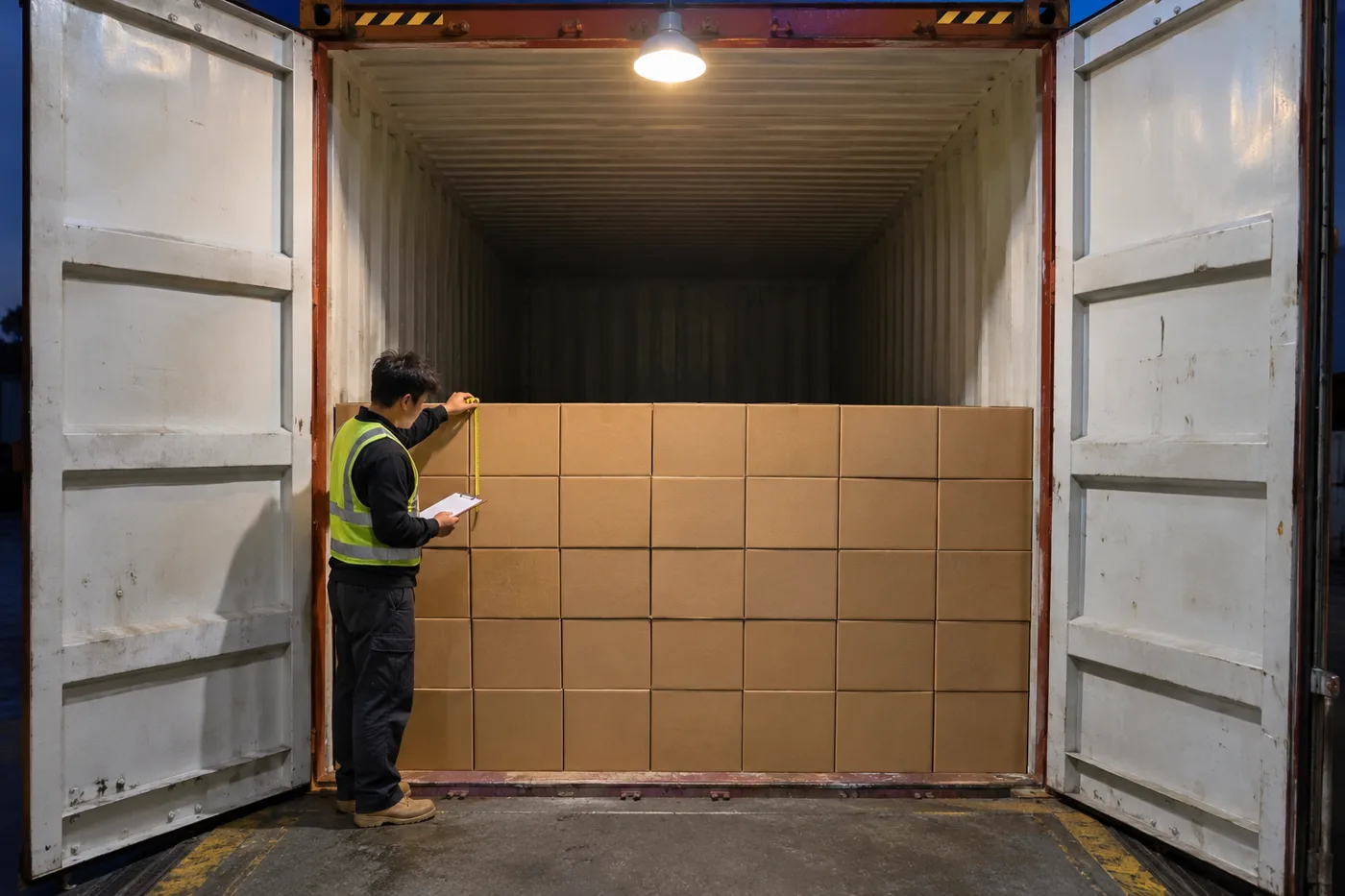
Start with the stated capacity, then expect to load less. Ocean Network Express lists a 20ft dry container at 33.1 m³ and a 40ft high cube, a 40ft box with extra height, at 76.2 m³. It notes the figures are "for reference only." Evergreen's figures differ slightly, at 33.2 and 76.4 m³.
To see how many cartons fit in a container, divide each inside dimension by the matching carton side, round each result down to whole cartons, and multiply. Try the carton turned different ways and keep the best result. Then make sure the stack clears the door height. ONE's figures:
- 20ft dry: 5,898 × 2,350 × 2,390 mm inside, with a door opening 2,280 mm high
- 40ft high cube: 12,032 × 2,350 × 2,695 mm inside, with a door opening 2,585 mm high
How much of the container you'll actually use
- 20ft dry: 225 cartons of 60 × 40 × 40 cm, about 65% of stated capacity, where simple division suggests 344
- 40ft high cube: 600 of the same cartons, about 76%, where simple division suggests 793
- A 36 × 36 × 24 inch carton: 36 in a 20ft, about 55%, where simple division suggests 64
- These are estimates for one carton size stacked by hand, not a carrier guarantee
Planning guides tend to be more generous. HZ Containers suggests planning on 85 to 90% of stated volume for cartons and 75 to 85% for pallets. When we stacked one carton size, all facing the same way, using ONE's inside measurements, the result came out well below that.
Mixing carton orientations or using a professional load plan can do better. Still, a container shipper on r/smallbusiness makes the point that irregular shapes mean you never use 100% of a container.
Weight rarely limits cartons like these. 225 cartons at 15 kg is about 3,400 kg, far under the 20ft's 28,330 kg payload, which is the most cargo weight the box can carry.
FCL, short for full container load, means you rent the whole box. Freightos's China to US guide says FCL is a flat rate "regardless of whether or not your container is completely full," and puts the tipping point "somewhere around 15 cubic meters." Its LCL guide says to start considering FCL at around 10 CBM, with a container becoming more cost-effective around 13 to 15 CBM.
From about 10 CBM, ask for both quotes. At 3.90 CBM, the example order stays LCL.
Why is the forwarder's CBM different from yours?
The forwarder's figure is the one you'll pay, and the carrier may remeasure your cargo without telling you first. ONE's bill of lading terms let the carrier "inspect, re-weigh, remeasure, revalue or repack the Goods without notice to the Merchant."
Ship4wd gives an example: "a shipment declared at 10 CBM that turns out to measure 13 CBM… will be rebilled at the correct volume." Suaid Global adds that "Carriers bill on the measured volume, rounded up. A carton that is two centimetres too tall can push you into the next unit."
Wrong figures can cost more than the difference. Under clause 6.3 of ONE's terms, if the shipment details are wrong, the shipper owes "double the correct Freight less the Freight charged."
The usual reasons your number and theirs don't match:
- The packed cartons measured bigger than the supplier's spec
- The volume was rounded up
Sometimes the CBM matches and only the billed amount is different. That usually means:
- A minimum charge applied
- You were billed on air chargeable weight, or on express's ÷5,000 divisor
Some commenters on a TikTok CBM how-to video say there's no point doing the sum, because whatever CBM or kg the shipping company gives you is what you'll pay.
That's half right. You do pay their figure, which is why you need your own. Without it, you can't spot a remeasure that's off by several cartons or a minimum you didn't expect.
Another commenter on the same video said the forwarder still hadn't sent their CBM figure. To avoid that, ask every forwarder to put the mode, the CBM, the gross weight and the chargeable weight in writing on the quote. Before the goods leave, ask your supplier to measure the cartons as packed.
What a per-CBM or DDP quote may leave out, and how to compare quotes fairly
A per-CBM rate often covers only the freight. Flexport's terms say rates don't include "customs clearance or import duties and/or taxes… unless explicitly specified," and are "subject to local origin or destination charges." Importers on Reddit threads warn that cheap per-CBM and DDP quotes can turn out to cover sea freight alone, and advise getting the full scope in writing.
GoFreight lists the lines a typical LCL quote can carry besides ocean freight:
- Origin CFS: handling at the container freight station, the warehouse where LCL cargo is gathered and packed into the shared container
- Destination deconsolidation: unpacking the shared container at the other end
- Documentation: charged per house bill of lading, the forwarder's shipping document for your cargo
- Fuel surcharge
Most of these are charged per W/M, so they grow with your CBM too.
If you import into the US, Customs and Border Protection adds its own fees. CBP's user fee table, last updated October 9, 2026, sets these:
- Merchandise Processing Fee on formal entries: 0.3464% of the goods' value, with a dollar minimum and maximum
- Informal entries: a flat fee instead (your customs broker, the licensed agent who files your entry, can tell you which type your shipment is)
- Harbor Maintenance Fee: 0.125% of value on ocean shipments
US sea shipments also need an Importer Security Filing, known as "10+2," which has applied to cargo arriving by vessel since January 26, 2009. CBP says failing to comply "could ultimately result in monetary penalties, increased inspections and delay of cargo." Ask whether your quote covers it.
If you import into another country, ask your forwarder which local customs fees and taxes the quote includes.
DDP is one of the Incoterms, the standard trade terms from the International Chamber of Commerce that set out who pays for and handles each stage. It stands for delivered duty paid. Under DDP, the ICC says, the seller carries out "all customs formalities, including export, import," which it notes "may be difficult for a foreign seller." The buyer generally still handles unloading at the delivery point. If a Chinese supplier or forwarder offers DDP, ask who acts as the importer and which fees the price covers.
To compare quotes fairly, send every forwarder identical data: the same carton sizes, gross weights, carton counts, delivery address and Incoterm. Forwarders price from the packing list, and charges follow the cargo as tendered, so different inputs make quotes hard to compare. Commenters on the r/AmazonFBA thread give the same advice. Then line the quotes up by billing basis, minimum, origin fees, destination fees, documents, customs clearance, and whether duties are in or out.
The bottom line
Before you approve your next order, get the packing list with carton sizes and gross weights. Run each carton size through the CBM calculator above this guide separately and divide the result across your units. If freight per unit breaks your margin at the trial quantity, check whether a 1 CBM minimum explains it. It often accounts for most of the problem on small orders.
Under about 10 CBM, LCL is usually the starting point. If the goods are light and urgent, multiply the air rate per kg by 167 and compare it with the sea rate per CBM. From 10 CBM up, ask for a full-container quote as well, and check your carton fit against the inside dimensions rather than the capacity on the label.
Send every forwarder the same carton data, and ask each to write back with its CBM, chargeable weight and every fee on its own line.
Questions people also ask
How much is 1 CBM in shipping?
There's no single price: 1 CBM by LCL is billed at the forwarder's freight rate per CBM, plus origin and destination fees. Because most LCL quotes set a 1 CBM minimum, it's also the least you'll pay for, even on a smaller load. For a real figure on your cargo, ask us for a dated quote.
What does 20 CBM mean?
20 CBM is 20 cubic meters of cargo, about 60% of a 20ft container's stated 33.1 m³ capacity, according to ONE. In this guide's own stacking example, 225 cartons of 60 × 40 × 40 cm, all facing one way, came to about 21.6 CBM in a 20ft, so 20 CBM may be close to the limit for cartons stacked like that. It's also above the 13 to 15 CBM range where Freightos says a full container starts to pay off, so ask for both LCL and FCL quotes.
How many kg is 1 CBM?
There's no fixed 1 CBM to kg conversion, because it depends on how you ship. Sea LCL compares 1 CBM against 1,000 kg and bills whichever side is larger. Air freight counts 1 CBM as 166.67 kg under IATA's ÷6,000 rule, and DHL Express's ÷5,000 makes it 200 kg. In every case, you pay on the higher of actual and volumetric weight.
Is sea freight charged by weight or volume?
LCL sea freight is charged on whichever is greater, the volume in CBM or the weight in metric tons. GoFreight describes this as whichever "produces the higher revenue," and most goods lighter than 1,000 kg per CBM pay on volume. A full container is different: Freightos notes it's a flat rate whether or not the box is full.
What is the minimum CBM for LCL shipping?
Most LCL quotes carry a minimum of 1 CBM, which is the rule Freightos gives and what Flexport's terms call "one weight or measure equivalent." GoFreight says some consolidators set the floor at 1 or 2 CBM. A forwarder such as Suaid Global may accept loads from 0.1 CBM but still bill most quotes at a 1 CBM minimum, so ask which figure you're looking at.