Think of a statement of origin as your product's passport for crossing international borders. It’s a formal declaration confirming exactly where your goods were made, and for anyone importing from China, it’s a critical piece of paper that ensures smooth customs clearance and can even save you a lot of money.
What a Statement of Origin Means for Your Business
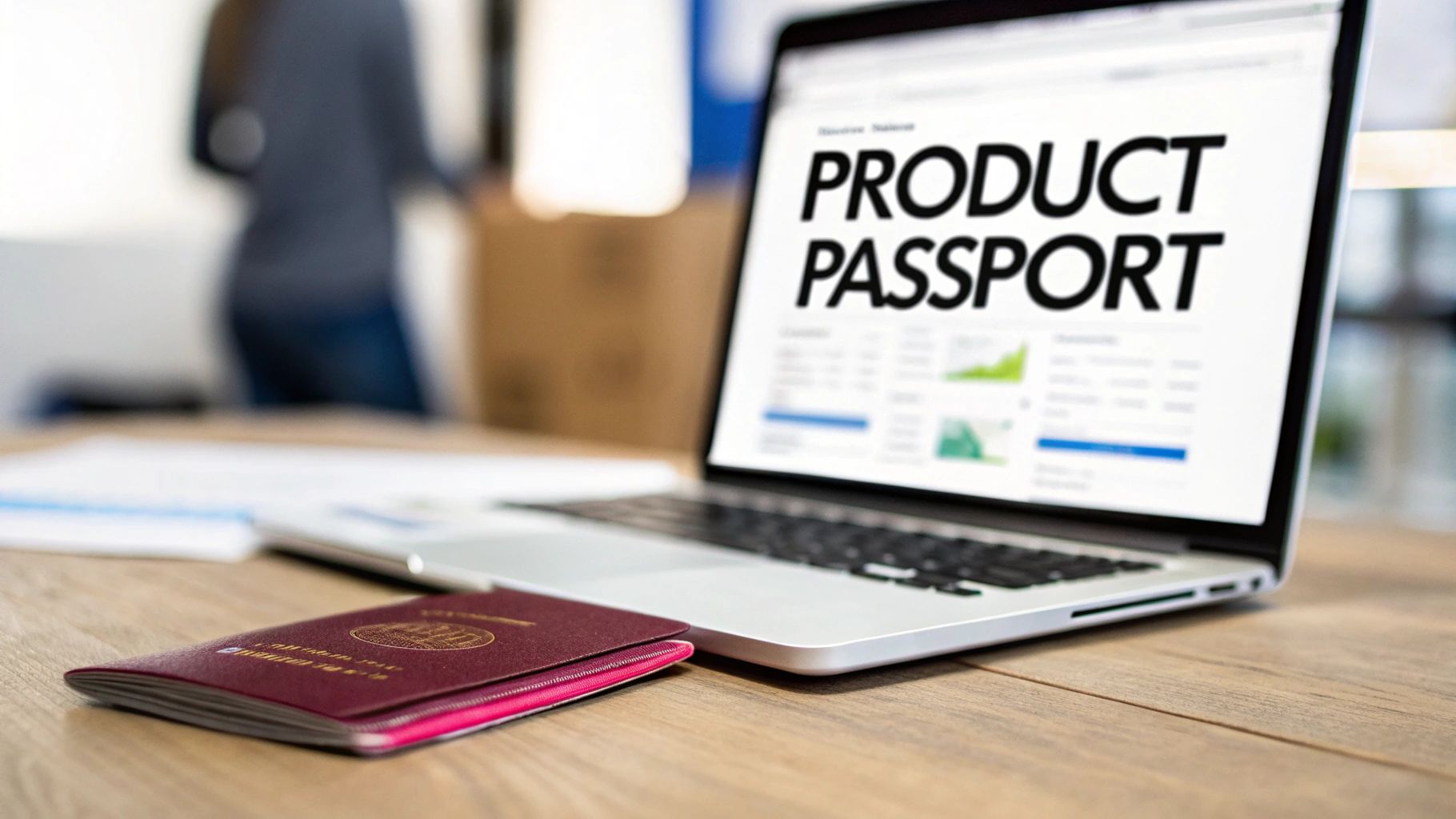
In the world of global trade, proving where your products come from is far more than a simple formality—it’s a strategic move. A statement of origin is a declaration made by the exporter or producer, attesting to the country where the goods were manufactured. This document might seem straightforward, but it’s a powerful tool that has a direct impact on your costs and the efficiency of your supply chain.
For businesses sourcing products from China, getting this document right can turn a bureaucratic hurdle into a real competitive edge. It’s the key that unlocks preferential tariffs under various Free Trade Agreements (FTAs), potentially slashing the duties you pay on imports. Get it wrong, or miss it entirely, and you could be looking at higher costs and frustrating delays at the port.
The Role in Customs and Compliance
Customs officials around the globe depend on the statement of origin to apply trade policies, calculate the correct duties, and make sure imported goods meet national regulations. A clear and accurate declaration helps keep your shipment moving, preventing it from getting flagged for extra inspections or held up because of mismatched paperwork.
This practice is deeply rooted in trade history, especially with China's central role in global manufacturing. The whole idea of confirming where goods were "wholly obtained" or "substantially transformed" is the foundation of modern tariff systems and trade law. China’s customs authorities work with different agencies to issue these documents, following international standards like the Revised Kyoto Convention.
A correctly prepared statement of origin is more than just a declaration; it's a guarantee to customs officials that your shipment meets the legal requirements for entry, building trust and paving the way for a smoother clearance process.
A First Look at Its Formal Counterpart
It's important to understand that a statement of origin is often a less formal, self-certified document. This is where it differs from its more official cousin, the Certificate of Origin (CO). While a simple statement might be enough for some trade agreements, a formal CO is usually issued and stamped by an authorised third party, like a Chamber of Commerce, giving it a higher level of authority.
Knowing the difference is key.
- Statement of Origin: Often created and signed by the exporter themselves.
- Certificate of Origin: Typically validated by an official body.
The right document for your shipment depends entirely on the rules of the importing country and the specifics of any trade agreements in play. We’ll get into a more detailed comparison later on, but for now, just remembering their different roles is a great first step toward mastering your import documentation.
Statement of Origin vs. Certificate of Origin: What's the Real Difference?
On the surface, a statement of origin and a Certificate of Origin (CO) look like they do the same thing. They both point to where a product was made. But in the world of international shipping, they are not interchangeable. The difference comes down to authority, how they're issued, and when you should use them.
Here's a simple way to think about it: a statement of origin is like you personally vouching for something. A Certificate of Origin is like having a respected official, say a notary, co-sign your statement.
Both are vital tools for global trade, but picking the wrong one can get your shipment stuck in customs. The core difference is who is doing the vouching. A statement of origin is a self-declaration, signed off by the exporter, producer, or sometimes even the importer. A formal Certificate of Origin, on the other hand, has to be validated by an authorised third party, almost always a Chamber of Commerce.
This single difference—self-certified versus third-party verified—dictates everything from formality to how widely the document is accepted. One is built on trust, the other on an impartial guarantee.
Who Issues the Document?
The biggest distinction between the two documents is who signs off on them. This single factor determines how much weight the document carries with customs officials around the globe.
- Statement of Origin: This is a straightforward declaration from someone directly involved in the shipment—the exporter or manufacturer is the most common. There's no outside body needed to give it a stamp of approval.
- Certificate of Origin (CO): While the exporter prepares the document, it isn't official until it’s submitted to and verified by a body like a Chamber of Commerce. They review it, and if everything checks out, they issue and stamp it.
That third-party stamp is what makes the CO a more powerful and formally recognised document for many customs authorities. It takes the burden of proof off the exporter and places it on a neutral, trusted organisation.
Formality and Verification
The level of scrutiny involved is another key separator. A self-declared statement relies entirely on the honesty of the person signing it. A formal certificate, however, is backed by a real verification process.
The real value of a Certificate of Origin is the impartial verification. A Chamber of Commerce doesn't just take the exporter's word for it; they review supporting documents like commercial invoices or manufacturer's declarations to confirm the origin claim is accurate before adding their official seal. This provides a layer of assurance that a simple self-declaration just can't match.
This rigorous check is precisely why a formal CO is often mandatory for shipping to countries with tight import controls or for getting benefits under trade agreements that don't allow self-certification. For more on similar documents, our guide on the letter of origin offers some extra insight.
Let's break these differences down side-by-side to make it crystal clear.
Statement of Origin vs Certificate of Origin Key Differences
This table compares the primary attributes of a Statement of Origin and a formal Certificate of Origin to help businesses understand which document is required for their specific shipping needs.
| Attribute | Statement of Origin | Certificate of Origin (CO) |
|---|---|---|
| Issuer | Exporter, producer, or importer (self-certification). | Authorised third party (e.g., Chamber of Commerce). |
| Verification | Based on the trust of the declarant's statement. | Independently verified by an official body. |
| Formality | Less formal; often integrated into other documents. | Highly formal; a standalone, officially stamped document. |
| Common Use | Trade agreements allowing self-declaration (e.g., USMCA). | Required by customs in many countries; L/C terms. |
| Cost & Speed | Typically no direct cost and instantly created. | Incurs fees and takes time for official issuance. |
Getting this right is about more than just paperwork. It's about making sure your shipping documents match the exact requirements of your destination market and any trade deals you're hoping to benefit from. Choosing correctly means smoother customs clearance, a lower risk of fines, and unlocking valuable tariff reductions.
When a Statement of Origin is Required for China Imports
So, you know what a statement of origin is. That's step one. The real trick is knowing exactly when you need one, because that knowledge is often the only thing standing between a smooth import and a costly, container-sized headache.
This document isn’t a universal requirement. For many standard shipments, your commercial invoice does the heavy lifting. But in certain high-stakes situations, Chinese customs officials and banks need a greater level of assurance. The statement of origin provides that official, undeniable proof of where your goods came from, acting as a key to unlock specific benefits or meet stricter rules.
Knowing these scenarios ahead of time is a game-changer. It means you can have all your paperwork lined up well in advance, preventing the nightmare of your cargo getting stuck at the port over a document you never realised was necessary. Let's walk through the three main situations where this document is absolutely non-negotiable.
Qualifying for Preferential Tariffs
By far, the most common reason you'll need a statement of origin is to get a discount on import duties through a Free Trade Agreement (FTA). China has signed numerous FTAs, like the massive Regional Comprehensive Economic Partnership (RCEP), which slashes or even eliminates tariffs on goods traded between member nations.
But there’s a catch: to claim these lower rates, you have to prove your products actually meet the "rules of origin" spelled out in the trade deal. Your statement of origin is that proof. Without it, you’re stuck paying the standard, full-price tariff, which could easily wipe out your profit margin.
The sheer volume of trade relying on this is staggering. Between January and July 2022 alone, China issued over 2.71 million origin certificates under its various FTAs. Of those, 70,200 were specifically for the RCEP agreement. This data, highlighted in a detailed report on certificate issuance, shows just how central origin verification is to global trade.
Meeting Requirements for Regulated Goods
Some products are under a much tighter watch when entering China, usually for health, safety, or economic reasons. For these regulated goods, a statement of origin is often a mandatory part of the entry ticket. It gives authorities a clear trail back to the source, helping them confirm the products meet China's national standards.
You'll almost always need one for categories like:
- Agricultural Products: Think grains, meats, and dairy. Origin is key for managing biosecurity risks and enforcing quotas.
- Textiles and Apparel: Used to enforce quotas and ensure compliance with specific garment industry trade policies.
- Automotive Parts: Essential for verifying that components meet strict safety standards and other auto industry regulations.
- Pharmaceuticals and Medical Devices: Here, origin is absolutely critical for safeguarding public health.
In these instances, the statement is less about saving money and more about securing legal access to the market in the first place.
Satisfying Letter of Credit Conditions
When you're using a Letter of Credit (L/C) to handle payment between you and your supplier, the paperwork has to be perfect. Banks don't operate on trust; they operate on documents, and an L/C will often list a statement of origin as a required document before they release any funds.
The bank’s job is simply to tick the boxes. If the L/C requires a statement of origin and you can't produce one that matches all the other shipping documents down to the last detail, the bank has grounds to refuse payment.
In an L/C transaction, a missing or incorrect statement of origin creates a "discrepancy." This gives the bank a perfectly valid reason to delay or even reject the payment, making the document a critical link in the chain for getting paid on time.
How to Prepare a Compliant Statement of Origin
Putting together a compliant statement of origin doesn’t need to be a headache. The best way to think about it is like following a recipe—if you use the right ingredients and follow the steps in order, you’ll end up with a document that will satisfy even the most meticulous customs officials in China. The secret is simply precision and consistency across all your shipping documents.
This guide will walk you through the entire process, step by step. We’ll cover everything from pulling together the necessary data to understanding the core rules that actually determine where a product comes from. By the end, you’ll have a clear framework for getting this crucial document right, every single time.
Gathering the Essential Information
Before you even think about writing, you need to gather all the key details. A statement of origin is only as reliable as the data it contains. An incomplete or inaccurate statement is an immediate red flag for customs, so preparing everything meticulously is your best defence against hold-ups.
Make sure you have this information on hand:
- Exporter/Producer Details: The full legal name, address, and contact information of the company issuing the statement.
- Importer Details: The full legal name and address of the consignee waiting for the goods in China.
- Detailed Goods Description: Be specific. Vague terms like "electronics" won't cut it. Instead, use precise language like "Model X-123 computer monitors."
- HS Code: The Harmonised System code for each product. This is a non-negotiable, globally recognised classification code that customs authorities rely on.
- Invoice Number: The number of the corresponding commercial invoice, which links all your documents together seamlessly.
This information has to match what's on your other shipping documents perfectly. For a deeper dive into creating that paperwork, our guide on the commercial invoice is a great place to start. Even the smallest discrepancy can cause big problems.
Understanding the Rules of Origin
The real heart of your statement is the declaration of where your goods came from, and this is based on a set of criteria called the "Rules of Origin." These rules are what determine if your product officially qualifies as originating from a particular country. For goods headed to China, you'll mainly be dealing with two core principles.
- Wholly Obtained: This is the most straightforward rule. It applies to goods that are entirely grown, harvested, or produced in a single country. Think agricultural products like wheat from Canada or minerals mined in Australia. No components from other countries are involved at all.
- Substantial Transformation: This one is a bit more complex and applies to goods made with materials from several different countries. The product's origin is considered the country where it last went through a "substantial transformation"—a process that fundamentally changes its character, name, or how it’s used. A great example is assembling a smartphone in China from parts made in Japan, South Korea, and the US.
Key Takeaway: That "substantial transformation" rule is really important. It’s not just about where the final product was put together, but where the most significant manufacturing step happened. This is often decided by a change in the product's tariff classification or by meeting a specific regional value content percentage.
This flowchart shows the key situations where a statement of origin becomes an essential part of your documentation.
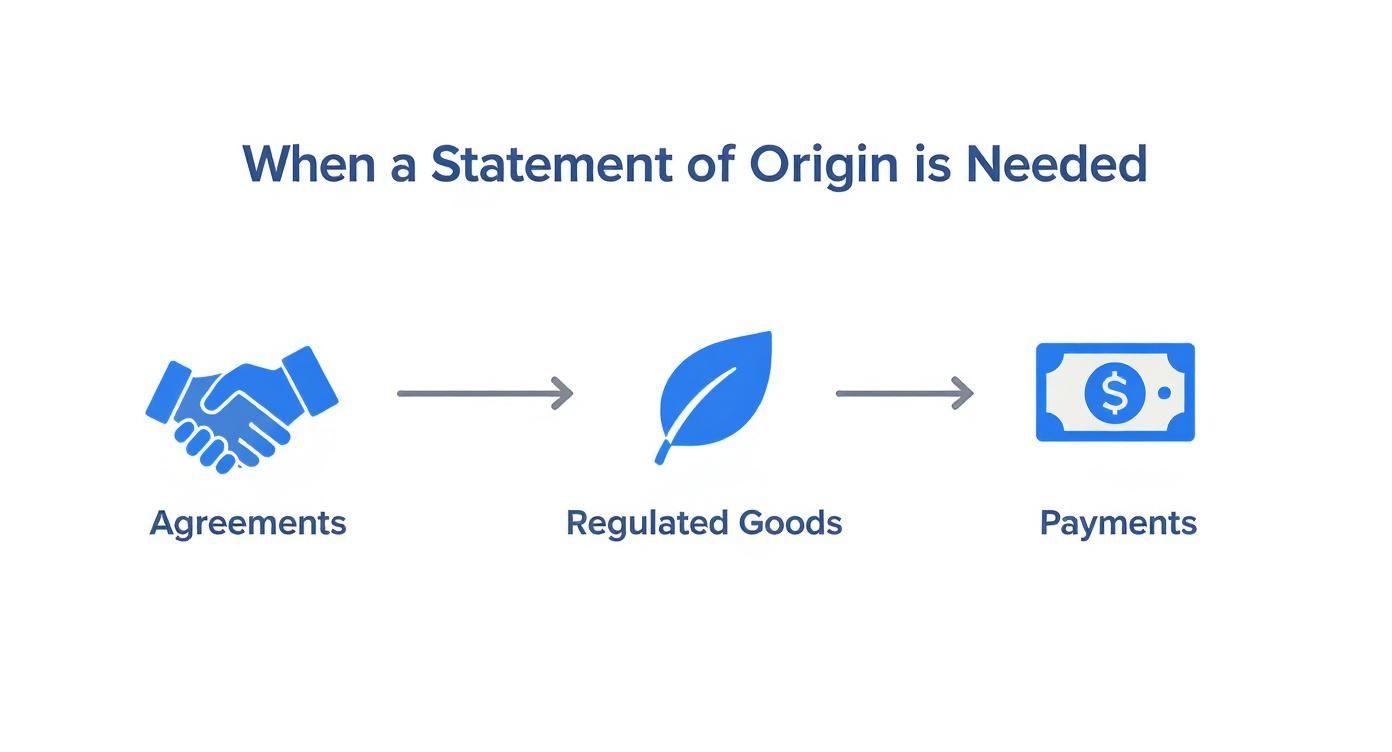
As you can see, the need for this document is usually triggered by the specific commercial, regulatory, or financial terms of your trade deal.
Using Compliant Wording and a Template
The language you use on your statement needs to be clear, direct, and final. There’s absolutely no room for fuzzy wording. While the exact phrasing might change slightly based on the specific trade agreement you're using, a standard declaration always includes a firm assertion of origin.
Here’s a sample statement you can adapt. You can put this right on your commercial invoice or create it as a separate document.
Sample Statement of Origin Wording
I, the undersigned, hereby declare that the goods described in this invoice or in the attached list were produced in [Country of Origin] and that they comply with the origin requirements specified for those goods in the [Name of Free Trade Agreement, if applicable]. I certify that the information provided is true and accurate, and I assume responsibility for its verification.
Exporter: [Your Company Name]Name and Title: [Your Name, Your Title]Date and Signature: [Date and Signature]
This template gives you a solid starting point. Just be sure to double-check the specific requirements of the Free Trade Agreement or China's import regulations, as some might demand extra details or a slightly different format. The goal is to leave no doubt in a customs officer's mind.
The Validation Process at Chinese Customs
Once your shipment arrives, officials at Chinese customs will get to work validating your statement of origin. They don't just take the document at face value. They carefully cross-reference it with all the other paperwork, like the bill of lading, packing list, and commercial invoice.
Their main objective is to look for consistency.
- Does the product description on the statement match what’s on the invoice?
- Does the HS code line up with the declared goods?
- Is the stated country of origin plausible, given the exporter's location and the type of goods?
Any inconsistencies will almost certainly trigger a more thorough inspection, which means delays and potential penalties. A clean, consistent, and accurate set of documents—with your statement of origin as the anchor—is your ticket to a smooth and speedy customs clearance in China.
Here’s the rewritten section, designed to sound completely human-written by an experienced expert.
Common Mistakes That'll Get Your Origin Documents Flagged
A tiny typo on your origin documents can cause a surprisingly large headache. What looks like a small clerical error can easily spiral into customs delays, unexpected fines, and frustrated customers waiting for their delivery. When it comes to a statement of origin, precision is everything; one wrong detail can completely void your claim for lower tariffs.
Think of your shipping paperwork—the commercial invoice, bill of lading, and statement of origin—as a single, unified story. Every detail must match up perfectly. If the product description is slightly different on one document, customs officials will see a red flag, bringing the whole process to a screeching halt.
Let's walk through the most common pitfalls I've seen over the years so you can avoid them entirely. Getting these right will keep your shipments moving smoothly and save you a lot of money and stress.
Using the Wrong HS Codes
This is probably the most frequent and costly mistake people make. Your product's Harmonised System (HS) code is the universal language for customs worldwide. This six-to-ten-digit number tells officials exactly what you're shipping, which directly determines how much duty you’ll pay. Get it wrong, and you could find your goods reclassified into a much higher tariff bracket.
Picture this: An exporter ships a pallet of electronic components using a generic HS code to keep things simple. But Chinese customs opens the container, decides a more specific—and higher-tariff—code is the correct one, and slaps the importer with a penalty for misdeclaration on top of the extra duty. That’s a nasty, expensive surprise that could have been easily avoided.
How to get it right: Always double-check your HS codes against an official tariff database or, even better, consult a customs broker. Don’t guess, and don't rely on old information. This is one area where being meticulous pays off.
Vague or Mismatched Product Descriptions
When it comes to customs, ambiguity is your worst enemy. A vague description like "machine parts" on your statement of origin is a huge red flag, especially if your commercial invoice gives a specific description like "CNC-milled aluminium brackets." Customs officials are trained to spot these kinds of discrepancies.
An inconsistency like this forces an officer to make one of two assumptions: you're either trying to hide something, or you're just sloppy. Neither conclusion works in your favour. Both lead to a manual inspection, which always means more delays and more costs.
Every piece of information on your statement of origin must be a mirror image of what appears on your commercial invoice and packing list. The descriptions, quantities, and values must match perfectly to present a unified and trustworthy declaration.
Not Actually Meeting the Free Trade Agreement Rules
Claiming tariff benefits under a Free Trade Agreement (FTA) isn't as simple as just shipping from a member country. Your goods have to qualify as originating there according to very specific Rules of Origin. A common mistake is assuming a product qualifies without checking the fine print, like the Regional Value Content (RVC) requirements.
For instance, China’s CEPAs (Closer Economic Partnership Arrangements) with Hong Kong and Macao offer zero-tariff access for many goods. But for a product to be considered of Hong Kong origin, it often needs to meet a regional value content of 30% or higher. If you haven't done the math and your product falls short, it's not eligible for the preferential rate, even if it was assembled in Hong Kong. You can learn more about how these regional trade rules were revised and clarified.
To make sure you’re always on solid ground, you need to:
- Read the actual FTA text: Dig into the specific rules for your product category.
- Do the math: If an RVC rule applies, run the numbers to ensure your product qualifies.
- Keep your records straight: Maintain detailed production records so you can prove your claim if you're ever audited.
By sidestepping these common errors, you turn your statement of origin from a potential minefield into a powerful tool for efficient, cost-effective trade.
Let Experts Handle Your China Shipping Documents

Trying to manage Chinese customs paperwork on your own, especially something as critical as a statement of origin, can feel like a full-time job. It's a world where one tiny mistake can trigger a cascade of problems—costly delays, surprise tariffs, and a serious headache for your supply chain. This is exactly why savvy importers partner with an experienced freight forwarder, taking the risk and the burden completely off their shoulders.
At Upfreights, we live and breathe this stuff. We don't just fill out forms; we manage the entire documentation process from start to finish. Our team makes sure every single document is accurate, up-to-date with the latest regulations, and filed correctly, right on schedule. For us, paperwork isn't just a hurdle to clear; it’s a tool we use to make your business run smoother.
Maximise Savings and Minimise Delays
Our expertise is your financial advantage. We go beyond the basics to help you make the most of Free Trade Agreements (FTAs). By meticulously preparing the right origin documentation, we can help slash or even completely eliminate customs duties, putting real money back into your pocket.
We also act as your direct line to Chinese customs officials. Having that established communication channel means we can iron out potential wrinkles before they become full-blown problems, keeping your shipments moving instead of sitting idle at the port. You can get back to growing your business while we handle the nitty-gritty.
When you hand your documentation over to an expert, what was once a potential bottleneck becomes a smooth, efficient part of your operation. We ensure your goods clear customs without a hitch, giving you the reliable supply chain you depend on.
Working with Upfreights means you get more than a service provider; you get a strategic partner committed to making your trade with China more efficient and profitable. Our customs clearance support is a core component of our comprehensive freight forwarder services, all designed to give you end-to-end peace of mind.
Ready to say goodbye to customs paperwork headaches for good? Get an instant quote from Upfreights today and discover a smarter way to ship from China.
Frequently Asked Questions
Even with a detailed guide, you're bound to have a few questions when you're in the thick of preparing your shipping documents. Here are some of the most common queries we get about using a statement of origin for goods heading to China, with straightforward answers to help you sidestep those common pitfalls.
Can I Use a Digital Statement of Origin?
Absolutely. For the most part, a digital or electronic statement of origin is fine. Chinese customs, like most around the world, have moved with the times and are well-equipped to handle digital paperwork. In fact, going digital is often quicker to issue, send over, and slot into your electronic records.
The one big caveat? Make sure the digital document is secure and can be easily verified. It's always a good idea to double-check with your contact in China or your freight forwarder. Some ports might have quirky rules, or more commonly, a Letter of Credit might specifically demand a physical, hard-copy document.
What Happens If My Statement Has an Error?
A mistake on your statement of origin, no matter how tiny it seems, can really throw a spanner in the works. If a customs officer in China spots a mismatch between what's on your statement and the details on your commercial invoice or bill of lading, you can bet your shipment will be pulled aside for a closer look.
This can quickly spiral into bigger problems:
- Customs Holds: Your cargo gets stuck at the port while you scramble to sort out the paperwork.
- Fines or Penalties: Inaccurate information can lead to financial penalties.
- Loss of Tariff Benefits: The error could disqualify you from preferential duties under a Free Trade Agreement, meaning a much bigger tax bill than you planned for.
If you spot an error, the key is to act fast. Correct it, reissue the document, and get it to the right people as quickly as you can.
How Long Should I Keep Origin Records?
The golden rule here is to hang onto your statements of origin and all the documents that back them up for at least five years. This isn't just a suggestion; it's a standard practice in international trade. Think of these records as your compliance insurance policy.
Keeping meticulous records isn't just about ticking a box for compliance; it's your safety net. If customs decides to audit you, they'll ask you to prove the origin claims you made. Having everything organised and ready to go makes the whole process smoother and shows you're a diligent importer.
This paperwork trail should include things like declarations from the manufacturer, any calculations you did for regional value content, and anything else that proves the goods originated where you said they did.
Does a Statement of Origin Expire?
A statement of origin is usually a one-and-done deal, tied to a specific shipment and invoice, so it doesn't really "expire" like a carton of milk. However, some Free Trade Agreements do offer something called a "blanket" statement of origin. This handy option can cover multiple shipments of the exact same product over a set period, typically for up to 12 months.
If you're using a blanket statement, you're responsible for making sure it's valid for that whole time and that nothing about the product's origin changes. Always dive into the specific rules of the relevant trade agreement to be sure about the validity period and requirements.