Shipping wheeled cargo like cars, trucks, or heavy machinery across the ocean might sound complicated, but one method makes it surprisingly straightforward: Roll-on/Roll-off, or RORO as it’s known in the industry.
Think of it as a massive, multi-level floating car park. Instead of using cranes to lift cargo, vehicles are simply driven directly onto a specialised vessel, and then driven off at the destination. It’s this simple, efficient process that gives RORO its name.
What Is Roll On Roll Off Shipping?
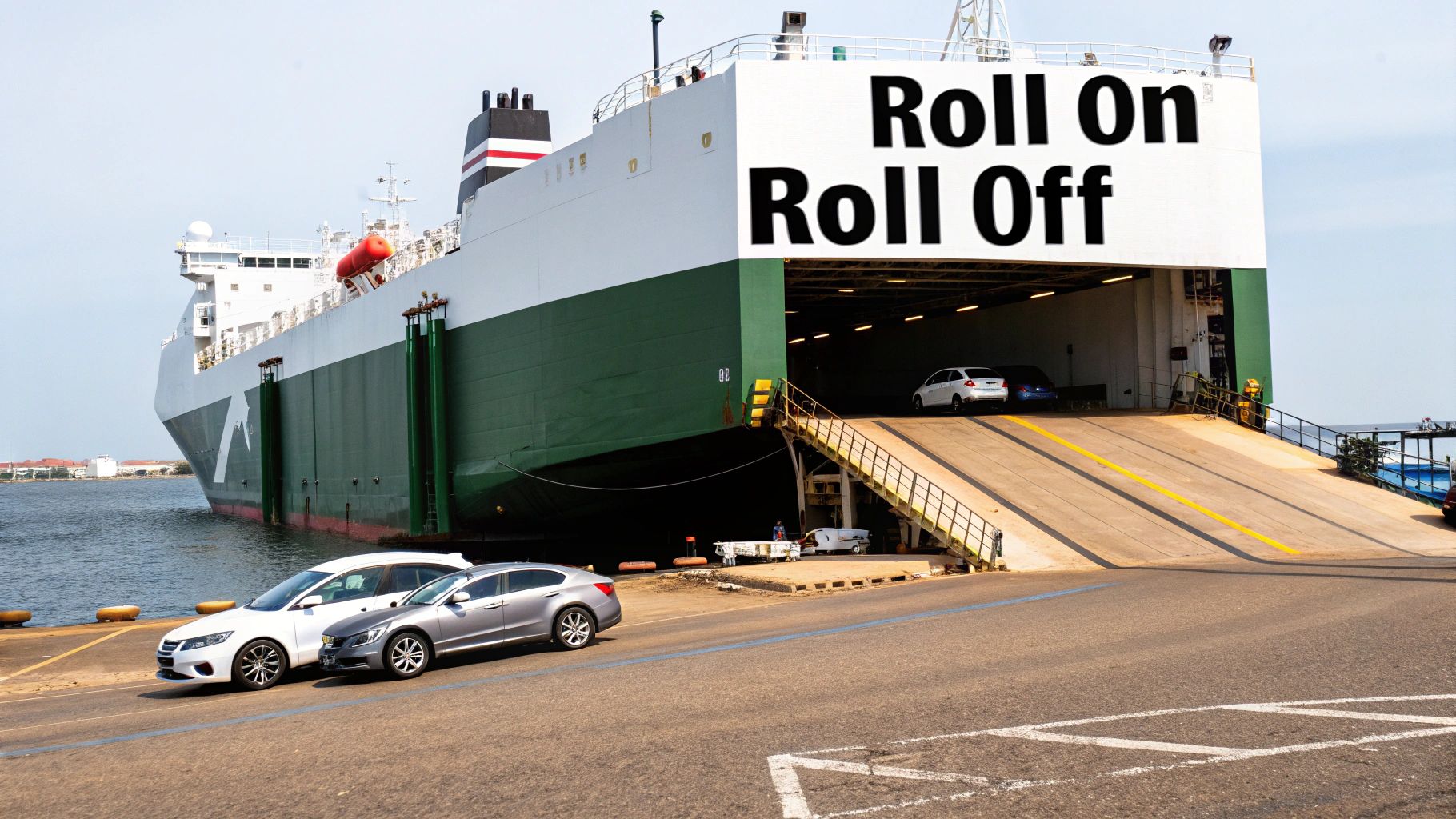
At its heart, roll on roll off shipping is all about speed and simplicity. By removing the need for cranes and complex lifting operations at the port, the entire loading and unloading process becomes much faster. Cargo is "rolled on" via a large, built-in ramp at the departure port and "rolled off" in the same way when it arrives.
The Floating Car Park Analogy
The best way to picture a RORO vessel is to imagine a multi-storey car park that sails across the ocean. These ships are built with multiple internal decks connected by ramps, allowing thousands of vehicles to be driven on board and parked securely. Once inside, they're protected from the wind, rain, and saltwater for the entire journey.
This unique design makes RORO the perfect solution for a whole range of shippers:
- Global car brands exporting thousands of new vehicles from manufacturing hubs in China.
- Construction firms needing to move heavy equipment like bulldozers, excavators, and cranes between international project sites.
- Agricultural businesses shipping tractors, combines, and other oversized farm machinery.
- Private individuals relocating to another country and taking their personal car or campervan with them.
The core principle is simple: if it has wheels and can be driven, it can likely be shipped via RORO. This elegant efficiency has made it a cornerstone of global logistics for any self-propelled cargo.
A Growing Force in Global Trade
The sheer simplicity and cost-effectiveness of RORO have made it a vital part of the global supply chain, especially for vehicle exports from China. The sector is booming, fuelled by a massive increase in vehicle exports and a surge in demand for New Energy Vehicles (NEVs). To keep pace, Chinese ports are investing heavily in specialised RORO berths and new multi-storey ramps to boost capacity.
Getting to grips with this fundamental shipping method is a must for any importer dealing with wheeled cargo. While the world of logistics has its share of jargon, understanding RORO is a great starting point. And if you come across any other unfamiliar terms, our freight forwarding terminology is always there to help you out.
How RORO Vessels and Terminals Actually Work
To really get your head around roll on roll off shipping, you have to picture more than just a big boat. We're talking about highly specialised vessels and terminals that operate with near-military precision. These aren't your typical container ships; they're essentially massive, floating car parks engineered for one job: moving anything on wheels.
Think of a RORO ship as a multi-storey car park that crosses oceans. The most obvious feature is the enormous ramp at the back (the stern). This thing is a hydraulic behemoth that lowers down onto the dock, creating a seamless bridge for vehicles to be driven straight on and off. That single ramp is the magic ingredient—it completely cuts out the need for portside cranes, which is a massive time and cost saver.
Step inside, and you'll find a maze of vast, open decks linked by internal ramps. These decks are often adjustable, meaning they can be raised or lowered to fit anything from a family saloon to a gigantic piece of mining equipment. The whole interior is designed for easy driving and packing vehicles in as tightly and safely as possible.
The Dance on the Docks: A RORO Terminal in Action
Watching a RORO terminal operate is like witnessing a masterclass in logistics. It's a carefully choreographed ballet of vehicles and people, where timing is absolutely everything.
A vehicle’s journey starts well before it even sees the ship:
- Arrival & Check-in: The moment a vehicle hits the port, it's logged into the system. All the paperwork, like the Bill of Lading and customs forms, is checked and double-checked.
- Pre-Shipment Inspection (PSI): Next, it gets a thorough once-over. Handlers document every little scratch or dent to avoid any arguments down the line. They also make sure it's ready for sea—for instance, checking that the fuel tank is nearly empty.
- Staging & Marshalling: After getting the green light, vehicles are driven to a huge, organised parking area called a marshalling yard. Here, they're sorted by size, destination, and where they'll go on the ship. Think of it as pre-sorting the puzzle pieces to make loading go faster.
Locked and Loaded for the High Seas
When the ship is ready, a team of expert stevedores gets to work. They drive each car, truck, or tractor from the marshalling yard, up the ramp, and into its pre-planned spot inside the vessel. It's a high-stakes game of Tetris, where every inch of space counts.
But just parking the vehicles isn't enough. The ocean doesn’t play nice.
To stop tonnes of metal from rolling around in rough seas, every single vehicle is lashed down. This means using heavy-duty ratchet straps and wheel chocks to anchor it firmly to special lashing points built into the deck. It's not going anywhere.
This whole system is a big deal for China. With its vehicle exports exploding, the country is doubling down on its RORO capabilities. Between 2023 and 2026, Chinese shipyards are slated to build around 200 new RORO vessels. That's a huge fleet expansion designed to keep pace with its manufacturing power. You can read more about the strategic expansion of China's shipbuilding industry to see just how serious they are.
From the ship's design to the terminal's workflow, every single part of the RORO process is fine-tuned for one purpose: moving wheeled cargo across the world, safely and efficiently.
Comparing RORO with Container and Breakbulk Shipping
Picking the right shipping method is a huge decision. It directly hits your budget, your delivery schedule, and how safely your cargo arrives. While roll on roll off shipping is the undisputed champion for anything with wheels, it isn't a silver bullet for every situation. To make the smart call, you need to see how it stacks up against the other big players: container shipping and breakbulk.
Each method has its own sweet spot, designed for different kinds of cargo and logistical challenges. Let's dig into some practical, real-world comparisons to see where each one truly shines.
RORO vs Container Shipping
When you picture ocean freight, you're probably thinking of container shipping—those massive vessels stacked high with thousands of identical steel boxes. This method is brilliant for goods on pallets, boxed items, and pretty much any general merchandise you can think of. But what happens when you need to ship a vehicle?
For a single car, RORO is usually simpler and kinder on the wallet. You're charged based on the vehicle's volume (its CBM, or Cubic Metres), and the whole loading process is incredibly straightforward. On the other hand, container shipping brings two major advantages to the table: security and flexibility.
- Security: Your cargo is locked inside a steel container, sealed away from the elements and protected from potential knocks and scrapes during handling.
- Flexibility: You can pack personal belongings or spare parts inside the vehicle. This is a strict no-go for RORO, which makes containers a go-to choice for people moving internationally.
Here’s a good example: A classic car collector sending a priceless vintage model from Shanghai would likely opt for a container. It lets them load up spare parts and tools with the car, and crucially, it stays sealed and untouched from start to finish. In contrast, a dealership importing 20 brand-new saloons would almost certainly go with RORO for its speed and lower per-unit cost.
RORO vs Breakbulk Shipping
Breakbulk is the old-school, traditional way of shipping cargo that’s too big or awkwardly shaped for a container and can't be driven onto a RORO vessel. We’re talking about things like massive factory components, entire yachts, or giant turbine blades. This kind of cargo is loaded piece by piece onto the ship using heavy-lift cranes.
The real difference is the loading mechanism. RORO is all about self-propelled or towable cargo. Breakbulk handles the static, non-wheeled giants. If you're shipping a fleet of new tractors, RORO is the obvious choice. If you’re shipping the unassembled components of a wind turbine, breakbulk is your only real option.
This simple flowchart can help you figure out which way to go for your larger cargo.
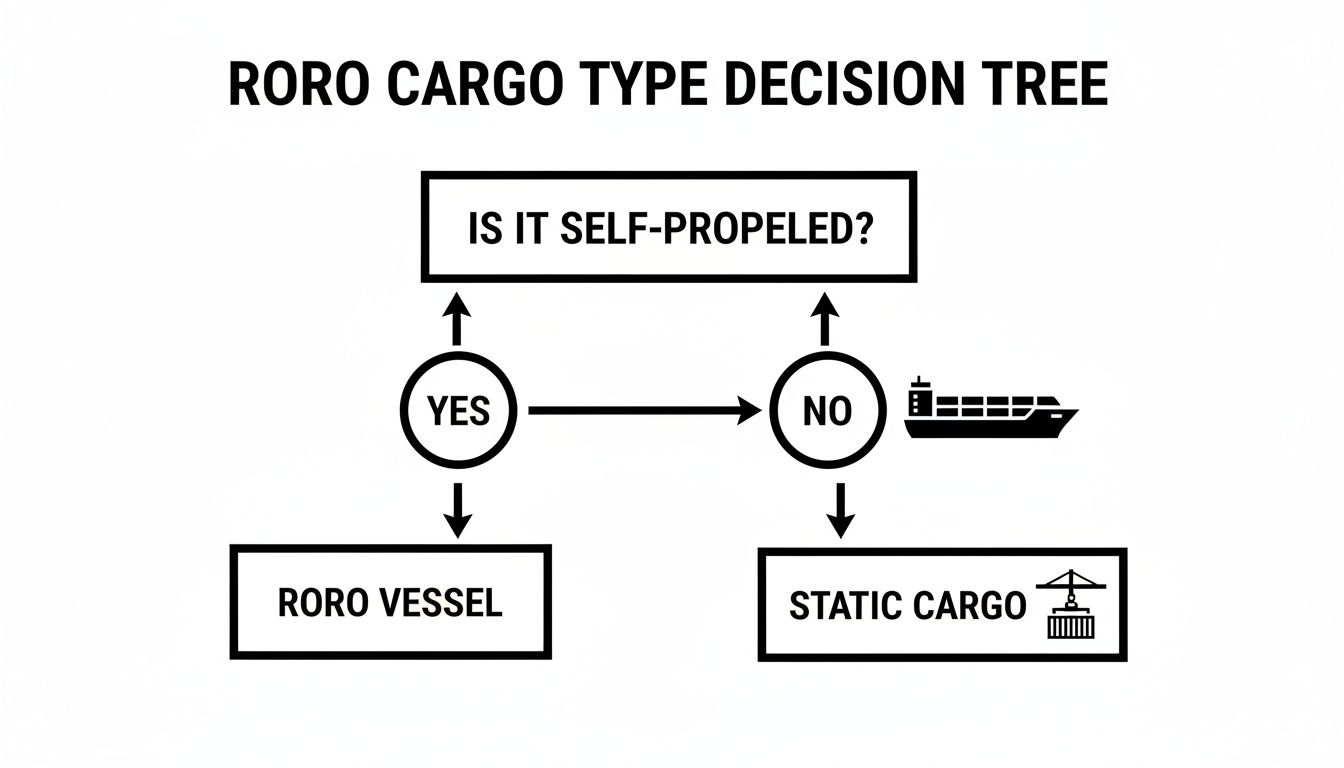
As you can see, the first question you need to ask is simple: can it move on its own?
RORO vs Container vs Breakbulk Shipping At a Glance
To make it even clearer, here’s a straightforward table breaking down how the three methods compare on the most important factors. It’s a handy reference for seeing the key differences in cost, speed, security, and the types of cargo each is best suited for.
| Feature | Roll On Roll Off (RORO) | Container Shipping | Breakbulk Shipping |
|---|---|---|---|
| Ideal Cargo | Vehicles, trucks, heavy machinery, and any self-propelled or towable cargo. | Boxed goods, palletised items, personal effects, and smaller vehicles. | Oversized, heavy, or non-containerised static cargo like machinery parts or yachts. |
| Loading Method | Cargo is driven or towed directly onto the vessel via a ramp. | Cargo is loaded into a container, which is then lifted onto the ship by a crane. | Individual cargo items are lifted directly onto the vessel by specialised cranes. |
| Cost Structure | Typically priced per Cubic Metre (CBM), making it cost-effective for vehicles. | Priced per container (FCL) or per CBM/weight (LCL). | Priced per metric tonne or CBM, often with higher handling and port fees. |
| Speed & Handling | Very fast loading and unloading, minimising port turnaround times. | Slower due to crane operations and container stacking/unstacking. | The slowest and most labour-intensive method due to individual handling. |
| Security | Cargo is secured below deck but is exposed during port operations. | High security as cargo is sealed inside a steel container from origin to destination. | Cargo is exposed to the elements and handling, requiring robust packing. |
At the end of the day, the right choice really boils down to what you're shipping. For importers bringing vehicles or heavy equipment out of China, roll on roll off shipping is often the most logical, efficient, and budget-friendly path. It cuts out the need for complex crane operations, reduces handling risks, and gets your valuable assets on the move much faster.
Where Does RORO Shipping Sail From? China's Major Ports and Routes
When you're planning to ship vehicles or heavy machinery from China, knowing the lay of the land—or in this case, the sea—is everything. Not every port is built for the unique demands of Roll-on/Roll-off shipping. As a global hub for manufacturing cars and equipment, China has poured serious investment into developing world-class ports that are the primary gateways for this kind of cargo.
Think of these ports not just as docks, but as massive, self-contained logistical cities. They feature specialised berths, enormous parking lots (known as marshalling yards), and direct links to the country's biggest industrial zones. Knowing which ports are the major players is the first step to building a smarter supply chain.
China's "Big Three" RORO Hubs
While plenty of Chinese ports can handle wheeled cargo, a few truly dominate the scene. Their sheer scale, advanced infrastructure, and global shipping connections make them the default choice for most international RORO shipments.
- Port of Shanghai: It's not just the busiest port in the world; Shanghai is an absolute powerhouse in RORO. Its Waigaoqiao terminal is a critical artery for exporting everything from family cars to giant construction equipment. Sitting right at the mouth of the Yangtze River, it has unmatched access to the industrial heartland of China.
- Port of Tianjin: As the main maritime gateway to Beijing and Northern China, Tianjin is a vital hub for heavy industry and automotive manufacturing. Its facilities are specifically designed to handle huge volumes of commercial trucks, buses, and construction machinery heading to markets all over the world.
- Port of Guangzhou: Down in the Pearl River Delta, Guangzhou is a major automotive manufacturing centre, so it’s no surprise its port is a RORO leader. It acts as a crucial link for vehicle trade in southern China, offering fantastic connections to Southeast Asia, Africa, and the Middle East.
Charting the Course: Popular Sea Lanes
From these key Chinese ports, RORO vessels follow well-established sea lanes that crisscross the globe, connecting to every major continent. The time it takes to travel these routes is a massive factor in your logistics planning, affecting everything from your inventory levels to your customer delivery dates.
It helps to picture the journey. A ship leaving Shanghai doesn't just point its bow and sail in a straight line. It follows specific maritime highways, often with planned stops, all optimised for fuel efficiency and safety.
Here’s a look at typical transit times for the most common RORO routes out of China:
- China to North America (West Coast): A very common route for vehicle exports. Getting from Shanghai or Tianjin to a port like Los Angeles usually takes between 15 and 25 days. You can get a more detailed breakdown of this popular lane in our guide on sea freight from Shanghai to Los Angeles.
- China to Europe: Journeys to major European RORO hubs like Antwerp in Belgium or Bremerhaven in Germany will typically take 30 to 40 days, as they involve navigating through the Suez Canal.
- China to South America: This is a rapidly growing trade corridor with new, direct routes. The new Chancay–Shanghai route, which opened in late 2024, is a game-changer. For example, a single RORO vessel in June 2025 carried an incredible 2,308 China-made vehicles on one trip to South America, highlighting the huge scale of these operations. You can discover more insights on China-Peru shipping routes to see how this trade link is evolving.
- China to Africa: Transit times here vary widely based on the destination. Shipments to East Africa might take 25 days, while reaching West Africa could take up to 45 days. Ports like Durban in South Africa and Lagos in Nigeria are frequent destinations.
Getting familiar with these key ports and the sea lanes that connect them allows you to make much smarter decisions. You can forecast arrival times more accurately and ultimately build a supply chain for your wheeled cargo that is far more resilient and predictable.
Unpacking RORO Costs and Your Document Checklist
Let's get down to the brass tacks: what does RORO shipping actually cost, and what paperwork do you need to get it done? The good news is that the financial side of roll on roll off shipping is much simpler than other methods. It’s less about how heavy your cargo is and almost entirely about how much space it takes up.
The magic number in RORO pricing is the Cubic Metre (CBM). Shipping lines calculate your cost by measuring the total volume your car or machine occupies on the vessel—just its length times its width times its height. This is a huge plus if you're shipping heavy but relatively compact machinery, as the sheer weight of it won’t inflate your freight bill.
What Goes into a RORO Quote?
Your final bill is never just the ocean freight. To create a realistic budget, you have to factor in a few standard charges that come with any international shipment. Knowing about these from the start means no nasty surprises when the invoice arrives.
Here’s a typical breakdown of what you’ll see on a RORO quote:
- Ocean Freight: This is the core charge for moving your cargo from the port in China to its destination. It’s the CBM-based price we just talked about.
- Terminal Handling Charges (THC): You’ll see these fees from both the departure and arrival ports. They cover the labour and equipment used to move your vehicle around the port—from the holding area onto the ship, and then off again at the other end.
- Port Fees: Pretty straightforward, these are the standard fees all port authorities charge for using their facilities.
- Customs Clearance Fees: This is what you pay a customs broker to handle the official declarations and paperwork needed by customs authorities in both countries.
- Security Fees: Modern ports have a lot of security measures, and these fees, like the ISPS (International Ship and Port Facility Security) charge, help cover those costs.
The real beauty of the RORO model is how its efficiency often leads to lower handling costs. Since there are no cranes involved and the whole process is incredibly fast, terminal charges are usually much more competitive than what you'd pay for container shipping, especially for a single vehicle.
Your Must-Have Document Checklist
Getting your paperwork right isn't just important—it's everything. A single mistake or a missing document can cause serious delays, rack up storage fees, and create a mountain of stress with customs. For any RORO shipment, there's a core set of documents you'll need to prove you own the cargo and that its value is declared correctly.
Here’s the essential list of documents for a smooth RORO shipment:
- Bill of Lading (B/L): Think of this as the holy grail of shipping documents. It’s your contract with the shipping line, a receipt for your cargo, and the legal title you need to claim your vehicle when it arrives.
- Commercial Invoice: This document outlines the sale between you and the seller. Customs officials use the value listed here to calculate any duties and taxes owed. If you're unsure, you can learn more about how to create a proper commercial invoice and what it includes.
- Vehicle Title or Certificate of Origin: This is your proof of ownership. If you're shipping a used vehicle, you’ll need the original title. If it’s a brand-new machine direct from a factory in China, you'll provide a Certificate of Origin instead.
- Packing List (If Applicable): You won't need this for a single empty car. But if you’re shipping machinery with separate parts loaded onto a MAFI trailer, a detailed packing list is a must.
- Letter of Credit (If Applicable): For some larger commercial deals, a bank-issued Letter of Credit might be part of the agreed payment terms between the buyer and seller.
Taking the time to get these documents perfect from the beginning is the single best thing you can do to ensure your cargo sails through customs. A good freight forwarder won't just ask you for these—they'll help you check and double-check every detail before your shipment is even booked.
Your Step-By-Step RORO Shipment Booking Checklist

Booking a roll on roll off shipping service can feel a bit daunting at first, but it's really just a matter of following a clear process. Think of this checklist as your roadmap. Breaking the process down into these simple, manageable steps will help you book your RORO freight with confidence and avoid any last-minute surprises.
Phase 1: Initial Prep and Quoting
This first stage is all about groundwork. Getting your information straight right from the start is key, because everything else—from the price you pay to your shipping contract—is built on these details.
- Gather Your Cargo Specs: Before you can even ask for a price, you need to know exactly what you're shipping.
Measure the precise dimensions: Length x Width x Height.
- Get the total weight.
- Jot down the make, model, and year of your vehicle or equipment.
- Request RORO Quotes: Now you can reach out to freight forwarders (like us at Upfreights!) with all those details. Make sure you provide the port of origin in China and the final destination port to get a complete quote that covers all the charges.
- Compare and Choose Your Partner: The cheapest quote isn't always the best one. You need to weigh the price against the carrier's reputation, their typical transit times, and how responsive their customer service is. A reliable partner is worth its weight in gold.
Phase 2: Paperwork and Pre-Shipment Prep
Once you've picked your forwarder, it's time to tackle the paperwork and get your cargo ready for its journey across the sea. Getting this part right is crucial for a smooth trip through customs and avoiding delays at the port.
Pro-Tip: Give your vehicle a good, thorough clean—inside and out—before it heads to the port. Customs and port authorities often inspect vehicles, and a clean one makes their job (and yours) much easier. It also helps when documenting its condition before shipping.
- Finalise All Your Documents: Your freight forwarder will guide you through preparing the must-have documents we've covered, like the Bill of Lading, Commercial Invoice, and Vehicle Title. Double-check that every single detail is 100% accurate to save yourself a massive headache with customs later.
- Get Your Vehicle Ship-Shape: Your vehicle needs to be in good running condition to be driven onto the vessel.
The fuel tank should be no more than one-quarter full.
- Make sure the battery is charged and the brakes are working perfectly.
- Clear out all personal items. They're strictly forbidden in RORO shipping.
Phase 3: Final Logistics and Tracking
You're on the home stretch! These last steps are about getting your cargo to the terminal and keeping an eye on it until it arrives safe and sound.
- Schedule Port Delivery: Work with your forwarder to book a time to deliver your vehicle to the designated RORO terminal. Pay close attention to the port's cut-off dates—missing them means your cargo will miss the boat.
- Confirm and Track: As soon as your cargo is loaded onto the vessel, you'll get a confirmation and tracking information. You can use this to follow your shipment's journey across the ocean, which really helps you plan for its arrival and collection at the other end.
RORO Shipping: Your Questions Answered
Even after getting the basics down, you probably have a few specific questions about how roll on roll off shipping works in practice. Let's tackle some of the most common ones we hear from our clients, giving you the straight answers you need to ship with confidence.
Can I Pack My Car with Personal Belongings?
This is a big one, and the answer is almost always a firm no. RORO carriers are extremely strict about this for both safety and customs reasons.
Think of it this way: the ship is a car park, not a storage unit. Your vehicle needs to be completely empty, except for standard factory items like a spare tyre and a jack. If port staff find personal items inside, they'll likely remove them (and charge you for it), or your vehicle might be refused for shipment altogether. If shipping your car and your stuff together is a must, you'll need to look at container shipping instead.
What's the Deal with Insurance for RORO?
While the shipping line has its own basic liability insurance, don't rely on it. It’s designed to protect them, not you, and it won’t come close to covering the full value of your vehicle if something happens. Getting your own marine cargo insurance isn't just a good idea; it's highly recommended.
Your freight forwarder is your best guide here. They can walk you through securing the right policy, whether that’s a comprehensive 'All Risk' plan or a more basic 'Total Loss Only' option, depending on your vehicle's value and your peace of mind.
Different policies cover different scenarios, so make sure you understand what you're buying. A little extra spent on proper insurance can save you a massive headache later on.
Does My Vehicle Actually Have to Run?
Yes, absolutely. This is the core principle of "Roll-on/Roll-off" – the cargo needs to be able to roll on and off the ship under its own power. To be accepted for a standard RORO shipment, your vehicle must have a working engine, good brakes, and steering that responds properly.
What if it doesn't run? You still have options, but it won't be a standard RORO booking. An inoperable vehicle has to be treated as static cargo, meaning it will likely be towed or craned onto a special platform, like a MAFI trailer, before being loaded. This is a different process with different handling and, naturally, a different price tag. Be upfront with your freight forwarder about your vehicle's condition from day one to avoid any costly surprises or delays at the port.