When it comes to importing auto parts into China, success really boils down to one thing: meticulous planning. This isn't a market where you can just wing it. Getting it right rewards preparation, while making assumptions can lead to costly delays and compliance headaches.
The journey from sourcing a component to its final delivery in China is packed with regulations, logistical hurdles, and careful cost management.
Getting a Handle on the Import Landscape
Bringing auto parts into China is far more than a simple shipping transaction. You're entering one of the most dynamic—and complex—automotive markets on the planet. To succeed, you need a practical, on-the-ground understanding of the entire process. It's about moving past theory and putting strategies into action that seasoned importers rely on to stay ahead.
That's what this guide is all about. We’ll walk through the essential, real-world steps for building an import strategy that actually works. You'll learn not just what to do, but how to do it—from navigating tricky customs rules to optimising your shipping for the best mix of speed and cost.
Why a Solid Strategy is Non-Negotiable
A scattergun approach to importing is a surefire way to run into trouble. A small mistake in your paperwork, a wrong product classification, or picking a less-than-ideal shipping partner can get your goods stuck at customs, rack up unexpected fees, and throw your entire supply chain into chaos. The stakes are just too high for guesswork.
Here’s where a concrete plan makes all the difference:
- Compliance Confidence: You need to be certain that every part meets China's specific safety and quality standards, like the China Compulsory Certification (CCC).
- Managing Costs: Accurately calculating your total landed cost is essential. This protects your profit margins and prevents nasty financial surprises down the line.
- Logistics Efficiency: Choosing the right freight mode and partners helps you strike the perfect balance between speed, cost, and reliability.
Think of your import strategy as your roadmap. It helps you see challenges coming, make smarter decisions, and transform a potentially frustrating process into a smooth, repeatable, and profitable part of your business.
A Market of Both Opportunity and Complexity
The Chinese auto parts sector is an absolute giant, influencing both its own domestic market and global trade flows. The industry's value was pegged at a staggering US$713.4 billion for 2025, with experts predicting an annualised export growth of 5.7% through 2030.
This data tells an interesting story. While China is a manufacturing titan, it still heavily relies on imports for specialised, high-performance components. This creates a massive opening for international suppliers who can fill that gap.
As you start to map out your own entry, one of the first calls you'll need to make is what kind of parts you'll be dealing with. A critical early step is getting to grips with the differences between OEM versus aftermarket parts, as this choice has major implications for quality, cost, and compliance in the Chinese market. It will directly shape your sourcing strategy and how you position your products.
Mastering Customs Compliance and Documentation
Think of customs compliance as the gatekeeper to your entire import operation. Get it wrong, and you're looking at crippling delays, surprise fines, and even having your goods seized. When you import auto parts, this is where meticulous attention to detail really pays off.
Navigating the web of regulations doesn’t have to be a nightmare, though. It’s all about understanding the core requirements and getting your documentation perfect before your shipment ever leaves the port. Let's break down exactly what you need to get right.
The following infographic gives you a bird's-eye view of the three main phases of a successful import journey, from planning and compliance right through to the final shipment.
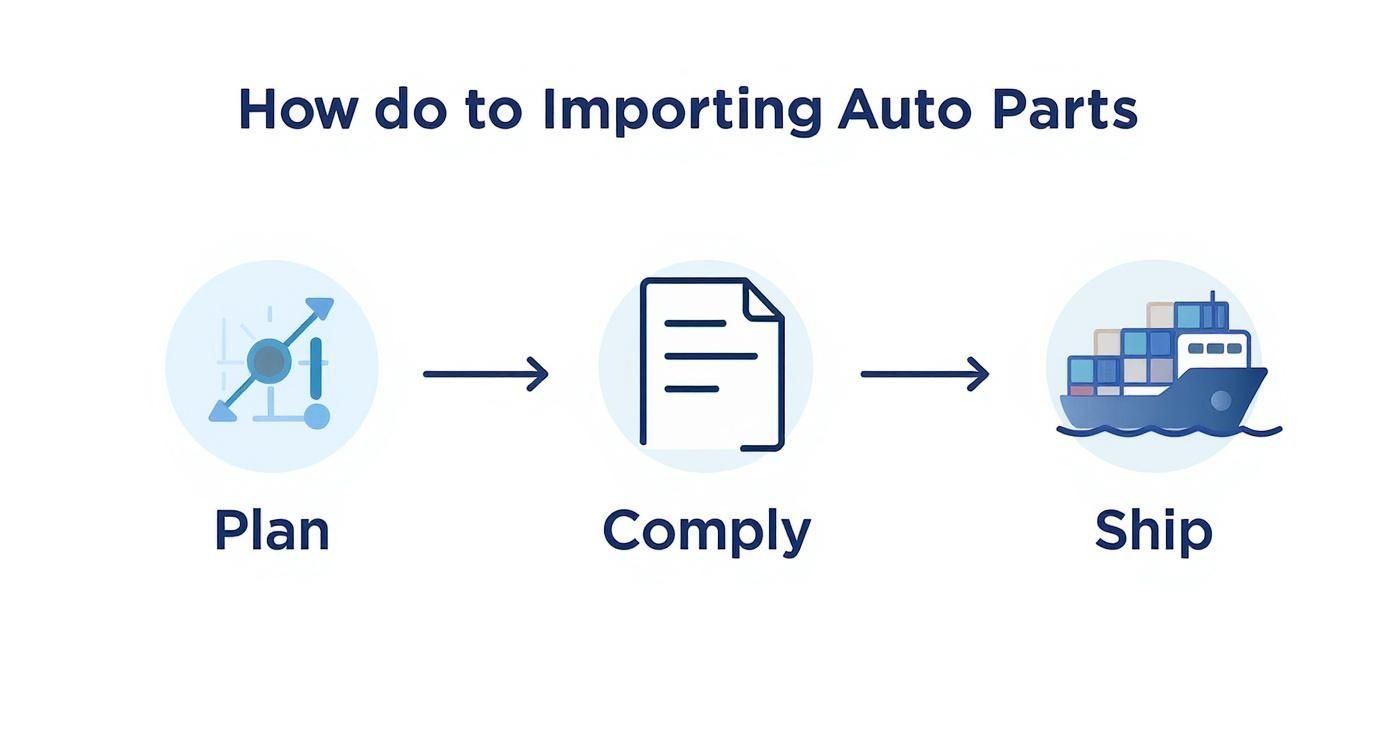
As you can see, compliance isn't just one step in the process; it's the central pillar that holds your strategy and logistics together.
Decoding HS Codes and CCC Marks
First things first, you have to classify your products correctly. Every single item you bring into the country needs a Harmonized System (HS) Code, which is the global standard for classifying traded goods. This code is much more than just a number—it directly determines the duties and taxes you'll be paying.
For instance, an electronic control unit (ECU) will have a completely different HS code and duty rate than a simple box of steel lug nuts. A misclassification, even if it's an honest mistake, can be flagged by customs as an attempt to dodge duties, and that comes with serious penalties.
On top of HS codes, many auto parts need a China Compulsory Certification (CCC) mark. This is a mandatory safety and quality stamp for products sold on the Chinese market. It’s non-negotiable for parts like:
- Brake hoses
- Safety glass
- Tyres
- Lighting and signalling devices
If your product needs a CCC mark and doesn't have one, it will be turned away at the border. No exceptions. The application process can be long, so you absolutely must start this well before your shipment is ready.
Your Essential Documentation Checklist
Proper paperwork is the lifeblood of a smooth customs process. While the fine print can vary, any standard shipment of auto parts requires a core set of documents. Having these in perfect order isn't just a good idea; it's a must.
Here is a look at the essential documents you’ll need to prepare.
Essential Documents for Importing Auto Parts to China
| Document Name | Purpose | Key Information to Include |
|---|---|---|
| Commercial Invoice | The main bill of sale between you and the supplier. Customs uses this to determine the value of your goods and calculate duties. | Detailed description of each part, quantity, unit price, total value, HS codes, and Incoterms (e.g., FOB, EXW). |
| Packing List | A detailed breakdown of the shipment's contents, including weights, dimensions, and how each carton or crate is packaged. | Net and gross weight of each package, dimensions, and markings. This information must perfectly match the commercial invoice. |
| Bill of Lading (B/L) or Air Waybill (AWB) | This is the contract between the shipper and the carrier. It acts as both a receipt for the goods and a title document. | Shipper and consignee details, port of loading/discharge, vessel/flight information, and a description of the goods. |
| Certificate of Origin (CO) | Certifies the country where the auto parts were made. This is crucial for determining if you qualify for preferential tariff rates. | Must be issued by an authorised body in the country of export and clearly state the origin of the goods. |
| CCC Certificate (if applicable) | Proof that your specific auto parts meet China's mandatory safety and quality standards. | The certificate has to be valid and must correspond directly to the products you are shipping. |
Getting these documents right is critical for a hassle-free import.
A common pitfall I see is a valuation discrepancy, where the value on the Commercial Invoice doesn't seem right to customs officials. This is a huge red flag that can trigger inspections and long delays. Always declare the true transaction value.
This is precisely why so many importers turn to experts. The paperwork can be complex. You can dive deeper into the process by exploring our detailed guide on customs clearance.
It's an interesting time in the market. While China’s new vehicle exports surged by 14.8% in the first nine months of 2025, hitting 4.95 million units, vehicle imports actually fell by around 35%. This points to growing self-sufficiency, but the demand for specialised, high-quality imported parts from advanced economies remains strong to support China's own manufacturing. You can discover more about China's evolving automotive trade dynamics.
Choosing Your Shipping and Logistics Strategy
Getting your auto parts from a factory in China to your warehouse isn't just a simple matter of moving boxes. This is a huge strategic decision that directly hits your bottom line, influencing everything from your final cost per unit to how quickly you can restock a hot-selling item. It’s time to move past the simple "fast is expensive, slow is cheap" mindset and start thinking like a seasoned importer.
The right shipping method really comes down to what you’re moving. If you’re importing high-value, lightweight electronics like ECU modules or delicate sensors, air freight is often the smartest bet. The extra cost is easily justified by the speed, which minimises the risk of damage and gets your valuable inventory into your hands faster.
On the other hand, for the heavy hitters—think engine blocks, transmissions, or entire suspension kits—sea freight is almost always the only logical choice. The sheer weight and bulk of these items would make air freight eye-wateringly expensive. A longer transit time is a small price to pay for the massive cost savings.
Air Freight vs Sea Freight for Auto Parts
When it's time to choose your transport mode, you're essentially juggling three balls: urgency, budget, and the physical nature of your products. Something like a batch of alternators could go either way. Do you need them urgently to fulfil backorders? Air freight it is. Can you wait a month and build them into your regular stock? Sea freight will save you a bundle.
This decision is so critical, I've put together a quick comparison to help you weigh the options for your auto parts.
| Factor | Air Freight | Sea Freight (FCL/LCL) |
|---|---|---|
| Speed & Urgency | Incredibly fast, usually 3–10 days from door to door. Perfect for urgent restocks or getting a new product line launched quickly. | Much slower, think 20–45 days or more. Best for planned inventory replenishment and bulk orders where time isn't the biggest concern. |
| Cost | Significantly more expensive. Billed on "chargeable weight," which is a calculation of actual weight versus volume. | The clear winner for cost-effectiveness on heavy or bulky goods. The price per part plummets as your shipment volume grows. |
| Shipment Size | Ideal for smaller, lighter shipments, typically anything under 500 kg. The cost advantages disappear quickly as you get heavier. | Built for large volumes. Handles everything from a few pallets (LCL) to multiple massive containers (FCL). |
| Risk of Damage | Generally a lower risk. The journey is shorter and there's far less handling involved. | A slightly higher risk due to the long transit time and potential for moisture. This is why bulletproof packaging is non-negotiable. |
In my experience, the smartest importers don't stick to just one method. They develop a hybrid strategy. They'll fly in a small, critical batch of parts to keep business moving, while the bulk of their inventory is already on a container ship making its way across the ocean.
Understanding FCL and LCL Sea Freight
If you've decided sea freight is the way to go, you’ve got another key choice to make: Full Container Load (FCL) or Less than Container Load (LCL).
FCL (Full Container Load): This is where you book an entire shipping container—usually a 20ft or 40ft one—just for your products. It's the go-to option once your shipment is big enough because it offers the best per-unit cost. It's also more secure; the container is sealed at your supplier's factory and isn't opened again until it reaches its final destination.
LCL (Less than Container Load): Your goods share space in a container with cargo from other importers. You only pay for the volume your freight takes up. LCL is a lifesaver for smaller businesses or for those placing orders that don't fill a whole container. It gives you the cost benefits of sea freight without having to order massive quantities.
A good rule of thumb I tell my clients: once your shipment volume crosses the 15 cubic metre mark, FCL usually starts to make more financial sense. It's also a touch faster than LCL because your container skips the consolidation and deconsolidation steps at the port warehouses.
For anyone just starting out or managing smaller, more frequent orders, LCL is an incredibly valuable tool. To get a better handle on the process, it's worth reading up on the finer points of shipping freight by sea, which breaks these options down even further.
Protecting Your Investment in Transit
No matter how you ship, you have to protect your goods. Don't ever forget that. Auto parts can be delicate, and the journey from a factory in Asia to your door is a long and rough one.
Here are the three things I insist on for every shipment:
- Proper Crating and Packaging: A simple cardboard box won't cut it for fragile items like headlights or mirrors. You need custom crating, foam inserts, and secure bracing to absorb the shocks and vibrations of transit.
- Moisture Protection: Moisture is the mortal enemy of anything electronic. For ECUs or sensor modules, demand that your supplier uses desiccant packs and vacuum-sealed plastic liners. This is especially critical for the long, humid journey on a container ship.
- Transit Insurance: This is not optional. It's a must. The standard liability offered by carriers is pennies on the dollar and won't come close to covering your costs if something goes wrong. Full cargo insurance is a small price to pay for the peace of mind that your entire investment is protected.
Calculating Your Total Landed Cost
The price your supplier gives you is just the starting line, not the finish. If you really want to know whether importing those auto parts will make you money, you have to nail down your total landed cost. Think of it as the true, all-in price to get a product from the factory floor in China to your warehouse door.
I've seen too many importers get burned by skipping this step. Overlooking a single fee can completely wipe out your profit margin, turning a great deal into a financial nightmare. In logistics, surprises are almost never good, so a precise landed cost calculation is your best defence. It's the only way to budget properly and price your parts competitively.
Breaking Down the Cost Components
Calculating your landed cost isn't rocket science, but it demands attention to detail. You need to map out every single point in the supply chain where you'll get hit with a fee.
Your formula will boil down to a few key variables:
- Product Cost: What you pay the supplier, which is often tied to Incoterms like FOB (Free On Board) or EXW (Ex Works).
- Freight Charges: The bill for sea or air transport from the origin port to the destination port.
- Insurance: This is non-negotiable. It protects your investment against damage or total loss while it's on the move.
- Customs Duties: The tax slapped on by Chinese customs, calculated as a percentage of your goods' value based on their HS code.
- Value-Added Tax (VAT): Another tax you'll pay during the import process in China.
- Ancillary Fees: This is a catch-all for things like port handling, customs brokerage fees, and any trucking needed to get the goods to your final destination.
The real magic of the landed cost calculation is getting to your final per-unit price. Just take the total landed cost and divide it by the number of units you ordered. That number is your actual cost of goods, not the supplier's quote.
When you're crunching the numbers, you also need to keep an eye on external factors like tariffs. Trade policies can change quickly, so staying informed is critical. You can often find helpful frameworks in resources that outline strategies to avoid Trump tariffs, as the principles apply to many different tariff situations.
A Practical Landed Cost Example
Let's walk through a real-world scenario to make this concrete. Imagine you're importing a container of 500 high-performance transmissions from a supplier in Germany to your facility in Shanghai.
Here’s what a typical cost breakdown might look like:
- Product Cost (FOB Hamburg): 500 units @ €400/unit = €200,000
- Ocean Freight (Hamburg to Shanghai): €4,500
- Cargo Insurance (0.5% of commercial value): €200,000 x 0.005 = €1,000
- Import Duties (e.g., 8%): €205,500 (Product + Freight + Insurance) x 0.08 = €16,440
- VAT (e.g., 13%): (€205,500 + €16,440) x 0.13 = €28,852
- Port Fees & Brokerage: €700
Tally it all up, and your total landed cost is €251,992. Now, divide that by your 500 units, and your true cost is €503.98 per transmission. That’s over 25% higher than the initial supplier price! This is why understanding Incoterms like DDP (which includes duties) is so important. You can dig deeper into this by reading our guide here: https://upfreights.com/blog/ddu-ddp-incoterms.
This calculation is absolutely vital. It’s also interesting to see how market trends play into this. For instance, in the first half of 2025, China's imports of similar specialty parts from the EU saw major growth. Imports of transmissions for large buses jumped by 40.8% and diesel engines by 65.2% year-over-year, even as China’s total imports dipped slightly. This proves the demand is there, which makes getting your costs right even more crucial.
Finding Your Logistics Team: Freight Forwarders and Customs Brokers
Even with the perfect product and flawless paperwork, your whole import plan can grind to a halt without the right logistics partners. Let's be blunt: trying to manage international shipping and customs on your own is a surefire way to lose time and money. This is where a top-notch freight forwarder and a sharp customs broker become the MVPs of your operation.
People often mix these two up, but they have very different—and equally critical—jobs.
Think of your freight forwarder as your logistics quarterback. They orchestrate the physical journey of your auto parts, booking space on a container ship or cargo plane, arranging trucking, and generally making sure your goods get from the factory floor in China to the destination port.
Your customs broker is your legal ace for navigating the complexities of customs. These are licensed pros who act on your behalf to ensure every ‘i’ is dotted and every ‘t’ is crossed. They handle the HS codes, file the entry documents, and basically argue your case to get your shipment cleared and released. Some larger forwarders have in-house brokers, but they are distinct specialities.
How to Choose a Partner You Can Trust
Picking the right partners isn't about finding the absolute lowest price. A few quid saved on a quote means nothing when your container of high-value alloy wheels is stuck in customs for three weeks, racking up storage fees. You're looking for expertise, not just a bargain.
When you're vetting companies to help you import auto parts, you need to do your homework. Here’s what really matters:
- Proper Licensing: This is non-negotiable. Your customs broker must be licensed by the customs authority in your country. For freight forwarders, look for memberships in reputable industry bodies. It’s a basic sign of professionalism.
- Specialised Experience: Don't be shy. Ask them point-blank about their experience with auto parts. Do they know the difference between a catalytic converter and an alternator? A partner who has handled similar products before will know to watch out for common pitfalls, like CCC certification issues.
- A Strong Network: A great forwarder doesn't just work with one shipping line. They have a deep network of carrier relationships, which means they can find you space on a vessel and get competitive rates, even when things get crazy during peak season.
- Clear, Proactive Communication: You need a partner who is responsive and speaks your language fluently. When there’s a problem—and eventually, there will be one—you want a phone call with a solution, not a week of silence.
I’ll give you a real-world example. We had a client whose supplier in China made a huge mistake on the commercial invoice, undervaluing a whole container of engine components. An eagle-eyed broker caught it before it was submitted to customs, saving the client from a massive fine and a potential import ban. That's what you're paying for.
The Questions You Must Ask
Before you sign on the dotted line, get them on the phone or a video call. How they answer these questions will tell you everything you need to know.
Here's a good starting list:
- Could you share references from other businesses that import auto parts?
- Walk me through your exact process if customs flags a shipment for inspection.
- Do you offer a web portal or some way for me to track my shipment in real-time?
- How do you keep everyone—your team, my supplier, and me—in the loop?
- What are the "hidden" fees? I want to know about every potential charge beyond what's in this initial quote.
Getting Your Parts From the Port to Your Door
Clearing customs feels like crossing the finish line, but there's still one critical leg of the race left: getting your auto parts from the port to your final destination. This "last mile" is where a lot of importers trip up, facing unexpected delays and costs that can eat into their profits. Once your container is released, the clock is ticking.
This final push involves moving your shipment from the port to your own warehouse, a factory, or maybe a third-party distribution centre. How you handle this inland journey directly impacts your delivery times and your bottom line.
Choosing Your Inland Transport: Truck vs. Rail
For getting goods from the port, you're usually looking at two main choices: truck or rail.
- Trucking: This is the go-to for most importers, and for good reason. It’s incredibly flexible. A truck can pick up your container at the port and drive it straight to your loading dock, offering true door-to-door service. If your delivery is time-sensitive or your facility isn't near a major rail hub, trucking is almost always the answer.
- Rail: If you're moving massive quantities of heavy parts—think pallets of engine blocks or transmissions—and your destination is near a major inland rail terminal, then rail can save you some money. The catch? It's slower, less flexible, and you'll still need a truck to get the container from the port to the rail yard, and then another from the destination yard to your facility. This adds steps and complexity.
For the vast majority of small and medium-sized businesses importing auto parts, trucking simply offers the best mix of speed, cost, and convenience for that final delivery.
Smart Warehousing and Inventory Management
Once your parts arrive, you need somewhere to put them. Good warehousing isn't just about finding shelf space; it's the core of an inventory strategy that keeps your business humming. Whether you use your own facility or team up with a third-party logistics (3PL) provider, having a plan is essential.
One savvy move some importers make is to use a warehouse inside a Free Trade Zone (FTZ).
Pro Tip: Storing your goods in an FTZ lets you delay paying import duties and taxes. You only pay when the parts actually leave the zone to be sold in the domestic market. For high-value auto parts, this can be a massive boost to your cash flow.
This approach means you can keep inventory ready and waiting close to your customers without having a huge chunk of your capital tied up in customs duties. It’s a real competitive edge.
The Final Step for E-Commerce and Amazon FBA Sellers
If you're selling online, especially through Fulfilment by Amazon (FBA), this final delivery stage has its own unique rulebook. Amazon’s warehouses are notoriously strict about how they accept inventory. Get it wrong, and they can flat-out refuse your shipment.
Before your freight forwarder even thinks about booking a delivery appointment with Amazon, you need to make absolutely certain that every box is prepped to their standards:
- FNSKU Labels: Every single product needs a scannable Amazon FNSKU barcode. Make sure it completely covers the original manufacturer's barcode.
- Carton Labels: The outside of each shipping carton requires a specific FBA shipment label. This is what links the box to your shipping plan in Amazon Seller Central.
- Packaging Rules: Follow Amazon’s guidelines to the letter. They have specific rules for everything from box weight and dimensions to the type of packing material you can use inside.
Slipping up on any of these points can lead to expensive chargebacks from Amazon or, even worse, your entire shipment being rejected at the loading dock. A good freight forwarder should be able to help with this final prep work, ensuring a smooth handover and getting your products checked in without a hitch.
Here are some of the questions that always seem to come up when you're getting ready to import auto parts. Think of this as a quick FAQ section to tackle those nagging queries we hear from importers all the time.
Is Importing Used Auto Parts a Viable Option?
Honestly, trying to import used auto parts into China is almost always a non-starter. The regulations are incredibly strict, designed to uphold safety and quality standards.
This means that most used components, especially anything critical like an engine block or a gearbox, will be flat-out prohibited. Your time and money are far better spent sourcing new parts from the get-go.
What Usually Causes Holdups at Customs?
Nine times out of ten, delays at the border come down to paperwork problems. It's rarely a big, dramatic issue; it's usually small, avoidable mistakes.
- HS Code Mismatches: The code you've used just doesn't line up with the product description. This is a huge red flag for customs.
- Questionable Valuations: If the value declared on your commercial invoice looks suspiciously low, officials will definitely take a closer look.
- Missing Paperwork: Forgetting a required certification, like the CCC mark for a specific electronic component, will stop your shipment in its tracks.
How Long Should I Expect the Import Process to Take?
Your total timeline really hinges on how you choose to ship your goods. The difference is significant.
- Air freight is your express option. You can typically expect your parts to arrive in 3–10 days, from the factory floor to your warehouse door.
- Sea freight is the marathon, not the sprint. You're looking at anywhere from 20–45 days on the water, and that's before factoring in port traffic.
Pro Tip: Always build a buffer into your schedule. I recommend adding at least an extra week to account for customs clearance and final delivery. This simple step can save you from a major headache and prevent stockouts if there's a minor hiccup along the way.
Do I Really Need to Bother with Transit Insurance?
Yes. Full stop. Don't even think about skipping it.
The basic liability coverage offered by a carrier is next to nothing—it won't come close to covering the actual cost of your goods if they get lost or damaged. Cargo insurance is a small price to pay for complete financial peace of mind. For high-value shipments like auto parts, importing without it is a massive, unnecessary gamble.