When you're trying to figure out how much you can fit into a 40-foot container, the numbers can be a bit deceiving at first glance. On paper, a standard 40 ft container has about 67 cubic metres (CBM) of space. If you opt for a 40 ft high-cube, you get a bit more room, roughly 76 CBM.
But here’s the crucial part that every experienced shipper knows: those figures are the container's absolute maximum internal volume, not what you can actually pack into it.
Your Quick Guide to 40 ft Container CBM
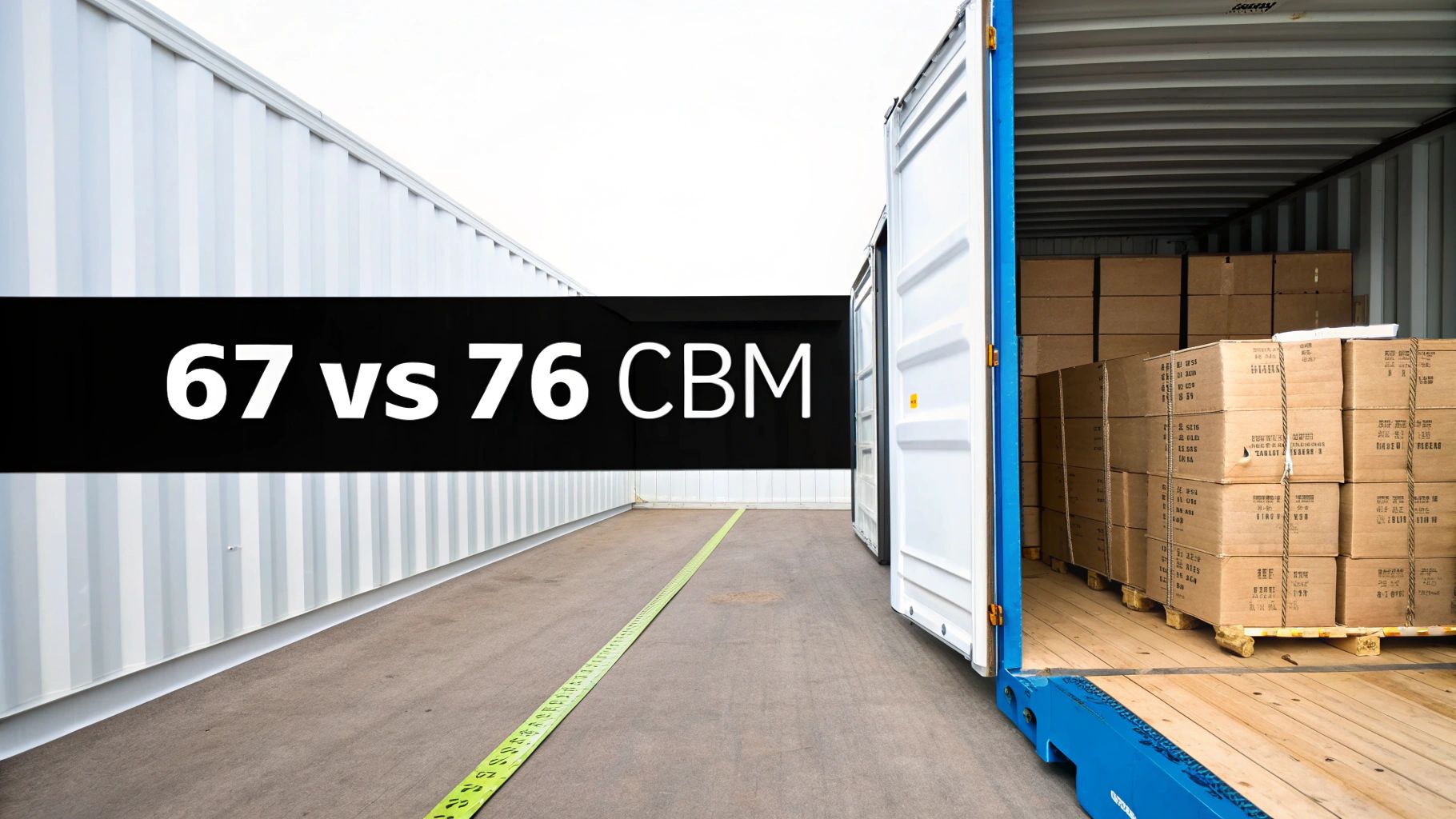
Getting to grips with the difference between theoretical and usable CBM is the key to efficient shipping. Think about packing a moving van. You can't use every single square centimetre because of the awkward shapes of furniture and the empty pockets of air that inevitably form between boxes. It's the exact same principle in logistics.
As a rule of thumb, it's wise to plan for about 10-15% less usable space than the container's official capacity. This buffer is essential to account for things like packaging materials, the dimensions of pallets, and all the small, unavoidable gaps that appear when loading. In reality, this means your practical, usable CBM is often closer to 58–60 CBM for a standard container and 65-68 CBM for a high-cube.
Standard vs. High-Cube: What's the Real Difference?
The two most common 40 ft containers each serve a different purpose, and it all comes down to volume.
- Standard 40 ft Container: With around 67 CBM, this is the industry's go-to choice for a huge range of goods. It’s particularly well-suited for dense, heavy cargo where you're more likely to hit the maximum weight limit before you run out of physical space.
- 40 ft High-Cube Container: Offering a more generous 76 CBM, this container gives you about an extra foot of vertical space. That extra height is a game-changer for shipping light but bulky items—think furniture, apparel, or oversized cartons that need that additional clearance.
For a clearer picture, here’s a quick breakdown of how they stack up.
40 ft Container Volume at a Glance
This table provides a simple comparison of the volume and capacity specifications for both standard and high-cube 40 ft containers, helping you see the key differences immediately.
| Specification | 40 ft Standard Container | 40 ft High-Cube Container |
|---|---|---|
| Internal Volume (CBM) | ~ 67 CBM | ~ 76 CBM |
| Internal Volume (CFT) | ~ 2,385 cubic feet | ~ 2,694 cubic feet |
| Practical/Usable CBM | 58–60 CBM | 65–68 CBM |
| Internal Height | ~ 2.39 m (7’ 10”) | ~ 2.70 m (8’ 10”) |
| Best For | Heavy, dense cargo | Lightweight, bulky cargo |
Ultimately, choosing the right container depends entirely on the nature of your goods.
In China, a global manufacturing hub, these container dimensions are universal. A standard 40-footer has internal measurements of approximately 12.03 metres long, 2.35 metres wide, and 2.39 metres high. The high-cube simply pushes that height up to 2.7 metres, providing that critical extra volume that so many shippers rely on. For a deeper dive into container specs, you can find more insights on container specifications on BWS.net.
Key Takeaway: While a 40 ft container technically holds 67-76 CBM, always base your plans on a realistic, usable volume of around 58-68 CBM. Your choice between a standard and a high-cube container should come down to one simple question: is my cargo heavy and dense, or is it light and bulky?
What Exactly Is a CBM in Shipping?
Before we can figure out how many CBM fit into a 40 ft container, we need to get on the same page with the language of logistics. The most important word in that language? The Cubic Metre (CBM). It’s the universal unit that tells everyone—from the factory to the shipping line—exactly how much physical space your goods will occupy.
Think of it like playing with Lego blocks. One CBM is a perfect cube, measuring one metre long, one metre wide, and one metre high. Every box you ship is just a smaller version of that block. Your freight forwarder's job is basically to play a giant game of Tetris, fitting as many of your blocks into the container as possible.
This simple concept is the foundation of every freight quote you’ll ever get. It’s why the volume of your cargo is often just as critical as its weight.
How to Calculate CBM for Your Shipment
Calculating the CBM for your shipment is actually quite simple. All you need are the dimensions of one of your cartons and the total number of cartons you plan to ship.
First, you find the CBM for a single carton by multiplying its length, width, and height—just make sure they're all in metres.
The Formula: Length (m) x Width (m) x Height (m) = CBM per Carton
Let's walk through a quick example. Imagine your cartons measure 50 cm x 40 cm x 30 cm. The first step is to convert those centimetres into metres: 0.5m, 0.4m, and 0.3m.
Pop those into the formula: 0.5m x 0.4m x 0.3m = 0.06 CBM per carton.
Now that you have the volume for one box, figuring out the total for your entire shipment is easy. Just multiply that number by how many cartons you have.
- CBM per Carton: 0.06 CBM
- Total Cartons: 200
- Total Shipment CBM: 0.06 CBM x 200 = 12 CBM
And just like that, you know your total shipment volume is 12 CBM.
Why Volume Can Matter More Than Weight
This CBM calculation is so important because freight costs aren’t always based on how heavy your goods are. Carriers use a metric called chargeable weight. They look at the actual weight of your shipment and compare it to its volumetric weight (which is based on its CBM), and you get charged for whichever is higher.
Here’s a simple way to think about it: imagine shipping a container full of pillows versus one packed with steel bars. Both take up the same amount of space—the entire container—but their actual weights are worlds apart. The pillows are light but incredibly bulky, so the carrier charges based on the space they occupy (their volume). The steel is dense and heavy, so the charge is based on its actual weight.
Knowing your total CBM is the first real step to getting an accurate freight quote and making the right call between booking a full 40 ft container or sharing space in a consolidated shipment.
Choosing Between Standard and High-Cube Containers
At a glance, a standard 40 ft container and its high-cube cousin look pretty much the same. But look closer, and you'll spot the crucial difference: one single foot of extra height. It might not sound like much, but that one foot can completely change your shipping strategy and final bill, adding about 9 additional CBM of usable space.
This seemingly small detail is often the make-or-break factor for shippers. If you're moving heavy, dense cargo—think industrial machinery, car parts, or pallets of stone tiles—the standard container is usually the way to go. Why? Because you’ll almost certainly hit the container’s maximum weight limit long before you run out of physical room.
But what if your cargo is the opposite? For anyone shipping light and bulky items, that extra vertical space is an absolute godsend.
When High-Cube Containers Make Sense
The 40 ft high-cube container really shines when your cargo takes up a lot of room without tipping the scales. This is precisely where understanding how many CBMs are in a 40 ft container helps you squeeze the most value out of your freight costs.
Think about goods like these:
- Furniture and Home Goods: Sofas, mattresses, and assembled cabinets often need that extra headroom to fit without being taken apart.
- Apparel and Textiles: Boxes of clothing are famously light but bulky. The high-cube’s 76 CBM capacity is perfect for them.
- Oversized Cartons: Products packed in tall boxes, like flat-screen TVs or certain consumer electronics, can be stacked far more efficiently with that extra height.
Opting for a high-cube can slash your cost-per-CBM and might even be the difference between needing one container or two. It's a classic logistics move: turning a small difference in dimensions into a significant cost saving. This is a big reason why these larger containers have become so popular, especially with the growth of manufacturing in China. By 2019, 40-foot high-cube containers actually became the majority of containers in service globally, with China producing around 90% of the world's supply.
Key Insight: Don't pay for space you don't need, but don't get caught short on room just to save a few bucks on the container. The right choice always comes down to your cargo's specific profile—its density, height, and how well it stacks.
While the choice between standard and high-cube is a common one, they're just two of the many options out there. Getting familiar with the full range of containers can really help fine-tune your shipping strategy. For a great overview of different container dimensions and their uses, check out this resource on the most usual variety and sizes of shipping containers.
And for a deep dive into more specific measurements, be sure to see our complete guide to the 40 ft container size.
How to Calculate Your Actual Cargo Fit
Knowing a container's total CBM is a great start, but it's only half the story. One of the most common mistakes I see is shippers simply dividing a container’s 67 CBM capacity by their carton’s CBM and assuming it will fit. This is where theory crashes into reality. We need to shift our focus from the maximum volume to the usable CBM—the number that truly matters for your shipment.
The hard truth is you will never use 100% of a container's internal space. It’s just not possible. Little pockets of lost space are an unavoidable part of loading, and they add up faster than you’d think.
From Maximum CBM to Usable CBM
Think of it like packing a moving box. No matter how neatly you arrange things, there are always tiny gaps and odd spaces left over. In a shipping container, those small gaps can equal a significant amount of unshipped cargo.
What causes this loss of space?
- Pallet Dimensions: If you're using pallets, they take up both floor space and height. The pallet itself is dead space that eats into your total volume.
- Unavoidable Gaps: Even perfectly uniform cartons create tiny air pockets between them and against the container walls. Irregularly shaped items? Even more wasted space.
- Dunnage and Securing: You need materials like airbags, straps, and wooden braces to keep your cargo from shifting and getting damaged. All of that takes up CBM.
On average, these factors will chew up about 10-15% of the container's total volume. This means a standard 40-foot container with a theoretical 67 CBM capacity realistically only holds about 58-60 CBM of your product. Forgetting this buffer is a surefire way to end up with a pile of cargo left on the dock.
This visual guide shows how your cargo type influences container choice, a key first step in planning your shipment.
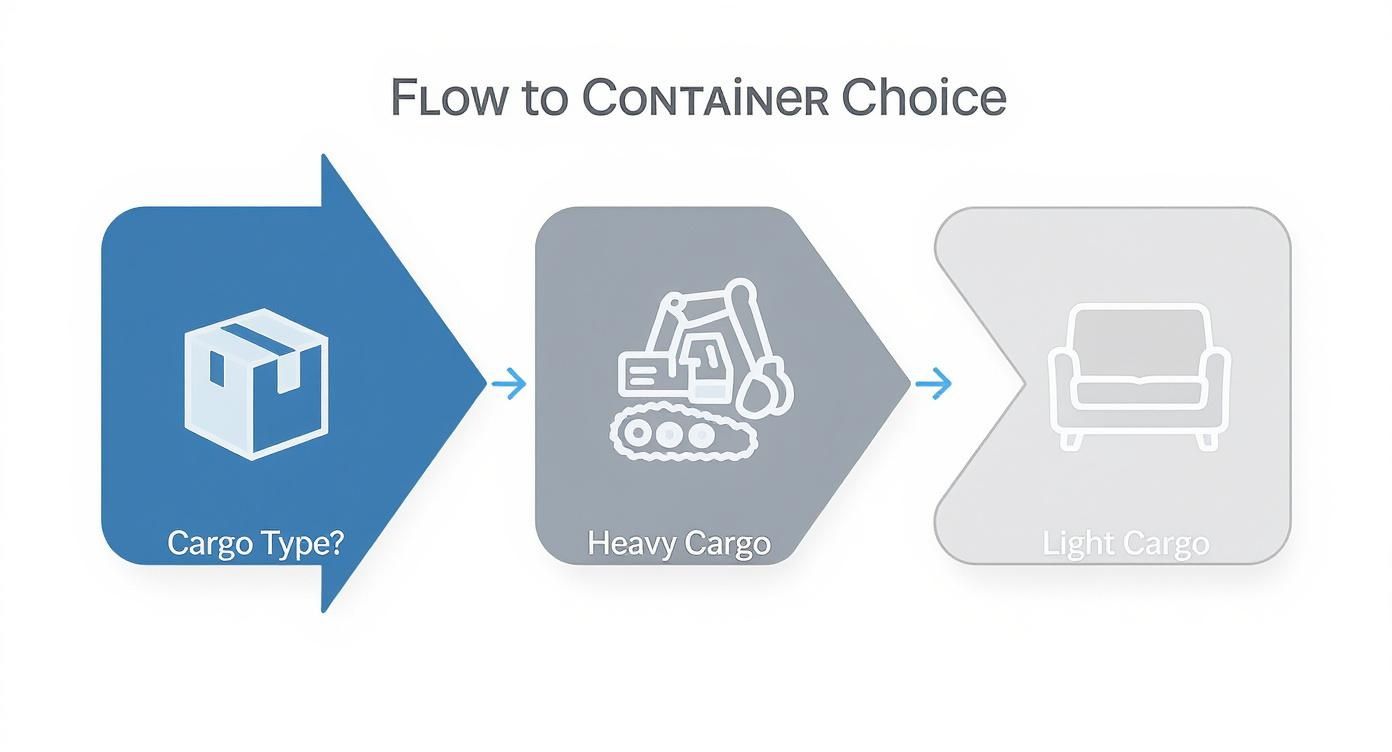
As the flowchart shows, the decision often boils down to whether your goods are heavy and dense or light and bulky.
A Practical Calculation Example
Let's walk through a real-world scenario. Imagine you're shipping cartons with the dimensions: 60cm (L) x 40cm (W) x 30cm (H).
First, we need the CBM for a single carton:0.6m x 0.4m x 0.3m = 0.072 CBM
Now, if we make that common mistake and use the container's total volume (67 CBM), we get:67 CBM / 0.072 CBM ≈ 930 cartons
This is the number that gets shippers into trouble. We must use the realistic, usable CBM. Let's work with a conservative figure of 58 CBM:58 CBM / 0.072 CBM ≈ 805 cartons
Real-World Impact: The difference between the theoretical maximum and a practical loading plan is 125 cartons. That’s a massive amount of product that would have been left behind, likely delaying your entire shipment and racking up unexpected costs.
Getting this right from the start is essential for accurate planning. If you need a refresher on the basics, you can find a detailed guide on how to calculate CBM for any shipment. Mastering this simple maths helps you avoid ordering a container that's too small and ensures your freight quotes are based on reality, not wishful thinking.
Why Container Weight Limits Are Just as Important
Figuring out the CBM of a 40 ft container is only half the battle. Every single container also has a non-negotiable weight limit, its payload capacity, that you can’t go over. This simple fact creates a fundamental challenge for every shipper: you'll either run out of space first or hit the weight limit first.
It’s a classic logistics problem. When your cargo is light but bulky, like furniture or insulation, you’ll fill every last inch of the container before you get anywhere near the weight limit. This is called "cubing out." The opposite happens with dense, heavy cargo—you’ll hit the maximum payload with plenty of empty space left. This is called "weighing out."
Cubing Out vs. Weighing Out
Imagine you’re loading a small van. You could pack it to the roof with bags of cotton wool and it would be completely full but still very light—you’ve cubed out. Or, you could load just a few pallets of lead batteries. The van might look mostly empty, but it's already at its maximum legal weight. You’ve weighed out.
Your 40 ft container works on exactly the same principle.
Shippers dealing with heavy products run into this all the time. If you're exporting goods like:
- Stone tiles or granite slabs
- Heavy machinery and industrial parts
- Scrap metal or dense raw materials
- Crates of wine or other bottled beverages
You will almost certainly weigh out long before you cube out. The container might look like it has tons of room left, but from a legal and safety standpoint, it's already full.
Getting the Terminology Right
To get this right, you need to understand three terms you'll find on the data plate of any shipping container:
- Tare Weight: This is simply the weight of the empty container. A typical 40 ft container weighs somewhere between 3,700 and 4,150 kg.
- Payload Weight: This is the big one—it's the maximum weight of the cargo you are legally allowed to load inside.
- Gross Weight: This is the total weight of the loaded container (Tare Weight + Payload Weight).
These limits aren’t just guidelines; they are strict regulations. Ports, railways, and road authorities enforce them rigidly to keep everyone safe. In China, the maximum payload for a 40-foot container is typically capped at 28,620 kilograms to align with rail and port infrastructure. For a closer look at these limits, you can explore the max payload guidelines followed by major carriers.
Crucial Takeaway: Never overload a container. It’s a serious mistake that leads to huge fines, your shipment being rejected at the port, and incredibly dangerous conditions on the road or at sea. Always check your total cargo weight against the container's payload limit.
If you want to dive deeper into how freight forwarders calculate chargeable weight, check out our guide on the relationship between CBM and kilograms.
Practical Tips for Maximising Your Container Space
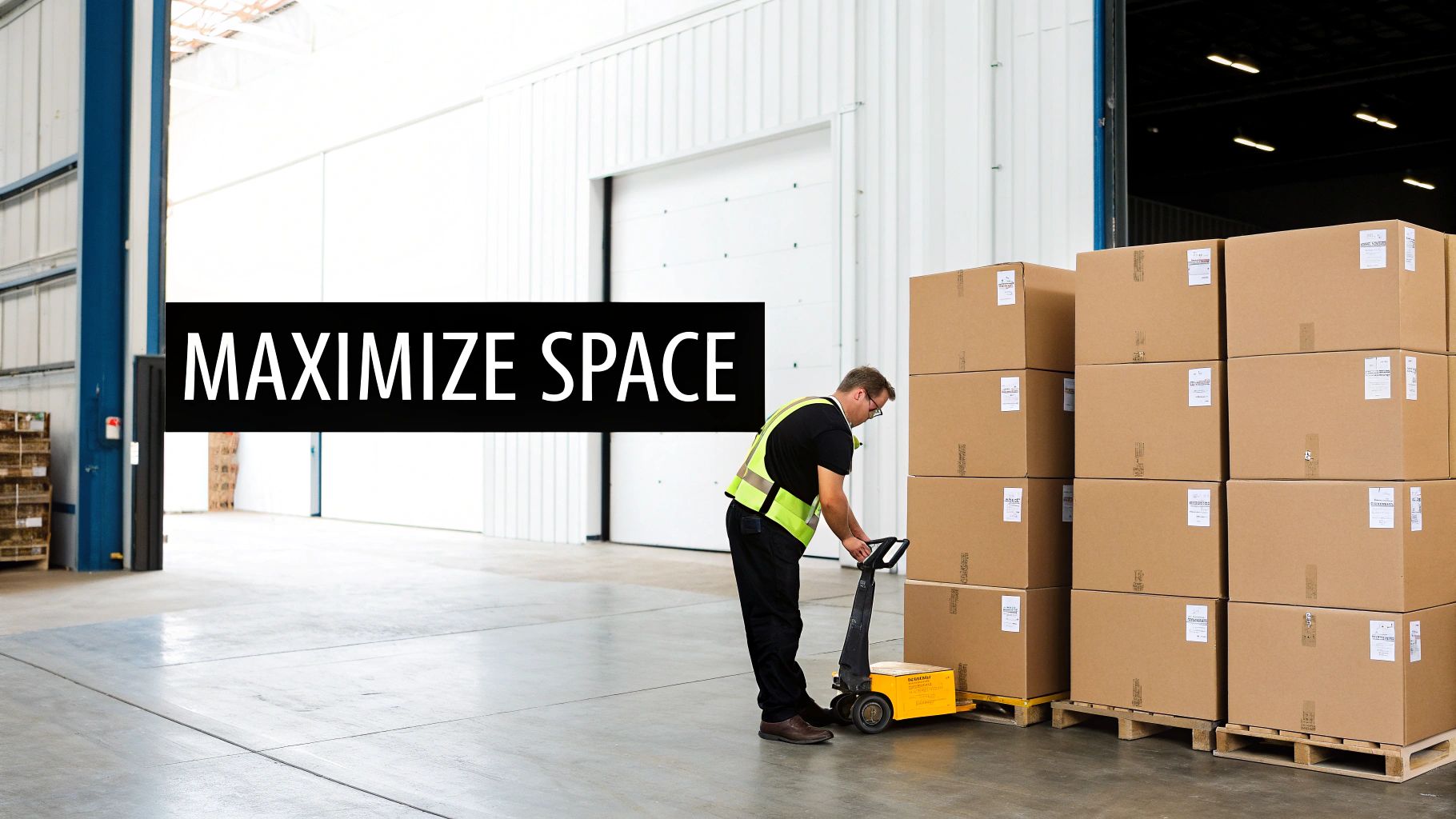
Knowing the official CBM of a 40-foot container is just the start. Actually packing it to capacity is a completely different challenge. To get the most out of every cubic metre, you need to think like a puzzle master, making sure every inch is working for you.
This goes beyond simple maths. It’s about adopting smart, practical loading strategies. One of the simplest yet most effective moves is to standardise your carton sizes. When all your boxes are uniform, they stack together perfectly, leaving minimal wasted air. This alone can dramatically increase how much you can fit inside.
Palletising vs Floor Loading
One of the biggest decisions you'll make is whether to load your goods on pallets or stack them directly on the container floor. Each approach has a huge impact on your final usable CBM.
- Floor Loading: This is exactly what it sounds like—hand-stacking cartons from floor to ceiling. You can pack the container incredibly tightly this way, often increasing your usable volume by up to 15%. The downside? It's much more labour-intensive at both ends of the journey.
- Palletising: Loading cargo on pallets is significantly faster. Forklifts do all the heavy lifting, which saves time and manpower. The trade-off, however, is lost space. The pallets themselves take up valuable floor area and vertical height, reducing the total CBM available for your products.
So, which is right for you? It really comes down to balancing labour costs, warehouse equipment, and what your customer is set up to handle on their end.
Pro Tip: If you're floor-loading, create a strong, stable stack by turning each layer of cartons 90 degrees, just like a bricklayer. This interlocking pattern prevents the stacks from tipping over and shifting around at sea.
Smart Cargo Arrangement
Finally, how you arrange the cargo is crucial for both safety and space efficiency. The golden rule is to always place the heaviest items on the bottom and spread the weight evenly across the floor. This keeps the container balanced and stable.
Lighter, more delicate goods should go on top and towards the centre. Use dunnage—materials like inflatable airbags or wooden braces—to fill any remaining gaps and secure the entire load. It might seem like a small detail, but preventing cargo from shifting not only protects your products but also ensures you're using every bit of space you paid for.
Your CBM Questions Answered
Even with the best planning, a few questions always pop up when you're getting ready to ship. Let's tackle some of the most common ones about container CBM so you can finalise your logistics with confidence.
What’s the Real CBM of a 40 ft Container?
On paper, a standard 40 ft container has an internal volume of about 67 CBM, while a 40 ft high-cube offers around 76 CBM. But here's the crucial part: you'll never actually use all of that space.
Think of it like packing a suitcase. There are always small gaps and awkward spaces you can't fill. The same goes for a container. Between pallets, protective dunnage, and the simple reality of fitting square boxes into a rectangular space, the usable CBM is always lower. A realistic estimate to work with is closer to 58-68 CBM.
How Many Pallets Fit in a 40 ft Container?
This really depends on the size of your pallets. If you're using standard Euro pallets (1.2m x 0.8m), you can typically load 24 to 25 pallets on the floor. For the slightly larger standard US pallets (48” x 40”), that number drops to around 20 to 21 pallets.
Of course, you can often stack them, provided your cargo is stable and you don't exceed the container's height and weight limits.
Should I Ship FCL or LCL?
This is a classic logistics dilemma, and the answer almost always comes down to your shipment's total volume.
- Full Container Load (FCL): If your goods take up more than about 15 CBM, booking your own container (FCL) usually makes the most sense financially. You pay for the whole box, but it's exclusively yours. This also means a faster journey, as your container goes straight to its destination without waiting for others.
- Less than Container Load (LCL): For smaller shipments (under 15 CBM), LCL is a great way to save money. You share container space with other shippers and only pay for the volume your cargo occupies. The trade-off is a slightly longer transit time due to the consolidation and deconsolidation process at both ends.
A simple rule of thumb: If your shipment is going to fill more than 60% of a container's usable space, it's almost always cheaper to book it as FCL.