A container loading calculator works like a digital chessboard for your cargo. It plots exactly how many pallets, crates or loose items you can fit into a standard 20ft or 40ft container, all while respecting weight limits.
By replacing guesswork with precise layouts, it squeezes every cubic metre of space and keeps weight distribution fully compliant.
Why Use A Container Loading Calculator
Accurate space modelling can shave significant costs off your freight bill. It spots hidden pockets of cubic room and cuts out costly re-handles.
Logistics teams rely on these tools to sketch pallet arrangements, verify weight limits and dodge last-minute delays.
- Minimises Idle Space to improve load efficiency
- Prevents Overweight Penalties with exact weight checks
- Reduces Labour Costs by removing trial-and-error packing
- Integrates Seamlessly with existing planning workflows
Before we dive deeper, take a quick look at the key benefits of adding this tool to your toolkit:
Key Benefits of Container Loading Calculator
| Benefit | Description |
|---|---|
| Space Optimisation | Maximises use of container volume |
| Weight Compliance | Keeps loads within legal weight limits |
| Time Savings | Cuts planning time with instant layouts |
| Cost Control | Avoids surcharges and re-handles |
This table highlights how a container loading calculator can boost your space utilisation, tighten cost control and speed up your planning cycle.
- Initial space planning before booking
- Pre-shipment checks on volume and weight
- Automated layout uploads to the Upfreights platform
- Real-time adjustments for on-the-fly loading changes
Key Takeaway
Precise loading plans can cut freight costs by up to 15% and slash loading time by 30%.
With clear layouts and weight checks in hand, logistics managers eliminate surprises and avoid extra fees. Next, we’ll explore the core concepts behind these calculators to set you up for flawless input, detailed output and smarter shipment planning.
Understanding Key Concepts
Imagine loading a container as a real-world 3D puzzle. On paper, you might fill every cubic inch, yet odd-shaped goods still leave sneaky pockets of air.
Weight matters just as much. Stack heavy pallets only at one end and you’ll shift the centre of gravity, risking axle overload and safety violations.
Balancing items from floor to ceiling on all axes is the only way to stay compliant and keep every wheel on the road.
Key Core Concepts
- Container vs cargo volume: fitting shapes like Tetris blocks
- Weight distribution: safety checks and legal limits
- Pallet layouts: boosting density and closing voids
- Container types: 20-foot, 40-foot and high-cube
Pallet Patterns And Stacking Density
Choosing the right pallet pattern turns a loose fit into a snug package. By interlocking 800×1200 mm and 1000×1200 mm pallets, you fill side gaps and squeeze out wasted space.
You’ll also notice fewer shifts in transit, which means less chance of damage when your consignment arrives.
Key Benefits Of Smart Stacking
- Greater space utilisation shrinks per-unit freight costs
- Even loads help you avoid penalties for overweight tyres
- Quicker handling reduces wear and tear on your cargo
Safe weight and volume planning protect your cargo and vehicles
How Calculators Model Space
A container loading calculator takes your cargo dimensions, max payload and container specs, then runs thousands of stacking scenarios in seconds. It flags empty pockets and suggests rotations so you can pack smarter from day one.
This virtual trial run slashes dockside delays and nearly eliminates costly re-handles.
Understanding FCL And LCL
Full Container Load (FCL) means you get exclusive rights to every inch of space. It’s ideal when you need predictable pricing and full control over loading.
Less-Than-Container Load (LCL) splits space among multiple shippers. In 2024, China led the Asia Pacific LCL market with a 32% share, generating USD 7.1 billion in revenue. Read the full research on Asia Pacific LCL Market on GM Insights
Accurate inputs—package measurements, tare weights and internal container dimensions—are the backbone of these calculations. Check out our guide on calculating CBM for step-by-step measurement tips (How to Calculate CBM).
These fundamental ideas will help you plan secure, cost-effective shipments every time. Next, we’ll dive into practical examples that put these insights to work.
Essential Inputs And Calculations
Gathering precise container and cargo metrics sets the stage for an effective loading plan. Accurate package dimensions and tare weights keep your simulation grounded in reality.
We’ll highlight best practices for measuring crates and pallets while factoring in overhang and dunnage.
Measuring Crates And Pallets
Measure the length, width and height of each crate or pallet to the nearest centimetre. Track the tare weight and the item weight separately. Note the quantity and any stacking limits to avoid unwelcome surprises.
Key measurements include:
- Outer Dimensions with protective packaging in place
- Dunnage Thickness and required clearance
- Pallet Deck Height and gap allowances
Accounting for these details ensures your calculator mirrors real-world volume.
Comparison Of Container Sizes And Capacities
Before crunching the numbers, you need to know your options. Here’s a quick overview of the most common container specs:
| Container Type | External Dimensions | Internal Volume | Max Payload |
|---|---|---|---|
| 20ft | 6.058 m × 2.438 m × 2.591 m | 33.2 m³ | 28,000 kg |
| 40ft | 12.192 m × 2.438 m × 2.591 m | 67.7 m³ | 26,500 kg |
| 40ft High Cube | 12.192 m × 2.438 m × 2.896 m | 76.4 m³ | 26,200 kg |
This quick reference helps you match your cargo to the right container size. Whether volume or payload is your priority, the table makes the choice clear.
Calculating Volume And Payload
Once your measurements are in place, multiply length × width × height for each item, then add them all up to get total cubic metres. Next, compare that volume-based space against the container’s weight limit to see which constraint binds first.
China’s container shipping rates underline why precision pays off. An FCL from Shanghai to the USA East Coast runs about US$3,899.65 per container. A misloaded box can tack on 10–15% in surcharges. Models that let you test 20ft and 40ft loads up to 30 tons save both time and money.
For more cost insights, visit Freightos.
Accurate weight distribution is just as vital. Your software should flag potential axle overloads and suggest cargo shifts to meet regulations.
Optimising Pallet Layouts
Think of pallets as a jigsaw puzzle. The right pattern locks pieces together and shrinks empty gaps.
Field-tested layouts include:
- Stagger adjacent pallets by half their width for smoother transitions
- Rotate every second row by 90° to fill cross-gaps
- Combine different pallet sizes in a systematic grid
“Precision in pallet planning can cut wasted space by up to 12%,” notes a logistics expert.
These strategies can drive utilisation above 90%. For help translating volume into shipment weight, see our guide on converting 1 CBM to KG conversion.
Next, let’s walk through a real-world example to see how dimensions, weights and container types come together in a high-impact plan.
Step By Step Example Calculation
Shipping an LD7.5t overhead crane from Shanghai to Egypt takes more than just booking space—it demands careful measuring, accurate weight tracking and the right container choice. In our walkthrough, we’ll capture every dimension, check crate details and work through the maths to squeeze out maximum space efficiency.
We’re dealing with a crane that spans 4.5 m, stands 5 m tall (tail swing included) and tips the scales at 7.5 tonnes. Follow along as we calculate volume, balance the load and map out the pallet layout.
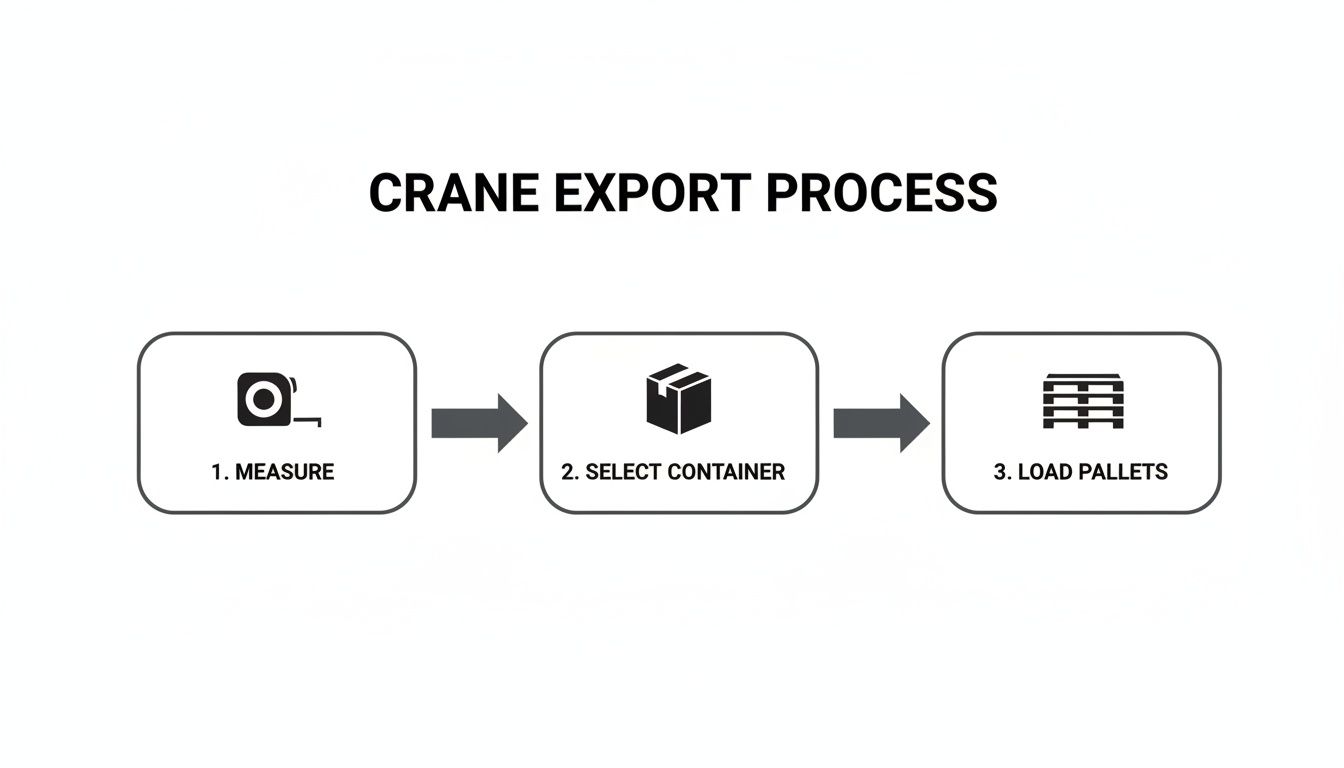
Accurate loading saves costs.
This diagram illustrates the three core steps of our container loading calculator: measuring, selecting and loading. By the end, you’ll see how each stage pushes utilisation up to 85–90%.
Before we dive into formulas, take a moment to verify container dimensions and clearances in our 40-ft Container Dimensions in Feet Guide.
Measurement And Data Recording
We begin by recording every critical number:
- Crane Span: 4.5 m
- Crane Height: 5 m (including tail swing)
- Crate Dimensions: 2.8 m × 1.6 m × 1.8 m
- Crate Tare Weight: 450 kg
- Payload Weight: 7 500 kg
These figures feed straight into our calculator to model total volume and ensure we stay within weight limits.
Volume And Weight Distribution
Next up, the calculations:
- Multiply length × width × height for each crate to get individual volumes.
- Add them together for total cargo volume.
- Compare against the container’s internal capacity (e.g. 67.7 m³ for a standard 40-ft).
- Check overall cargo weight against the maximum payload (26 500 kg).
- Tweak the layout to balance axle loads and prevent any overweight zones.
For our crate: 2.8 m × 1.6 m × 1.8 m equals 8.06 m³ of space.
Optimization Tips for FCL Palletised Loads
- Rotate alternate pallets by 90° to fill irregular gaps.
- Fit corner protectors on stacked crates to lock everything in place.
- Centre heavy components to keep the container balanced.
By following this step-by-step approach, importers can lock in accurate plans with Upfreights, dodge last-minute adjustments and slash detention fees. Precision in every measurement really does pay off when you partner with a reliable forwarder.
Advanced Optimisation Strategies
Once you’ve got the basics locked down, a handful of smart tweaks can push your space utilisation above 90%. These approaches take your container loading calculator beyond simple estimates, fine-tuning full container loads (FCL), less than container loads (LCL) and pallet layouts in step with seasonal rhythms.
Key Moves:
- Combine FCL and LCL runs to cut wasted space and costs
- Interlock pallet columns to eliminate voids
- Schedule shipments around seasonal demand spikes
- Feed calculator outputs directly into Upfreights for seamless planning
Pallet Arrangement For Maximum Density
Think of pallets like books on a shelf. When each “book” fits snugly against its neighbour, there’s no empty space left to waste.
Expert Insight“Interlocking mixed pallet sizes can increase space efficiency by 5–7%,” says a logistics lead at Upfreights.
Key pallet tactics include:
- Rotate every second pallet by 90° to fill cross-gaps
- Add corner protectors to stabilise uneven stacks
- Centre heavier pallets to balance weight distribution
Dynamic Scheduling Techniques
Packing is crucial, but timing can be just as impactful. By testing different departure dates in your calculator, you can match shipments to peak windows—whether it’s the July rush or the Lunar New Year surge.
| Scenario | Benefit |
|---|---|
| Advance Booking | Locks in favourable rates early |
| Flexible Windows | Absorbs last-minute volume shifts |
| Multi-Port Options | Reduces port congestion delays |
Running these “what-if” scenarios helps you sidestep detention fees and keep goods moving on time.
Integration With Upfreights Dashboard
Linking your calculator to the Upfreights dashboard turns planning and booking into a single workflow. Export your CBM and weight metrics as CSV or push them via API.
- Upload metrics in one click
- Book containers at pre-negotiated rates
- Track transit milestones in real time
This integration slashes manual entry errors and keeps everyone—from shippers to carriers—on the same page.
Cost Impact And Key Metrics
Keeping an eye on per-unit freight cost tells the real story. By layering these advanced tactics, you can shrink your shipping spend by up to 12%.
- Reduce detention fees by 3% through precise container planning
- Lower per-cubic-metre cost by 5–8% with mixed FCL/LCL runs
- Improve loading time by 25% using pre-tested layouts
- Boost cubic-metre efficiency by 4% with cross-stack patterns
When space becomes profit, every optimisation—from pallet layouts to dynamic schedules—adds up. Integrating your container loading calculator with Upfreights closes the loop, taking you from simulation all the way to delivery.
Common Mistakes To Avoid
Even the most experienced planners can hit a wall when they skip a few vital checks. Avoid these four traps to keep your shipment on track and within budget.
Mistake 1: Underestimating Weight Distribution
Focusing only on volume is like loading one side of a seesaw – it throws everything out of balance. A lopsided load shifts the centre of gravity, risks damage and may incur hefty penalties.
To prevent that, run a quick weight-balance simulation across each bay before you book space.
Mistake 2: Misreading Container Specs
Imagine buying new furniture without measuring the doorframe. Ignoring a container’s actual interior size, door opening or floor capacity can wreck your loading plan at the last minute.
Always double-check the spec sheet or measure the space in person:
- Verify internal length, width and height
- Note floor strength and weight limits
- Check door sill height and width
Mistake 3: Overloading Axles
Clustering heavy pallets at one end is an invitation for axle-weight fines. In fact, careful checks during the planning phase can save up to $500 per container.
“Running axle-load checks early prevented several of our clients from costly penalties,” recalls a senior logistics advisor.
Use your calculator’s axle-load feature to flag overloads and tweak placement before loading.
Mistake 4: Ignoring Height Clearance
Tall pallets or irregular crates might scrape the roof or block ventilation ports. That not only damages goods but also disrupts airflow.
Measure total height, including dunnage and required ventilation gaps, before finalising your layout.
Checklist For Safe Packing
- Confirm weight balance on all axes
- Align cargo height with container clearances
- Factor in dunnage and ventilation spaces
- Review container specs twice
Once these checks are done, export your layout and weight summary to Upfreights. Then upload it in the dashboard to compare carriers, book your container and get real-time tracking. That way, you close the loop on your plan without surprises.
FAQ
Planning a container load can feel like piecing together a complex puzzle. This FAQ cuts through the guesswork, offering practical tips to help you pack smarter and ship faster.
What Inputs Are Essential For Accurate Calculations
Accurate packing starts with precise measurements. You’ll need:
- Package Dimensions: length, width and height in centimetres
- Pallet Size: deck area and maximum load capacity
- Tare Weight: weight of an empty container or crate
- Container Specifications: internal volume, door aperture and maximum payload
- Clearance & Dunnage: required gaps for ventilation or padding
“Once we fine-tuned every dimension, our tool’s accuracy jumped by 20%,” recalls a senior logistics manager.
How Calculators Handle Mixed Pallet Sizes
Imagine fitting different shaped tiles into a mosaic. The software tackles this in three steps:
- It maps out each pallet’s footprint and quantity.
- It experiments with rotation and placement patterns.
- It chooses the arrangement that leaves the fewest gaps.
In practice, this method dramatically reduces wasted space between loads.
Can I Optimise FCL And LCL Loads Together
Yes—you can blend full-container (FCL) and less-than-container (LCL) loads for maximum efficiency. To do so:
- Run joint FCL/LCL simulations in your container loading calculator
- Compare cost per cubic metre to steer clear of LCL surcharges
- Adjust load ratios until you reach roughly 95% fill without triggering fees
Pro Tip Pair FCL for bulkier goods with LCL for smaller batches. This strategy keeps costs down and flexibility high.
How To Integrate Results With Upfreights
After finalising your layout, export it as a CSV or use the API. Then:
- Log in to your Upfreights Dashboard
- Upload under Shipments and compare carrier rates
- Confirm bookings and track milestones in real time
By syncing data, you eliminate manual entry and shave hours off your planning process.
Before you wrap up, remember to:
- Double-check every metric before finalising
- Scan outputs for hidden voids or overloads
- Sync updates instantly to prevent mismatches