Think of a cargo forwarding service as the ultimate travel agent for your products. When you're shipping goods from one country to another, you don't have to piece together the journey yourself. A forwarder steps in to manage everything, from the factory floor to the customer's doorstep, making sure the entire process is smooth, efficient, and affordable.
Decoding the Role of a Cargo Forwarder
Imagine you need to get your products from a supplier in Shanghai to a warehouse in London. You'd have to find a local truck in China, book space on a massive container ship, navigate the maze of customs paperwork on both ends, and then arrange for another truck to handle the final delivery. It’s a logistical headache, and one small mistake can lead to costly delays.
This is exactly the problem cargo forwarding solves. A forwarder is your logistics expert. They don't own the ships or planes, but they have deep industry connections and know-how to orchestrate the entire move. They're the coordinators who bring all the separate pieces of the shipping puzzle together for you.
The Travel Agent Analogy
The travel agent comparison really hits the mark. If you were planning a complex trip with multiple flights, transfers, and hotels, you wouldn't call each company one by one. You'd go to a travel agent who bundles it all into a single, seamless itinerary.
A cargo forwarder does the same for your shipment. You give them the details, and they handle the rest—finding the best routes, negotiating rates with carriers, and making sure all the i's are dotted and t's are crossed on the paperwork. It simplifies everything down to a single point of contact.
Key Takeaway: The real value of a cargo forwarding service is simplification. It takes the tangled, stressful process of international shipping and turns it into one managed service, saving you a massive amount of time, money, and hassle.
What Does a Forwarder Actually Do?
A forwarder's job is much more than just booking a spot on a ship. They provide a whole suite of services that are crucial for getting international shipping right.
Here's a quick look at the core tasks a cargo forwarder manages to keep your supply chain moving.
| Function | Description |
|---|---|
| Transport Negotiation | Forwarders ship huge volumes, which gives them the leverage to get much better freight rates from airlines and shipping lines than a single business could. |
| Documentation Management | They're experts at handling all the critical paperwork—like the Bill of Lading, commercial invoices, and packing lists—to avoid hold-ups. |
| Customs Clearance | With licensed customs brokers on their team or in their network, they guide your shipment through complex regulations and inspections without a hitch. |
| Cargo Consolidation | If you don't have enough to fill a whole container (LCL), they'll group your goods with others, so you only pay for the space you use. |
In short, a forwarder brings together all these essential functions under one roof, creating a reliable and predictable shipping experience from start to finish.
A Step-by-Step Look at the Complete Cargo Forwarding Process
To really grasp what a cargo forwarder does, it helps to follow a shipment from the factory floor all the way to the final delivery address. It's a surprisingly complex dance of logistics, paperwork, and coordination, all managed by your forwarding partner to make sure everything goes off without a hitch.
Let's break down this journey step by step.
The diagram below gives you a bird's-eye view of the entire workflow. It boils the process down to three core stages: the initial negotiation, sorting out the documents, and the actual physical logistics.
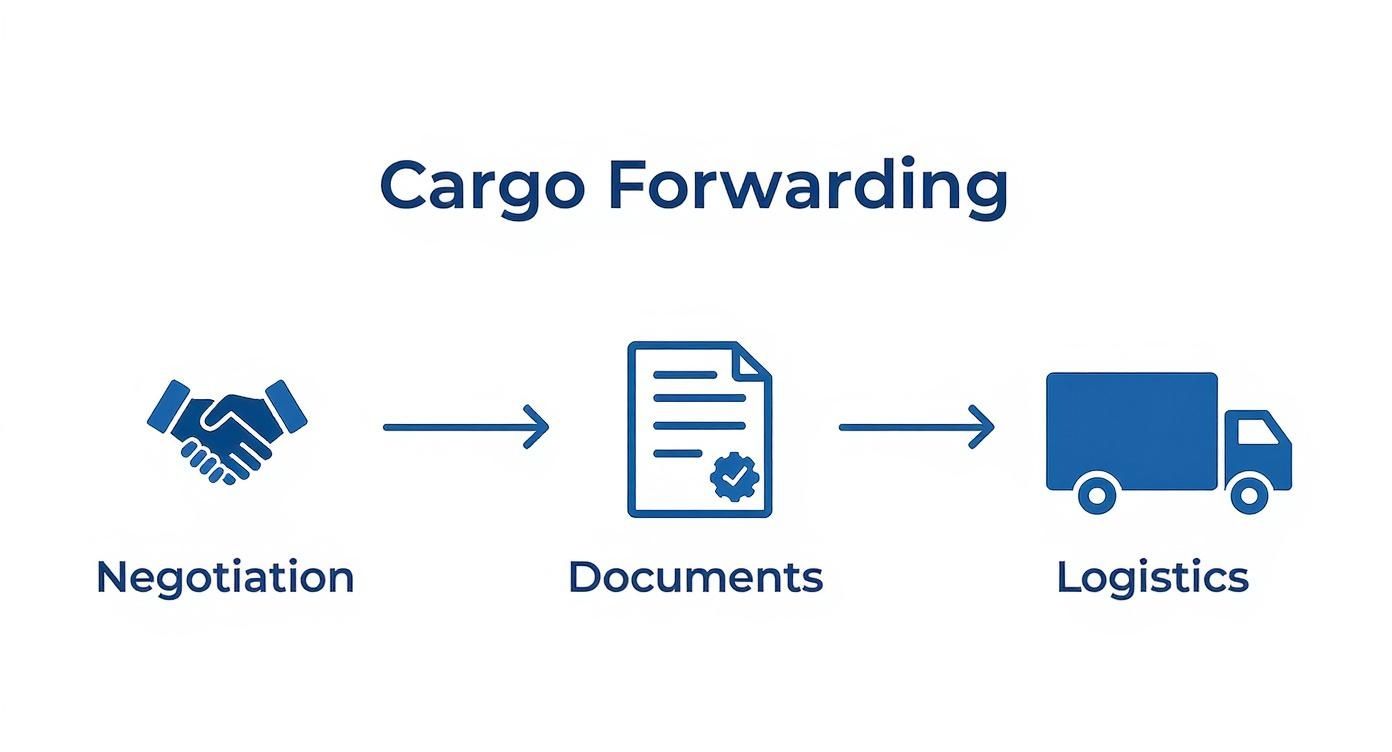
As you can see, a successful shipment isn't just about moving boxes from A to B. It’s built on a foundation of solid commercial agreements and watertight regulatory compliance before anything even leaves the warehouse.
Step 1: Initial Quote and Booking
It all starts when you reach out for a quote. You'll need to give your forwarder the essential details: where the cargo is coming from and where it's going, its weight and dimensions, and what kind of goods are inside. With that info, they’ll come back to you with different shipping options—air or sea, FCL or LCL—along with a detailed breakdown of the costs.
Once you give them the green light and book the shipment, the forwarder kicks into high gear. They immediately secure space on a plane or ship with the carrier and start lining up all the other logistical dominoes. This first step is absolutely critical because it locks in your spot and sets the schedule for the entire operation.
Step 2: Cargo Pickup and Consolidation
Next up is the first-mile journey. Your forwarder will arrange for a truck to collect the cargo right from your supplier's factory or warehouse. This is the first official handover, where the responsibility for your goods shifts to your logistics partner.
From there, your cargo is taken to the forwarder's local warehouse or a consolidation centre. If you're shipping Less than Container Load (LCL), this is where the magic happens. Your boxes are carefully grouped with shipments from other customers heading to the same destination. This consolidation is what makes it affordable to ship smaller quantities of goods internationally.
Expert Insight: At the consolidation warehouse, your cargo gets a thorough check-up. It's inspected, re-weighed, and re-measured. This double-check makes sure the details you provided are accurate, which is crucial for avoiding surprise fees or customs headaches down the line.
Step 3: Export Documentation and Customs
Now we get to what is often the trickiest part of the whole process: the paperwork. Your forwarder takes the lead on preparing and checking all the necessary export documents, like the commercial invoice, packing list, and the Bill of Lading (for sea) or Air Waybill (for air). There is zero room for error here; even a tiny mistake can cause major delays.
At the same time, they handle the export customs clearance in the country of origin. This means filing all the right forms with the local authorities to get official permission for your goods to leave the country. A good forwarder knows exactly what's needed to get your cargo on its way without any snags.
If you're new to international shipping, the paperwork can feel overwhelming. To get a better handle on it, check out our complete guide to the customs clearance process.
Step 4: The Main Transit Leg
With the paperwork sorted and customs cleared, your cargo is finally loaded onto the vessel or aircraft for the main part of its journey. This is typically the longest phase, especially for sea freight, which can take weeks depending on the route.
Throughout this transit time, a reliable forwarder will give you tracking information and regular status updates. This visibility is key, as it lets you keep an eye on your shipment's progress and plan for its arrival, making it much easier to manage your inventory and operations.
Step 5: Arrival and Final-Mile Delivery
When the shipment reaches the destination port or airport, the whole process plays out again, but in reverse. Your forwarder’s local agent takes over, managing import customs clearance. They'll submit all the required declarations and handle the payment of any duties and taxes on your behalf.
Once customs gives the all-clear, the cargo is moved to a local warehouse. If it was part of an LCL shipment, this is where it gets "deconsolidated," or separated from the other goods.
Finally, your forwarder arranges the final-mile delivery. They'll dispatch a truck to take your goods from the warehouse straight to your chosen endpoint, whether that's your own facility, a third-party distribution centre, or an Amazon FBA warehouse. And with that, the end-to-end journey is complete.
Choosing the Right Forwarding Service for Your Cargo
Picking the right cargo forwarding service isn't just a logistical detail; it's a strategic business decision. Think of it like this: you wouldn't send a fragile antique through the standard mail, and you wouldn't charter a private jet for a pallet of bricks. Every shipment has its own unique mix of urgency, budget, and handling needs.
Get it wrong, and you could be looking at blown budgets or missed deadlines that send ripples through your entire supply chain. But when you understand your options and how to match them to your needs, you build a logistics strategy that’s both efficient and a real competitive edge. It’s all about making the service fit the cargo, not the other way around.
Let's break down the main options you'll encounter.
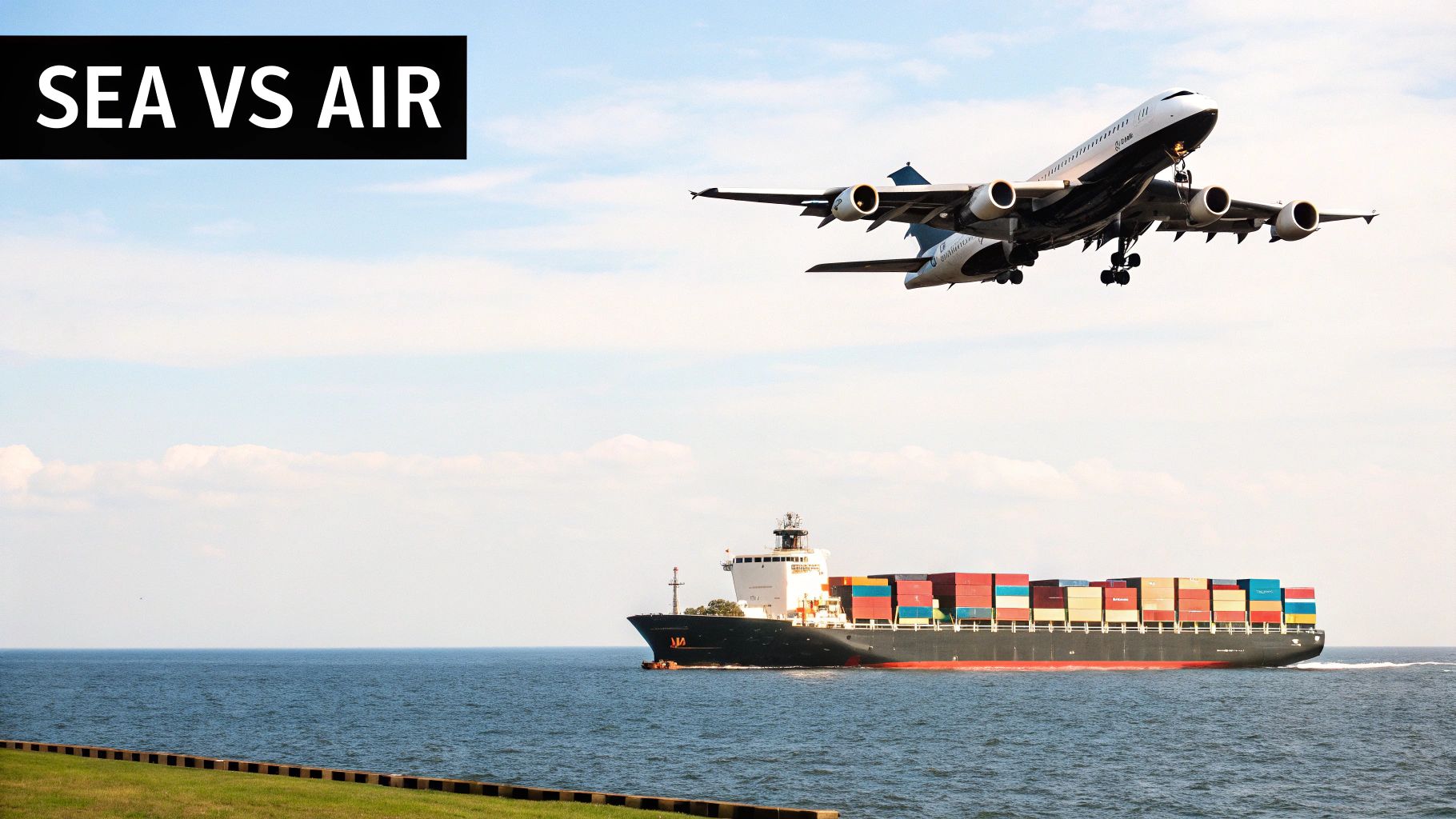
The Great Debate: Air Freight vs. Sea Freight
At the highest level, your first choice is almost always between air and sea. This is the classic trade-off: speed versus cost.
Air freight is your express option. It’s the fastest way to get goods from one continent to another, with transit times often counted in days, not weeks. This speed makes it the go-to for:
- High-value goods, like electronics or luxury items, where the shipping cost is just a small slice of the product's total worth.
- Time-sensitive cargo, such as seasonal fashion, urgent replacement parts, or perishables that have to hit the market fast.
- Smaller, lighter shipments where the cost gap between air and sea isn't quite so dramatic.
On the flip side, sea freight is the undisputed workhorse of global trade. It’s dramatically cheaper than air, especially for anything large, heavy, or bulky. The trade-off is time, but for businesses that can plan their inventory in advance, its cost-efficiency is impossible to beat.
Rule of Thumb: If speed is everything and the budget can handle it, choose air. If cost is your main concern and you have a few weeks of flexibility, sea freight is almost always the smarter financial move.
Decoding Ocean Shipping: FCL vs. LCL
If you decide sea freight is the way to go, you’ve got another key decision to make: do you need a Full Container Load (FCL) or is Less than Container Load (LCL) a better fit?
A Full Container Load (FCL) means you’re booking an entire container—usually a 20-foot or 40-foot unit—all for yourself. This is your best bet if you have enough goods to fill most of it. FCL is also typically faster than LCL because your container is sealed at the factory and isn't opened again until it reaches its final destination, which means less handling and fewer delays.
Less than Container Load (LCL), however, is a game-changer for smaller shipments. With LCL, your cargo shares space in a container with goods from other shippers. You only pay for the space you actually use, whether by volume or weight, making it an incredibly cost-effective option for small and medium-sized businesses. If this sounds like it fits your needs, you can dive deeper with our guide on Less than Container Load shipping.
Specialised Cargo Forwarding Services
Beyond the standard choices, the logistics world is full of specialised services for specific types of cargo. Two of the most common you’ll see are door-to-door and temperature-controlled shipping.
Door-to-door delivery is the "set it and forget it" option. Your forwarder handles absolutely everything from pickup at the supplier’s warehouse to the final drop-off at your location. This seamless service bundles trucking, customs clearance at both ends, and the main freight journey into one simple package.
Temperature-controlled shipping is non-negotiable for sensitive products like pharmaceuticals, fresh food, and certain chemicals. Using refrigerated containers (known as 'reefers'), this service ensures a stable temperature from start to finish, protecting the integrity and value of your goods.
This kind of specialisation is a sign of a mature logistics market, especially in China. The cargo forwarding industry here has seen steady growth, fuelled by the country's huge manufacturing and export base. Industry revenue has grown at a compound annual rate of 5.7% over the past five years and is expected to hit $40.9 billion by 2025. With 64% of all outbound cargo originating from China’s eastern provinces, partnering with a forwarder who has a strong network there is absolutely critical. You can discover more about China's freight industry growth on ibisworld.com.
How to Select a Reliable Cargo Forwarder

Choosing a cargo forwarder is one of the most important decisions you'll make for your supply chain. This isn't just about finding a company to move boxes; it's about picking a strategic partner whose performance directly impacts your bottom line, customer satisfaction, and ability to weather disruptions.
A great partner feels like an extension of your own team. The wrong one? That path leads to costly delays, damaged goods, and a cascade of logistical headaches you just don't need.
Making the right call means looking beyond the first price quote. A truly reliable forwarder brings a powerful combination of network strength, real-world industry experience, modern technology, and—most importantly—clear, honest communication. They don't just execute shipments; they anticipate problems before they can derail your business.
Evaluating Network and Specialisation
First things first: assess a forwarder’s operational footprint and what they're actually good at. Do they have a strong presence in the markets you care about? A forwarder with deep-rooted networks in both your origin and destination countries will have better relationships with local carriers, customs officials, and warehouses. That local know-how is crucial for a smooth journey.
Just as important is their experience with your specific type of product. Shipping sensitive electronics is a world away from moving perishable food or heavy machinery. A forwarder who already understands the unique handling, paperwork, and compliance rules for your goods is far less likely to make a critical mistake.
Expert Insight: Don't just ask if they ship to your destination. Dig deeper. Ask about their local agent relationships, their experience with the specific ports you'll be using, and how they handle common challenges in that region. A detailed answer tells you they've been there and done that.
Take China’s freight market, for instance. It's incredibly fragmented, with a mix of huge global players and countless smaller operators. While the top three express firms—ZTO, SF, and YTO—handle about 55% of the express delivery volume, the wider forwarding landscape is far more diverse. This makes it essential to carefully evaluate a potential partner's scale and network to ensure they are the right fit for your needs. You can explore a detailed analysis of the Chinese logistics market on mordorintelligence.com.
Technology and Transparency
In modern logistics, information is just as valuable as the physical movement of your goods. Any dependable cargo forwarding service must offer solid tech tools that give you a real-time window into your shipments.
Here are the key technological capabilities to look for:
- A user-friendly online portal for booking, managing documents, and tracking.
- Real-time GPS tracking that lets you see your cargo’s exact location at any time.
- Automated milestone notifications via email or text for key events like customs clearance or port arrival.
- Data analytics and reporting to help you analyse transit times, costs, and overall performance.
This level of transparency gives you the power to manage your inventory more effectively, anticipate potential delays, and keep your own customers in the loop. It transforms your forwarder from a simple service provider into a proactive information partner.
Creating Your Cargo Forwarder Evaluation Checklist
Once you've narrowed it down to a few potential forwarders, it's time to dig deeper with some pointed questions. Putting in the work to properly vet them now will save you a world of trouble later on. A simple checklist can help you compare your options apples-to-apples.
Here is a practical checklist to help you compare and select the best partner for your business.
| Evaluation Criteria | What to Look For |
|---|---|
| Licensing & Insurance | Are they fully licensed (e.g., FMC, IATA)? Can they provide proof of cargo insurance? |
| Network & Specialisation | Do they have strong agent networks in your key markets? Do they have proven experience with your specific product type? |
| Communication | Will you have a dedicated point of contact? What are their standard response times? How are urgent issues handled? |
| Technology | Do they offer a modern online portal? Is real-time tracking available? Are there automated alerts and reporting tools? |
| Contingency Planning | What's their process for delays, customs inspections, or cargo damage? Do they have backup plans? |
| Quote Transparency | Is the quote all-inclusive? Does it clearly break down all potential fees (fuel, terminal handling, duties)? |
By carefully asking these questions and evaluating their answers, you can confidently choose a forwarder who truly aligns with your business goals. For more insights, our guide on choosing between freight forwarding services companies can offer additional valuable perspectives.
Common Cargo Forwarding Mistakes and How to Avoid Them
Even the most carefully planned shipment can hit a snag. In international logistics, a tiny oversight can easily spiral into customs delays, surprise fees, and a headache for your entire supply chain. Knowing where things typically go wrong is the first step to making sure they go right.
The key to smooth cargo forwarding services isn't just reacting to problems—it's getting ahead of them. By understanding the common hurdles, you can build a shipping strategy that keeps your goods moving on time and on budget. Let's break down the most frequent mistakes and, more importantly, how to sidestep them completely.
Overlooking Documentation Details
If there's one thing that trips up shippers more than anything else, it's paperwork. A simple typo on a commercial invoice, the wrong HS code, or a missing certificate of origin is often all it takes for customs to pull your cargo aside for a long inspection. That's when the clock starts ticking on expensive demurrage and detention fees.
The fix? A rock-solid pre-shipment check.
- Double-check everything: Before your goods even leave the warehouse, go over the commercial invoice, packing list, and bill of lading with a fine-tooth comb.
- Verify HS codes: Make sure your product classification codes are correct for both the country you're exporting from and the one you're importing to. They can differ.
- Confirm all requirements: Your forwarder should be your partner here. Work with them to confirm you have every single permit or certificate needed for your specific cargo and destination.
A little diligence here turns a potential bottleneck into a green lane through customs.
Falling for Incomplete Quotes
That unbelievably low shipping quote? It's often too good to be true. Many quotes conveniently leave out a whole host of charges that only show up on the final bill. Things like fuel surcharges, terminal handling fees, port congestion fees, and documentation costs can blow your budget out of the water.
The best defence is to demand total transparency from the get-go. A trustworthy forwarder won't hesitate to provide an all-inclusive or "door-to-door" quote that breaks down every single potential cost, so there are no nasty surprises later.
Always press your forwarder for a detailed cost breakdown. If a line item looks vague, ask them to explain it. This upfront conversation is crucial for keeping your logistics spend predictable.
Neglecting Cargo Insurance
This is a big one. A lot of shippers assume that if something happens to their cargo, the carrier's liability will cover its full value. The hard truth is that carrier liability is severely limited by international law and might only pay out a tiny fraction of what your goods are actually worth—sometimes just a few dollars per kilogramme.
The solution is simple: always secure comprehensive cargo insurance. Your forwarder can easily arrange this for you. The premium is a small price to pay for the peace of mind that comes with knowing your investment is fully protected against loss or damage.
Ignoring Proper Packaging and Loading
Damage in transit can almost always be traced back to one of two things: poor packaging or improper loading. If goods aren't properly secured inside a container, they can shift, break, or even be crushed during a rough sea voyage or air turbulence.
To minimise risks and ensure that goods arrive safely, especially when handling palletized shipments, understanding the best practices for load security is crucial. For guidance on enhancing pallet safety and load containment, consider exploring a guide to stretch hood machines and pallet safety. By ensuring your cargo is properly packed and braced, you protect your investment and prevent costly losses.
Your Top Questions About Cargo Forwarding, Answered
Even when you've got the basics down, the world of cargo forwarding can feel like it has its own language. It’s packed with terms and situations that aren't always straightforward, and if you’re new to international shipping, you’re bound to have questions. Getting solid answers is the first step toward feeling confident and making smart moves for your business.
We get asked a lot of the same questions by businesses just starting out. So, think of this as your go-to guide for clearing up those common uncertainties and getting on with your shipping strategy.
Is a Freight Forwarder the Same as a Carrier?
This is easily one of the most common mix-ups, but the difference is pretty simple when you break it down.
A carrier is the company that actually owns the assets that move your goods—the ships, the planes, the trucks. Think of giants like Maersk, MSC, or CMA CGM. They own the vessels that sail the seas.
A freight forwarder, like us, is a logistics expert and organiser. We don't own the ships or aircraft. Instead, we act as the bridge between you (the shipper) and the many carriers out there. We book large amounts of space with these carriers, which lets us get better rates, and then we manage the entire shipment from start to finish on your behalf.
Here’s a simple analogy: A carrier is like an airline (say, British Airways). A freight forwarder is like a great travel agent (like Expedia). The travel agent doesn't own the planes, but they expertly piece together your entire trip—flights, hotels, transfers—into one seamless package. That's what we do for your cargo.
What's the Difference Between a Freight Forwarder and a Customs Broker?
While their paths definitely cross, a freight forwarder and a customs broker have very different core jobs.
A freight forwarder is in charge of the entire physical journey of your cargo. From the moment it leaves your factory to the moment it arrives at its final destination, we handle the logistics.
A customs broker, on the other hand, is a specialist focused on just one crucial part of that journey: getting your goods legally cleared through customs. They are experts in the complex web of import/export rules, tariff codes, and all the required paperwork. Their entire job is to ensure your shipment enters or leaves a country without any legal hiccups.
Many top-tier freight forwarders, including Upfreights, have in-house customs teams or dedicated partners. We bundle this service into our offering to make sure the whole process is as smooth as possible for you.
How Are Cargo Forwarding Fees Calculated?
There's no single, flat fee when it comes to forwarding. The price is built from a few key components that depend entirely on the specifics of your shipment. Once you know what they are, any quote you get will make a lot more sense.
Here’s what typically drives the cost:
- Mode of Transport: Air freight and sea freight have completely different pricing structures.
- Weight and Volume: You’ll be charged based on either the actual weight of your cargo or its volumetric weight (how much space it takes up)—whichever is greater. This is known in the industry as "chargeable weight."
- Distance and Route: The journey from origin to destination is a major factor. Busy, common shipping lanes are usually more cost-effective than less-travelled routes.
- Type of Goods: Shipping hazardous materials or goods that need special handling, like refrigeration, will naturally cost more.
- Surcharges: These can pop up for things like fuel price fluctuations, shipping during peak season, or port handling fees.
A trustworthy forwarder will always give you an itemised quote that breaks everything down clearly. No hidden fees, no surprises.
Do I Really Need Cargo Insurance?
In one word: absolutely. It’s probably the most critical part of shipping that people tend to overlook. Many shippers think the carrier's standard liability will cover them if something goes wrong, but that's a dangerous assumption.
International shipping laws limit a carrier's liability to a tiny amount, usually based on weight. That means if your container of high-value electronics falls overboard, the carrier's payout might only cover a fraction of what you’ve actually lost.
Don't skip this: Getting your own cargo insurance is non-negotiable. It’s the only real way to protect your investment from damage, theft, or total loss while it's in transit. The small cost of the premium is nothing compared to the peace of mind it buys you.
How Long Does International Shipping Take?
Transit times are all over the map and really depend on the mode of transport and the route you choose. It's important to have realistic expectations from the get-go.
For a shipment coming from China, here’s a rough idea of what to expect:
- Air Freight: The fastest way, by far. You can typically expect door-to-door delivery in 1 to 7 days.
- Sea Freight (FCL): A full container is usually faster than sharing one. Port-to-port transit can take 15 to 35 days, plus you'll need to add time for customs clearance and final delivery.
- Sea Freight (LCL): If you're sharing a container, expect it to take a bit longer. There’s extra time needed for consolidating goods at the origin and de-consolidating them at the destination.
At Upfreights, we maintain a 98.5% on-time delivery rate, so you can build your plans around reliable schedules. We give you full visibility with transparent tracking across our 270+ routes, meaning you’ll always know exactly where your cargo is and when it’s due to arrive.