So, you're ready to get your products from China to the US. The whole process can seem a bit daunting at first, but it really boils down to a classic trade-off: do you need it fast, or do you need it cheap? Your answer to that single question will guide your most important decisions.
For time-sensitive, high-value items, air freight is your express lane, getting your goods stateside in a matter of days. But for larger shipments where you can afford to wait, sea freight is the budget-friendly workhorse, saving you a significant amount of money in exchange for a few extra weeks of transit time.
Your Essential First Steps for Shipping from China
Navigating the journey from your Chinese supplier to your US warehouse feels complicated, but let's break it down into a few manageable steps. At its core, the process is straightforward: you get a quote, pick your shipping method, and then sort out the final delivery. Grasping this simple sequence gives you a clear roadmap right from the start.
This handy visual lays out the three basic stages of any shipment.
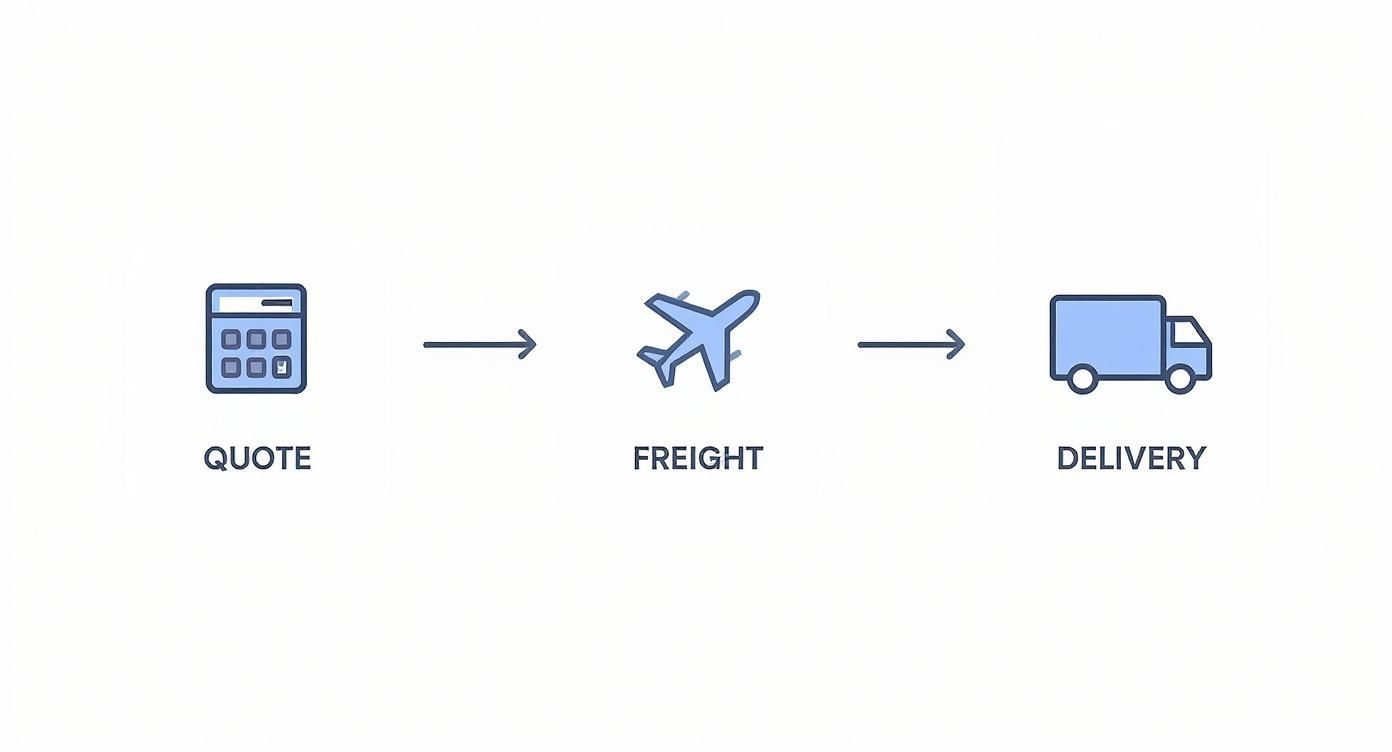
As you can see, everything kicks off with a quote. From there, your cargo moves by either plane or ship, and finally, it's transported to its ultimate destination. That middle step—choosing your freight method—is where you'll make your first critical decision, and it will set the tone for your entire timeline and budget.
Making Your First Big Decision: Air or Sea?
Your very first and most crucial choice is between air and sea freight. This isn't just a small detail; it impacts everything from your shipping costs to how you manage your inventory.
Think of it like this: are you mailing a small, urgent parcel or moving house? For the parcel, you'd use an express courier. For your furniture, you'd hire a moving truck. The same logic applies here. Air freight is the courier, and sea freight is the moving truck.
To make this crystal clear, here’s a quick side-by-side look at how they stack up.
Air Freight vs Sea Freight: A Quick Comparison
This table breaks down the two main shipping methods from China to the USA, helping you decide which is the right fit for your cargo.
| Factor | Air Freight | Sea Freight |
|---|---|---|
| Transit Time | Fast (typically 3-10 days) | Slow (typically 30-40 days) |
| Cost | High (priced by weight) | Low (priced by volume) |
| Best For | Urgent, high-value, lightweight goods | Bulky, heavy, low-urgency goods |
| Reliability | Very reliable schedules | Prone to weather/port delays |
| Capacity | Limited by aircraft size | Very large capacity |
Ultimately, the right choice comes down to balancing speed, cost, and the type of product you’re shipping.
If your goods are in high demand and your profit margins can absorb the cost, the speed of air freight is a fantastic competitive advantage. For most businesses, however, especially those dealing with larger, heavier items, the cost savings of sea freight are simply too good to pass up. This decision is the foundation of your entire shipping strategy, so it's worth getting right.
Choosing Your Shipping Method: Air vs. Sea Freight
Alright, you've got the big picture: air is fast, sea is cheap. But now it’s time to get into the weeds, because the real decisions happen when you start looking at the specific services within each category. This is where you move from a general idea to a concrete plan, and the choices you make here will directly impact your wallet and your delivery timeline when shipping from China to USA. It’s not just about speed vs. cost; it’s about finding the perfect fit for your specific cargo.
For most importers bringing in a decent volume of goods, sea freight is the default workhorse. You simply can't beat the cost-effectiveness for larger shipments. But "sea freight" isn't a one-size-fits-all solution. It breaks down into two main types: Full Container Load (FCL) and Less than Container Load (LCL). Getting this distinction right is the first major step to mastering your shipping costs.
FCL vs. LCL: The Two Faces of Sea Shipping
Think of it this way: a shipping container is like a moving truck.
With Full Container Load (FCL), you’re renting the entire truck for yourself. It’s yours exclusively. It doesn’t matter if you only fill it halfway or pack it to the ceiling—you pay for the whole space. This is the go-to option for anyone shipping a large volume, typically anything over 15 cubic metres (CBM).
Less than Container Load (LCL), on the other hand, is like a rideshare for your products. You’re sharing the container with other importers and just paying for the amount of space your boxes take up. It’s the perfect solution for smaller businesses, startups, or anyone shipping lower volumes, usually under 15 CBM.
Key Takeaway: The FCL vs. LCL decision really boils down to your shipment's volume. FCL gives you better security and is a bit quicker once it's on the water because your container is sealed shut and goes straight to its destination. LCL is the budget-friendly choice for smaller shipments but can take longer because your goods have to be bundled with others at the origin port and then separated at the destination port.
To make the right call for your business, here’s what to weigh up:
- Shipment Volume: If you're shipping more than 15 CBM, FCL almost always works out cheaper and is more straightforward.
- Urgency: FCL shipments generally have more predictable and slightly shorter transit times since they get to skip the whole consolidation/deconsolidation dance that LCL requires.
- Security: With FCL, your goods are sealed in a container at your supplier's factory and aren't touched again until they reach you. This seriously cuts down the risk of damage or theft along the way.
If you want to get deeper into the pros and cons of ocean shipping, our guide on sea freight from China to the USA breaks down the costs and details even further.
Air Freight: Standard vs. Express Services
Just like sea freight, air freight isn't a single service. It also has different tiers, mainly based on how fast you need your stuff. Your main choices are standard air freight and express air freight. They’re both miles faster than a container ship, but they’re built for different needs and have very different price points.
Standard air freight is the reliable workhorse of the sky. It moves goods from airport to airport, typically taking about 8-10 days. This service is run by dedicated cargo airlines or the cargo holds of passenger planes. It's the perfect middle ground for goods that are time-sensitive but don’t need to be there tomorrow—think high-value electronics, new fashion lines, or crucial medical supplies.
Express air freight is the premium, all-inclusive, door-to-door option. This is the world of couriers like DHL, FedEx, and UPS. It is, without a doubt, the fastest way to get products from China to the USA, with deliveries often landing in just 3-5 days. You're paying a premium, but that price includes everything: pickup from the factory, customs clearance, and delivery right to your doorstep.
How to Make the Right Choice: A Practical Checklist
Picking the right shipping method is a balancing act between three things: your budget, your deadline, and what you’re actually shipping. Run through this quick checklist to find your sweet spot.
- Assess Your Shipment's Weight and Volume:
Under 150 kg: Express air freight is often your best bet, both for cost and simplicity.
- 150 kg to 500 kg: Standard air freight usually hits the perfect balance of speed and price.
- Over 500 kg (or more than 2 CBM): This is where sea freight (LCL for smaller volumes, FCL for larger) becomes the only sensible economic choice.
- Evaluate Your Urgency:
Critical (Need it in under a week): Express air freight is really your only play.
- Urgent (Need it in 1-2 weeks): Standard air freight will get it there without breaking the bank.
- Flexible (Can wait 30+ days): Go with sea freight. The cost savings are huge.
- Consider Your Product Type:
High-Value, Low-Weight Goods (e.g., jewellery, electronics): The extra security and speed of air freight are well worth the cost.
- Bulky, Heavy, Low-Value Goods (e.g., furniture, raw materials): You need the low cost of sea freight to have any chance of making a profit.
By walking through these points one by one, you can stop guessing and start making a strategic choice that perfectly fits your business needs and budget.
What Shipping from China to the USA Really Costs (and How Long It Takes)
When that first shipping quote for your China-to-USA shipment lands in your inbox, it's easy to feel a sense of relief. You see a number, say $500, and you plug it straight into your cost of goods. But hold on. That initial figure is almost never the full story.
Think of it less as a final price and more as a down payment. The reality is that international shipping involves a whole chain of services and mandatory fees, each adding a new line item to your final bill. Getting a handle on these isn't just about avoiding sticker shock—it's about truly understanding and controlling your supply chain costs.
Let's pull back the curtain and see what’s really going on behind that simple freight quote.
What’s Actually in That First Quote?
Your initial quote typically covers one thing: the base freight rate. This is the core price for the ocean or air journey itself—moving your container from, say, the Port of Shanghai to the Port of Los Angeles.
But getting your products from a factory floor in China to a warehouse in Ohio involves a lot more than just a boat trip. A whole host of other services and charges are layered on top of that base rate, and they are not optional extras. They're essential parts of the process.
Unpacking the "Hidden" Fees (That Aren't Really Hidden)
To budget like a pro, you need to know the lingo and anticipate the charges that will inevitably show up. These aren't sneaky tactics by freight companies; they're the standard, operational costs of moving goods across the world.
Here are the most common ones you'll see on every international shipment:
- Terminal Handling Charges (THC): Think of this as the port's service fee. It’s charged at both the origin and destination ports to cover the cost of cranes, equipment, and labor used to load your container onto the ship and then unload it when it arrives.
- Fuel Surcharges (BAF/FAF): Global oil prices are always in flux. Carriers use a Bunker Adjustment Factor (BAF) or Fuel Adjustment Factor (FAF) to pass on the fluctuating cost of the ship's fuel. It’s a variable charge you’ll see on nearly every invoice.
- Customs Brokerage Fees: Unless you’re an expert in US import law, you’ll need a licensed customs broker. This fee pays for their expertise in preparing and filing the complex paperwork required to get your goods cleared by US Customs and Border Protection (CBP). It’s money well spent to avoid costly mistakes.
- Import Duties and Taxes: This is often the biggest line item after the freight cost itself. The US government charges duties and taxes based on what your product is (its HS Code) and its declared value. This money goes directly to CBP, not the shipping company.
A Quick Analogy: Your freight quote is like the base price of a new car. It gets you the engine and the frame, but you still have to pay for destination fees, taxes, and dealer prep to actually drive it off the lot. For shipping, these "add-ons" are just as non-negotiable.
Putting It All Together: How a Quote Becomes an Invoice
Let’s walk through a quick, real-world example. Imagine you have a small LCL (Less than Container Load) shipment and you get an initial base freight quote of $500.
Here’s a more realistic breakdown of what you’ll likely end up paying:
| Item Description | Estimated Cost | What It's For |
|---|---|---|
| Base Freight Rate | $500 | The ocean journey from Port A to Port B. |
| Origin THC | $75 | Handling your cargo at the port in China. |
| Destination THC | $100 | Unloading and handling your cargo at the US port. |
| Fuel Surcharge | $60 | The carrier's adjustment for fuel prices. |
| Customs Brokerage | $250 | The broker's fee for clearing your goods. |
| Import Duties (10% of $5,000 value) | $500 | The tax paid to the US government. |
| Estimated All-In Cost | $1,485 | A much more realistic budget for your shipment. |
See the difference? The final, all-in cost is nearly three times the initial quote. This is exactly why you should always ask your freight forwarder for a detailed, itemized quote that includes all anticipated charges. No surprises.
The Truth About Transit Times
Just like costs, shipping timelines aren't as simple as they first appear. When a carrier says a sea freight journey takes "30 days," they're usually just talking about the time the vessel is physically sailing on the water.
The door-to-door timeline is almost always longer. Here’s why:
- Port Congestion: Major ports like Los Angeles and Long Beach can get incredibly busy. It’s not uncommon for ships to have to wait at anchor for days, or even weeks, before they can get a berth to unload.
- Customs Delays: A simple typo on your paperwork or a random customs inspection can put your shipment on hold. These delays can last anywhere from a few days to over a week, completely outside of your carrier's control.
- Inland Transit: Once your container is off the ship and cleared by customs, it still needs to get to you. The final leg of the journey by truck or rail can add another 3-10 days depending on how far your warehouse is from the port.
On top of that, you have to keep an eye on the bigger picture. Global trade policies can ripple through the entire shipping industry. For example, recent US trade policies have caused US port calls by Chinese-built ships to plummet by 54% year-to-date. This kind of shift can affect vessel schedules, capacity, and route availability, underscoring why it's so important to work with a knowledgeable partner. You can read more about the impact of trade policies on shipping from China to USA.
Getting Through US Customs: Paperwork and What to Expect
If there's one part of the China-to-USA shipping journey that trips up importers, it's clearing customs. This isn't just a bit of paperwork. It's the process of proving to US Customs and Border Protection (CBP) that your products are legal, valued correctly, and safe to enter the country. A single mistake here can quickly turn a smooth shipment into a costly mess of delays, inspections, and fines.
Think of customs clearance as the final exam for your shipment. To pass, you need a full and accurate set of documents telling the complete story of your goods. Getting this right from the very start isn't just a good idea—it's your best defence against the biggest bottleneck in international shipping.
Your Essential Document Checklist
While some specialised goods need extra forms, nearly every single import from China relies on three core documents. Knowing what each one does is the first step to a headache-free customs process.
- Commercial Invoice: This is the most important document for customs. It's more than just a bill; it’s a detailed declaration listing the buyer and seller, a complete description of the goods, their value, and the terms of sale (Incoterms). CBP uses this invoice to figure out the duties and taxes you'll owe.
- Packing List: This document breaks down exactly what's inside your shipment. It details the quantity, weight, and dimensions of every box and explains how everything is packed. If customs pulls your container for an inspection, they'll use this list as their map to find specific items quickly.
- Bill of Lading (for sea) or Air Waybill (for air): This is your contract with the shipping company. It acts as a title to the goods, a receipt for your cargo, and holds all the key details of the shipment’s journey from origin to destination. You simply can't claim your freight at the port without it.
These three documents work together to create a clear, transparent record for the government. On top of that, cargo security is a huge deal. Making sure you use proper container seals can help prevent tampering and shows you're taking compliance seriously.
Why You Absolutely Need a Customs Broker
It can be tempting to try handling the customs paperwork yourself to save a few bucks. Don't. For any commercial import, this is a massive and unnecessary risk. A licensed customs broker is your professional representative to the US government, making sure your entry is filed correctly and that you're playing by all the rules.
Their job is to take your documents and translate them into the language CBP understands, using the right product codes and electronic filing systems.
A good customs broker does more than just file papers—they spot problems before they happen. Their deep knowledge of HS code classification, duty calculations, and import regulations is the best shield you have against expensive delays and penalties. For almost any business, their fee is a smart investment, not an expense.
Brokers are vital because they live and breathe this stuff, staying on top of constantly changing trade policies. The US-China trade relationship, for instance, has seen non-stop shifts in tariffs and rules. Having an expert on your side ensures you’re always compliant. You can dive deeper into how this all works in our guide to customs clearance procedures.
Common Mistakes That Cost You Time and Money
Customs officials are trained to spot anything that looks out of place. Even tiny, accidental errors can get your shipment flagged for a full-blown inspection, which always means delays and extra fees.
Here are the most common pitfalls to watch out for:
- Wrong HS Code: The Harmonized System (HS) code is a universal number used to classify every product imaginable. Using the wrong one means you might pay the wrong duty rate. If CBP catches it during an audit, you could face hefty fines and back-payments.
- Undervaluing Your Goods: Declaring a lower value on your invoice to try and pay less in duties is illegal and a huge red flag for CBP. They have massive databases that track typical product values, and anything that looks suspiciously cheap will almost certainly trigger an inspection and serious penalties.
- Mismatched Information: This is a classic rookie mistake. If the weight on your Packing List doesn't match the weight on the Bill of Lading, it instantly tells a customs agent something is wrong. All your details must be perfectly consistent across all documents.
At the end of the day, successfully clearing customs comes down to three things: accuracy, consistency, and honesty. By understanding your documents, hiring a skilled broker, and double-checking every detail, you can turn customs from a major source of stress into just another manageable step in your supply chain.
Understanding Incoterms and Cargo Insurance
When you're bringing goods in from China, two things are absolutely critical for protecting your investment and knowing exactly what you’re responsible for: Incoterms and cargo insurance. These aren't just technical terms; they’re the ground rules that decide who pays for what and, crucially, when the risk for your shipment officially becomes your problem. Getting this right is fundamental to a smooth and predictable supply chain.
Think of Incoterms as the official "rules of the game" for global shipping. They're a set of universally understood, three-letter trade terms that pinpoint the exact moment responsibility for the goods shifts from the seller to you. A simple misunderstanding here can hit you with some serious unexpected costs.
What Are Incoterms and Which Ones Actually Matter?
Incoterms cut through the confusion and answer the big questions: Who books the truck and the ship? Who pays for it? Who handles the paperwork for customs? And at what precise moment does the risk of something going wrong transfer from your supplier to you? While there are a bunch of them, you’ll likely only ever run into a few when importing from China.
Here are the three most common Incoterms you need to know:
- EXW (Ex Works): This one puts almost all the responsibility squarely on your shoulders. Your supplier’s only job is to have the goods ready for pickup at their factory door. From that point on, everything is up to you—arranging the truck, handling export customs in China, the main sea or air journey, and clearing customs in the US.
- FOB (Free On Board): This is probably the most popular and balanced choice for importers. Your supplier is responsible for getting the goods to the port in China and loaded onto the vessel. The second your cargo is safely "on board," all responsibility, risk, and future costs are transferred to you.
- DDP (Delivered Duty Paid): Think of this as the complete opposite of EXW. Here, the seller takes on the maximum responsibility. They manage the entire journey from their factory to your doorstep, including all shipping, customs, duties, and final delivery.
Key Takeaway: The Incoterm you agree on directly shapes your total shipping cost and how much control you have. FOB strikes a great balance, letting you manage the main international freight leg. EXW offers total control but also total responsibility. DDP is the easy button, but it's often pricier because the seller just bakes their (often higher) shipping costs into your product price. You can dive deeper into the latest updates in our guide explaining Incoterms 2025.
Why Cargo Insurance Is a Non-Negotiable
Once you've settled on your Incoterms, the next vital step is protecting your cash with cargo insurance. So many people fall into the trap of thinking the shipping line’s liability will cover them if something goes wrong. That is a dangerous and potentially very expensive mistake.
A carrier's liability is legally capped and offers pocket change for compensation, usually based on the weight of the cargo, not its actual value. For instance, if your $10,000 shipment of lightweight electronics gets lost at sea, you might only get a few hundred dollars back from the carrier. Cargo insurance, on the other hand, is designed to cover the full invoice value of your goods against real-world risks like damage, theft, or a complete loss.
Let's be real—global shipping has its share of bumps in the road. For instance, recent data showed US containerized imports from China hit 869,523 TEUs in August, a 10.8% drop from the year before, which points to ongoing shifts in the market. You can read more about these global shipping trends on Descartes.com.
At the end of the day, skipping insurance to save a tiny fraction of your shipment's cost is a massive gamble. A solid cargo insurance policy ensures that one bad day during the long journey from China doesn't wipe out your entire investment. It’s all about financial security and peace of mind.
Shipping Tips for E-commerce and Amazon FBA Sellers
When you're shipping from China to USA for your online store, you're doing a lot more than just moving boxes. You're juggling cash flow, trying to keep products in stock without over-ordering, and managing customer expectations in a market that moves at lightning speed. A shipment that's a week late isn't just an inconvenience—it's a stockout, lost sales, and a dip in your Amazon ranking.
For Amazon FBA sellers, the pressure is cranked up even higher. Amazon runs a tight ship with incredibly specific, non-negotiable rules for any inventory coming into their fulfillment centres. Get one small detail wrong, and your entire shipment could be turned away at the door, leaving you with a costly logistical mess to sort out.
Mastering Amazon FBA Requirements
Amazon’s rulebook covers everything from how your individual products are labelled to how they're stacked on a pallet. Getting this wrong is one of the most common—and expensive—mistakes new sellers make. It's absolutely critical that your supplier and your freight forwarder are perfectly aligned on these details.
Here are the big ones you can't afford to mess up:
- FNSKU Labelling: Every single item you sell needs its own scannable Amazon barcode, applied correctly. No exceptions.
- Carton Labelling: Each shipping box, or master carton, must have a specific FBA box label placed exactly where Amazon wants it.
- Pallet Standards: If you’re shipping enough inventory to use pallets, they have to conform to Amazon's exact size and height limits. They also need to be wrapped and labelled according to spec.
This is where a good freight forwarder becomes your best friend. Look for one who offers FBA prep services right there in China. They can be your eyes on the ground, inspecting your goods and handling all the labelling and prep work to Amazon's standards before your shipment ever leaves the country. This simple step can save you a world of headaches and dramatically cuts down the risk of your inventory being rejected.
For Amazon FBA sellers, a dedicated resource on managing freight, customs, and costs specifically for shipments from China can be invaluable. You can find a step-by-step guide for shipping from China to Amazon FBA that offers detailed, practical advice.
Choosing the Right Shipping Strategy
Running an e-commerce business is a constant balancing act. Go out of stock, and you lose sales. Order too much, and your cash is tied up in a warehouse. Your shipping strategy is central to getting this balance right.
For FBA sellers who need to get a hot-selling product back in stock now, DDP (Delivered Duty Paid) air freight is often the go-to solution. Yes, it costs more, but the speed and sheer simplicity are often worth it. You pay a single, all-in price, and your goods show up directly at Amazon’s door with all duties and taxes taken care of. That kind of predictability is gold when you're trying to stay in stock.
Keep an eye on the bigger picture, too. Broader economic trends and policy changes can have a real impact on shipping. For instance, the US Bureau of Economic Analysis reported that the US goods and services deficit dropped to $59.6 billion in August from $78.2 billion in July, mostly because imports fell. Shifts like these affect how much space is available on ships and planes, which in turn influences rates. Staying informed helps you make smarter decisions.
Your Top Questions About Shipping from China, Answered
Let's be honest, figuring out international logistics can feel like trying to solve a puzzle. To help clear things up, I’ve put together some quick, straightforward answers to the questions I hear most often from importers shipping goods from China to the USA.
How Long Does Shipping from China to the USA Take?
The timeline really comes down to the shipping method you pick.
If you're not in a huge rush, sea freight is your steady, budget-friendly option. A typical port-to-port journey on the water will take somewhere between 30 to 40 days. Just remember, that’s only the time spent at sea—you'll need to add extra time for getting your goods to the port in China and through customs in the US.
Need it faster? Standard air freight is a great middle ground, usually getting your cargo from one airport to another in about 8 to 10 days. But if time is truly critical, express air freight is the Usain Bolt of shipping. Couriers can get your products from the factory floor to your doorstep in as little as 3 to 5 days.
What Is the Cheapest Way to Ship from China?
Nine times out of ten, if your shipment is over 150kg, sea freight will be your cheapest bet. It’s the go-to for bigger, heavier loads where saving money is more important than speed.
For smaller businesses that don't have enough product to fill a whole container, Less than Container Load (LCL) shipping is a game-changer. You essentially split the cost of a container with other importers, only paying for the space your boxes take up. It’s a fantastic way to keep costs down when you're just starting out or shipping smaller batches.
A Quick Tip from Experience: While sea freight looks cheaper on a per-kilogram basis, don't forget to add up all the costs—port fees, customs, inland trucking—before making a final call. For very small shipments (under 150kg), you might be surprised to find that express air is not only faster but can sometimes be just as cheap, and it’s a whole lot simpler.
Do I Need a Customs Broker to Import from China?
Legally, you aren't required to have one for every single import. But in practice? I would never recommend a commercial importer go without one. Think of a good customs broker as your guide through the maze of US customs regulations.
Their job is to make sure your paperwork is flawless, your goods are classified with the right HS codes, and your duties are calculated correctly. This isn't just about convenience; it's about avoiding expensive delays, surprise fines, and the nightmare of having your shipment stuck at the port. For most businesses, the broker's fee is a small investment for some serious peace of mind.